Tongue in Aspic
Layered terrine of sliced pork tongue, boiled eggs and pickles in clear savory aspic – a classic appetizer for festive family tables.

Historical recipe
Modernised adaptation of an early 20th‑century source. Not independently kitchen-tested by Attic Recipes. Quantities, temperatures, and food safety guidance have been updated for a contemporary kitchen — results may vary and errors may exist. Nutritional values, where provided, are estimates only and have not been laboratory tested. Always follow current food safety guidelines for your region. If you have a health condition, allergy, or dietary requirement, consult a qualified professional before preparing this recipe.
Use of this recipe is entirely at your own risk and subject to our Terms of Service and Privacy Policy. Attic Recipes accepts no liability for any adverse outcome.
- Eggs
- Celery
- Sulphites
Additional notes
-
Note
When using commercially produced aspic powder or stock, check the label for celery and sulphites — both are common additives. Homemade aspic from plain bone broth and homemade fermented cucumbers do not carry these allergens.
-
Caution
Aspic dishes must be kept refrigerated at all times and consumed within 2–3 days of preparation. Do not leave at room temperature for more than 1 hour when serving.
- 1
Place the pork tongue in a large pot and cover with cold water. Bring to a boil, then drain and rinse — this removes impurities. Cover again with fresh cold water, add a pinch of salt, and simmer gently for 1.5 to 2 hours until the tongue is completely tender when pierced with a skewer.
Tip The tongue is ready when the skin peels away easily. Do not rush this step — undercooked tongue is rubbery and difficult to slice thinly. - 2
Remove the tongue from the pot and transfer immediately to a bowl of cold water. While still warm, peel away the outer skin using your fingers and a small knife — it should come off in large pieces. Discard the skin. Allow the peeled tongue to cool completely, then refrigerate until firm, at least 1 hour.
- 3
Slice the cooled tongue into thin, even slices — approximately 3–4mm thick. Slice the hard-boiled eggs into rounds of similar thickness. Slice the pickled cucumbers into thin rings, or cut into decorative shapes (stars, hearts, or leaves) using a small sharp knife or cookie cutter.
- 4
Gently warm the prepared aspic until fully liquid. Pour a thin base layer — approximately 1cm — into the loaf pan. Transfer to the refrigerator and chill until completely firm, about 30 minutes.
Tip Work with the aspic when it is cool but still pourable. If it begins to set in the pot, warm it gently over low heat. - 5
Arrange the pickle slices or decorative shapes on the set aspic base. Pour just enough liquid aspic to barely cover the pickles — 2–3mm. Return to the refrigerator until firm.
- 6
Arrange a single layer of sliced boiled eggs over the set pickle layer. Pour enough aspic to cover the eggs completely. Refrigerate until firm.
- 7
Arrange a layer of sliced tongue over the set egg layer, overlapping the slices slightly. Pour aspic to cover. Refrigerate until firm.
- 8
Repeat with a second layer of eggs, then a second layer of tongue, chilling the aspic between each addition until completely firm.
- 9
Finish with a final pour of aspic to fill the mold completely, covering the top layer of tongue. Refrigerate overnight, or for a minimum of 8 hours, until fully set and firm throughout.
- 10
To unmold, briefly dip the base of the pan in hot water for 5–8 seconds to loosen the aspic. Place a serving platter face-down over the pan, then invert quickly. Slice with a sharp knife dipped in hot water between cuts. Serve cold.
Nutrition Information per 1 serving (approx. 150g)
Nutritional values are approximate estimates and may vary based on specific ingredients used, preparation methods, and portion sizes.
Serving Suggestions
Serve cold on a platter with sharp mustard, freshly grated horseradish, and dark rye bread. A cold terrine like this benefits from being sliced at the table — bring it whole and slice in front of guests.
About This Recipe
A tongue in aspic is one of those dishes that announces itself — unmolded at the table, its layers of meat, egg, and pickles visible through clear golden jelly. It was a serious undertaking for a home cook and a serious statement at the table: nothing was wasted, every part of the animal was treated with care, and the skill of the cook was literally on display.
The pork tongue is an underused cut today, but it is remarkably well-suited to this preparation. It holds its shape when sliced thin, has a firm but yielding texture, and carries a clean, mild flavour that doesn’t compete with the savory depth of the aspic. The pickles cut through the richness; the eggs add body and a visual rhythm to each slice.
This is a make-ahead dish by design. It needs time — to cook, to cool, to set — and it rewards patience. Prepare it the day before you plan to serve it.
Why It Works
The layering technique is not purely decorative. Each layer must be fully set before the next is added because aspic at different temperatures will bond cleanly to itself — a liquid layer poured onto a partially set one will sink and displace it. The sequence also distributes the structural elements evenly, so every slice contains all the components.
The tongue must be cooked until completely tender and peeled while still warm — the connective tissue that makes the skin easy to remove at this stage becomes difficult once the meat has cooled. Chilling the tongue before slicing firms it enough to cut cleanly without tearing.
Modern Kitchen Tips
The aspic recipe is published separately as a guide on Attic Recipes — you will need approximately 750ml for this mold, prepared and ready to use in liquid form. A loaf pan lined lightly with a thin film of neutral oil before the first pour makes unmolding easier, though it can slightly cloud the base layer.
For the decorative pickle garnish, small cookie cutters or a sharp paring knife both work. The shapes only need to be simple — they will be visible through the jelly and even a basic ring or half-moon reads well once chilled.
A classic of early 20th century home cooking, preserved and adapted for the modern kitchen.
The Story Behind This Recipe
Historical Context
Layered aspic molds were a staple of early 20th century Central European entertaining — a way to use every part of the animal with evident craft and care. The tongue, often preserved by salting and light smoking or drying after the autumn slaughter, had a firmer texture and more concentrated flavour than fresh-cooked meat, which gave the terrine its distinctive character. The decorative pickle garnishes — cut into stars, hearts, and leaves — were a mark of the home cook's skill, visible through the clear jelly when the mold was unmolded at table.
Modern Kitchen Adaptation
Fresh pork tongue replaces the cured or lightly smoked tongue of the original; if you want to approximate the original flavour, ask your butcher for a smoked tongue. The aspic in period recipes was made entirely from reduced bone broth — a natural process requiring hours of simmering; a full guide to preparing aspic from scratch is published separately on Attic Recipes. Oven temperature is not applicable to this recipe. Chilling time (minimum 8 hours) is listed under marinating.
This recipe is an independent modern adaptation developed from historical sources in the public domain. It is provided for informational and educational purposes only and does not constitute professional dietary, nutritional, or medical advice. Food preparation involves inherent risks. The reader assumes full responsibility for safe food handling, ingredient sourcing, and adherence to current local food safety guidelines. The site operator accepts no liability for outcomes resulting from the preparation or consumption of this recipe.
One recipe.
Every week.
You Might Also Like
More recipes from the same category

Almond Cream Biscuit Torte
A light sponge layered with almond buttercream and finished with a poured chilled custard sauce — a classic of early 20th century Central European pastry.
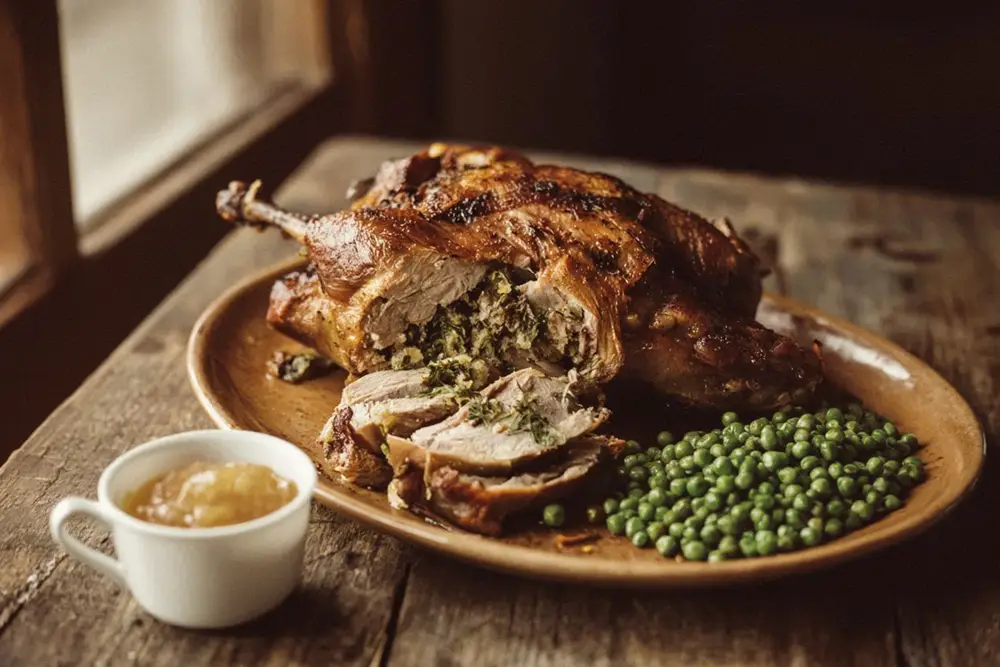
Baked Duck with Sage and Onion Stuffing and Apple Sauce
A whole roast duck stuffed with sage and onion, basted with pan drippings, and served with a warm apple sauce — a classic Central European Sunday roast.

Beef Wellington
Aged beef tenderloin coated in a mushroom and caper paste, wrapped in golden puff pastry — a celebration roast from the early 20th century.