Malaga Wine
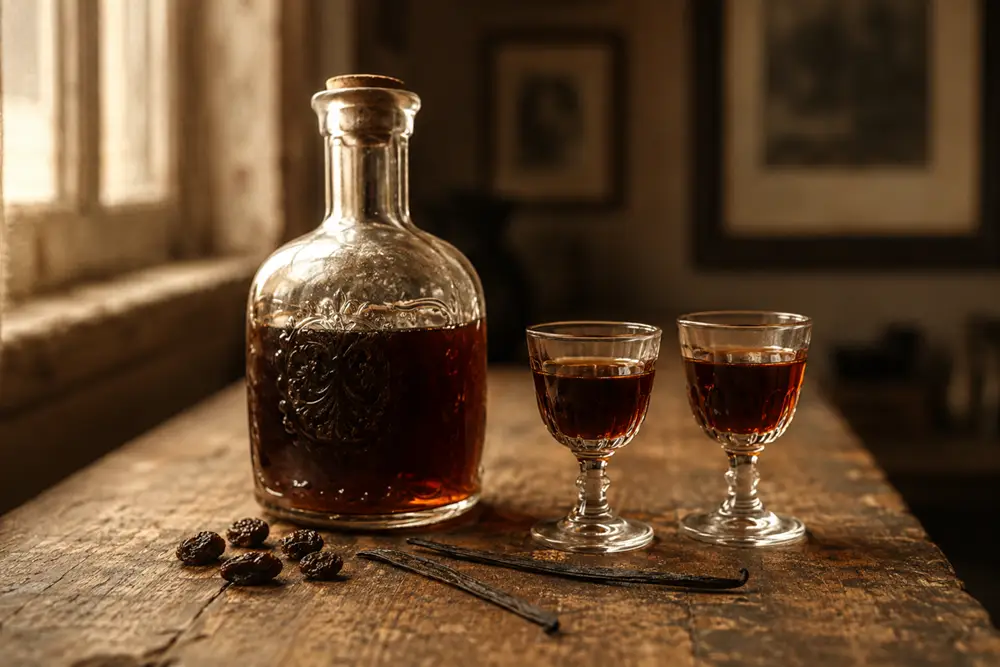
A rich, caramel-infused homemade liqueur that replicates the deep, sweet character of Malaga wine using red wine, dark rum, vanilla, and raisins.
Quick Summary
A rich, caramel-infused homemade liqueur that replicates the deep, sweet character of Malaga wine using red wine, dark rum, vanilla, and raisins.
Historical recipe
Modernised adaptation of an early 20th‑century source. Not independently kitchen-tested by Attic Recipes. Quantities, temperatures, and food safety guidance have been updated for a contemporary kitchen — results may vary and errors may exist. Nutritional values, where provided, are estimates only and have not been laboratory tested. Always follow current food safety guidelines for your region. If you have a health condition, allergy, or dietary requirement, consult a qualified professional before preparing this recipe.
Use of this recipe is entirely at your own risk and subject to our Terms of Service and Privacy Policy. Attic Recipes accepts no liability for any adverse outcome.
- Sulphites
Additional notes
-
Warning
Hot caramel reaches temperatures above 170°C (338°F) and causes severe burns on contact with skin. Keep children away from the stove during caramelization. Never leave hot caramel unattended.
-
Note
This recipe contains alcohol. Not suitable for pregnant women, children under 18, elderly individuals, or those with conditions affected by alcohol consumption. The finished product contains approximately 5–7% ABV.
- 1
Rinse raisins under cold water and pat dry. Set aside. Split the vanilla pod lengthwise and scrape out the seeds, keeping both pod and seeds.
- 2
Place the 50g sugar in a heavy-bottomed saucepan over medium heat. Do not stir — let it melt undisturbed until it turns deep amber (about 170°C / 338°F). Remove from heat the moment it reaches a dark caramel color. It will continue cooking briefly off the heat, so do not let it go too dark on the stove.
Tip Caramel burns in seconds. Keep a bowl of cold water nearby and watch constantly from the moment the sugar begins to color. - 3
Carefully pour the first 1000ml of red wine into the hot caramel. Stand back — the mixture will bubble vigorously. Return to low heat and stir until all caramel has fully dissolved into the wine. Add the vanilla pod and seeds.
Tip Pour the wine slowly along the side of the pan, not directly onto the caramel center, to reduce splashing. - 4
Simmer the wine-caramel mixture gently for 10 minutes, stirring occasionally, until fully homogenized. Remove from heat.
- 5
Remove from the stove. Add the remaining 1000ml of cold red wine and the 40ml of dark rum. Stir to combine.
- 6
Add the 20g of rinsed raisins. Stir once. Pour the entire mixture into a clean glass bottle or jar with an airtight lid. Seal and store in a cool, dark place for 8 days.
- 7
After 8 days, strain the liquid through a fine mesh strainer or cheesecloth into clean, sterilized glass bottles. Discard the raisins and vanilla pod. Seal tightly.
Tip To sterilize bottles: wash thoroughly, then place in a 120°C oven for 15 minutes, or boil for 10 minutes and allow to air-dry upright. - 8
The finished liqueur is ready to serve immediately after straining but improves further with an additional week of rest. Serve slightly chilled or at room temperature in small glasses of approximately 130ml.
Nutrition Information per 1 glass (approx 130ml)
Nutritional values are approximate estimates and may vary based on specific ingredients used, preparation methods, and portion sizes.
Serving Suggestions
Serve in small glasses (approximately 80–130ml) as a dessert wine or digestif. Pairs well with dark chocolate, aged hard cheese, walnut cake, or dried fruit. Also excellent as a base for mulled wine in winter. Store in a sealed bottle in a cool, dark pantry for up to 3 months; refrigerate after opening.
About This Recipe
Long before fortified wines were widely imported and affordable, home cooks across Central Europe produced their own versions of fashionable wines they had read about but could rarely obtain. Malaga — the deep, sweet, caramel-touched wine from southern Spain — was one such luxury. This recipe is a faithful recreation of that tradition: a homemade liqueur built from caramelized sugar, robust red wine, a measure of dark rum, and a slow steeping of raisins and vanilla.
The result is not a replica of commercial Malaga wine, and it was never meant to be. It is something more interesting: a glimpse into how resourceful home cooks interpreted fashionable flavors using entirely local means. The caramelization step gives the finished drink its characteristic dark amber color and a faint bitterness that balances the sweetness of the raisins. The vanilla softens everything. After eight days, the raisins have given up their sugars and texture to the liquid, which becomes noticeably rounder and more complex than it was on the first day.
This is a make-ahead recipe by definition. The eight-day maceration is not optional — it is where the flavor is built. Plan accordingly, and the reward is a small-batch liqueur ready for the table with almost no active effort.
Why It Works
The caramelization step is the technical heart of this recipe. When sugar is heated past its melting point to approximately 170°C, the sucrose molecules break down into hundreds of compounds responsible for the characteristic color, bitterness, and toasted depth that define caramel. Dissolved into hot wine, these compounds integrate fully and cannot be replicated by simply adding sugar directly.
The two-stage wine addition serves a purpose: hot wine goes into the hot caramel to dissolve it fully, while cold wine is added afterward to stop the cooking process and preserve the wine’s fruit character. Adding all the wine at once while the caramel is still very hot would drive off too many volatile aromatics.
Raisins are not just a sweetener here — they act as a slow-release flavoring agent. Over eight days, the dried fruit rehydrates and releases concentrated grape sugars, phenolic compounds, and residual flavor into the wine. The texture of the final liquid becomes noticeably fuller as a result.
Modern Kitchen Tips
Use a kitchen thermometer for the caramelization step if you are not experienced with sugar work. The window between deep amber (correct) and burnt (bitter and unusable) is roughly 10–15 seconds. Pull the pan off the heat the moment the color is right — residual heat will carry it slightly further on its own.
For the wine, resist the temptation to use something expensive. A reliable, moderately priced Merlot or Grenache will perform better than a delicate or tannic wine. The caramelization and eight-day maceration will dominate the flavor profile regardless.
The finished liqueur improves with time. If you can resist opening it immediately after straining, an additional week of rest in sealed bottles will round out any remaining sharp edges.
A classic of early 20th century home cellaring, preserved and adapted for the modern kitchen.
The Story Behind This Recipe
Historical Context
Early 20th century home cooks across Central Europe produced imitation Malaga — a sweet, deep-colored Spanish fortified wine that was fashionable but expensive and not always available. The home version followed a consistent logic: caramelized sugar for color and bitterness, a robust red wine as the base, a spirit for fortification, vanilla for aromatic complexity, and raisins for body and additional sweetness during steeping. The original recipe used 8 liters of wine, producing enough to fill the household cellar for the season. The quantities here have been scaled to a practical home batch of approximately 2 liters.
Modern Kitchen Adaptation
The original recipe did not specify a wine variety — any strong red wine was understood. A low-tannin, fruit-forward wine (Merlot, Grenache, Zinfandel) gives the best result, as high tannins interact poorly with caramel and become bitter. The rum quantity has been specified as 40ml (one čašica, a standard period measure) with a minimum ABV requirement of 40% to ensure consistent flavor. The original called for 'a handful' of dried grapes — 20g is the practical equivalent scaled to this batch size. Unsulfured raisins are recommended where available, as sulfites in conventional raisins can affect the final flavor of the infusion.
This recipe is an independent modern adaptation developed from historical sources in the public domain. It is provided for informational and educational purposes only and does not constitute professional dietary, nutritional, or medical advice. Food preparation involves inherent risks. The reader assumes full responsibility for safe food handling, ingredient sourcing, and adherence to current local food safety guidelines. The site operator accepts no liability for outcomes resulting from the preparation or consumption of this recipe.
One recipe.
Every week.
You Might Also Like
More recipes you'll enjoy
Fried Turkey Skin Rolls with Liver, Tongue and Pistachios
Crispy turkey skin rolls filled with ham, tongue, goose liver, capers and pistachios — an elegant Central European festive appetizer.
Sourdough Roses with Caramel Cream
Enriched yeast dough rolled with butter and sugar, cut into roses, baked with a vanilla milk glaze, and served with a poured caramel custard cream.
Chicken Stew with Spices
A fragrant braised chicken with walnuts, saffron, cinnamon, raisins, and savory — a Caucasian-inspired stew from a Central European cookbook.