What Is Pastrma? A Guide to Central Europe's Forgotten Cured Meat
Pastrma is a dry-cured, air-dried meat with roots across Central and Eastern Europe. Here is what it is, how it is made, and how to cook with it.
Somewhere between the butcher’s hook and the winter table, there is a category of food that most of the English-speaking world has never had reason to name. Not a sausage, not a ham, not a salami — something older and simpler than any of those. Salt. Air. Time. The result is pastrma: a dry-cured meat that once served as both protein and seasoning across Central and Eastern European kitchens, hanging from rafters through the cold months and appearing, thinly sliced or torn into pieces, in soups, stews, and braises from autumn through spring.
It is not pastrami. The names are related — both descend from the same ancient tradition of pressing and drying meat — but the products are fundamentally different. Understanding what pastrma actually is requires setting that association aside entirely.
The Name and Its Relatives
The word pastrma shares a root with a family of preserved meats that spread across an enormous stretch of territory stretching from the Armenian highlands to the Adriatic coast. The underlying concept — salting, pressing, and air-drying whole cuts of meat — appears under different names across the region: pastirma and pastırma in Turkish and broader Anatolian traditions, basturma in Armenian cuisine, pastourma in Greek, pastarma in Bulgarian. In Bosnian, Croatian, and Serbian, the form is pastrma.
What links all of these is the basic method: the removal of moisture through salt and air, without cooking, until the meat becomes stable at room temperature. What varies — significantly — is the specific animal, the cut, the degree of smoking, and whether a spice paste is applied. The Turkish and Armenian versions often feature a heavy coating of cemen, a paste made from fenugreek, garlic, and red pepper that gives basturma its unmistakeable pungency. The Central European versions tend to be sparer: salt, perhaps pepper, cold mountain air, and smoke — nothing more.
Pastrma in this context is the regional expression of that broader tradition: a home-preserved product made primarily from lamb or mutton, sometimes beef, dried without the elaborate spice coatings of its eastern relatives.
How It Is Made
The process is straightforward in principle and demanding in practice.
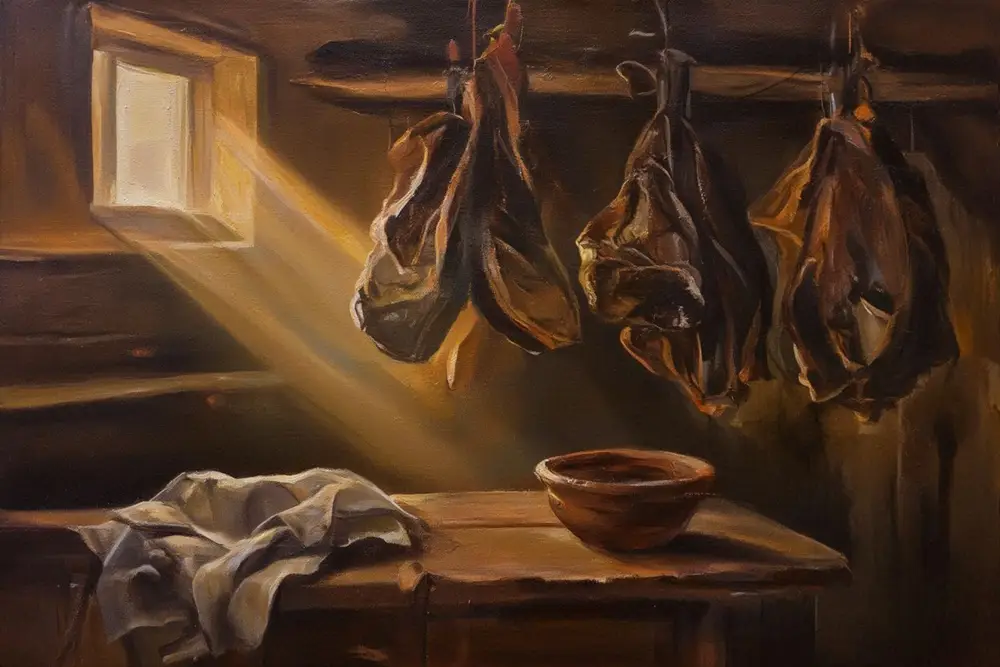
A whole muscle cut — typically a leg, shoulder, or loin — is rubbed heavily with salt and left to cure for several days, during which moisture is drawn out and the surface firms. The meat is then pressed under weight to expel additional liquid and to compact the muscle fibres. After pressing, it is hung to dry in cool, well-ventilated conditions — traditionally in a cold room, cellar, or outdoors in autumn and winter air.
Drying continues for several weeks. During this period, the water activity of the meat drops to a level at which most spoilage bacteria cannot survive. This is the same principle that food scientists now refer to as hurdle technology: combining multiple mild preservation factors — in this case, salt reducing water availability, low temperature slowing microbial activity, and drying reducing moisture further — so that no single factor needs to be extreme. The combination achieves stability that none could achieve alone.
In many regional variations, smoking is added as an additional step, either during or after drying. Cold smoke contributes antimicrobial compounds to the meat’s surface while also adding flavour. The result is a product with a deep brown exterior, a firm texture, and an intensely concentrated flavour that is unlike anything produced by faster methods.
What Pastrma Tastes Like
Raw or thinly sliced, pastrma is aggressively savoury — saltier and more concentrated than prosciutto, with a denser chew and, in the lamb versions, a distinct gamey note that can be polarising when eaten on its own. This is not a product designed for a charcuterie board in the Italian sense.
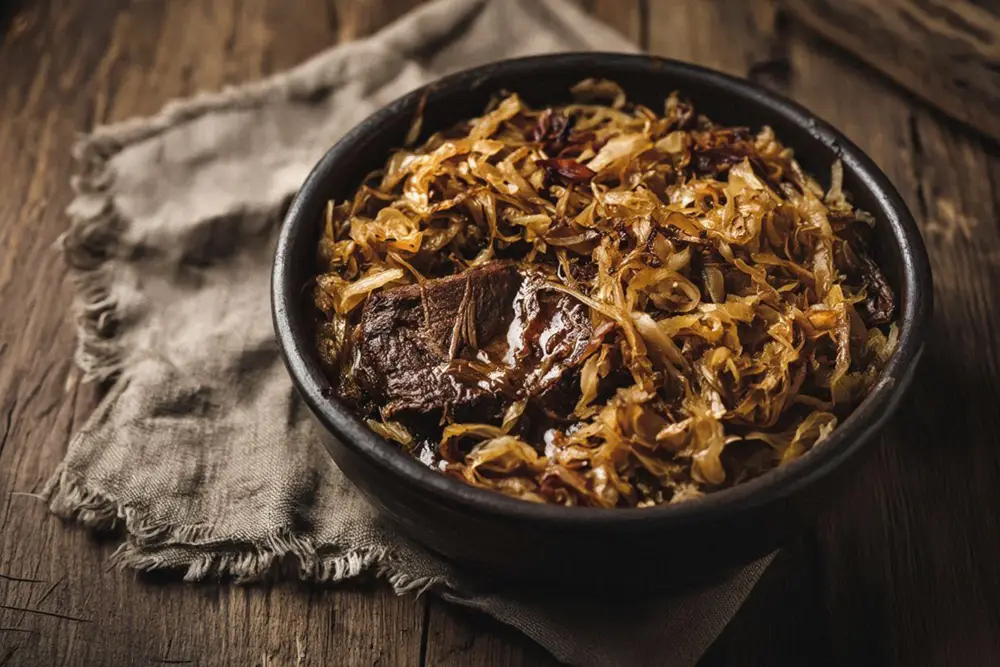
Its natural habitat is the cooking pot. When pastrma is added to a braise — tucked into a stew of sauerkraut, submerged in a bean soup, or layered into a slow-cooked casserole — that intensity becomes an asset. The salt disperses through the dish. The fat, rendered slowly, enriches the liquid. The gamey depth, which could overwhelm a delicate preparation, provides exactly the foundation that a long-cooked winter dish needs. The meat itself softens from something almost jerky-like into something closer to braised short rib: tender, unctuous, and thoroughly integrated into its surroundings.
This is why pastrma and sauerkraut appear together so consistently in early 20th century Central European recipes. The acidity of fermented cabbage cuts through the richness of the cured fat; the salt of the pastrma seasons the dish from within; the slow cooking time that sauerkraut requires gives the dried meat exactly the time it needs to rehydrate and tenderise. The combination is not accidental — it reflects a deep understanding of how preserved ingredients work together.
Pastrma in the Early 20th Century Kitchen
For home cooks of the interwar period across Central Europe, pastrma was a practical winter staple rather than a specialty product. Autumn slaughter — of sheep kept through the grazing season — produced more meat than any household could consume immediately. Curing and drying extended that meat across the months when fresh supplies were limited and expensive.
The product that resulted was not uniform. Every household had its own method. Some dried longer; some smoked more heavily; some used only salt while others added a handful of pepper. The result varied by region, by season, by the animal’s age and condition. What was consistent was the role the product played: a background ingredient that contributed protein, salt, and depth to dishes built primarily from preserved vegetables — sauerkraut, dried beans, pickled roots.
This is a pantry ingredient in the original sense of the word: something made in abundance when conditions permitted, stored against the months when they did not, and used steadily through the winter as a seasoning as much as a meat.
Finding and Buying Pastrma Today
Outside Central and Eastern Europe, pastrma is not widely available in general supermarkets. The most reliable sources are Central or Eastern European delicatessens — particularly those serving communities from the former Yugoslav states — and halal butchers, who frequently stock dried and cured lamb products under various names.
When buying, look for a product that is firm but not brittle, with a deep brown exterior and no off smell beyond the expected sharpness of cured meat. Avoid anything that feels wet or tacky. The interior, when sliced, should be a consistent dark red with visible fat marbling if made from lamb or mutton.
If pastrma is not available in your area, the closest functional substitute for cooking — not for eating raw — is a good-quality smoked streaky bacon or smoked pork neck. The flavour profile will be different: pork is milder, lacks the gamey depth of lamb, and the smoke character will vary. But in a long-cooked dish where pastrma plays a structural role alongside fermented vegetables, a well-smoked pork product will carry the dish. Adjust the added salt in the recipe accordingly, since commercial bacon tends to be saltier than traditionally made pastrma.
Practical Takeaways
Pastrma is a dry-cured, air-dried meat — most commonly lamb or mutton — produced through salting, pressing, and extended drying, often with cold smoking. It is not pastrami, which is a different product developed in a different context from different ingredients.
Its flavour is intense and concentrated, which makes it unsuitable as a standalone cold cut for most palates but exceptional as a cooking ingredient in long, slow, moist preparations. Sauerkraut braises, bean soups, and winter stews are its natural context — dishes where time and liquid transform it from something austere into something deeply satisfying.
If you can find it, buy it. If you cannot, a smoked pork substitute will work in cooked dishes, with the understanding that something has been lost in translation.
Attic Recipes — digitizing and adapting Central European home cooking from the early twentieth century.
Frequently Asked Questions
01What is pastrma?▶
Pastrma is a dry-cured, air-dried meat traditional to Central and Eastern European cooking, most commonly made from lamb, mutton, or beef. The meat is salted, pressed, and dried — sometimes smoked — over several weeks, resulting in a dense, intensely flavoured product with a long shelf life.
02Is pastrma the same as pastrami?▶
No. Despite the similar name, they are distinct products. Pastrami is a steamed, heavily spiced deli meat developed by Romanian Jewish immigrants in New York, made from beef brisket. Pastrma is an older, drier, unspiced or minimally spiced tradition of air-drying whole cuts of meat, common in Central and Eastern European home kitchens.
03What does pastrma taste like?▶
It is intensely savoury, with a concentrated meaty flavour from the extended drying process. Lamb or mutton pastrma carries a distinct gamey note that softens considerably during cooking. The texture is firm and dry when sliced thin, but breaks down into richness when braised or simmered.
04Can I substitute pastrma in a recipe?▶
There is no direct substitute, but smoked streaky bacon or a good-quality smoked pork neck will provide a comparable salt-and-smoke profile in cooked dishes. The flavour will be milder and the meat character different — lamb pastrma has a depth that pork cannot replicate — but the structural role in the dish will be similar.
05Where can I buy pastrma outside Central Europe?▶
Pastrma is rarely found in general supermarkets outside the region. Your best options are specialist Central or Eastern European delicatessens, halal butchers (who often carry dried lamb and mutton products), and online importers. In some cities, it may also appear under the name pastirma, basturma, or dried lamb.