Green, Yellow, or Flat: A Guide to Bean Varieties in the Kitchen
What is the actual difference between yellow wax beans and green beans? And what about those long, flat ones? A cook's guide to bean varieties.
Introduction
Most cooks encounter green beans regularly and yellow beans occasionally, assume they are essentially the same thing, and move on. That assumption is mostly correct — but only mostly. The difference between yellow wax beans and green beans comes down to a single gene, and that gene’s product (or absence of it) has a subtle but real effect on flavour, colour stability, and how the bean behaves on the plate.
And then there are the others: the wide, flat Romano beans that reward long braising with a silky meatiness nothing like a standard string bean; the dramatic yardlong beans from Southeast Asia that are, despite appearances, not really the same vegetable at all. Understanding these distinctions does not make you a better cook automatically — but it helps you choose the right bean for what you are making, and occasionally produces a noticeably better result.
The One Gene That Separates Yellow from Green
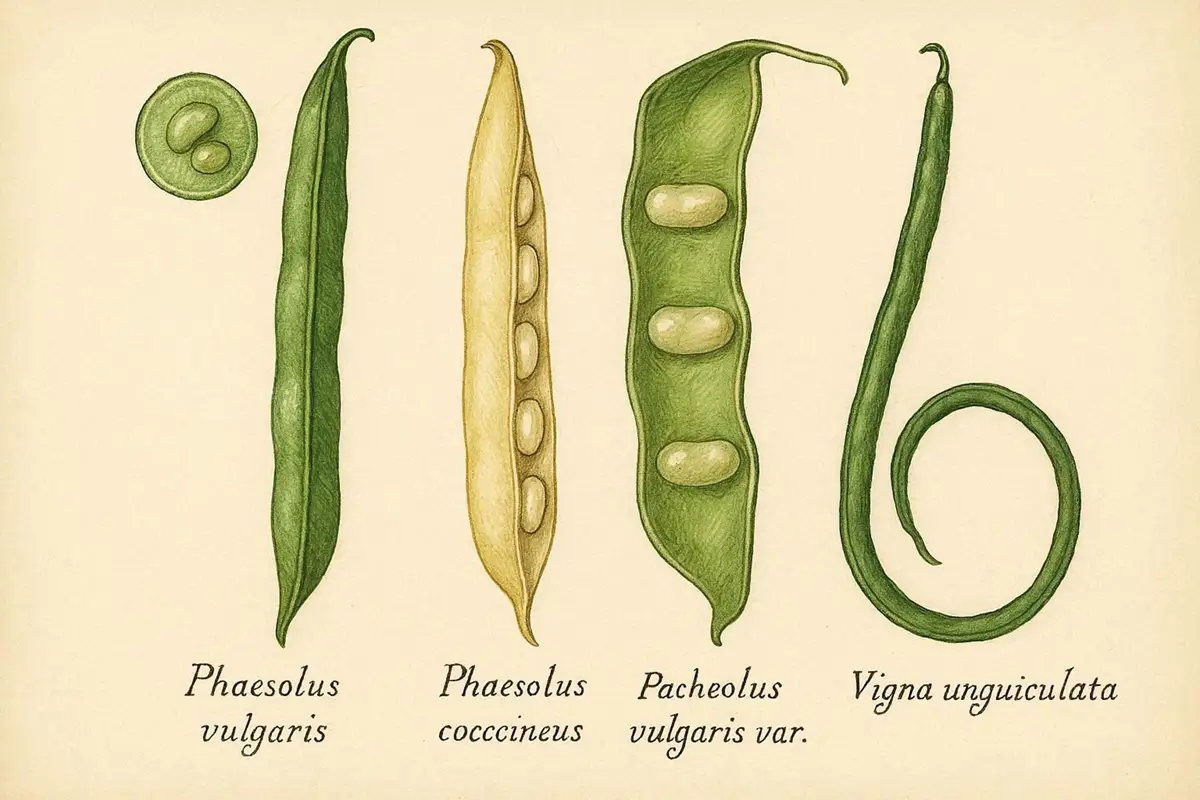
Green beans and yellow wax beans are the same species — Phaseolus vulgaris — grown by the same methods, harvested at the same stage, and cooked identically. The one key difference is that wax beans have been bred to produce no chlorophyll, the pigment that makes plants green.
The numerous cultivars of string beans contain varying levels of chlorophyll, so they range from light to dark green. Wax beans are pale to golden yellow because they contain none. This also explains why green beans shift colour when cooked while wax beans maintain their hue — heat breaks down chlorophyll, making green beans turn from bright to duller olive, while wax beans have no pigment to lose.
For the cook, this has two practical implications. First: wax beans bring a bright, cheerful yellow to a meal, providing a different aesthetic with the same nutritional profile, texture, and cooking time. In pale, cream-sauced dishes — a béchamel, a custard bake, a butter braise — yellow wax beans look more elegant than green ones, which tend to clash visually with the sauce. Second: yellow beans will hold their colour through long cooking, while green beans will fade.
Does the Flavour Actually Differ?
This is where honest cooks tend to disagree. When you taste them side by side, there is a subtle difference. Green beans tend to have a more pronounced, grassy, “green” flavour from their chlorophyll content. Wax beans are often described as slightly milder and more delicate, with a faintly sweeter taste.
The difference is most noticeable when lightly steamed. Once the beans are braised for 30 minutes in butter and broth, or baked under a milk-and-egg custard, the distinction narrows considerably. Some cooks report finding them indistinguishable in heavily seasoned preparations.
The practical takeaway: if the recipe is about the beans — a simply dressed salad, a light sauté — yellow wax beans offer a subtler, sweeter result. If the beans are a background ingredient in a heavily spiced or sauced dish, use whichever is fresher and better-looking at the market that day.
Romano Beans: The Flat Ones
Romano beans — also called Italian flat beans, fagiolini piattoni, or helda beans — look dramatically different from either green or wax beans. They are broader, flatter, and meatier, with a more robust flavour and a texture that holds up to long cooking in a way that standard string beans do not.
The pods average 10 to 15 centimetres in length and have a satisfying, dense snap when fresh. Their flavour is earthier and sweeter than conventional green beans, with a slightly nutty quality that deepens with heat.
The most important thing to know about Romano beans is that they genuinely improve with time in the pan. Unlike standard green beans, which become unpleasantly soft if over-braised, Romano beans only get better. A proper braise — olive oil, garlic, broth, and patience — takes at least 45 to 60 minutes on the stovetop over low heat, or around 40 minutes in a 180°C oven. The result is a silky, yielding texture with concentrated flavour that no quick-cooked bean can match. This makes Romano beans the best modern choice for exactly the kind of slow-cooked vegetable dishes found in early 20th century Central European cookbooks.
Romano beans also come in yellow versions, which combine the mildness of wax beans with the meaty texture of the Romano — a genuinely interesting ingredient, and one worth seeking out at farmers’ markets in summer. Like all fresh beans, both green and yellow Romano beans should be cooked before eating.
A Note on Eating Beans Raw
All fresh beans — green, wax, Romano, and yardlong — contain lectins, naturally occurring proteins that can cause digestive discomfort when consumed raw in significant quantities. The specific lectin in common beans (Phaseolus vulgaris) is phytohaemagglutinin. Fresh green beans contain it at much lower levels than dried kidney beans, and eating a few pieces raw is unlikely to cause problems for most healthy adults. However, recipes that use raw beans as a main component — large salads built around uncooked beans, for example — are best approached with caution, particularly for children, pregnant women, and anyone with a sensitive digestive system.
Cooking resolves this entirely. All standard cooking methods — boiling, steaming, sautéing, braising, roasting — reach temperatures sufficient to deactivate lectins in fresh beans. For the recipes on this site, beans are always cooked. If you want the crunch of raw beans in a salad, the safest approach is to blanch them briefly — two to three minutes in boiling salted water, then immediately into ice water — before using them cold.
A Brief Note on Long Beans
Those very long, thin beans — sometimes reaching 30 to 50 centimetres — that appear at Asian grocery stores and some farmers’ markets are yardlong beans, also called asparagus beans or Chinese long beans. Despite their appearance, they are a distinct species (Vigna unguiculata subsp. sesquipedalis), more closely related to cowpeas than to common green beans.
Their flavour is broadly similar to green beans but slightly earthier and less “green”; their texture is denser and less crisp, with a more flexible pod. They are not a substitute for Romano beans or standard green beans in Central European recipes — the texture and character are too different. They are best treated as their own ingredient, suited to high-heat stir-frying and the Asian preparations they come from.
Selecting Beans at the Market
For any bean variety, the same rules apply. Look for pods that feel firm and heavy, with no soft spots, browning, or wrinkling. A fresh bean should snap cleanly and audibly when broken — a rubbery or fibrous break indicates the pod has aged past its best. For yellow wax beans specifically, look for pods that are bright, even yellow — paler or greenish patches can indicate uneven ripening.
Romano beans require particular attention: young beans are most tender. If allowed to develop until the seeds are visibly bulging through the skin, the pods will be noticeably tougher and may develop strings along the seam. At a farmers’ market, look for pods where the surface is smooth and the seeds inside are not yet prominent.
In the Central European Kitchen
Old Central European recipes rarely distinguish between bean varieties by name — they simply say “green beans” or “French beans” and expect the cook to use what is available and fresh. The implicit assumption was that the beans came from a garden or local market the same day.
For recipes calling for a long braise or an oven finish, Romano beans are often the best modern choice — their texture holds and their flavour deepens with time. For pale-sauced dishes where colour matters — a cream-finished stew, a béchamel-dressed vegetable plate — yellow wax beans are the more elegant option. For quick cooking where colour should remain bright, standard green beans, blanched briefly and shocked in ice water, perform best.
Practical Takeaways
- Green beans and yellow wax beans are genetically identical except for one gene controlling chlorophyll production. They cook in the same time and can always be substituted for each other.
- Yellow wax beans are subtly milder and sweeter, with a stable colour under heat. They are the better choice for pale-sauced, cream-based, or baked dishes where visual coherence matters.
- Romano beans are a different character entirely — meatier, sweeter, better suited to long braising of at least 45 to 60 minutes on the stovetop. They are the bean to reach for in slow-cooked preparations.
- Yardlong beans are a different species and should be treated as a distinct ingredient, not a substitute for Romano or standard green beans in Central European recipes.
- All fresh beans should be cooked before eating. For cold preparations like salads, blanch first — two to three minutes in boiling water, then ice water — rather than using them fully raw.
- For all varieties: freshness matters more than variety. A fresh green bean will always outperform an old wax bean, regardless of which is theoretically more suitable for the recipe.
Further Reading
- Wikipedia — Phaseolus vulgaris
- Wikipedia — Asparagus bean (Vigna unguiculata subsp. sesquipedalis)
- Centre for Food Safety (Hong Kong) — Phytohaemagglutinin Poisoning
Attic Recipes — digitizing and adapting Central European home cooking from the early twentieth century.
Frequently Asked Questions
01Are yellow wax beans and green beans the same vegetable?▶
They are the same species — Phaseolus vulgaris — with one key difference: wax beans have been bred to lack chlorophyll, the pigment that makes green beans green. Everything else — growing habits, nutritional value, cooking methods, and season — is essentially identical.
02Do yellow wax beans taste different from green beans?▶
The difference is subtle but real. Green beans have a more pronounced grassy flavour from their chlorophyll content. Yellow wax beans are milder and slightly sweeter. The difference is most noticeable when lightly cooked — once braised or heavily seasoned, they are nearly indistinguishable.
03Why do green beans change colour when cooked but yellow wax beans do not?▶
Green beans contain chlorophyll, a pigment broken down by heat — this is why cooked green beans shift from bright green to a duller olive shade. Yellow wax beans have no chlorophyll to lose, so their pale yellow colour remains stable throughout cooking.
04What are those long flat beans sometimes sold at markets?▶
Those are most likely Romano beans — also called Italian flat beans. They have broad, flat pods, a meatier texture, and a sweeter, more robust flavour than round string beans. They benefit from longer cooking and are excellent braised.
05Can I substitute yellow wax beans for green beans in a recipe?▶
Yes, always. They cook in exactly the same time and by the same methods. The only change is colour — the dish will look paler, which in braised preparations is often more elegant.