Edible Mushrooms Around the World: A Continent-by-Continent Guide
A culinary and scientific overview of the world's most notable edible mushrooms by continent — from European porcini to Australian saffron milk caps.
Introduction
Humans have been eating mushrooms for a very long time. The earliest evidence of mushroom consumption comes from 13,000-year-old archaeological sites in Chile, and by the time of the Roman Empire, they were considered luxury food — eaten by the upper classes and tasted by food testers before reaching the emperor’s table. Today, mushrooms are cultivated in at least 60 countries, and according to FAOSTAT data, global production of mushrooms and truffles reached approximately 43–44 million tonnes by the early 2020s, with China accounting for more than 93% of the total.
This post is an overview — not a foraging guide. Its purpose is to introduce readers to the culinary world of edible mushrooms on each continent: what grows where, what it tastes like, how it is used in local cooking traditions, and when it appears. If you cook with mushrooms, knowing something about the species and its origin will make you a better cook. If you forage, this post is a starting point only — please read the companion post on toxic species, and always identify with the help of an expert before eating anything wild.
Important notice: This post is for informational and culinary purposes only. It is not a foraging guide and should not be used to identify mushrooms for consumption. Many edible species have toxic lookalikes that cannot be distinguished without expert knowledge, spore prints, and in some cases microscopy. Always buy mushrooms from a reputable supplier. If you choose to forage, do so only under the guidance of a certified mycologist or experienced forager.
Europe
Europe has one of the richest mushroom foraging traditions in the world, particularly in Central and Eastern Europe where seasonal mushroom gathering remains a cultural practice. The forests of Poland, the Czech Republic, Austria, and Russia are considered among the best hunting grounds.
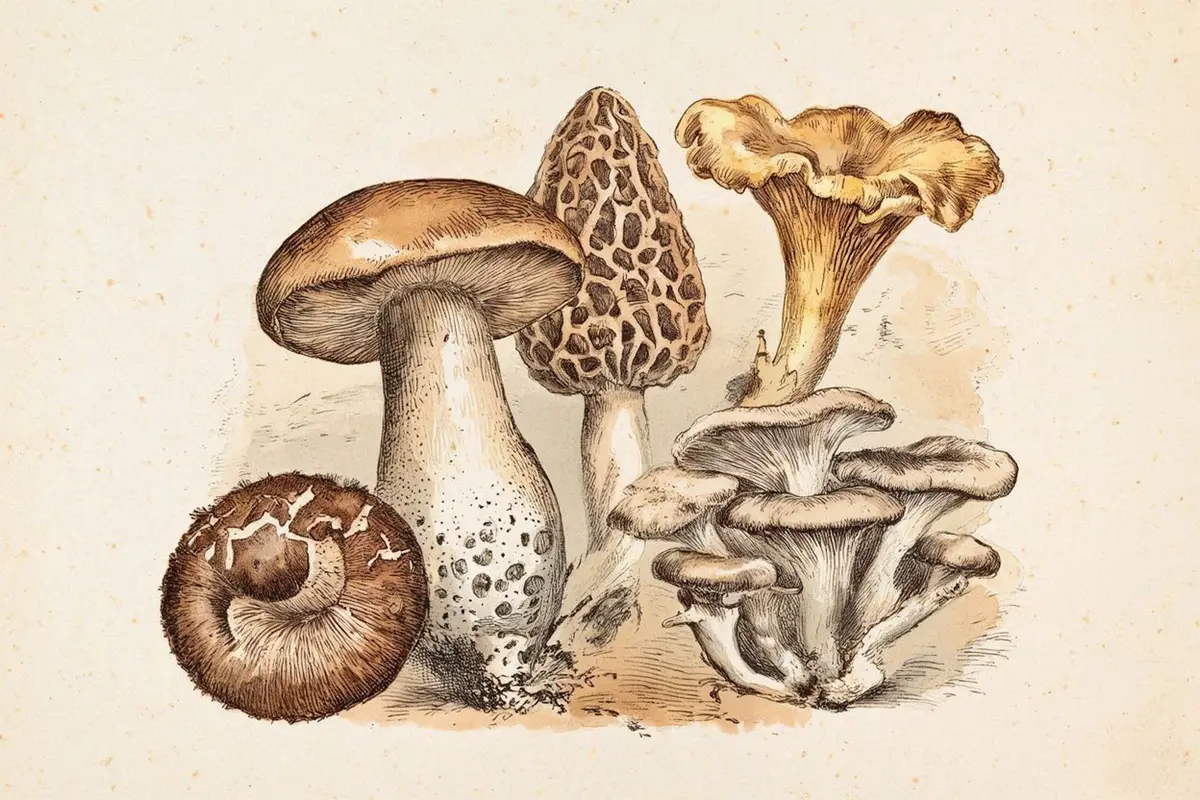
Porcini — Boletus edulis (King Bolete / Penny-bun) The most prized wild mushroom in European culinary tradition. Porcini have a deep, intense flavor with an earthy taste and nutty notes, and are one of the most famous and expensive wild edible mushrooms due to the difficulties of cultivating them on a large scale. Found in summer through autumn in mixed broadleaf and coniferous forests across the continent. Excellent fresh, but their real power comes when dried — the drying process concentrates umami compounds dramatically. Essential to Italian risotto, Central European soups, and slow-braised meat dishes across the continent.
Chanterelle — Cantharellus cibarius Chanterelles are widely regarded as one of the best-tasting edible mushrooms, with a rich depth of flavor, and tend to be expensive due to the lack of commercial cultivation. Golden-yellow, with a characteristic fruity aroma faintly reminiscent of apricot. Found in deciduous and mixed forests from June to November. They do not dry as well as porcini — best used fresh, sautéed simply in butter. Commercially, there are growing concerns about depletion of European chanterelle populations as foraging demand increases.
Saffron Milk Cap — Lactarius deliciosus Popular across Southern and Central Europe, especially in Catalonia. The cap is orange with concentric rings, the flesh stains green when cut. Has a firm, meaty texture and a mild, slightly resinous flavor. Best grilled or roasted whole.
Caesar’s Mushroom — Amanita caesarea Native to Southern Europe and Northern Africa and a favorite of Roman nobility, Caesar’s mushroom is most commonly eaten in the juvenile button stage — in Italy it is often prepared raw with oil and salt, or fried with spices. One of the few edible members of the otherwise dangerous Amanita genus. Requires absolute certainty in identification: the young button stage can be confused with the deadly Amanita phalloides (death cap) and Amanita verna, both of which emerge from a similar white egg-like membrane. Expert verification is essential before consuming any specimen found in the button stage.
Morel — Morchella spp. A spring mushroom, appearing briefly in April and May in moist woodlands across Europe and North America. The honeycombed cap is distinctive. Morel mushrooms have a rich flavor that pairs well with a wide range of dishes and are often served alongside meats or inside ravioli. Morels must always be cooked thoroughly before eating — raw or undercooked morels contain naturally occurring toxins (monomethylhydrazine precursors) that cause gastrointestinal illness. They are never eaten raw.
Hedgehog Mushroom — Hydnum repandum Underrated and often overlooked in favor of porcini and chanterelles. The underside features short spines rather than gills, making it one of the easier wild mushrooms to identify with confidence. Mild, nutty flavor. Excellent sautéed in butter.
Asia
Asia, and particularly East Asia, is the world’s dominant force in mushroom cultivation and consumption. China produces the vast majority of the world’s commercial mushrooms. The culinary and medicinal use of fungi in China, Japan, Korea, and Vietnam spans thousands of years.
Shiitake — Lentinula edodes Shiitake mushrooms are one of the world’s most popular and best-tasting edible mushrooms, easily identifiable by their brown umbrella-shaped caps with a slightly curled rim. When cooked, they release a rich umami flavor, enhancing the depth of dishes they are added to. They are versatile in stir-fries, soups, and broths — dried shiitakes in particular are used to make broths, imparting a deep, woody flavor.
Matsutake — Tricholoma matsutake The prized but rare matsutake mushroom is popular in many eastern countries. It has a thick, tall base with an undersized cap and a uniquely spicy aroma. Because they prefer to grow in very specific conditions in certain types of forests, they are not always easy to find, and pine parasites and continued deforestation have greatly reduced the number harvested each year, driving up the price exponentially. In Japan, matsutake is one of the most expensive foods available, often gifted as a luxury item.
Enoki — Flammulina velutipes Enoki mushrooms are part of culinary medicine in Vietnam, China, Japan, and Korea. They have a very distinctive needle-like appearance and are well known for their nutritional properties — a fruity and sweet yet delicate flavor profile with a soft texture. Note that the wild form looks very different from the cultivated white variety found in supermarkets: wild enoki has a darker brown cap and shorter, sturdier stem. The two forms are the same species but require separate identification.
Lion’s Mane — Hericium erinaceus Lion’s Mane mushrooms develop long teeth-like structures resembling a mane. They offer a unique lobster-like flavor and have become increasingly popular among chefs. Found on broadleaf trees across Asia and increasingly cultivated worldwide.
King Oyster — Pleurotus eryngii The largest species of oyster mushroom, the trumpet-shaped King Oyster has a wide base and inverted cap. The flesh is meaty and, despite having little taste in its raw form, develops a wonderful umami flavor when cooked. Widely cultivated across Asia and now available globally.
Maitake — Grifola frondosa The strangely shaped, ribbony Maitake mushroom is a staple in Asian cooking. The name comes from the Japanese word meaning “dancing mushroom.” The flavor is deeply earthy and rich, making it a great choice for meals with complex flavors. Also known as hen-of-the-woods.
North America
There are thousands of fungi species in North America, and only a small number of them are edible. Among the edible species, some are safe to eat but have little culinary interest or are difficult to identify reliably in the field. The following are among the most culinarily significant.
Morel — Morchella spp. One of the most sought-after spring mushrooms in North America, appearing in April and May in deciduous forests. Difficult to cultivate commercially, so the majority available in restaurants are wild-harvested — a task that can fetch foragers significant prices. As with all morels worldwide, thorough cooking is mandatory — the naturally occurring toxins present in raw or undercooked morels cause gastrointestinal illness regardless of where the mushroom was harvested.
Chanterelle — Cantharellus spp. Several species of chanterelle grow across North American forests. The Pacific Golden Chanterelle (Cantharellus formosus) of the Pacific Northwest is among the most commercially important wild mushrooms on the continent.
Giant Puffball — Calvatia gigantea The Giant Puffball is considered edible under specific and strictly verified conditions. Before eating, a specimen must be sliced completely in half from top to base: the interior must be entirely uniform white throughout, with no visible internal structure, coloration, or silhouette of any kind. This step is not optional. Young specimens of deadly Amanita species — including Amanita phalloides (death cap) — emerge enclosed in a white membrane and can appear externally similar to a young puffball. The internal cross-section reveals the developing mushroom structure inside an Amanita; a true edible puffball shows only uniform white tissue. Any specimen that is not pure white throughout, or that shows any internal structure, must not be eaten. Once the spores begin to develop (the interior turns yellow or brown), it is no longer safe to eat. These enormous fungi can exceed 50cm across and provide substantial eating when correctly identified.
Saffron Milky Cap — Lactarius deliciosus The saffron milky cap stands out on the forest floor with its brilliant orange coloring. It is relatively easy to identify due to the coloring and the way the gills stain green when cut. An excellent edible species with a mild flavor and dense texture.
Lobster Mushroom — Hypomyces lactifluorum A mushroom that is the same color as a cooked sea lobster and tastes faintly of seafood. It is the result of a mild-tasting host species — most commonly Russula brevipes or certain Lactarius species — being parasitized by the mold Hypomyces lactifluorum, which transforms its surface completely. A uniquely North American culinary curiosity.
South America
The earliest confirmed archaeological evidence of mushroom consumption — approximately 13,000 years old — comes from sites in Chile, making South America home to one of humanity’s oldest documented relationships with fungi.
Cyttaria darwinii (Darwin’s Fungus) A small orange, golf-ball-like ascomycete fungus that grows on southern beech trees (Nothofagus spp.) in southern Chile and Argentina. First described by Charles Darwin during the voyage of the Beagle. Indigenous Fuegian peoples have eaten this species for millennia — one of the few fungi truly native to the Southern Hemisphere’s culinary tradition. A separate but related species, Cyttaria gunnii, is native to Tasmania and southeastern Australia and is not the same fungus as the South American form.
Suillus spp. Several species of Suillus (slippery jacks) grow in association with pine forests across South America, particularly in the plantation forests of Chile and Argentina where European pines were introduced. The mycorrhizal fungi followed the trees. Edible when the slimy skin is peeled and the specimens are cooked.
South America remains significantly under-researched in terms of edible mycology. Indigenous knowledge of local edible species exists but has been poorly documented in scientific literature.
Africa
African mycology remains one of the least documented fields in the world. Indigenous knowledge of edible fungi is substantial in many regions but has historically not been captured in Western scientific literature.
Termite Mushroom — Termitomyces spp. Perhaps the most important group of edible wild mushrooms across sub-Saharan Africa. These large, meaty mushrooms grow from termite mounds and are highly prized across the continent for their firm texture and rich, savory flavor. They cannot be cultivated — they exist only in symbiosis with specific termite species — which makes them an exclusively wild ingredient. Widely eaten across Central Africa, West Africa, and southern African countries.
Oyster Mushrooms — Pleurotus spp. Several native species of oyster mushroom grow across Africa on hardwood trees and are collected seasonally. Oyster mushrooms have a large and distinctive appearance, a chewy and spongy texture, and a sweet and delicate flavor.
Caesar’s Mushroom — Amanita caesarea Native to Southern Europe and Northern Africa, this prized edible species appears in the Mediterranean fringe of the continent. Identification caution applies as noted in the European section above.
King Tuber Oyster — Pleurotus tuber-regium A tropical species found across sub-Saharan Africa and parts of Asia and Australia. In Africa it is sometimes cooked like meat in stews. The tubers are soaked for over 12 hours then ground into a paste, used in soups or mixed with corn flour and fried.
Australia
The total number of fungi estimated to occur in Australia — including those not yet described — is around 250,000 species, of which roughly 5,000 are mushrooms and approximately 5% have been formally described. Knowledge of traditional Aboriginal use of fungi is limited in the published literature, with a few well-documented exceptions.
Saffron Milk Cap — Lactarius deliciosus Introduced to Australia with European pine plantations, this is now one of the most widely foraged edible mushrooms on the continent. Found in association with pine plantations, it is among the more easily identifiable edible species in Australia.
Slippery Jack — Suillus luteus and S. granulatus Both species grow in association with pines and are popular edible species in Australia. Like the Saffron Milk Cap, they arrived with imported European trees.
Blackfellow’s Bread — Laccocephalum mylittae A native Australian species with documented traditional use by Aboriginal Australians. The dense, starchy underground sclerotia (tuber-like storage organs) were baked and eaten. One of the few edible fungi with a well-documented place in pre-European Australian food culture.
Cyttaria gunnii (Myrtle Orange) An edible ascomycete fungus native to Tasmania and southeastern Australia, a specific parasite of myrtle beech trees (Nothofagus cunninghamii). It has a documented place in traditional Aboriginal food culture. Note that this species is distinct from the South American Cyttaria darwinii, despite the similar appearance and ecological role.
Giant Bolete — Phlebopus marginatus Possibly Australia’s largest mushroom, this impressive native species can exceed 1kg. Edible and occasionally found in markets in northern Australia and Southeast Asia.
Dried Wild Mushrooms: The Best of Both Worlds
For most home cooks, the question is not which wild mushrooms to forage — it is which dried wild mushrooms to buy. The dried mushroom industry has grown significantly over the past two decades, with specialist suppliers now offering a wide range of wild-harvested species from across the world, properly dried and packaged for long shelf life.
Drying is not a compromise. For many species — particularly porcini and shiitake — the drying process actively improves the culinary outcome. Moisture evaporates, cell walls break down slightly, and glutamate and nucleotide concentrations increase, producing an umami intensity that fresh mushrooms of the same species cannot match. The soaking liquid that results from rehydrating dried mushrooms is itself a valuable ingredient — essentially a concentrated mushroom stock, and one of the oldest principles of Central European kitchen economy: the water in which mushrooms were cooked should never be discarded.
Which species are worth buying dried:
Dried porcini (Boletus edulis) are the most versatile and widely available. A small quantity — 20 to 30 grams — added to a soup, stew, or risotto transforms the depth of flavor entirely. Buy whole dried caps where possible; broken pieces and powder indicate lower-grade sourcing. Italian, Polish, and Central European suppliers consistently produce the best quality.
Dried shiitake are essential for East Asian cooking and increasingly used in Western kitchens for broths and vegetarian dishes. Look for thick-cap specimens — thin caps dry out completely and contribute less flavor.
Dried morels are expensive but exceptional in cream-based sauces and pasta. Their honeycomb structure holds flavor compounds well and rehydrates into a particularly rich soaking liquid.
Dried chanterelle is less commonly available and loses some of its delicate apricot aroma in drying, but contributes good body and flavor to mixed mushroom dishes.
Where to buy dried wild mushrooms:
Reputable specialty retailers include Sous Chef and Natoora for European buyers, Gourmet Food Store and Marx Foods for North America, and Gustiamo for Italian-sourced porcini. Quality varies significantly between sellers on general marketplaces — prioritize verified specialty food sellers, and always check that country of origin is clearly stated.
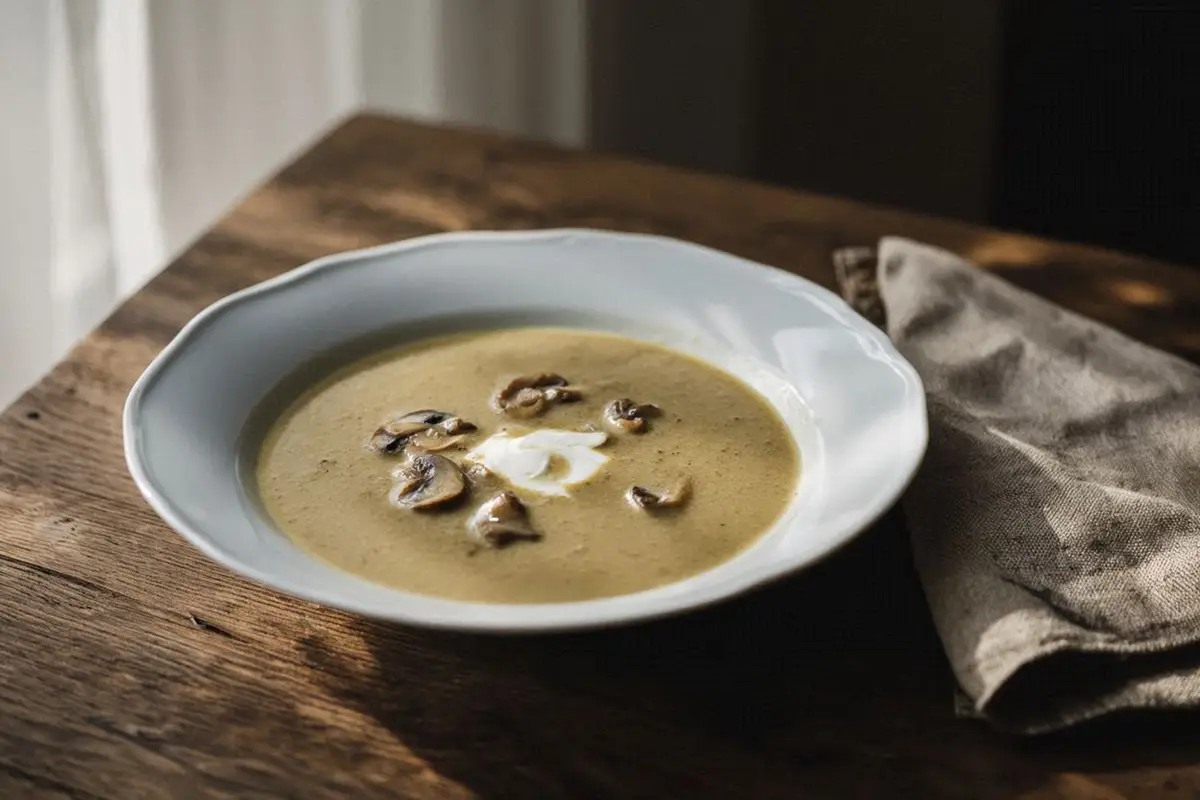
How to use dried mushrooms: Soak in warm (not boiling) water for 20 to 30 minutes. Reserve and strain the soaking liquid through a fine cloth or coffee filter — it is too valuable to discard and too gritty to use unstrained. Add both the rehydrated mushrooms and the strained liquid to your dish.
Practical Takeaways
The world’s edible mushrooms reflect their landscapes. European fungi favor temperate deciduous forests and have shaped centuries of cooking traditions. East Asian species — shiitake, enoki, maitake — were cultivated long before European science understood mycology. African termite mushrooms remain uncultivatable, making them one of the few truly wild foods with no commercial substitute. In Australia and South America, the mycological record is still being written.
A few principles that apply everywhere: most edible mushrooms must be cooked, both for flavor and safety. Drying concentrates flavor and extends shelf life. The soaking or cooking liquid is nearly always worth keeping. And wherever you are in the world, the safest mushroom is always the one bought from a reputable supplier, not the one picked from an unfamiliar forest floor.
Further Reading
- Benjamin, D. R. (1995). Mushrooms: Poisons and Panaceas. W.H. Freeman and Company.
- Stamets, P. (2000). Growing Gourmet and Medicinal Mushrooms. Ten Speed Press.
- Carluccio, A. (2003). The Complete Mushroom Book. Quadrille.
- Arora, D. (1986). Mushrooms Demystified. Ten Speed Press.
- Shepherd, C. J. & Totterdell, C. J. (1988). Mushrooms and Toadstools of Australia. Inkata Press.
- FAOSTAT (2022). Food and Agriculture Organization of the United Nations Statistics Database. fao.org/faostat
Disclaimer: This post is for informational and educational purposes only. It does not constitute a foraging guide and must not be used to identify mushrooms for consumption. Always consult a qualified mycologist before consuming any wild mushroom.
Attic Recipes — digitizing and adapting Central European home cooking from the early twentieth century.
Frequently Asked Questions
01What are the best dried mushrooms for cooking?▶
Dried porcini (Boletus edulis) are considered the gold standard — their drying process intensifies umami compounds dramatically and the soaking liquid is one of the finest natural broths available. Dried shiitake are a close second, particularly for Asian-style broths and stews. Dried morels are excellent for cream sauces and pasta.
02Where can I buy dried wild mushrooms?▶
Dried wild mushrooms are widely available from specialty food retailers online, including Amazon, Sous Chef (UK/Europe), Gourmet Food Store (US), and Gustiamo (US/Italian imports). Look for whole dried caps rather than broken pieces — they indicate better sourcing and deliver more flavor.
03Are dried mushrooms as good as fresh?▶
For most cooking purposes, dried mushrooms are not just a substitute — they are often superior. Drying concentrates glutamates and other flavor compounds, producing a deeper umami than fresh mushrooms of the same species. The soaking liquid itself is a valuable cooking ingredient. Fresh mushrooms have an advantage in texture for dishes where the mushroom is the primary ingredient.
04Do I need to wash wild mushrooms with water?▶
It is best to avoid soaking them. Wild mushrooms act like sponges — use a soft brush or a slightly damp cloth to gently wipe away debris. If they are very dirty, a very quick rinse followed by immediate, thorough drying is the only exception.
05How do you rehydrate dried mushrooms?▶
Soak them in warm (not boiling) water for about 20–30 minutes until fully softened. The soaking liquid is essentially a concentrated mushroom stock — strain it through a fine-mesh sieve or coffee filter to remove any grit and add it to soups, risottos, or braises. Never discard mushroom soaking liquid.
06How can I tell if a dried mushroom is still good to use?▶
Dried mushrooms have a long shelf life, but they should remain aromatic. If they have lost their distinct, earthy scent or appear significantly discolored beyond their natural dried state, it is time to discard them. Always store them in an airtight container in a cool, dark place.
07Can I mix different types of mushrooms in one dish?▶
Yes, and it is highly encouraged. Mixing a mild, meaty mushroom like cremini or porcini with a more delicate variety creates a complex flavor profile. Just be mindful of cooking times — add tougher, thicker mushrooms to the pan first and more delicate ones towards the end.
08Why do some recipes call for cooking mushrooms on high heat?▶
Mushrooms have high water content. Cooking them on high heat evaporates that moisture quickly, allowing them to brown and caramelize rather than steam in their own juices. This browning is where the deep, savory umami flavor develops.
09Can I use a smartphone app to identify edible mushrooms?▶
Current identification apps are unreliable and have contributed to serious poisonings. They should never be used as the sole method of identification. Always cross-reference with multiple printed field guides and consult an experienced mycologist before consuming any wild mushroom.