Vegan Almond Wafer Bars (Three-Layer)
Dairy-free, egg-free almond wafer bars in three colorful layers — a no-bake Lenten dessert built from almond paste and crisp wafer sheets.
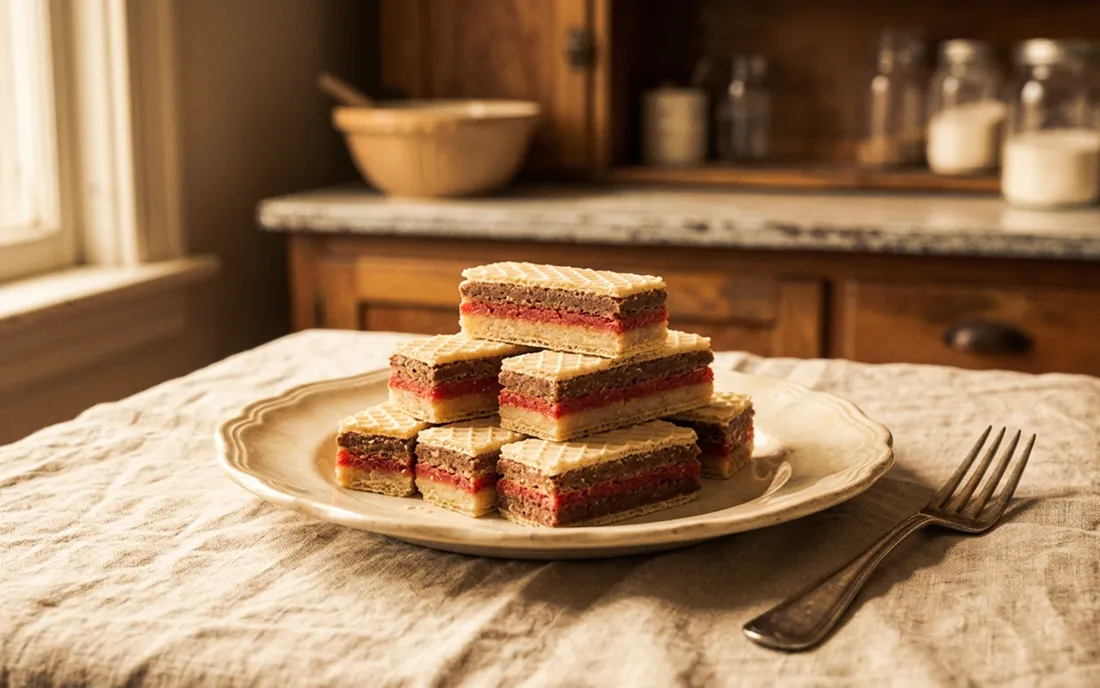
Quick Summary
These vegan almond wafer bars layer a sweet almond paste — divided into brown, red, and natural portions — between crisp wafer sheets. Beyond blanching and cooking the paste, no baking is needed. A colorful, dairy-free, egg-free dessert rooted in early 20th century Lenten baking.
This recipe uses How to Blanch Almonds: The Technique Behind the White Kernel — prepare it in advance if you haven't already.
Historical recipe
Modernised adaptation of an early 20th‑century source. Not independently kitchen-tested by Attic Recipes. Quantities, temperatures, and food safety guidance have been updated for a contemporary kitchen — results may vary and errors may exist. Nutritional values, where provided, are estimates only and have not been laboratory tested. Always follow current food safety guidelines for your region. If you have a health condition, allergy, or dietary requirement, consult a qualified professional before preparing this recipe.
Use of this recipe is entirely at your own risk and subject to our Terms of Service and Privacy Policy. Attic Recipes accepts no liability for any adverse outcome.
- Tree Nuts
- Gluten
Additional notes
-
Note
This recipe traditionally uses alkermes, a spiced Italian liqueur (about 20-35% ABV), to color one portion of the filling. Since the paste isn't cooked or baked again after the alkermes is added, the alcohol isn't cooked off — worth noting for pregnant women, children, and anyone avoiding alcohol.
Substitute a few drops of natural red food coloring, such as beet powder or a plant-based red gel color, for a fully alcohol-free version.
-
Note
Almonds are the primary ingredient here, not a minor addition — a clear concern for anyone with a tree nut allergy.
Finely ground, toasted sunflower seeds can approximate the texture for a nut-free version, though the flavor will differ noticeably.
-
Note
Wafer sheets are typically made from wheat flour, so this dessert contains gluten.
Gluten-free wafer or rice paper sheets, available from specialty baking suppliers, can be substituted.
-
Note
This dessert is dense in calories and added sugar per bar, given the almond paste base — worth keeping in mind for older adults, pregnant women, and anyone managing sugar intake.
- 1
Bring a pot of water to a boil and blanch the almonds for 1 minute, then drain. Once cool enough to handle, rub off the skins, then grind the peeled almonds finely in a food processor.
Tip Store-bought blanched almond flour can replace this entire step. - 2
In a heavy-bottomed pot, combine the sugar and water. Bring to a gentle boil, stirring until the sugar fully dissolves.
- 3
Add the ground almonds and lemon juice to the syrup. Cook over medium-low heat, stirring frequently, until the mixture thickens into a dense, spreadable paste.
Tip This can take 15-20 minutes. Stir often to prevent scorching, especially as the mixture thickens. - 4
Remove from heat and let cool slightly, then divide the almond paste into three roughly equal parts.
- 5
Mix the cocoa powder into one part until evenly colored brown. Mix the alkermes into a second part until evenly colored red. Leave the third part uncolored.
- 6
Lay the first wafer sheet flat on a tray or work surface. Spread the brown almond paste evenly over it.
- 7
Place a second wafer sheet on top and spread the red almond paste evenly over it.
- 8
Place a third wafer sheet on top and spread the uncolored almond paste evenly over it.
- 9
Top with the fourth wafer sheet, pressing down gently to help the layers adhere.
- 10
Cover and refrigerate for at least 4 hours, or preferably overnight, until firm enough to slice cleanly.
Tip The original recipe called for a cold pantry or cellar; a refrigerator does the same job today. - 11
Trim the edges with a sharp knife and cut into small bars. Serve chilled.
Nutrition Information per 1 bar (approx 55g)
Nutritional values are approximate estimates and may vary based on specific ingredients used, preparation methods, and portion sizes.
Serving Suggestions
Slice into small bars and serve chilled, alongside other Lenten sweets on a dessert plate. Store covered in the refrigerator.
About This Recipe
These almond wafer bars belong to a category of desserts built specifically without dairy or eggs — a practical necessity during religious fasting periods, but one that produces something genuinely worth making on its own merits. A simple sugar-and-almond paste does all the work here, needing no butter, cream, or eggs to feel rich.
What makes this version stand out is the layering: the almond paste is split into three portions, each colored differently, then spread between wafer sheets to build a striped, colorful slab that’s sliced into small bars once fully set. It’s a dessert built almost entirely on the stovetop and in the refrigerator, with the wafer sheets doing the structural work that a baked pastry layer would otherwise do.
Vegan and Lenten-style desserts like this one were common enough that commercial wafer sheets were sold specifically for building layered cakes and bars at home, without any need for an oven beyond the almond paste itself.
Why It Works
Cooking sugar, water, and ground almonds together drives off moisture and lets the sugar bind the almond meal into a firm, spreadable paste as it cools — the same basic principle behind marzipan. Because the paste is plant-based and cooked to a stable, low-moisture consistency, it can be layered and chilled without any of the food safety concerns that come with dairy or egg-based fillings. The wafer sheets absorb a small amount of moisture from the almond paste as the bars chill, softening just enough to slice cleanly without turning soggy.
Modern Kitchen Tips
Work with the almond paste while it’s still slightly warm and pliable — it firms up quickly once it starts to cool, making it harder to spread evenly. If you’re short on time, blanched almond flour and a natural food coloring in place of alkermes cut out two of the more time-consuming and specialty steps without changing the result much. These bars also freeze well; wrap tightly and thaw in the refrigerator before slicing.
A classic of early 20th century home cooking, preserved and adapted for the modern kitchen.
The Story Behind This Recipe
Historical Context
Dairy-free and egg-free desserts held an important place in early 20th century Central European home baking, especially during periods of religious fasting when animal products were avoided. Ground almonds made an excellent base for these sweets, rich and satisfying on their own. A bright coloring agent — often the same spiced red liqueur used to tint pastries across parts of Europe at the time — turned a simple almond paste into something festive-looking, while commercially produced wafer sheets let home cooks build an elegant, sliced dessert with very little baking involved.
Modern Kitchen Adaptation
The original calls for '2 cups' of water without a standard size, so this recipe uses 200ml glasses (400ml total). Blanching, peeling, and grinding whole almonds can be skipped entirely by using store-bought blanched almond flour instead. The traditional red coloring agent, alkermes, is a spiced Italian liqueur — since it's stirred into an uncooked portion of the paste, its alcohol content isn't cooked off; a few drops of natural food coloring, such as beet powder, gives a similar red without any alcohol. For the brown layer, use unsweetened cocoa powder or a dairy-free dark chocolate to keep the recipe fully vegan, since some chocolate blends contain milk solids. Wafer sheet size wasn't specified in the original; this recipe assumes standard commercial sheets around 20 x 30cm. For a gluten-free version, gluten-free wafer or rice paper sheets are available from specialty suppliers.
This recipe is an independent modern adaptation developed from historical sources in the public domain. It is provided for informational and educational purposes only and does not constitute professional dietary, nutritional, or medical advice. Food preparation involves inherent risks. The reader assumes full responsibility for safe food handling, ingredient sourcing, and adherence to current local food safety guidelines. The site operator accepts no liability for outcomes resulting from the preparation or consumption of this recipe.
One recipe.
Every week.
You Might Also Like
More recipes you'll enjoy
No-Bake Pineapple Cream
A light, chilled pineapple cream made with canned pineapple, gelatin, and whipped cream — no oven required, just a few hours to set.
No-Bake Strawberry Cream
A silky, chilled strawberry cream made with fresh strawberries, gelatin, and whipped cream — no oven required, just a few hours to set.
No-Bake Date and Fig Bars
A no-bake almond marzipan base layered with ground dates, figs, and walnuts, finished with a dark chocolate icing. Naturally dairy-free.