How to Blanch Almonds: The Technique Behind the White Kernel
Blanching almonds takes under two minutes. Here is what actually happens to the nut — and why Central European pastry relied on this simple step.
Introduction
Blanching almonds appears in early 20th century Central European pastry recipes with the same matter-of-fact brevity as sifting flour or clarifying butter — a step assumed to be understood, noted without elaboration. The instruction was typically a single line: scald the almonds and remove the skins. What the recipe did not explain, because it did not need to, was why the skin had to go in the first place.
The reason is the skin itself. The brown papery layer that covers a raw almond kernel is composed largely of cellulose and contains a significant concentration of tannins — astringent phenolic compounds responsible for the dry, slightly bitter sensation familiar from strong tea or red wine. In a straightforward snack, that edge is barely perceptible. In a finely ground almond filling, a custard, or a batch of marzipan, it registers clearly and undermines the clean, sweet nuttiness the preparation depends on.
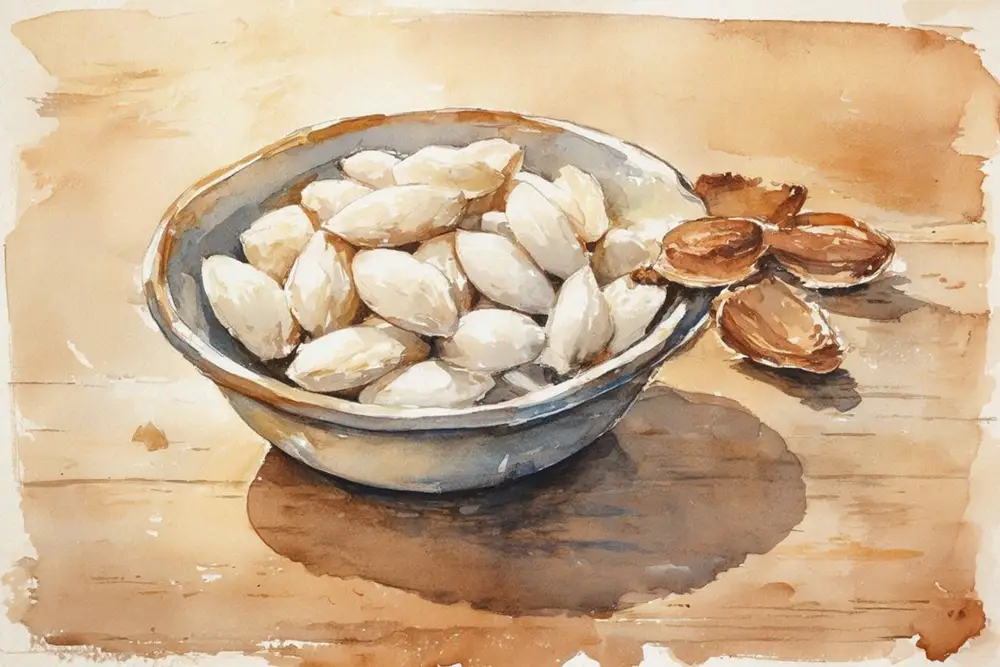
Blanching is the method that resolves this. Brief contact with boiling water softens the bond between skin and kernel enough that the skin slips away intact, leaving the white almond behind — unmarked, mild, and ready for grinding or slicing.
What Happens During Blanching
The mechanism is straightforward. The almond skin adheres to the kernel through a thin layer of cells at their interface. When the nut is submerged in boiling water, heat rapidly penetrates the skin and disrupts this adhesion layer — the cells swell, the bond loosens, and the skin separates from the smooth kernel beneath.
The process is deliberately brief. Sixty seconds in boiling water is the standard, and the timing is not arbitrary. The goal is to affect the skin without materially changing the kernel. Prolonged heat exposure would begin to soften the kernel itself, alter its texture, and in the case of ground preparations, affect the finished consistency of the paste or flour. The cold water bath that follows — the step sometimes called shocking — arrests any further cooking the moment the nuts leave the pot.
What leaves with the skin is chemically significant. The tannins and polyphenols in the almond skin are present at substantially higher concentrations than in the kernel — one measure puts the total phenolic content of almonds with skin at around five times that of peeled almonds. These are the same compounds responsible for the bitterness. Their removal is the functional purpose of blanching, not merely a cosmetic one.
A secondary effect, noted in food science literature, is a modest reduction in phytic acid — a mineral chelator found in the skin that can reduce the absorption of certain minerals like iron and zinc. This is a minor consideration for typical quantities used in baking, but it is the reason some cooks prefer blanched almonds in preparations consumed in larger amounts.
The Method
The technique requires nothing beyond a small saucepan, a bowl of ice water, and attention to timing.
Bring a pot of water to a full rolling boil. Add the almonds and leave them for exactly sixty seconds — use a timer. Do not walk away. Drain immediately and transfer to a bowl of cold water with ice. Let them sit for one minute to cool completely.
Drain again. Take an almond between thumb and forefinger, apply gentle pressure at one end, and the skin will slide off cleanly. Work through the batch while the almonds are still slightly warm — the skin is easier to remove before it dries and re-adheres.
Spread the peeled almonds on a clean cloth or paper towel and allow them to dry thoroughly before using them in a recipe. Moisture on the surface of the kernel can affect grinding consistency, oil absorption in pastry, and the final texture of a custard or filling.
When the Skin Stays On
Blanching is not always the right choice. The tannins in the skin contribute structure and a background note that can be an asset in certain preparations — particularly where almonds are toasted, used whole in a rustic cake, or paired with strong flavors that can absorb the bitterness. Early 20th century kitchen writing reflects this balance: blanched almonds appear consistently in refined pastry and custard applications, while whole roasted almonds with skin appear in more robust contexts.
The rule of thumb that emerged from period practice, and holds today: blanch when the almond will be ground fine, cooked into a cream, or used where a clean white appearance matters. Leave the skin on when the almond is a textural element, will be toasted, or is part of a preparation where a degree of bitterness is welcome.
Practical Takeaways
Blanching almonds takes under two minutes of active work. The technique works because brief heat disrupts the adhesion between skin and kernel — sixty seconds in boiling water, immediate transfer to cold water, then gentle pressure to slip the skin away.
The skin is not merely cosmetic. It contains tannins that contribute bitterness, which is imperceptible in a handful of whole almonds but detectable in a fine ground filling or a delicate custard. Removing it is the difference between an almond preparation that tastes clean and mild and one with an underlying edge.
For any preparation where almonds will be ground, creamed, or cooked into a filling — blanch first. For preparations where almonds are whole, toasted, or paired with robust flavors — the skin can stay.
Attic Recipes — digitizing and adapting Central European home cooking from the early twentieth century.
Frequently Asked Questions
01How long should almonds be blanched?▶
Boiling water, sixty seconds — no more. Longer exposure softens the kernel itself, which affects texture in finished recipes. Transfer immediately to ice water to stop the cooking process.
02Can I blanch almonds in advance?▶
Yes. Once peeled and dried, blanched almonds keep well in an airtight container at room temperature for several days, or refrigerated for up to two weeks. Make sure they are fully dry before storing — residual moisture accelerates spoilage.
03Why do some recipes specifically call for blanched almonds?▶
The almond skin contains tannins — astringent compounds that contribute bitterness. In delicate preparations like marzipan, custard fillings, or finely ground almond flour, that bitterness is detectable and unwanted. Blanching removes it.
04Is there a difference between blanched almonds and raw almonds nutritionally?▶
The kernel itself — protein, fat, most minerals — is essentially unchanged by brief blanching. The skin, which is removed in the process, contains a higher concentration of polyphenols and tannins than the kernel. The practical difference for a home cook is minor.
05Can I use pre-blanched almonds from the shop instead of blanching at home?▶
Yes, with one caveat: commercially blanched almonds are often dried and may be slightly older. For recipes where freshness of flavor matters — a fresh custard or a delicate almond cream — blanching at home gives a noticeably cleaner, sweeter result.