Tomato Risotto with Parmesan
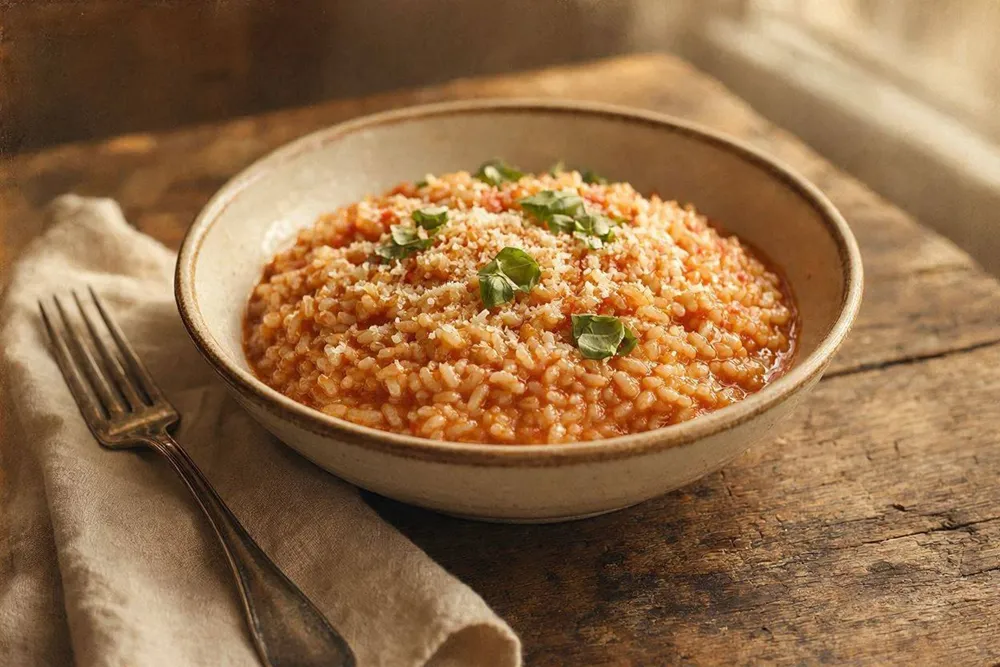
Rice slowly cooked in lard and absorbed with warm water, enriched with a prepared tomato sauce and finished with grated parmesan.
This recipe uses Slow-Simmered Tomato Sauce — prepare it in advance if you haven't already.
Historical recipe
Modernised adaptation of an early 20th‑century source. Not independently kitchen-tested by Attic Recipes. Quantities, temperatures, and food safety guidance have been updated for a contemporary kitchen — results may vary and errors may exist. Nutritional values, where provided, are estimates only and have not been laboratory tested. Always follow current food safety guidelines for your region. If you have a health condition, allergy, or dietary requirement, consult a qualified professional before preparing this recipe.
Use of this recipe is entirely at your own risk and subject to our Terms of Service and Privacy Policy. Attic Recipes accepts no liability for any adverse outcome.
- Dairy
Additional notes
-
Note
This dish is higher in saturated fat per serving (from lard and parmesan) than many everyday meals. Those monitoring saturated fat intake may want to reduce the lard/oil quantity or portion size.
Replacing the lard with olive oil reduces the saturated fat content noticeably while keeping the dish's texture.
- 1
Melt the 100g lard in a heavy-bottomed pot over medium heat.
- 2
Add the 500g rice and stir for 2-3 minutes, until the grains have absorbed the fat and turned slightly glossy.
- 3
Add the warm water gradually, about 250ml at a time, stirring occasionally and letting the rice absorb most of the liquid before adding the next portion.
- 4
After about 12-15 minutes, once the rice is about half-cooked, stir in the 500ml prepared tomato sauce.
Tip See the linked Slow-Simmered Tomato Sauce recipe if you haven't prepared it yet — it should be ready before you start the risotto. - 5
Continue cooking, adding the remaining warm water as needed, for a further 15-18 minutes, until the rice is tender and the risotto has a creamy, cohesive consistency. Season with the 0.75 tsp salt to taste.
- 6
Just before serving, stir in the 45g grated parmesan until melted through.
- 7
Serve hot, with the remaining 30g grated parmesan sprinkled over each portion at the table.
Nutrition Information per 1 serving (approx 380-400g)
Nutritional values are approximate estimates and may vary based on specific ingredients used, preparation methods, and portion sizes.
Serving Suggestions
Serve on its own as a main course, or alongside simply cooked meat. A final sprinkle of parmesan and a few torn basil leaves at the table finish it well.
About This Recipe
This risotto is a natural companion to the tomato sauce it’s built on — rice cooked slowly in fat, absorbing water in stages, and finished with a spoonful of rich tomato sauce and a generous handful of parmesan. It’s the kind of dish that turns a few pantry staples into something substantial, and it shows just how closely the absorption method used across Central European kitchens of the era mirrors the classic Italian risotto technique.
What stands out is the flexibility baked into the original approach: a nod to swapping the fat for cured pork, or skipping the cooked sauce altogether in favor of raw pureed tomato when time is short. Both variations are worth trying once you’ve made the base version.
Why It Works
Cooking the rice in fat first coats each grain, which slows down starch release just enough to keep the rice from turning gummy while it absorbs the water in stages. Adding the liquid gradually, rather than all at once, gives the rice time to release its starch gently into the surrounding liquid — that’s what builds the creamy, cohesive texture risotto is known for, without needing constant vigorous stirring.
Folding in the tomato sauce partway through, rather than at the very start, means the rice finishes cooking in a liquid that’s already thick and flavorful, rather than diluting the sauce with excess starch too early.
Modern Kitchen Tips
Keep a kettle or a second pot of water warm on the stove while you cook — adding cold water straight from the tap will shock the rice and slow the whole process down. If you want a lighter version, swap the lard for olive oil and use the raw pureed tomato variation instead of the cooked sauce; this cuts down significantly on both time and saturated fat.
Leftovers reheat well with a splash of water or stock stirred in to loosen the texture back up.
A classic of early 20th century home cooking, preserved and adapted for the modern kitchen.
The Story Behind This Recipe
Historical Context
Home cooks of the period prepared this dish by first cooking rice in fat until it had absorbed it, then gradually adding warm water and letting the rice cook through by absorption — a technique widespread across Central European households of the era, closely related to the classic risotto method. The traditional approach did not specify a quantity for the water, salt, or the parmesan stirred through at the end, leaving these to the cook's judgment. Two variations were also commonly noted: replacing the fat with cured pork fat, or substituting a raw, pureed tomato for the cooked sauce.
Modern Kitchen Adaptation
Lard has been kept here as the historically correct fat; if you prefer, it can be replaced with an equal weight of neutral oil or butter with a very similar result. Water quantity (1.35L total), the point at which the rice is considered half-cooked (12-15 minutes in), and total cooking time (about 30 minutes) were all estimated based on the typical absorption rate for 500g of rice, since none were specified originally. Salt was not mentioned anywhere in the original recipe; a modest starting amount (0.75 tsp) has been added here, since a dish of this size needs some seasoning beyond what the tomato sauce and parmesan provide on their own — adjust to taste. As noted in the historical approach, cured pork fat (like dry-cured bacon or smoked lard) can replace the oil/lard, and a raw pureed tomato can be used in place of the cooked tomato sauce for a lighter, fresher variation.
This recipe is an independent modern adaptation developed from historical sources in the public domain. It is provided for informational and educational purposes only and does not constitute professional dietary, nutritional, or medical advice. Food preparation involves inherent risks. The reader assumes full responsibility for safe food handling, ingredient sourcing, and adherence to current local food safety guidelines. The site operator accepts no liability for outcomes resulting from the preparation or consumption of this recipe.
One recipe.
Every week.
You Might Also Like
More recipes from the same category

Whipped Apricot or Peach Preserve (No-Cook)
A silky, pale fruit spread made by whipping raw apricot or peach puree with sugar - no cooking required.

Apricot Fruit Paste
Sieved ripe apricots cooked with equal weight sugar and lemon juice, poured into molds and air-dried — from early 20th century Central European kitchens.

Asparagus Venetian Style
Fresh asparagus baked under a rich egg yolk cream sauce and a golden meringue-cheese topping. An elegant Central European appetizer.