Stuffed Veal Stomach
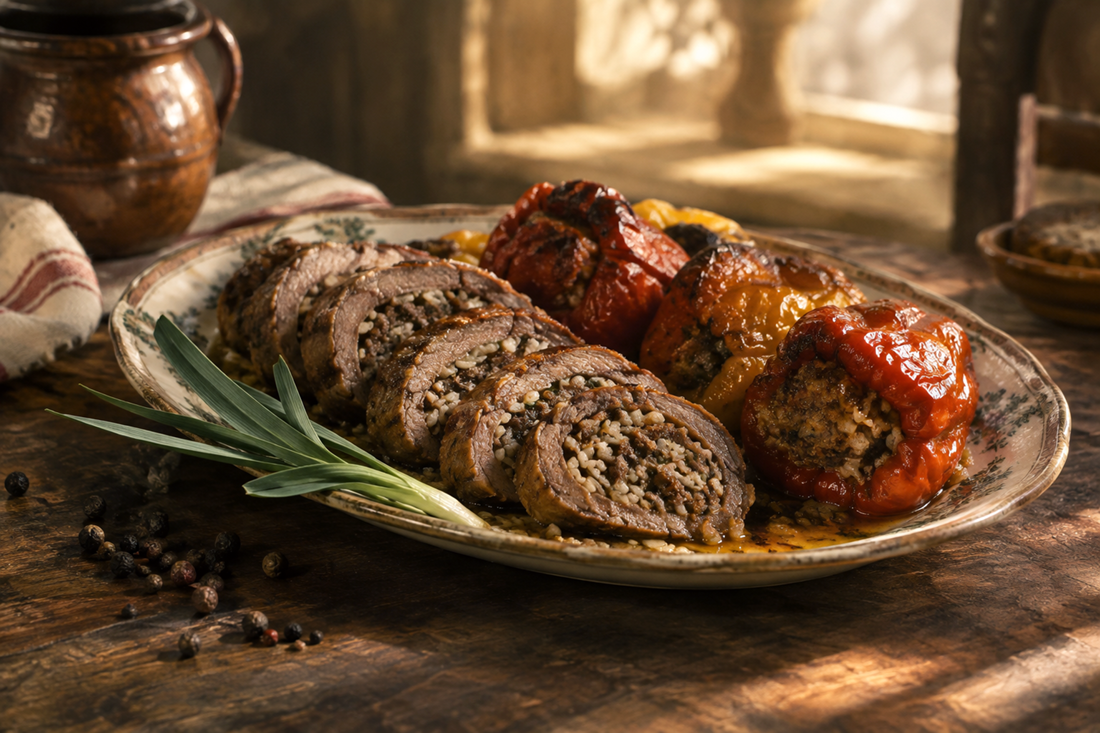
Veal stomach stuffed with rice and ground veal, roasted alongside stuffed peppers, then sliced thin and served like a savory roulade.
Quick Summary
This nose-to-tail dish stuffs a calf's stomach with a rice-and-ground-veal filling, roasts it alongside stuffed peppers, and slices it thin once baked, like a savory roulade. The stomach itself is hard to source today, so a beef tripe substitute is included.
Historical recipe
Modernised adaptation of an early 20th‑century source. Not independently kitchen-tested by Attic Recipes. Quantities, temperatures, and food safety guidance have been updated for a contemporary kitchen — results may vary and errors may exist. Nutritional values, where provided, are estimates only and have not been laboratory tested. Always follow current food safety guidelines for your region. If you have a health condition, allergy, or dietary requirement, consult a qualified professional before preparing this recipe.
Use of this recipe is entirely at your own risk and subject to ourTerms of Service andPrivacy Policy. Attic Recipes accepts no liability for any adverse outcome.
- Dairy
Additional notes
Warning
The filling is raw ground veal and rice that finish cooking inside the stomach casing during baking. Because the casing insulates the center, confirm with a food thermometer that the filling reaches at least 74°C (165°F) throughout before serving — don't rely on the outside appearance alone.
Note
This dish is high in saturated fat from the butter and organ meat. Those managing cholesterol or heart health may want a smaller portion.
Note
As with any organ meat, freshness matters more here than with muscle cuts. Buy from a butcher you trust, keep it well chilled, and cook it promptly rather than storing it for long.
- 1
Melt the butter in a pan. Add the chopped leeks and the salt, and cook until golden.
- 2
Add the ground veal and fry everything together until the meat is no longer pink.
- 3
Stir in the washed rice, pepper, and paprika. Mix well and set the filling aside off the heat.
- 4
Wash the veal stomach thoroughly in several changes of clean water.
- 5
Fill the stomach with the meat-and-rice mixture, then close the opening with kitchen string or small skewers.
- 6
Place the stuffed stomach in the center of a roasting dish.
- 7
Stuff the hollowed peppers with the remaining meat mixture and arrange them around the stomach.
- 8
Pour in the water and add the extra tablespoon of butter to the dish.
- 9
Bake until the stomach and peppers are cooked through, basting occasionally with the pan juices.
TipCheck the internal temperature of the filling near the center of the stomach — it should read at least 74°C (165°F) before serving, since ground meat inside an insulated casing can look done on the outside before the center is fully cooked. - 10
Once baked, slice the stomach into thin rounds like salami. Arrange on a plate and serve alongside the stuffed peppers.
Nutrition Informationper 1 serving (approx 1/5 of the recipe)
Nutritional values are approximate estimates and may vary based on specific ingredients used, preparation methods, and portion sizes.
Serving Suggestions
Serve warm, sliced, with the stuffed peppers and their pan juices spooned over.
About This Recipe
This is a genuine nose-to-tail dish built around an organ most modern cooks will never have encountered by name: the calf’s rennet stomach, emptied, washed, and used as an edible pouch for a simple rice-and-veal filling. It’s roasted alongside stuffed peppers in the same dish, so the whole thing bakes and bastes together, and once cooked, the stomach is sliced thin like a savory roulade rather than served whole.
The dish asks nothing unusual of the filling itself — it’s the same rice-and-meat mixture you’d find inside any stuffed pepper — but the casing is what makes it distinctive, and increasingly difficult to reproduce exactly as written.
Why It Works
Stuffing raw rice and meat into the stomach and letting both finish cooking together inside it, rather than pre-cooking the filling fully first, lets the rice absorb flavor from both the meat and the organ casing as everything bakes. The stomach itself acts much like a natural sausage casing, holding the filling’s shape and keeping it moist through the roast, while slicing it into thin rounds afterward turns what would otherwise be an unfamiliar-looking dish into something that presents cleanly, more like a terrine or roulade.
Modern Kitchen Tips
If you do manage to source a whole veal stomach, ask your butcher whether it’s already been cleaned — a properly cleaned stomach still benefits from a thorough home rinse in several changes of water, but starting from one that’s already been trimmed and scalded saves considerable time. If using the tripe substitute, look specifically for a thinner section that can be folded and sewn into a pouch shape without excessive bulk.
A classic of early 20th century home cooking, preserved and adapted for the modern kitchen.
The Story Behind This Recipe
Historical Context
The calf's rennet stomach owes its name to its historical role in cheesemaking — the enzyme it naturally contains was extracted to curdle milk long before commercial rennet existed. Using the emptied organ itself as an edible casing for a rice-and-meat filling, rather than discarding it, is a straightforward extension of that same nose-to-tail habit: nothing from the animal went to waste, including the container the rennet came from.
Modern Kitchen Adaptation
A whole veal stomach is genuinely difficult to source today — it's rarer even than ordinary beef tripe, since most calves processed now aren't kept in a form that preserves this organ separately for retail. Realistic sourcing options are a specialty or nose-to-tail butcher, an ethnic butcher serving a community with a strong offal tradition, or asking a small abattoir to set one aside. The most practical substitute is cleaned beef tripe, formed into a pouch and sewn shut with kitchen string — it's far more widely available and holds a stuffing the same way, though the flavor will be a little different from the more delicate, milk-fed taste of a calf's stomach. If no organ casing is available at all, the filling can be baked directly in the roasting dish alongside the stuffed peppers instead; this loses the nose-to-tail character of the dish but keeps the flavor. The fat is only specified as "heated fat" in the original, so butter is used here by default, but a neutral oil or lard tolerates the initial frying step better without the risk of burning.
This recipe is an independent modern adaptation developed from historical sources in the public domain. It is provided for informational and educational purposes only and does not constitute professional dietary, nutritional, or medical advice. Food preparation involves inherent risks. The reader assumes full responsibility for safe food handling, ingredient sourcing, and adherence to current local food safety guidelines. The site operator accepts no liability for outcomes resulting from the preparation or consumption of this recipe.
One recipe.
Every week.
You Might Also Like
More recipes you'll enjoy
Beef Tongue in Mushroom Sauce
Tender sliced beef tongue layered in a rich dark mushroom sauce, finished with sour cream, Parmesan, and a golden oven crust.
Beef Tongue with Creamy Sardine Sauce
Tender simmered beef tongue served sliced under a rich sardine, sour cream, and bacon sauce — a classic way to dress up an economical cut.
Marinated Veal Brain with Egg Yolk Dressing
Veal brain gently poached in an acidulated broth, cooled, sliced, and dressed with a rich sieved egg yolk, oil, and lemon dressing. Served cold.