Strawberry Meringue Pie
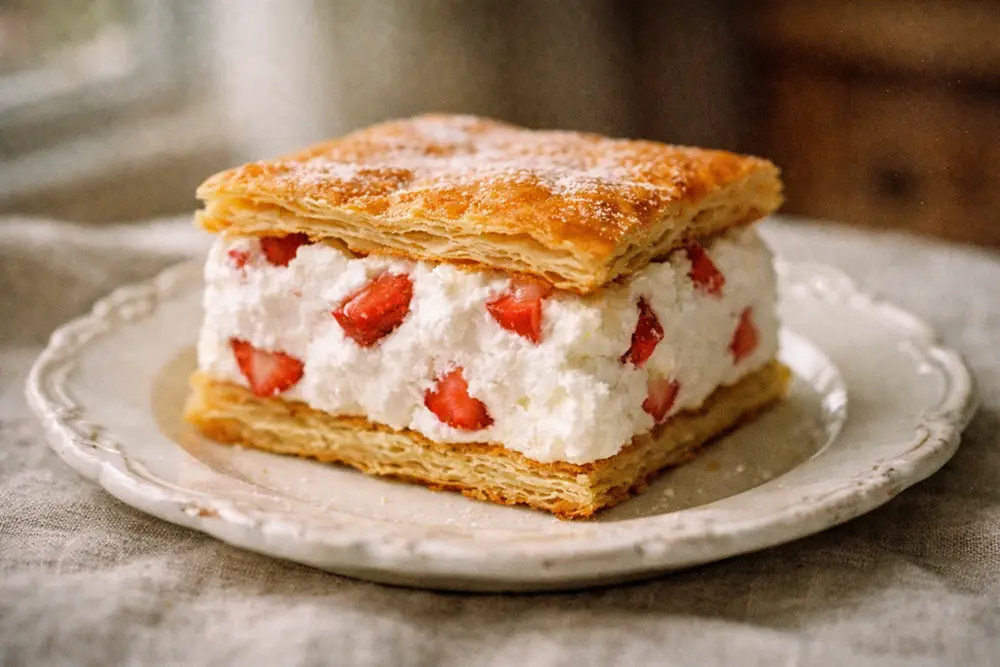
Italian meringue with fresh strawberries between two rough puff pastry crusts. A Central European celebration dessert from early 20th century home baking.
Historical recipe
Modernised adaptation of an early 20th‑century source. Not independently kitchen-tested by Attic Recipes. Quantities, temperatures, and food safety guidance have been updated for a contemporary kitchen — results may vary and errors may exist. Nutritional values, where provided, are estimates only and have not been laboratory tested. Always follow current food safety guidelines for your region. If you have a health condition, allergy, or dietary requirement, consult a qualified professional before preparing this recipe.
Use of this recipe is entirely at your own risk and subject to our Terms of Service and Privacy Policy. Attic Recipes accepts no liability for any adverse outcome.
- Eggs
Additional notes
-
Warning
Hot sugar syrup reaches temperatures above 115°C (239°F) and can cause severe burns on contact with skin. Pour slowly and keep children away from the stove during this step.
-
Note
The egg whites in this recipe are fully heat-treated by the hot sugar syrup (Italian meringue method) and are safe for pregnant women, the elderly, young children, and immunocompromised individuals.
- 1
Prepare and rest the rough puff pastry according to the linked recipe. Divide into two equal portions.
- 2
Preheat the oven to 200°C (400°F) / 180°C fan. Roll each portion of dough to fit the baking tray (approx. 30×40 cm). Prick the entire surface thoroughly with a fork — this prevents uneven puffing and keeps the crust flat.
Tip Prick generously and evenly. Any un-pricked spot will balloon up and create an uneven base for the filling. - 3
Bake each crust for 20–25 minutes until golden and cooked through. Bake one at a time, or use two identical trays side by side. Transfer to a wire rack and let cool completely before assembling.
- 4
While the crusts cool, prepare the sugar syrup. Combine the 200g granulated sugar and 80ml water in a heavy-bottomed saucepan. Cook over medium heat, stirring only until the sugar dissolves, then stop stirring and let it boil undisturbed until it reaches 115–118°C (soft-ball stage). If you don't have a thermometer: dip a thin wire loop into the syrup, blow firmly through it — if a sugar bubble holds its shape and flies free, the syrup is ready.
Tip Do not stir once it boils. Stirring causes crystallization. - 5
While the syrup cooks, whip the 10 egg whites in a clean, dry bowl until stiff peaks form. Add the 50g fine sugar and whip for another 30 seconds to incorporate.
- 6
With the mixer running on medium speed, pour the hot syrup into the whipped whites in a slow, thin, steady stream — aiming between the bowl wall and the beaters, not directly onto them. Once all the syrup is incorporated, increase speed and whip until the meringue is thick, glossy, and the bowl feels only slightly warm to the touch. This is Italian meringue.
Tip The meringue will be very voluminous and marshmallow-like. It should hold firm peaks and not look wet or grainy. - 7
Gently fold the 500g prepared strawberries into the meringue with a wide spatula, using slow, sweeping strokes. Work quickly but carefully — the meringue will deflate slightly, which is expected.
- 8
Place one cooled crust on a flat serving board or tray. Spread the strawberry meringue over it to a depth of approximately 7–8 cm (4 fingers). Use a spatula to level the top.
- 9
Carefully lay the second crust over the filling, pressing down very gently so it seats evenly. Using a sharp knife, cut into 16 equal squares (4×4 grid). Dust with powdered sugar and serve.
Tip For the cleanest cuts, chill the assembled pie for 20–30 minutes before slicing. A sharp chef's knife in one firm downward motion — no sawing — prevents the meringue from compressing unevenly.
Nutrition Information per 1 square (filling only, approx. 80g — does not include crust; see linked recipe for crust nutrition)
Nutritional values are approximate estimates and may vary based on specific ingredients used, preparation methods, and portion sizes.
Serving Suggestions
Serve at room temperature or slightly chilled. Pairs well with unsweetened whipped cream or a glass of cold sparkling water. If serving the next day, keep refrigerated and dust with fresh powdered sugar just before serving — period cooks noted this meringue holds well overnight if the syrup was properly cooked.
About This Recipe
Strawberry Meringue Pie — literally “foam pie” — is one of the more theatrical desserts in the Central European home baking canon. Two thin, crackling sheets of rough puff pastry sandwich a filling that is part marshmallow, part cloud: a stabilized Italian meringue folded generously with fresh strawberries. The result is simultaneously crisp, airy, and fruit-forward, with the kind of textural contrast that made this a fixture on the tables of Sunday gatherings and saint’s day celebrations across the Austro-Hungarian successor states.
What makes this recipe technically interesting is the meringue itself. It uses a hot sugar syrup — cooked to soft-ball stage — poured into whipped egg whites while the mixer runs. This is Italian meringue, and it solves two problems at once: it pasteurizes the egg whites through heat, and it produces a foam stable enough to hold the weight of half a kilogram of strawberries without collapsing. Home cooks of the era used exactly this technique, with a wire loop and a blown sugar bubble as the syrup test — a method that maps precisely to what we now call 115–118°C.
The strawberries do more than add flavor. Their moisture softens the meringue slightly over time, which is why period versions of this dessert were known to keep until the next day. The balance between structure and tenderness depends almost entirely on cooking the syrup to the correct temperature — too low, and the meringue weeps and slides; correct, and it sets into something close to a soft nougat by the following morning.
Why It Works
Italian meringue is fundamentally more stable than French meringue (sugar beaten dry into the whites) because the hot syrup both denatures the egg white proteins and dissolves any remaining sugar crystals, producing a foam that holds its structure under load. At soft-ball stage, the syrup contains enough concentrated sugar to act as a humectant, drawing moisture slowly rather than weeping. This is why the assembled pie can sit overnight without the filling collapsing or the crust going soggy — the syrup chemistry does the work that modern stabilizers (cream of tartar, gelatin) would otherwise do.
The fork-pricking of the crust serves the same function here as in any laminated pastry: releasing steam prevents the layers from puffing unevenly and gives you a flat, structural base that can support the filling without tipping.
Modern Kitchen Tips
A candy thermometer removes all guesswork from the syrup stage and is worth using if you have one. If not, the wire loop test described above is genuinely reliable — a bubble that holds its shape and detaches cleanly is a good indicator of soft-ball stage.
Room temperature egg whites whip faster and to a greater volume than cold ones. If you’ve stored your eggs in the refrigerator, separate them 30–45 minutes before starting.
The meringue begins to set as it cools, so work efficiently once the syrup is incorporated. Fold in the strawberries and assemble immediately — don’t let the meringue sit in the bowl.
A classic of early 20th century home cooking, preserved and adapted for the modern kitchen.
The Story Behind This Recipe
Historical Context
Early 20th century home cooks across the Austro-Hungarian successor states made šaum-pita as a celebration dessert, typically for saint's days and Sunday gatherings. Period recipes gave no oven temperature for the crust, relying instead on the cook's familiarity with wood-fired stoves. The syrup test — blowing through a wire loop to catch a sugar bubble — was the standard confectionery technique before candy thermometers became household items, and it maps precisely to what we now call the soft-ball stage. Wild strawberries, when in season, were used whole; cultivated ones were halved or quartered. The meringue technique described is Italian meringue, though home cooks of the period would not have used that term.
Modern Kitchen Adaptation
The wire loop test has been translated to a candy thermometer reading of 115–118°C (239–244°F). The water quantity for the syrup is estimated at 80ml — the original specifies only 'pour water,' which was standard shorthand when cooks worked by feel. Oven temperature is estimated at 200°C (400°F) / 180°C fan based on standard rough puff pastry requirements. A pinch of cream of tartar (¼ tsp) added to the egg whites before whipping further stabilizes the meringue — the original did not call for this, but it is recommended for reliability in modern kitchens. No other changes to the method: this is already a stable, cooked meringue and requires no food safety modifications. The egg whites are fully pasteurized by the hot syrup.
This recipe is an independent modern adaptation developed from historical sources in the public domain. It is provided for informational and educational purposes only and does not constitute professional dietary, nutritional, or medical advice. Food preparation involves inherent risks. The reader assumes full responsibility for safe food handling, ingredient sourcing, and adherence to current local food safety guidelines. The site operator accepts no liability for outcomes resulting from the preparation or consumption of this recipe.
One recipe.
Every week.
You Might Also Like
More recipes from the same category
Almond Meringue Crescents
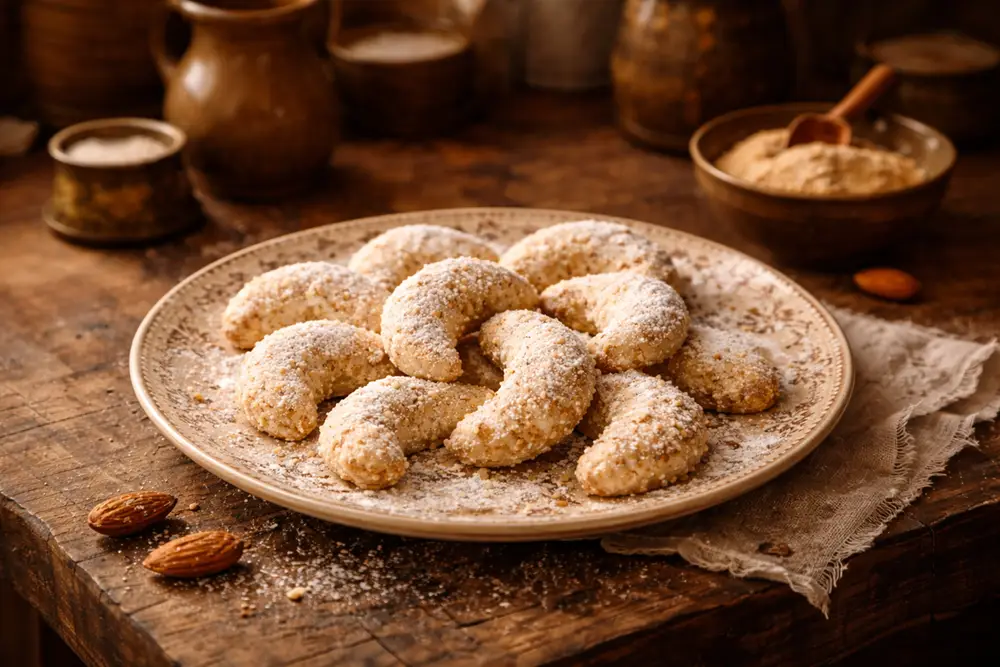
Crisp Central European confections of Swiss meringue shaped into crescents, coated in ground almonds, oven-dried until white and firm.
Apple Pie with Whipped Cream
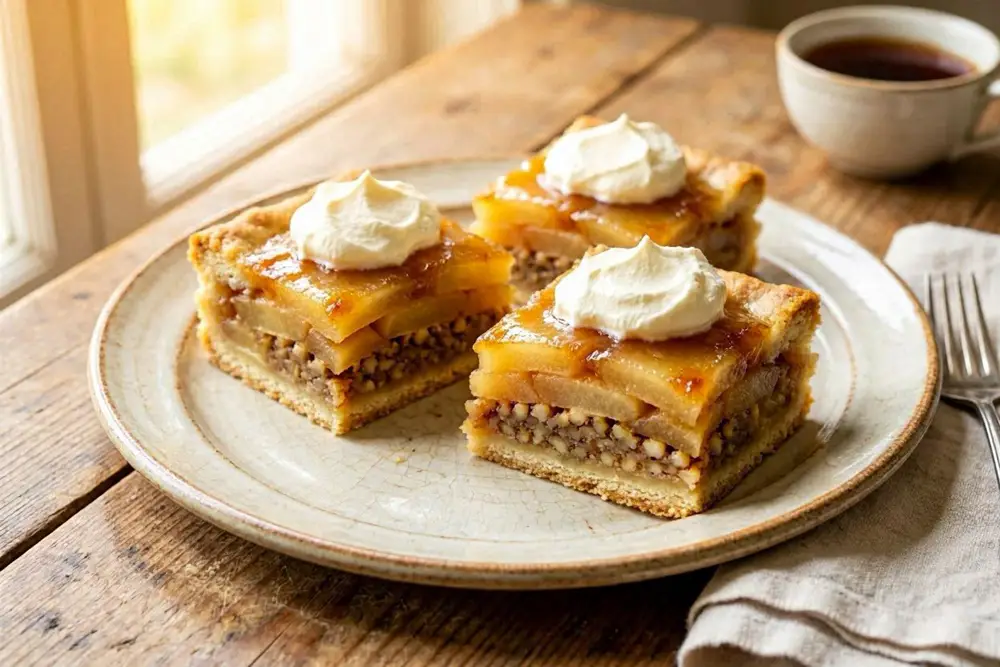
A crisp almond shortcrust base layered with ground walnuts, poached apples, apricot jam, and a thick cloud of sweetened whipped cream.
Almond Gurabije Cookies
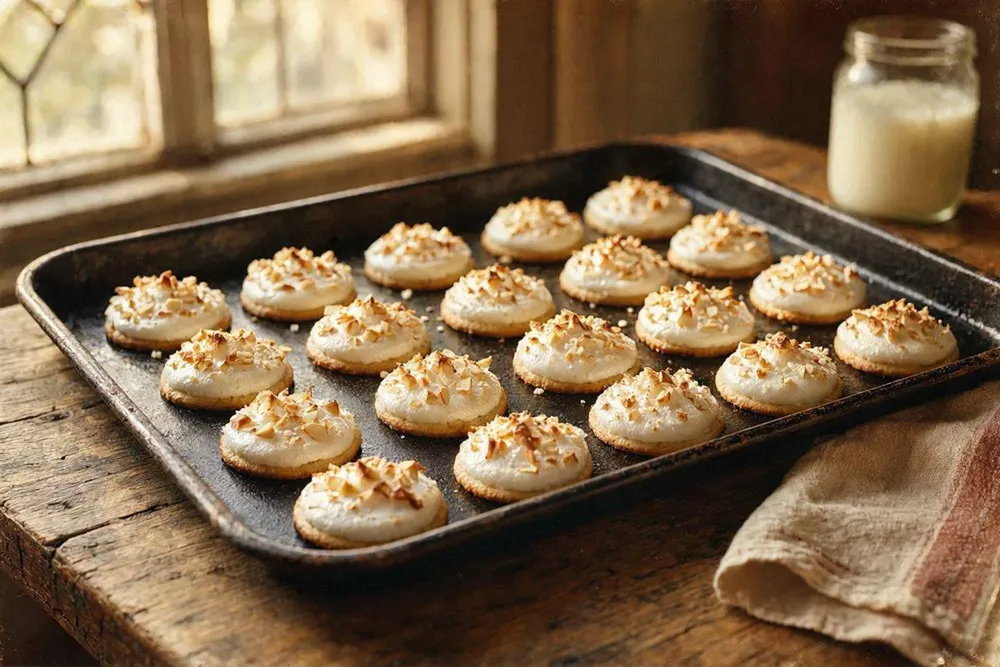
Small lemon-scented cookies made with lard and egg yolk, indented in the center, coated in whipped egg white, and rolled in sugar and chopped almonds.