Preserved Pepper and Tomato Salad with Celery and Parsley
Salted peppers and tomatoes, layered with celery and parsley and preserved in a vinegar brine — a jarred vegetable salad for winter.
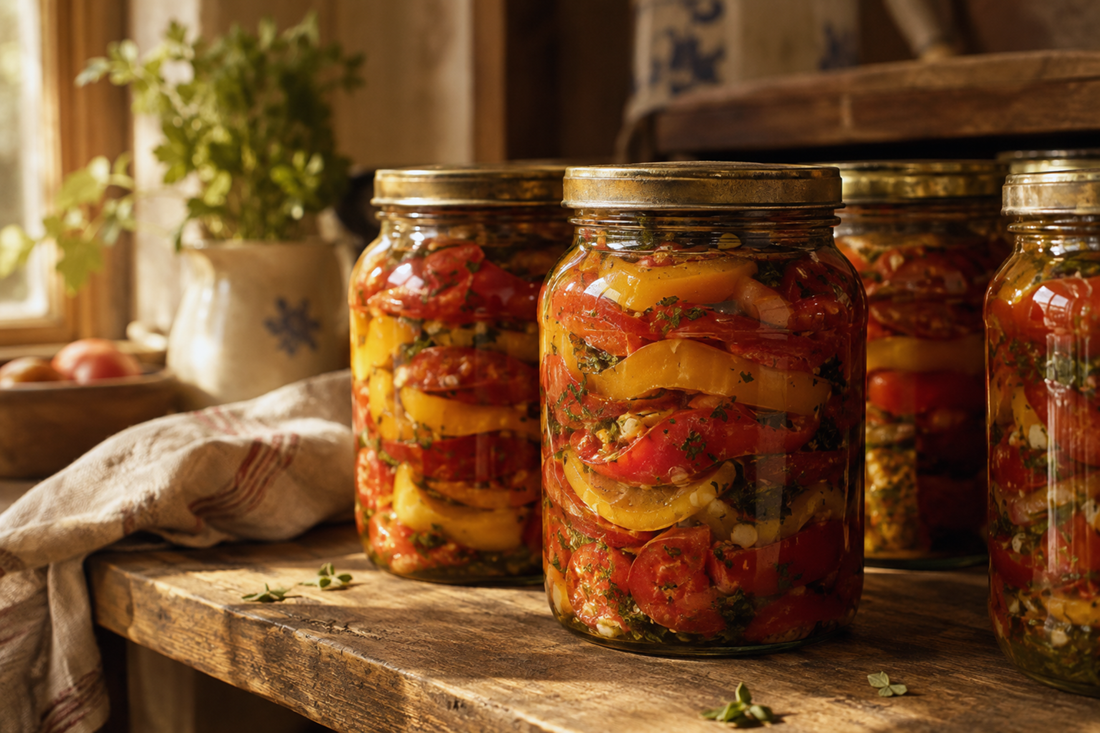
Quick Summary
Sliced peppers and tomatoes are salted separately, layered in jars with celery and parsley, and covered in vinegar brine. Jars can be shelf-stable processed or just refrigerated — a preserved salad for colder months, eaten alone or stirred into stewed vegetables.
Historical recipe
Modernised adaptation of an early 20th‑century source. Not independently kitchen-tested by Attic Recipes. Quantities, temperatures, and food safety guidance have been updated for a contemporary kitchen — results may vary and errors may exist. Nutritional values, where provided, are estimates only and have not been laboratory tested. Always follow current food safety guidelines for your region. If you have a health condition, allergy, or dietary requirement, consult a qualified professional before preparing this recipe.
Use of this recipe is entirely at your own risk and subject to our Terms of Service and Privacy Policy. Attic Recipes accepts no liability for any adverse outcome.
Additional notes
-
Warning
Do not substitute any chemical preservative for the vinegar brine described here. Peppers are a low-acid vegetable, and jars that aren't properly acidified and sealed can support the growth of Clostridium botulinum, which causes botulism — a rare but potentially fatal form of food poisoning.
-
Warning
A tied parchment paper cover, as used historically, does not create a safe seal. Use new, undamaged two-piece canning lids, and process filled jars in a boiling water bath if you intend to store them at room temperature.
-
Caution
If you skip water-bath processing, keep the jars refrigerated at all times and use them within a few weeks. Never store unprocessed jars at room temperature.
-
Note
This preserve is relatively high in sodium due to the salting step used to draw moisture from the vegetables. Those managing blood pressure or on a sodium-restricted diet may want to rinse the vegetables briefly before layering them into jars.
- 1
Wash the peppers in cold water and let them drain well. Slice into thin strips, place in a large bowl, salt, mix well, and let stand for 30 minutes.
- 2
Wash the tomatoes in cold water and let them drain briefly. Slice into thin strips or rounds, place in a separate bowl, salt, mix gently, and let stand for 30 minutes.
- 3
While the peppers and tomatoes rest, wash and finely chop the celery and parsley leaves.
- 4
Layer the salted peppers, tomatoes, and chopped celery and parsley into clean canning jars, leaving about a finger's width of space at the top.
Tip Use jars with new, undamaged two-piece lids — a tied parchment cover, as used historically, doesn't create the airtight seal that safe preservation needs. - 5
If making this in winter, add the sliced onion to the layers as well.
- 6
Combine the liquid released by the salted tomatoes with the vinegar and water to make a brine, and pour it over the layered vegetables until fully submerged, leaving the same finger's width of headspace.
Tip This vinegar-based brine replaces the chemical preservative used in the original recipe — see Modern Adaptation for why that change matters. - 7
Wipe the jar rims clean, seal with new lids and bands, and process in a boiling water bath for about 20 minutes to make the jars shelf-stable.
Tip If you'd rather not water-bath process the jars, seal them with clean lids and keep them in the refrigerator instead, using them within a few weeks — don't store unprocessed jars at room temperature. - 8
Let the jars cool completely and check that the lids have sealed before storing them in a cool, dark place. Serve on its own as a salad, or stir into a stewed vegetable dish in winter.
Nutrition Information per 1 serving (approx 100g)
Nutritional values are approximate estimates and may vary based on specific ingredients used, preparation methods, and portion sizes.
Serving Suggestions
Serve chilled as a side salad, or stir into a simmering stewed vegetable dish in winter for extra brightness.
About This Recipe
This is a preserved vegetable salad built from two of the most abundant late-summer vegetables — peppers and tomatoes — salted separately, layered with fresh celery and parsley, and packed into jars to see the household through winter. It’s meant to be made in quantity, at the point in the season when both vegetables are cheap and plentiful, and used sparingly for months afterward.
The technique itself is simple: salt draws moisture out of the vegetables and starts the preservation process, while the jars are ultimately what carry them safely through storage. That second half of the process — what actually keeps the jars safe over time — is where this recipe has needed real modern updates, addressed in detail below.
Why It Works
Salting the peppers and tomatoes before packing them into jars draws out excess moisture and begins seasoning the vegetables throughout, not just on the surface, before they’re layered and covered in brine. The vinegar in the final brine does the real preservation work: it lowers the pH of the liquid surrounding the vegetables enough to prevent the growth of harmful bacteria, which is exactly the role a chemical preservative or a properly executed boiling-water-bath process is meant to play.
Modern Kitchen Tips
Slice the peppers and tomatoes to a similar thickness so they layer evenly and the brine can reach all the vegetables in the jar. If you’re processing the jars in a boiling water bath, make sure they’re fully submerged with at least an inch of water above the lids throughout processing.
A classic of early 20th century home cooking, preserved and adapted for the modern kitchen.
The Story Behind This Recipe
Historical Context
Before boiling-water-bath canning and refrigeration became standard household practice, home preservers sometimes relied on chemical preserving agents mixed directly into a jar's liquid to prevent spoilage — agents such as salicylic acid were common in the period but are now recognized as unsafe for food use and are no longer permitted. Salting the sliced vegetables before packing them into jars, as this recipe does, was itself a legitimate preservation step, since drawing out moisture with salt helps control spoilage; it's mainly the sealing method and the preserving liquid around the vegetables that needed to change.
Modern Kitchen Adaptation
The original recipe calls for a chemical preservative added directly to the jars and a seal made of dampened parchment paper — neither is safe by current food preservation standards, and both have been replaced here. The chemical preservative is replaced with a vinegar-based brine, which lowers the pH enough to inhibit bacterial growth, including Clostridium botulinum, the organism responsible for botulism in improperly preserved low-acid vegetables like peppers. The parchment seal is replaced with new two-piece canning lids, which create the airtight seal that proper preservation requires. Two safe options are given: process filled jars in a boiling water bath for shelf-stable storage, or skip processing and keep the jars refrigerated for shorter-term use. For anyone canning for shelf-stable, room-temperature storage, it's worth checking a trusted modern canning reference (such as the USDA Complete Guide to Home Canning) for processing times adjusted to your exact jar size and altitude, since both affect how long jars need to process safely. Salt, celery, and parsley quantities are estimated, since the original gives no measurements for these.
This recipe is an independent modern adaptation developed from historical sources in the public domain. It is provided for informational and educational purposes only and does not constitute professional dietary, nutritional, or medical advice. Food preparation involves inherent risks. The reader assumes full responsibility for safe food handling, ingredient sourcing, and adherence to current local food safety guidelines. The site operator accepts no liability for outcomes resulting from the preparation or consumption of this recipe.
One recipe.
Every week.
You Might Also Like
More recipes you'll enjoy
Slow-Cooked Melon Preserve
A fragrant, golden melon preserve slow-cooked with sugar until thick and spreadable, updated with a food processor and safe modern canning steps.
Vegan Cabbage Rolls with Rice and Walnuts (Sarma)
Vegan stuffed cabbage rolls filled with rice, onion, and walnuts, simmered slowly in a paprika roux — no meat, no dairy.
Piquant Mixed Vegetable Pickle
A colorful mix of blanched vegetables, gherkins, green tomatoes, and hot peppers is packed into jars and covered with a tangy vinegar brine.