Lenten Vegetable Broth with Carrot, Potato and Turnip
A clear, light vegan broth of carrot, potato, turnip, peas and beans, simmered slowly for four hours and served plain or with rice, noodles or sago.
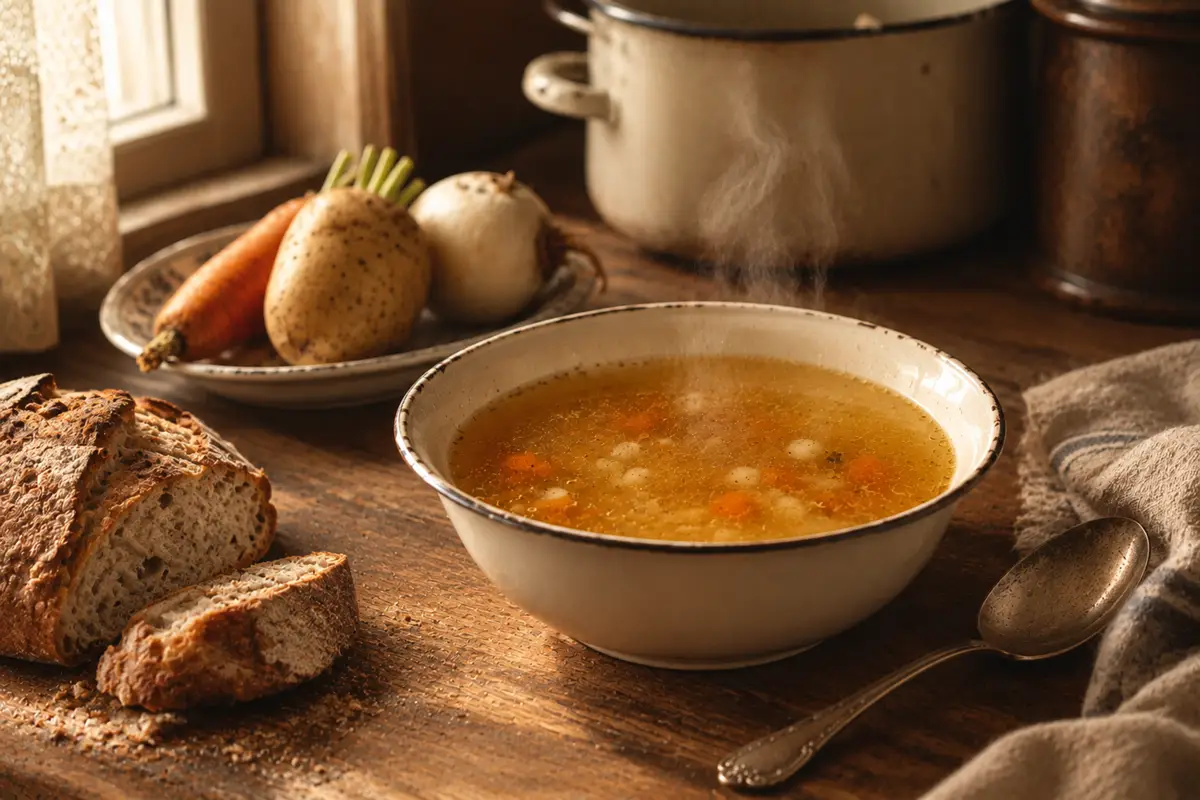
Quick Summary
This light Lenten vegetable broth simmers carrot, potato, turnip, dried peas and white beans in soft water for four hours, then is strained and seasoned. It is served plain or with fine noodles, rice, sago or tapioca cooked in the broth. It yields about four bowls.
Historical recipe
Modernised adaptation of an early 20th‑century source. Not independently kitchen-tested by Attic Recipes. Quantities, temperatures, and food safety guidance have been updated for a contemporary kitchen — results may vary and errors may exist. Nutritional values, where provided, are estimates only and have not been laboratory tested. Always follow current food safety guidelines for your region. If you have a health condition, allergy, or dietary requirement, consult a qualified professional before preparing this recipe.
Use of this recipe is entirely at your own risk and subject to ourTerms of Service andPrivacy Policy. Attic Recipes accepts no liability for any adverse outcome.
- Gluten
Additional notes
Warning
Dried beans contain a natural toxin that causes severe stomach upset if the beans are undercooked. Boil the beans hard for at least 10 minutes before the slow simmer, and never use red kidney beans. This is especially important for children, pregnant women, older adults and immunocompromised people.
Caution
Cooked rice left at room temperature can grow bacteria that cause food poisoning. If you make the soup with rice, cool leftovers quickly, refrigerate within 1 hour, eat within 1 day, and reheat until steaming hot (74°C / 165°F). This is especially important for pregnant women, children, older adults and immunocompromised people.
- 1
Peel and cut the vegetables: 60g potato and 15g white turnip into small dice, and 45g carrot into thin slices. Rinse 6g dried peas and 6g dried white beans, picking over the beans for any stones.
TipNo soaking is needed because of the long simmer. Cut the vegetables small, since smaller pieces release more flavor. - 2
Put all the vegetables, peas and beans in a heavy 2-litre pot with 1 litre cold soft water. Bring to a rolling boil, boil hard for 10 minutes, skimming off any foam, then cover tightly and reduce the heat to the lowest setting.
TipThe 10-minute hard boil makes the beans safe to eat. A slow simmer alone does not reach a high enough temperature to destroy the natural toxin in dried beans. - 3
Simmer, covered, on the lowest heat for 4 hours, so that the liquid only barely trembles.
TipA tight lid keeps evaporation low. Do not stir, which keeps the broth clear. - 4
Strain the broth through a fine sieve into a 1-litre measuring jug, discarding the solids. Top up with about 150ml freshly boiled water to reach exactly 1 litre. Stir in 1 tsp fine salt and taste.
TipThe vegetables are very soft and have given up most of their flavor after 4 hours, so they are discarded. Add salt gradually, because the broth is mild. - 5
For a plain broth, pour it back into the pot, reheat until steaming hot and serve. To add one starch, return the broth to a rolling boil, then slowly sprinkle in your chosen add-in in a thin stream, so that the broth does not stop boiling: 4 tbsp fine noodles for 10–12 minutes, or 100g rinsed rice for 20 minutes, or 80g sago for 20 minutes, or 70g tapioca for 20 minutes.
TipAdd the starch slowly, in a thin rain, so the broth stays hot and the grains do not clump. Cook the rice until the grains are whole and still slightly firm. Sago and tapioca turn translucent when done and will thicken the broth a little. - 6
Ladle into warm bowls and serve at once.
TipRice, sago and tapioca keep absorbing liquid as the soup stands, so serve soon after cooking. If the soup becomes too thick, thin it with a little hot water.
Nutrition Informationper 1 bowl (250ml, plain broth)
Nutritional values are approximate estimates and may vary based on specific ingredients used, preparation methods, and portion sizes.
Serving Suggestions
Serve hot in bowls as a light first course, with a slice of bread on the side. Plain leftover broth keeps in the refrigerator for up to 3 days and works as a base for other soups. Soups made with rice, sago or tapioca keep for 1 day.
About This Recipe
This is a plain vegetable broth made from just a few small root vegetables, a pinch of dried peas and a pinch of dried beans, simmered very gently for four hours and then strained. The result is clear, light and naturally sweet, with a mild savory depth from the legumes. It is vegan and fully Lenten, with no animal products at all.
It can be served just as it is, as a gentle first course, or turned into a more filling soup by cooking one of four starchy additions in the strained broth: fine noodles, rice, sago or tapioca. Each gives a different texture, from tender noodles to glossy, translucent pearls.
The recipe is a good example of how little a simple soup can need: a handful of vegetables, soft water and time.
Why It Works
A long, gentle simmer draws sugars, starch and flavor out of even small amounts of vegetables, and the dried peas and beans add body and a savory note that the vegetables alone would lack. Using soft, low-mineral water matters here. The calcium in hard water keeps legumes from softening and can cloud the broth.
Straining and topping the broth back up to exactly one litre fixes its strength, and it also fixes the amount of liquid for the starchy additions. Sprinkling those into boiling broth in a thin stream keeps the liquid hot, so the grains start cooking at once and stay separate instead of clumping.
Modern Kitchen Tips
Always boil the beans hard for the first 10 minutes. This is the one step you should not skip, because beans that are only slow-simmered may not be safe to eat.
Keep the lid on and the heat very low so the liquid barely moves. A hard boil clouds the broth and evaporates too much of it.
For a more flavorful broth, a modern cook can add more vegetables, but the broth is traditionally mild, which makes it a good base for the added grains.
A classic of early 20th century home cooking, preserved and adapted for the modern kitchen.
The Story Behind This Recipe
Historical Context
Early 20th century recipes for plain vegetable broths typically relied on small amounts of root vegetables and dried legumes, simmered for hours and then strained, which made a light soup suited to fasting days. Home cooks of the period used soft, lime-free water, which helps dried legumes soften and keeps the broth clear, and measured the vegetables by weight per litre of water. The traditional approach offered four starchy additions to turn the broth into a more filling soup (fine noodles, rice, sago or tapioca), each cooked in the strained broth and sprinkled slowly into the boiling liquid so that it would not cool suddenly.
Modern Kitchen Adaptation
'Lime-free' water is read here as soft, low-mineral water; filtered or bottled low-mineral water works, and hard tap water can keep legumes firm and cloud the broth. A 10-minute hard boil for the beans is added before the gentle simmer, because dried beans contain a natural toxin that a slow simmer alone does not destroy; this is not part of the period method, and the dish should not be made with red kidney beans. 'Ripe beans' are read as dried white beans, and 'dried peas' as dried yellow or green peas. The salt (1 tsp), the boiling water to top up (about 150 ml), the cut size of the vegetables, and the very low simmer (about 90°C) were not specified and have been estimated. Four tablespoons of fine noodles is about 30 g. The broth is intentionally mild, since the vegetables are used in very small amounts; for a fuller flavor a modern cook can double the vegetables, though that departs from the period quantities. The nutrition values are for the plain strained broth, with an estimated 20% of the solids extracted into the liquid, and the add-ins contribute per serving about 28 kcal (noodles), 90 kcal (rice), 70 kcal (sago) or 63 kcal (tapioca).
Images on this site are AI-generated illustrations in a 1930s style; your finished dish may look different.
This recipe is an independent modern adaptation developed from historical sources in the public domain. It is provided for informational and educational purposes only and does not constitute professional dietary, nutritional, or medical advice. Food preparation involves inherent risks. The reader assumes full responsibility for safe food handling, ingredient sourcing, and adherence to current local food safety guidelines. The site operator accepts no liability for outcomes resulting from the preparation or consumption of this recipe.
One recipe.
Every week.
You Might Also Like
More recipes you'll enjoy
Brown Clear Soup with Beef, Veal and Hen (Double Broth)
A deep brown clear soup made by browning beef, veal and liver with bacon and onion, then simmering them with a hen in beef broth for four hours.
Cheese and Spinach Soup
A hearty soup of leek, spinach, and aged sheep's cheese, thickened with a paprika roux and finished with carefully tempered eggs.
Mixed Bone Broth Soup with Sour Cream and Fried Bread
A rich bone broth made from pork, veal, and beef bones, built on caramelized root vegetables and finished with a sour cream thickening and a splash of vinegar.