Butter Biscuit with Candied Fruit
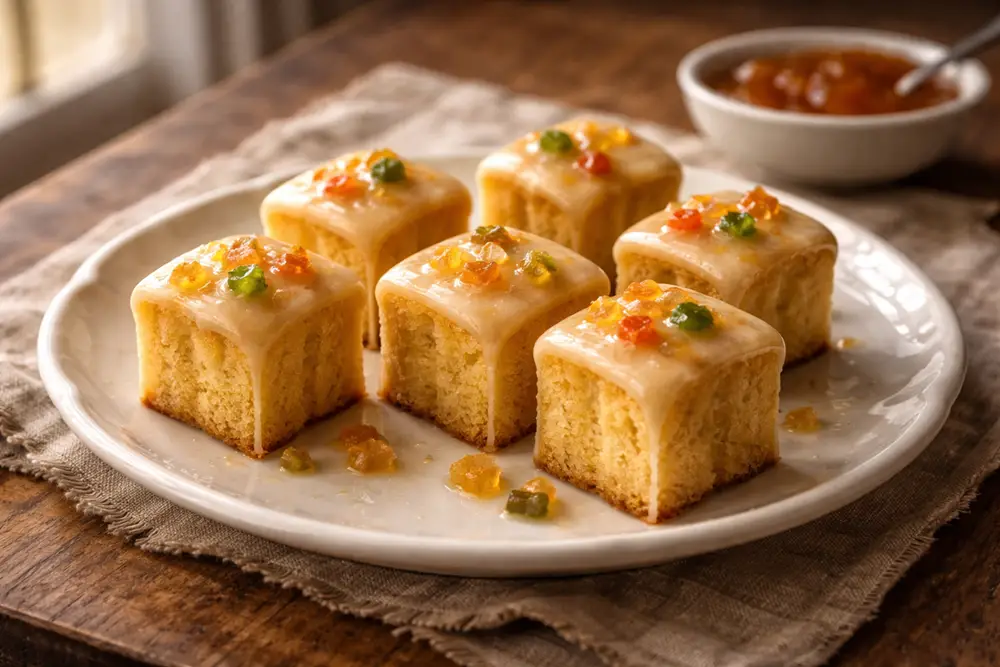
A lemon-scented sponge sandwich filled with fruit marmalade, topped with chopped candied fruit and a rum-lemon glaze, cut into small cubes for serving.
Quick Summary
Butter Biscuit with Candied Fruit is a Central European dessert of lemon sponge layered with fruit marmalade, topped with candied fruit, and finished with a glossy rum-lemon glaze. It takes about 55 minutes, with a smooth, shiny crust and airy sponge.
Historical recipe
Modernised adaptation of an early 20th‑century source. Not independently kitchen-tested by Attic Recipes. Quantities, temperatures, and food safety guidance have been updated for a contemporary kitchen — results may vary and errors may exist. Nutritional values, where provided, are estimates only and have not been laboratory tested. Always follow current food safety guidelines for your region. If you have a health condition, allergy, or dietary requirement, consult a qualified professional before preparing this recipe.
Use of this recipe is entirely at your own risk and subject to our Terms of Service and Privacy Policy. Attic Recipes accepts no liability for any adverse outcome.
- Eggs
- Dairy
- Gluten
Additional notes
-
Note
This recipe contains rum in the glaze. While the alcohol does not cook off (glaze is not heated), the quantity per cube is minimal (under 1ml). Pregnant women, children under 18, and anyone avoiding alcohol should omit the rum and substitute with an equal volume of lemon juice.
Replace the 15ml rum with an additional 15ml lemon juice for a fully alcohol-free glaze with a sharper citrus flavour.
-
Warning
This recipe contains raw eggs that are gently warmed over a bain-marie but do not reach 74°C (165°F). Pregnant women, elderly individuals, immunocompromised persons, and young children should use pasteurised eggs.
- 1
Place the 5 whole eggs and 150g powdered sugar in a heatproof bowl set over a saucepan of barely simmering water (bain-marie). Whisk continuously — by hand or with a hand mixer — until the mixture is completely thick, pale, and falls in a slow ribbon from the whisk. This takes 8–10 minutes. The bowl should be warm to the touch but not hot.
Tip The mixture is ready when it holds a visible trail for 3–4 seconds after the whisk is lifted. Do not rush this step — it is the only leavening in the sponge. - 2
Remove the bowl from the heat. Gently fold in the 80g melted cooled butter, the zest and juice of ½ lemon. Sift the 100g flour over the mixture in two additions, folding carefully each time with a spatula to preserve as much air as possible.
- 3
Preheat the oven to 180°C (350°F) / 160°C fan. Grease a 20x30cm oblong baking tin generously with butter and dust with flour, tapping out any excess. Line the base with a sheet of clean parchment paper cut to fit.
- 4
Pour the batter evenly onto the parchment paper in the prepared tin, smoothing the surface with a spatula. Bake for 25–30 minutes until the surface is deep golden and a skewer inserted in the centre comes out clean. The sponge should be pulling away slightly from the tin edges.
- 5
Immediately invert the baked sponge onto a wooden board or wire rack. Carefully peel away the parchment paper. Leave to cool completely — do not rush this step, as a warm sponge will tear when sliced horizontally.
- 6
Once fully cold, use a long serrated knife to slice the sponge horizontally into two equal layers. Spread the 80g marmalade generously and evenly over the cut surface of the bottom layer. Place the top layer back on, pressing lightly to adhere.
- 7
Scatter the 60g finely chopped candied fruit evenly across the entire top surface of the assembled sponge.
- 8
Prepare the glaze: combine the 150g granulated sugar, 7g marmalade, juice of 1 lemon, and 15ml dark rum in a small bowl. Stir vigorously until the sugar is mostly dissolved and the mixture is thick and pourable — it should coat the back of a spoon.
- 9
Pour the glaze evenly over the candied fruit layer and spread with a spatula to cover the entire surface. Leave undisturbed at room temperature for at least 30 minutes until the glaze is fully set and dry to the touch.
Tip The glaze sets faster in a cool, dry room. Do not refrigerate before it has set — condensation will prevent it from drying properly. - 10
Once the glaze is completely set, use a sharp knife to cut the cake into 24 equal cubes (4 cuts along the short side, 6 cuts along the long side). Wipe the blade clean between cuts for neat edges.
Nutrition Information per 1 cube (approx. 39g)
Nutritional values are approximate estimates and may vary based on specific ingredients used, preparation methods, and portion sizes.
Serving Suggestions
Serve at room temperature. The cubes keep well in a single layer in a cool place for up to 2 days — the glaze continues to firm up over time. Do not stack before the glaze is fully set. A small glass of dessert wine or black tea pairs well.
About This Recipe
This is a cake assembled in layers and cut into cubes — the format that made it practical for a table where guests served themselves, picking up a piece without knife or fork. The sponge is a génoise-style batter, whisked warm over a bain-marie until thick and pale, then folded with melted butter and lemon. No baking powder, no vanilla, no shortcuts.
The filling is simple: a generous spread of fruit marmalade between two layers. The topping is where the recipe becomes something more distinctive — finely chopped candied fruit scattered across the surface, then glazed with a thick paste of sugar, marmalade, lemon juice, and rum. Once set, the glaze gives the cubes a lacquered surface and a sharp, bright finish that cuts through the richness of the butter sponge.
The three marmalade options the recipe offers — apricot, redcurrant, or raspberry — are interchangeable in technique but produce noticeably different results. Apricot is the mildest and most neutral. Redcurrant is sharper and cuts the sweetness more cleanly. Raspberry is the most aromatic.
Why It Works
Warming eggs and sugar over gentle heat before whisking — the bain-marie step — partially denatures the egg proteins, making them more elastic and capable of holding more air when whisked. The result is a foam that is both more stable and finer-grained than cold-whisked eggs. This is why the sponge holds together without any chemical leavening and bakes to a uniform, close crumb rather than an open, irregular one.
The butter is added melted and cooled, not creamed. Creaming would add air but would also require flour for structure. Here the flour content is low — 100g for five eggs — because the egg foam is doing the structural work. Butter adds richness and keeps the crumb tender.
The glaze does not set by cooking or by cooling — it sets by drying. Sugar dissolved in lemon juice forms a supersaturated solution that, spread thin, crystallises slowly as moisture evaporates. The small amount of marmalade in the glaze provides pectin, which slows crystallisation slightly and keeps the surface smooth rather than grainy. The rum slows evaporation, giving the glaze time to level before it sets.
Modern Kitchen Tips
An electric hand mixer makes the bain-marie step considerably easier — whisking by hand for 8–10 minutes over heat is tiring. If using a stand mixer, warm the eggs and sugar in the bowl set over a saucepan first, then transfer to the mixer.
The sponge must be completely cold before slicing horizontally. A warm sponge compresses and tears. If time allows, wrap it in a clean cloth and leave for an hour before assembling.
For the cleanest cube cuts, chill the assembled, glazed cake briefly in the refrigerator once the glaze has fully set. A cold cake cuts more cleanly than one at room temperature. Wipe the blade between each cut.
A composed occasion cake from early 20th century Central European home baking — simple in its parts, precise in its assembly.
The Story Behind This Recipe
Historical Context
Early 20th century home baking made frequent use of the génoise-adjacent technique of warming eggs and sugar together before whisking — a method that produces a stable, fine-crumbed sponge without chemical leavening. This recipe follows that approach directly. The instruction to bake in 'a good heat, oven must be warm' reflects the period's reliance on the cook's experience with their own oven rather than specified temperatures. Candied fruit as a topping was a common marker of a more elaborate occasion cake, as candied fruit was a purchased ingredient rather than a home-preserved one. The glaze — sugar, marmalade, lemon juice, and rum stirred to a thick paste — is a simplified version of the fondant glazes common in the same period.
Modern Kitchen Adaptation
The original gave no oven temperature; 180°C is estimated from the described bake time and texture. Rum quantity was unspecified — 15ml (1 tablespoon) is estimated as the minimum needed to flavour the glaze without making it too liquid; it may be omitted entirely or replaced with an equal volume of additional lemon juice for an alcohol-free version. The bain-marie whisking step is essential and should not be skipped — it is the sole leavening mechanism in the sponge. No vanilla or baking powder appears in the original; the AI translation's suggestion of these has been discarded.
This recipe is an independent modern adaptation developed from historical sources in the public domain. It is provided for informational and educational purposes only and does not constitute professional dietary, nutritional, or medical advice. Food preparation involves inherent risks. The reader assumes full responsibility for safe food handling, ingredient sourcing, and adherence to current local food safety guidelines. The site operator accepts no liability for outcomes resulting from the preparation or consumption of this recipe.
One recipe.
Every week.
You Might Also Like
More recipes you'll enjoy
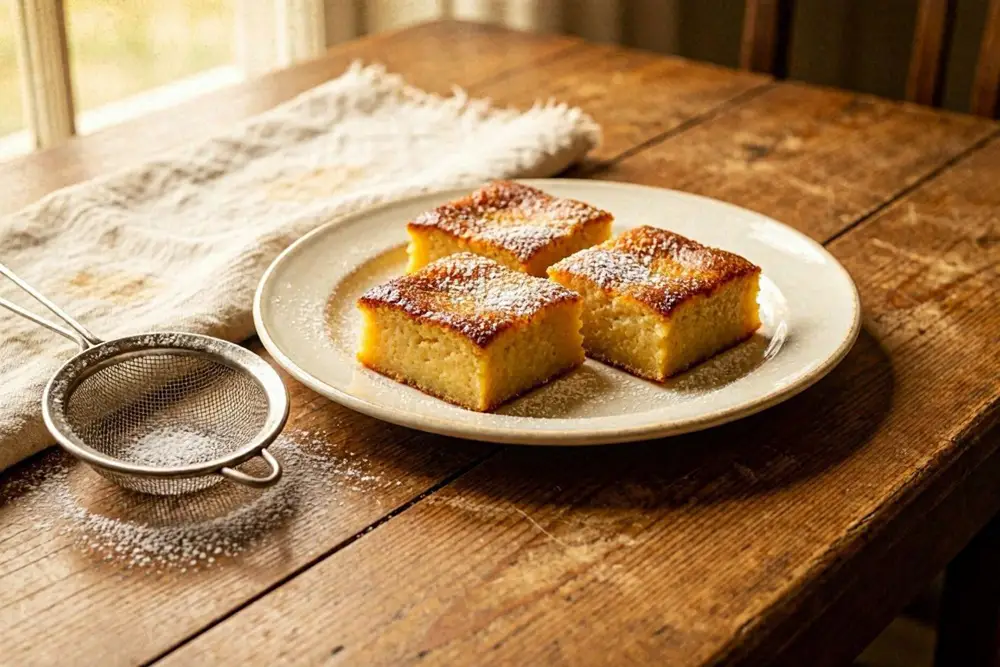
Carrot Pudding Cake
A soft, naturally sweet carrot pudding cake with no eggs and no flour in the batter — carrots boiled, sieved, and baked.
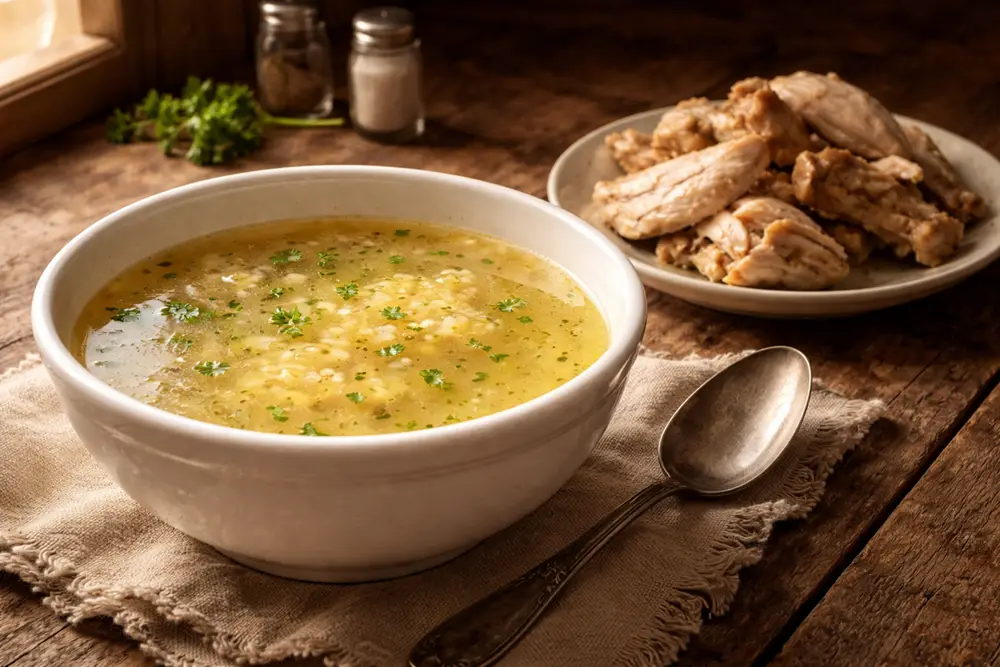
Sour Soup (Kisela Čorba)
A clear poultry broth thickened with egg yolks and mileram, sharpened with wine vinegar or lemon juice, served with rice and meat on the side.
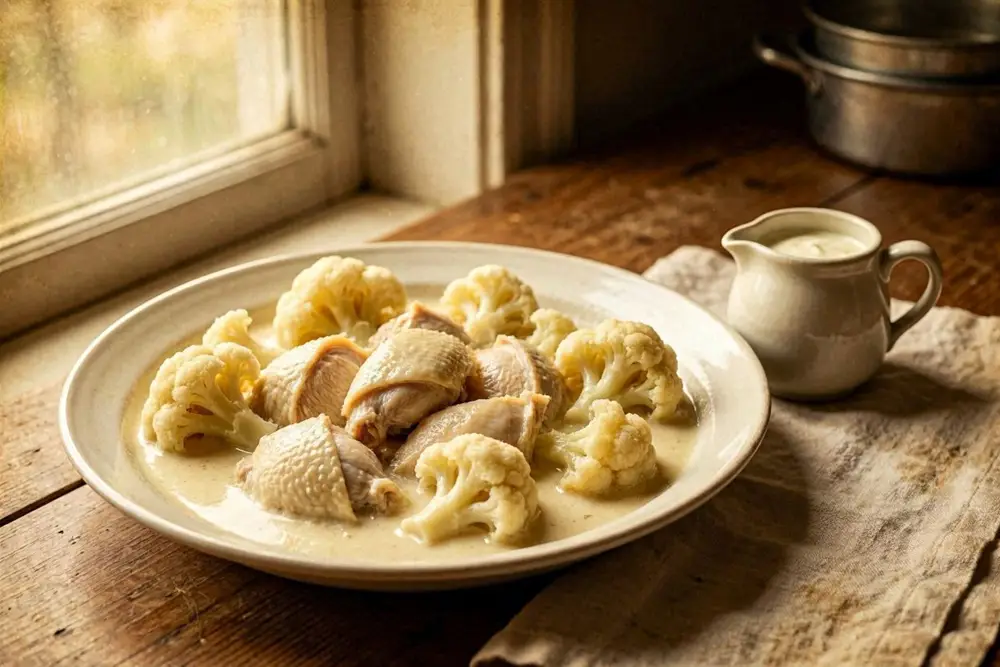
Chicken and Cauliflower in Sour Cream Sauce
A quartered young chicken cooked in a white sour cream roux, served with boiled cauliflower florets arranged around the meat and the cooking sauce poured over.