Braised Celeriac and Potatoes
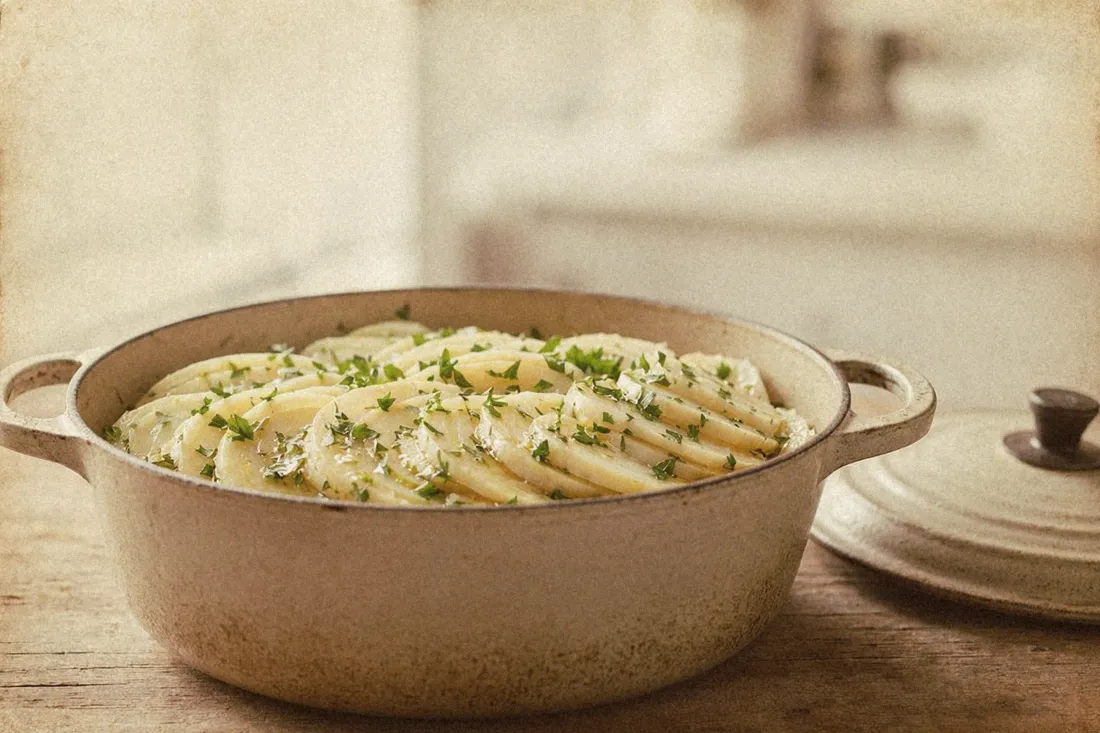
Layers of celeriac and potato, seasoned and gently stewed in a covered pot until tender — a simple meatless side traditionally served alongside beef.
Quick Summary
A layered, meatless side dish of celeriac and potato, seasoned and stewed slowly under a lid until soft. Ready in under an hour with minimal hands-on work. Central European home cooking at its plainest and most practical.
Historical recipe
Modernised adaptation of an early 20th‑century source. Not independently kitchen-tested by Attic Recipes. Quantities, temperatures, and food safety guidance have been updated for a contemporary kitchen — results may vary and errors may exist. Nutritional values, where provided, are estimates only and have not been laboratory tested. Always follow current food safety guidelines for your region. If you have a health condition, allergy, or dietary requirement, consult a qualified professional before preparing this recipe.
Use of this recipe is entirely at your own risk and subject to our Terms of Service and Privacy Policy. Attic Recipes accepts no liability for any adverse outcome.
- 1
Peel the celeriac roots and potatoes. Slice both into thin rounds, keeping the two piles separate.
- 2
Choose a heavy-bottomed pot or Dutch oven with a lid — ideally one you're happy to bring straight to the table.
- 3
Layer the vegetables in the pot, alternating a row of potato with a row of celeriac.
- 4
Season each row with a little salt, pepper, and a scattering of chopped parsley as you build up the layers.
Tip Seasoning layer by layer distributes flavor far more evenly than seasoning only the top. - 5
Once all the vegetables are layered, pour the oil and water evenly over the top.
- 6
Cover the pot and set it over low heat, pushed to the edge of the burner, so the dish stews gently rather than boils.
Tip Gentle, even heat is what makes this dish work — a hard boil will break the layers apart before the celeriac softens. - 7
Cook for about 30-35 minutes, until the celeriac is tender when pierced with a knife.
- 8
Serve warm as a side dish alongside beef.
Nutrition Information per 1 serving (approx 370g)
Nutritional values are approximate estimates and may vary based on specific ingredients used, preparation methods, and portion sizes.
Serving Suggestions
Serve warm as a side alongside roast or boiled beef, with a little extra chopped parsley scattered over the top.
About This Recipe
This is one of those quiet, unassuming dishes that made up the bulk of an early 20th century Central European table — not a centerpiece, but the thing that made a small piece of beef stretch into a full meal. Celeriac and potato, sliced thin and layered with nothing more than salt, pepper, parsley, a little oil, and a splash of water, then left to stew gently under a lid until soft.
There’s nothing technically demanding here, which is part of the point. It’s a dish built around patience rather than skill — layer, season, cover, and let low heat do the rest. The pairing of celeriac’s mild sweetness with potato’s starch is a combination that home cooks of the period returned to often, precisely because it required so little from the pantry and even less from the cook.
Why It Works
Slicing both vegetables thinly and layering them — rather than dicing and stirring everything together — means each layer cooks in gentle contact with the oil and the small amount of liquid, while the lid traps steam and keeps the whole pot cooking evenly from top to bottom. The result is vegetables that soften through braising rather than boiling, holding their shape while still turning tender.
Modern Kitchen Tips
Slice the celeriac and potato to a similar thickness so they finish cooking at roughly the same time — celeriac cut noticeably thicker than the potato will still be firm once the potato has gone soft. A wide, shallow pot works better than a narrow, deep one, since it lets more of the vegetables sit in direct contact with the base layer of oil and water.
A classic of early 20th century home cooking, preserved and adapted for the modern kitchen.
The Story Behind This Recipe
Historical Context
Early 20th century home kitchens relied heavily on meatless vegetable side dishes to accompany a modest portion of meat, stretching a single cut of beef across a full table. Root vegetables like celeriac and potato, layered and stewed slowly under a lid, were a practical, low-effort way to fill out a meal using what was in the cellar through the colder months. The traditional approach did not specify exact seasoning quantities, relying instead on seasoning each layer by feel as it was built.
Modern Kitchen Adaptation
The original did not give precise amounts for salt, pepper, or parsley, since these were added by feel to each layer — the quantities here are estimated to keep the dish reasonably seasoned without oversalting. Total cooking time may vary depending on how thickly the celeriac is sliced and the size of the roots; test for tenderness with a knife rather than relying on time alone. Any neutral vegetable oil can be used in place of sunflower oil.
This recipe is an independent modern adaptation developed from historical sources in the public domain. It is provided for informational and educational purposes only and does not constitute professional dietary, nutritional, or medical advice. Food preparation involves inherent risks. The reader assumes full responsibility for safe food handling, ingredient sourcing, and adherence to current local food safety guidelines. The site operator accepts no liability for outcomes resulting from the preparation or consumption of this recipe.
One recipe.
Every week.
You Might Also Like
More recipes you'll enjoy

Baked Potato and Egg Gratin with Sour Cream
Layers of sliced boiled potato and hard-boiled egg, baked with sour cream until golden — a simple, hearty Central European side dish.

Veal Trotter Soup with Egg and Vinegar Finish
A rich, collagen-thickened soup made from slow-simmered veal trotters, finished with a tangy egg and wine vinegar mixture and served with toasted bread cubes.

Savory Cabbage Crepes with Ham and Sour Cream
Thin cabbage-and-egg crepes layered with smoked ham and sour cream, baked until warmed through — a hearty Central European appetizer.