Kajmak: A Guide to Central Europe's Oldest Dairy Tradition
What kajmak is, how it is made, why salt and fat work as natural preservatives, and how to source or substitute it in your kitchen today.
What Kajmak Actually Is
Kajmak is what happens when full-fat milk is slowly heated, then left to cool undisturbed. As the temperature drops, the fat rises and sets into a thick, wrinkled skin on the surface. That skin is carefully lifted off, salted, and layered into a container — then the process is repeated the next day, and the day after that, until the container is full.
The result is something that does not translate neatly into any Western dairy category. It is richer than clotted cream, more complex than butter, and less sharp than most fresh cheeses. Young kajmak is pale, soft, and mildly tangy. Aged kajmak is dense, crumbly, deeply salty, and unmistakably fermented. Both are the same product — the difference is time.
In Central European households of the early twentieth century, kajmak was not a specialty item. It was a way of preserving the daily excess of milk that could not otherwise be kept. Every skimming added another layer. Every layer was salted. By the time the container was full, the kajmak at the bottom had been aging for weeks.
The Preservation Logic
What makes kajmak stable without refrigeration — as it was kept for much of its history — is not a single mechanism but several working together.
Fat is the first barrier. The cream layer that forms on the surface of heated milk is almost entirely fat, with very little free water. Bacteria need moisture to grow, and the high fat content of kajmak gives them very little to work with. Serbian food regulations set the minimum fat content of young kajmak at 65% fat in dry matter; aged kajmak must reach 75%. These are not arbitrary numbers — they reflect the threshold at which the product becomes genuinely shelf-stable under the right conditions.
Salt is the second barrier. Each layer of skimmed cream is salted individually as it is added to the container. This is not seasoning — it is active preservation. Salt binds water molecules, lowering the water activity of the product and creating conditions that most spoilage bacteria cannot survive. The saltiness that characterizes kajmak, particularly the aged variety, is a direct consequence of this layered salting technique.
The butter seal is the third. Traditional recipes call for pouring a layer of melted kajmak or clarified butter over the surface of the filled container before storage. This creates a physical oxygen barrier — the same principle used in confit and potted meats across Central European and Western European preserving traditions. Without oxygen at the surface, aerobic spoilage organisms cannot establish themselves.
Together, these three mechanisms — fat content, salt concentration, and surface sealing — constitute what food technologists now call hurdle technology: multiple preservation barriers applied simultaneously, each reinforcing the others.
Milk: What You Need and Why It Matters
The single most important variable in kajmak is the fat content of the milk. More fat means a thicker cream layer, which means more kajmak per litre and a richer final product. This is not a matter of preference — it is chemistry. Homogenized milk, in which fat globules have been mechanically broken and distributed evenly throughout the liquid, will not produce a usable cream layer at all. The fat cannot rise because it has been prevented from doing so.
What you are looking for, in practical terms:
Non-homogenized whole milk is the standard starting point. In Central European households of the period, this was simply fresh milk from a household cow or a local farm — unhomogenized as a matter of course, since homogenization was an industrial process that had not yet reached most domestic supply chains. Today, non-homogenized milk is sold in many countries under labels such as “cream-top milk,” “vat-pasteurized milk,” or “batch-pasteurized milk.” Farm shops and farmers’ markets are reliable sources.
Raw milk, where legally available, produces the richest kajmak because it retains all of its original fat structure and naturally occurring microorganisms, which contribute to the fermented character of aged kajmak. In many countries, however, the sale of raw milk is restricted or prohibited. If you are using raw milk, sourcing from a reputable producer with regular testing is important.
High-fat pasteurized but non-homogenized milk — increasingly available from smaller dairies — is a practical middle ground. It has been heat-treated for safety but retains its original fat structure, which means the cream layer forms naturally on cooling.
Standard supermarket whole milk (homogenized) will not work for traditional kajmak. The fat has been permanently emulsified. No amount of slow heating or gentle cooling will reverse that.
If non-homogenized milk is genuinely unavailable, a reasonable approximation can be made by combining whole milk with heavy cream before heating — this artificially raises the fat content to a level where a workable layer will form. The result will be softer and milder than traditional kajmak, but the technique translates.
Young and Aged: Two Products, One Method
The same preparation produces two very different results depending on how long you continue it.
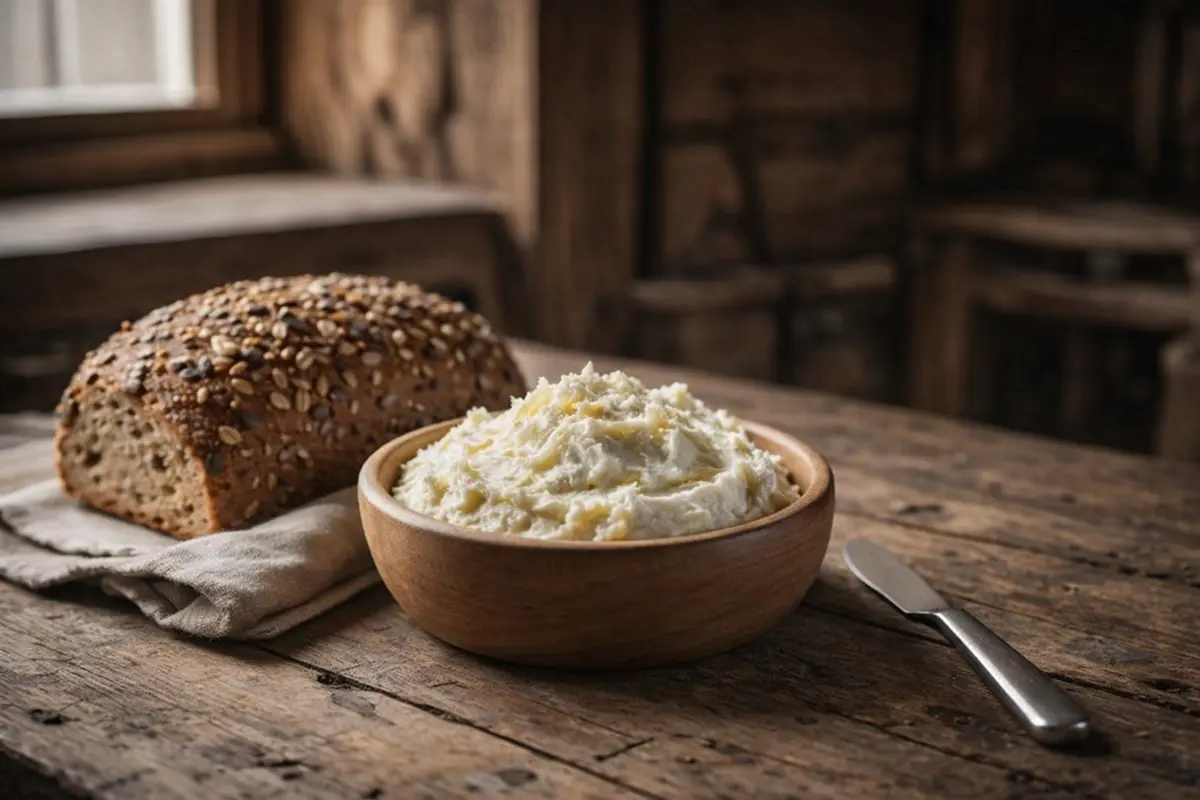
Young kajmak is collected over two to three days, lightly salted, and consumed within a week or so. The texture is soft enough to spread easily, the colour is off-white to pale cream, and the flavour is mild and slightly tangy — closer to a very rich, lightly salted cream than to anything fermented. This is the version most commonly served with bread, alongside grilled meats, or stirred into warm dishes at the table.
Aged kajmak is the same product left to develop over weeks or months. As moisture continues to drain through the perforated base of the traditional wooden container, the texture becomes progressively denser and more crumbly. The colour shifts toward yellow. The flavour deepens — saltier, sharper, with a pronounced lactic tang that comes from the slow activity of naturally occurring bacteria in the cream. Aged kajmak is often used in cooking rather than served raw, because its intensity holds up under heat in a way that young kajmak does not.
The transition from one to the other is not a specific moment — it is a gradual shift that the maker tracks by texture, colour, and taste.
Finding Kajmak Outside the Region
Kajmak is sold commercially in many Central and Eastern European countries and is increasingly available in specialist shops in Western Europe, North America, and Australia — typically refrigerated, vacuum-sealed, and labelled in Serbian, Bosnian, or Croatian. Quality varies considerably. Commercial kajmak is often milder and less salty than homemade, produced under standardized conditions that favour consistency over character.
If you cannot find kajmak locally, substitutes depend on which type the recipe requires:
For young kajmak: mascarpone is the closest structural match — similarly high in fat, soft, and mild. Crème fraîche blended with full-fat cream cheese approximates the slight tang. Clotted cream, where available, is another reasonable option, though it lacks saltiness.
For aged kajmak: the sharpness and salt are harder to replicate. A blend of softened unsalted butter with crumbled feta — roughly two parts butter to one part feta, adjusted to taste — captures some of the character. A mild aged goat cheese or a well-drained labneh with added salt can also work, depending on the application.
No substitute fully replicates the layered, slowly fermented quality of traditionally made kajmak. But in cooked applications — stirred into a sauce, melted over grilled meat, folded into pastry — the difference is less noticeable than when it is served raw.
Practical Takeaways
The most important things to carry away from this:
Kajmak requires non-homogenized milk. This is non-negotiable — without it, the cream layer cannot form. If you cannot source non-homogenized milk, adjust the fat content of your starting liquid manually by adding heavy cream.
Salt is not optional and not just flavour. The saltiness of kajmak, particularly the aged variety, is a function of its preservation logic. Reducing salt to taste will shorten shelf life significantly.
Fat content determines yield. Richer milk gives more kajmak per litre. This is why the tradition developed in regions with access to high-fat milk from well-pastured animals.
Time is the only ingredient that turns young kajmak into aged kajmak. There is no shortcut. The texture, colour, and flavour that characterize the aged version come from slow moisture loss and gradual fermentation — both of which require patience rather than technique.
Attic Recipes — digitizing and adapting Central European home cooking from the early twentieth century.
Frequently Asked Questions
01What type of milk is best for making kajmak?▶
Full-fat, non-homogenized cow's milk gives the best results. Homogenized milk has had its fat globules broken up mechanically, which prevents the thick cream layer from forming on the surface. Raw milk produces the richest kajmak, but high-fat pasteurized milk from a farm or specialty shop is a practical alternative.
02Why is kajmak so salty?▶
Salt in kajmak is not just seasoning — it is a preservative. Each layer of skimmed cream is salted separately as it is added to the container, which lowers the water activity of the product and slows bacterial growth. The saltiness intensifies as kajmak ages and moisture drains away.
03What is the difference between young and aged kajmak?▶
Young kajmak (mladi kajmak) is soft, pale, and mild — collected over a few days and eaten fresh. Aged kajmak (stari kajmak) is left to drain and mature for weeks or months, developing a sharper, more complex flavour and a crumblier texture. Both are salted, but aged kajmak is noticeably saltier.
04Can I substitute something for kajmak in a recipe?▶
For fresh kajmak, mascarpone or a mix of crème fraîche and cream cheese is the closest match in texture and fat content. For aged kajmak, a blend of softened butter and feta or a mild aged goat cheese approximates the saltiness and tang. No substitute fully replicates the layered, slowly fermented character of the original.
05Is kajmak safe to make at home?▶
Yes, with attention to hygiene and salt ratios. The combination of fat content, salt, and cold storage creates an environment that inhibits spoilage. Use clean equipment, salt each layer consistently, and store in the refrigerator. Discard any batch that develops an off smell, discolouration, or visible mold.