Agar-Agar: The Seaweed That Set the Table
From a Japanese innkeeper's accident to European kitchens and bacteriology labs — the long.
A Winter Night and a Forgotten Pot
The story of agar-agar begins, as many good food stories do, with an accident.
According to a well-documented tradition, sometime around 1658, an innkeeper in Fushimi, near Kyoto, discarded the leftovers of a seaweed soup outside on a cold winter night. The next morning, the frozen broth had collapsed in the sun into something unexpected — a porous, spongy mass that, when boiled again, reconstituted into a clear jelly. The innkeeper, Mino Tarōzaemon, had stumbled onto something. The seaweed he had been using for his soup — a preparation called tokoroten, known in Japan for centuries — had gelling properties that could be isolated, concentrated, and dried for later use.
What he had discovered, without knowing the chemistry behind it, was that the polysaccharides in red algae behave differently from other natural gels. They dissolve in boiling water and set on cooling. They can be dried, stored, and reconstituted. And crucially, unlike animal-based gelatin, they remain stable at room temperature even on a warm day — a property that would later prove decisive in places very far from a Japanese kitchen.
The Japanese called it kanten, meaning “cold sky” — a name that referred to the outdoor freeze-drying method used in traditional production. The word agar-agar is Malay, drawn from the language spoken across the Indonesian archipelago where the Dutch, through their trading presence in Japan, first encountered the ingredient and brought knowledge of it westward. By the time it appeared in European kitchens and pharmacies in the 19th century, it carried a name from a language that had nothing to do with where it was made.
What It Actually Is
Agar-agar is not a single substance. It is extracted from the cell walls of red algae — primarily two genera, Gelidium and Gracilaria — and it consists of two distinct polysaccharides: agarose and agaropectin.
Agarose is the fraction responsible for gelling. It is a linear chain built from alternating sugar units — D-galactose and 3,6-anhydro-L-galactose — linked in a regular, repeating pattern. When heated above roughly 90°C in water, these chains separate and move freely through the liquid. As the temperature drops below about 40°C, they begin to reassemble, forming a network of double helices that trap water and create a gel. The process is physical rather than chemical — no covalent bonds are broken or formed — which means it is reversible. You can melt and reset agar-agar gel repeatedly without degrading its gelling capacity.
Agaropectin makes up the remainder. It has a similar backbone to agarose but carries additional charged groups — sulfate, pyruvate, glucuronate — that interfere with gel formation. In commercial production, much of the agaropectin is removed during processing, which is why commercially purified agar sets more cleanly and firmly than cruder preparations (Duckworth & Yaphe, 1971; ScienceDirect, Agar overview).
This gap between melting point and setting temperature — roughly 90°C to melt, 32–40°C to set — is unusual among natural gelling agents and has significant practical consequences. It means agar gels are stable at temperatures that would liquefy gelatin, and it means you have a working window of several minutes between the time the mixture cools enough to fold in other ingredients and the time it begins to firm.
The Same Ingredient in Two Entirely Different Worlds
By the late 19th century, agar-agar had made its way into European food production. It was used in confectionery, in pharmacy as a binder and coating agent, and in the kind of refined cold desserts that defined middle-class household cooking of the period — smooth fruit jellies, moulded creams, and set puddings that displayed both technical skill and access to imported ingredients.
At almost exactly the same time, agar was making a very different kind of history in a Berlin laboratory.
Robert Koch, who would go on to identify the bacteria responsible for tuberculosis and cholera, was struggling with a practical problem: how to grow bacterial colonies on a stable, transparent medium. Gelatin, which scientists had been using, melted at 37°C — precisely the temperature at which most human pathogens grow best. It also broke down when bacteria digested it, turning the medium into an unusable liquid.
The solution came not from Koch himself but from Fanny Angelina Hesse, who was assisting her husband Walther in Koch’s laboratory. Hesse knew agar from cooking — she had used it to make jams and jellies that held their shape in the summer heat when gelatin would not. In 1881, she suggested it as a replacement for gelatin in the culture medium (Science History Institute, Fanny Angelina Hesse; Smithsonian Magazine, 2024).
The results were immediate. Agar set firmly at 37°C. It was transparent enough to observe colonies clearly. It resisted the digestive enzymes of nearly all the bacteria being studied. It could be sterilised by autoclaving without losing its gelling properties. Koch used the new medium to cultivate Mycobacterium tuberculosis and published his findings in 1882 — mentioning agar in a single sentence, without acknowledging either of the Hesses. Fanny Hesse received no credit and no financial benefit. The couple declined to publish their own account, and her name remained largely unknown until archival research in the late 20th century brought it to light.
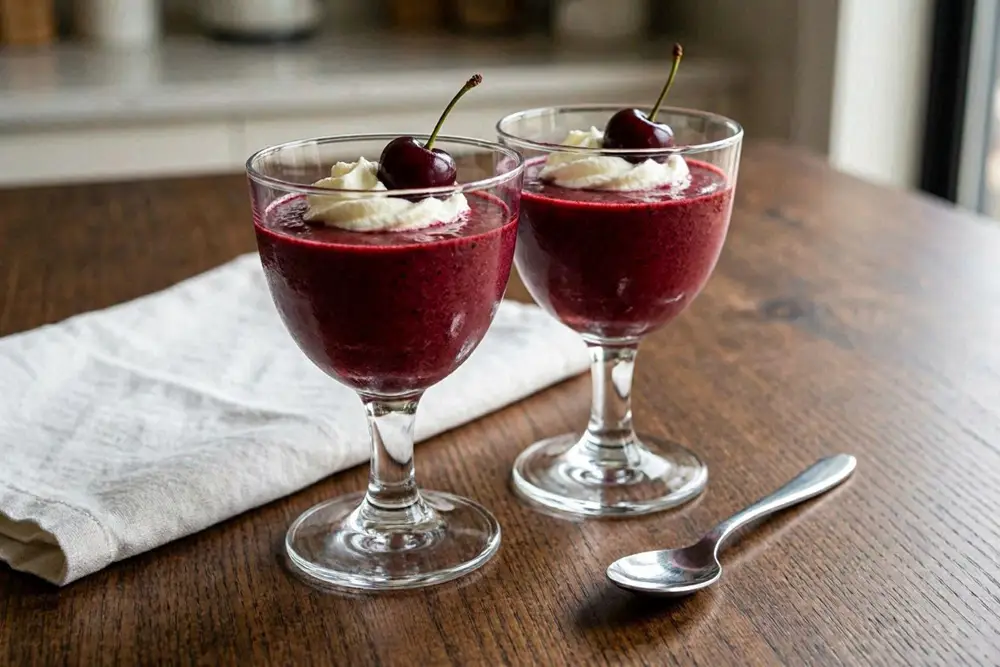
The agar plate she introduced into microbiology is still in use in virtually every microbiology laboratory in the world. It is the same substance, from the same red algae, that sets the cherry cream in the recipe linked below.
Food Grade and Bacteriological Grade
The agar you buy in a food shop and the agar used in a microbiology lab are both derived from red algae, but they are not the same product. Bacteriological grade agar — the kind used in Petri dishes — undergoes more rigorous purification to remove compounds that might interfere with bacterial growth or introduce unwanted nutrients into the growth medium. It is tested for gel strength, transparency, and consistency under controlled conditions.
Food grade agar is held to different standards: safety and consistency of gelling behaviour in food applications, but not the microbiological purity required for culture media. In practice, food grade agar may contain more agaropectin relative to agarose, which can produce a slightly softer or less uniform gel — one reason why professional confectionery applications often specify gel strength by Bloom value rather than by weight.
The primary commercial sources differ too. Gelidium species produce agar with naturally high agarose content and strong gel strength, and are the preferred source for bacteriological grade. Gracilaria species are more easily farmed — Gelidium, which grows on rocky seabeds in turbulent water, cannot be cultivated at scale and must be wild-harvested — and so dominate food grade production globally. The current market for agar spans food, pharmaceutical, cosmetics, and biotechnology, with food and beverage applications accounting for the majority of consumption (ScienceDirect, Agar overview).
How to Work With It in the Kitchen
Understanding the chemistry helps explain exactly why the technique matters.
It must boil. Agar-agar polysaccharide chains only fully separate above approximately 90°C. Bringing the mixture to a near-boil is insufficient — a full rolling boil for at least two minutes is necessary for complete dissolution. Liquid that looks clear after heating at lower temperatures may still contain undissolved agar that will produce a grainy or uneven set.
Disperse it in cold liquid first. Sprinkling agar powder directly into hot liquid causes it to clump on the surface before it can hydrate. Adding it to cold liquid first and stirring before heating allows the particles to disperse evenly and dissolve smoothly during the boil.
Acid weakens the gel. Strongly acidic ingredients — citrus juice, vinegar, very tart fruit — can partially hydrolyse agar’s polysaccharide chains during cooking, producing a softer set. When working with high-acid mixtures, a modest increase in agar quantity (around 20–25%) compensates for this effect. Avoid prolonged boiling with acidic liquids.
The working window is narrow but predictable. Agar gels at 32–40°C and melts at around 85–90°C — a gap of roughly 50°C that gelatin does not have. This means agar-set desserts are genuinely stable at room temperature, will not weep or slump in summer heat, and can be prepared well in advance. It also means that once the mixture drops below 40°C, you have minutes rather than the extended working time of a gelatin-based preparation. Have your moulds or cups ready before you begin folding in other components.
Conversion from gelatin is not 1:1. Agar sets more firmly per gram than gelatin. A rough working ratio is 1 g agar powder to 3 g gelatin, though the precise substitution depends on the firmness of the original recipe and the gel strength of the specific agar product being used. For a light, spoonable texture — closer to a soft mousse than a firm jelly — work at concentrations of 0.5–0.8% agar by weight of liquid.
In Early 20th Century Kitchens
By the time the recipes now in this archive were written, agar-agar was already a familiar ingredient in Central European confectionery and home cooking. It appeared in the same pharmacies that stocked gelatine sheets, sold in dried bar or strip form — the same form referred to in the cherry cream recipe on this site, where the instruction to cut it into small pieces before use reflects how it was sold and handled at the time.
Home cooks of the period did not have powder or standardised gel-strength measurements. They worked with bars of varying purity, dissolved by boiling, and calibrated by experience. The absence of precise quantities in many period recipes for set desserts is not vagueness — it is an acknowledgement that the cook was expected to know the strength of their own agar. A cook who had used the same product from the same pharmacy for years would have a reliable intuition that a modern recipe cannot transmit.
What the period recipes do transmit is the underlying logic: boil, cool to the right point, combine with the other components quickly. The chemistry was not understood in those terms, but the technique that emerges from following it correctly is sound.
Practical Takeaways
Agar-agar is red seaweed, processed into a powder, flake, or bar. Its active component — agarose — forms a gel by creating a physical network of polysaccharide chains as temperature drops. It sets between 32–40°C, melts between 85–90°C, and holds firm at room temperature. It is tasteless, colourless, and suitable for all dietary requirements including vegan and vegetarian.
For kitchen use: always disperse in cold liquid, always bring to a full rolling boil for at least two minutes, work quickly once the mixture approaches 40°C, and account for acid content when working with tart fruit or citrus. Food grade powder is the most consistent and easiest form to use; bars and flakes require roughly three times the quantity by weight to achieve the same effect.
The bacteriological grade agar on the Petri dish and the food grade agar in a cherry cream dessert are the same substance, from the same algae, doing the same thing: holding water in a network of long-chain sugars that freeze on cooling and release on heating. A kitchen accident in 17th-century Japan led, through a long chain of trade, curiosity, and one uncredited suggestion in a Berlin laboratory, to both.
Attic Recipes — digitizing and adapting Central European home cooking from the early twentieth century.
Frequently Asked Questions
01What is agar-agar made from?▶
Agar-agar is extracted from the cell walls of red algae, primarily Gelidium and Gracilaria species. The seaweed is boiled, filtered, and the resulting liquid is dried into powder, flakes, or bars. It contains no animal products.
02Can I substitute agar-agar for gelatin in any recipe?▶
In most cases, yes — but the ratio and technique differ. Agar sets firmer and holds at room temperature, while gelatin melts above roughly 35°C. Agar also requires boiling to activate, whereas gelatin dissolves in warm water. Use approximately one-third the amount of agar powder by weight compared to gelatin.
03Why does agar-agar need to boil?▶
Agar-agar must reach a full rolling boil to dissolve completely. Its polysaccharide chains only break free from each other at high temperatures — typically above 90°C. Insufficient heating results in an uneven or failed set.
04Does agar-agar have a taste?▶
Pure agar-agar powder is essentially tasteless and odourless, which makes it suitable for both sweet and savoury applications. Lower-quality or less-processed forms may carry a faint marine note.
05Why does agar set differently in acidic mixtures?▶
High acidity — from citrus juice, vinegar, or very tart fruit — can weaken an agar gel by partially breaking down its polysaccharide structure during cooking. If working with strongly acidic ingredients, increase the agar quantity slightly and avoid prolonged boiling.