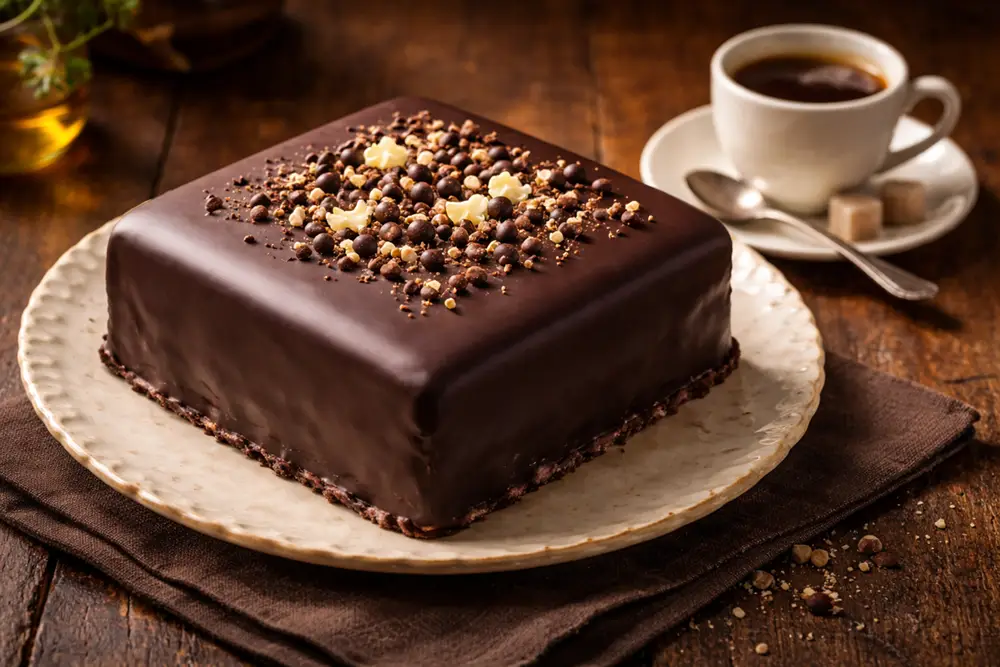
Warsaw Almond and Chocolate Torte
A flourless no-bake torte of boiled egg yolks, ground almonds, and dark chocolate, filled with Italian meringue and almond cream, glazed with chocolate.
Historical recipe
Modernised adaptation of an early 20th‑century source. Not independently kitchen-tested by Attic Recipes. Quantities, temperatures, and food safety guidance have been updated for a contemporary kitchen — results may vary and errors may exist. Nutritional values, where provided, are estimates only and have not been laboratory tested. Always follow current food safety guidelines for your region. If you have a health condition, allergy, or dietary requirement, consult a qualified professional before preparing this recipe.
Use of this recipe is entirely at your own risk and subject to our Terms of Service and Privacy Policy. Attic Recipes accepts no liability for any adverse outcome.
- Eggs
- Dairy
- Tree Nuts
Additional notes
-
Warning
The filling uses Italian meringue — egg whites cooked to a safe temperature by hot sugar syrup at 121°C. A sugar thermometer is essential; do not attempt this step without one. Hot sugar syrup causes severe burns on contact with skin.
-
Note
The original recipe used raw egg whites in the filling. The modernized version uses Italian meringue to eliminate this risk. If raw egg whites are used instead, this cake is not suitable for pregnant women, children under 18, elderly individuals, or the immunocompromised.
-
Note
High saturated fat content (approx. 10g per serving) from chocolate, almonds, butter, and cream. Individuals managing cardiovascular risk should be mindful of portion size.
- 1
Hard-boil the 10 eggs for 10 minutes. Peel and separate the yolks from the whites. Reserve 5 egg whites for the Italian meringue filling and set aside at room temperature. While still warm, press the 10 yolks through a fine-mesh sieve into a large mixing bowl.
- 2
Add the 125g ground almonds with skin, 125g sifted powdered sugar, and 500g finely grated dark chocolate to the sieved yolks. Mix thoroughly until a firm, cohesive dough forms. Divide the dough into two equal portions. Wrap each in cling film and rest at room temperature for 15 minutes.
- 3
On a lightly dusted pastry board, roll each portion of dough into a square approximately 1 cm thick. Both squares should be the same size. Set aside.
Tip The dough is dense and may crack at the edges when rolled — simply press it back together. Aim for an even thickness rather than perfect edges. - 4
Make the Italian meringue. Place the 125g granulated sugar and 40ml water in a small saucepan. Heat over medium heat without stirring until the syrup reaches 121°C on a sugar thermometer. While the syrup heats, begin whipping the 5 reserved egg whites in a stand mixer or with a hand mixer until they hold stiff peaks. When the syrup reaches 121°C, remove from heat immediately. With the mixer running on medium speed, pour the hot syrup in a thin, steady stream down the side of the bowl — do not pour it directly onto the whisk. Continue whipping until the meringue is thick, glossy, and the bowl feels cool to the touch, approximately 5–8 minutes.
- 5
Make the filling. In a separate bowl, combine the 140g blanched ground almonds, 4 tbsp sifted powdered sugar, and 1 tbsp clotted cream. Mix until uniform. Gently fold the Italian meringue into this almond base in two additions, using a large spatula and a light hand to preserve as much volume as possible.
- 6
Place one square of dough on a flat serving board or plate. Spread the almond meringue filling evenly over it, reaching to the edges. Carefully lift the second square of dough and place it on top, aligning the edges as closely as possible. Press down gently and evenly.
- 7
Make the glaze. Place the 100g chopped dark chocolate, 25g sifted powdered sugar, 1 tbsp milk, and 12g butter in a small saucepan. Heat over very low heat, stirring constantly, until the butter and chocolate have melted and the glaze is smooth and glossy. Do not allow it to boil. Remove from heat and allow to cool for 2–3 minutes until slightly thickened but still pourable.
Tip A small heatproof bowl set over a pan of barely simmering water (bain-marie) gives better control than direct heat and prevents the chocolate from seizing. - 8
Pour the warm glaze over the top of the assembled cake. Use a palette knife or the back of a spoon to spread it gently to the edges. Allow the glaze to set at room temperature for 30 minutes, then refrigerate for at least 1 hour before cutting.
- 9
Cut into triangular pieces with a sharp knife, wiping the blade clean between each cut. Serve at cool room temperature.
Nutrition Information per 1 slice (approx. 85g)
Nutritional values are approximate estimates and may vary based on specific ingredients used, preparation methods, and portion sizes.
Serving Suggestions
Serve in thin slices at cool room temperature. The cake is rich and dense — small portions are appropriate. Pairs well with unsweetened black coffee or espresso. Keeps refrigerated for up to three days; bring to room temperature for 20 minutes before serving.
About This Recipe
Warsaw Cake is built entirely without flour, without an oven, and against most expectations of what a cake can be. The dough is made from boiled egg yolks pressed through a sieve and worked together with ground almonds, powdered sugar, and an extraordinary quantity of grated dark chocolate — five full bars — until it becomes something dense and pliable enough to roll. It bakes nothing. It sets cold, in layers, with the filling between them and a thin chocolate glaze over the top.
The filling is the lighter counterpart to the dough: blanched almonds, a spoonful of cream, and whipped egg whites that carry the whole thing upward. In the original, those whites went in raw. Here they are brought through Italian meringue — hot syrup streamed into the whipping whites — which cooks them to a safe temperature and gives the filling a glossy stability that raw whites cannot match.
Home cooks of the period who made this cake were making it for occasions. Ten hard-boiled eggs, five hundred grams of chocolate, and a filling requiring separate preparation — this is not an everyday recipe. Cut into triangles and served on a plate, it looks exactly as substantial as it is.
Why It Works
Boiled egg yolks pressed through a sieve behave very differently from raw yolks. Cooking denatures the proteins and drives off moisture, leaving behind concentrated fat and emulsifiers in a dry, crumbly form. When worked with sugar and fat from the ground almonds and chocolate, they bind into a dough that is plastic enough to roll but firm enough to hold its shape without refrigeration or baking. The chocolate quantity — 500g for the dough alone — is not incidental; it provides both structure and the characteristic dark, bitter flavour that keeps the cake from being overwhelmingly sweet.
The Italian meringue filling works because the hot syrup simultaneously cooks the whites and dissolves any remaining sugar granules, producing a foam that is stable at room temperature for hours rather than minutes.
The glaze is minimal — chocolate, sugar, milk, and a small knob of butter — and sets to a thin, slightly matte finish rather than a thick coating. It seals the top layer of dough and gives the triangular slices their clean, finished appearance.
Modern Kitchen Tips
The dough can be made up to a day ahead and wrapped tightly at room temperature. Do not refrigerate it before rolling — cold dough cracks badly.
Make the Italian meringue immediately before assembling. It does not hold well once cooled.
For the glaze, err on the side of slightly too cool rather than too hot when pouring — a glaze that is too fluid will run straight off the sides. If it thickens too much before you can spread it, set the saucepan briefly over low heat and stir.
Use a ruler to mark the triangles before cutting — the geometry is easier to plan before the knife goes in.
A classic of early 20th century Central European home cooking, preserved and adapted for the modern kitchen.
The Story Behind This Recipe
Historical Context
Early 20th century recipes for this style of flourless almond and chocolate torte specified quantities with unusual precision for the dough — weights for almonds, sugar, and chocolate — while leaving the assembly and finishing entirely to the cook's judgment. The filling called for skorup skimmed from heated milk, a traditional Central European dairy product similar to clotted cream, used in small quantities as a binding agent. The egg white quantity in the original was specified as half the whites remaining from the boiled eggs — five whites from the ten eggs used for the yolks — a practical instruction tied directly to the yield of the dough step. The cake was presented as a no-bake torte, assembled cold and cut into triangular pieces without any oven step.
Modern Kitchen Adaptation
The original filling used raw egg whites folded directly into the almond base. In the modernized version, the egg whites are cooked to a safe temperature via Italian meringue technique: a sugar syrup brought to 121°C is streamed into the whipping whites, bringing them to a safe temperature while producing a stable, glossy meringue. This eliminates the food safety risk of raw whites without altering the character of the filling. Skorup (skin skimmed from heated milk) has been substituted with clotted cream or heavy cream, which is the closest widely available equivalent. The marble-sized piece of butter in the glaze is estimated at 12g. Dark chocolate quantities reflect the period convention of a standard bar weighing approximately 100g.
This recipe is an independent modern adaptation developed from historical sources in the public domain. It is provided for informational and educational purposes only and does not constitute professional dietary, nutritional, or medical advice. Food preparation involves inherent risks. The reader assumes full responsibility for safe food handling, ingredient sourcing, and adherence to current local food safety guidelines. The site operator accepts no liability for outcomes resulting from the preparation or consumption of this recipe.
One recipe.
Every week.
You Might Also Like
More recipes from the same category
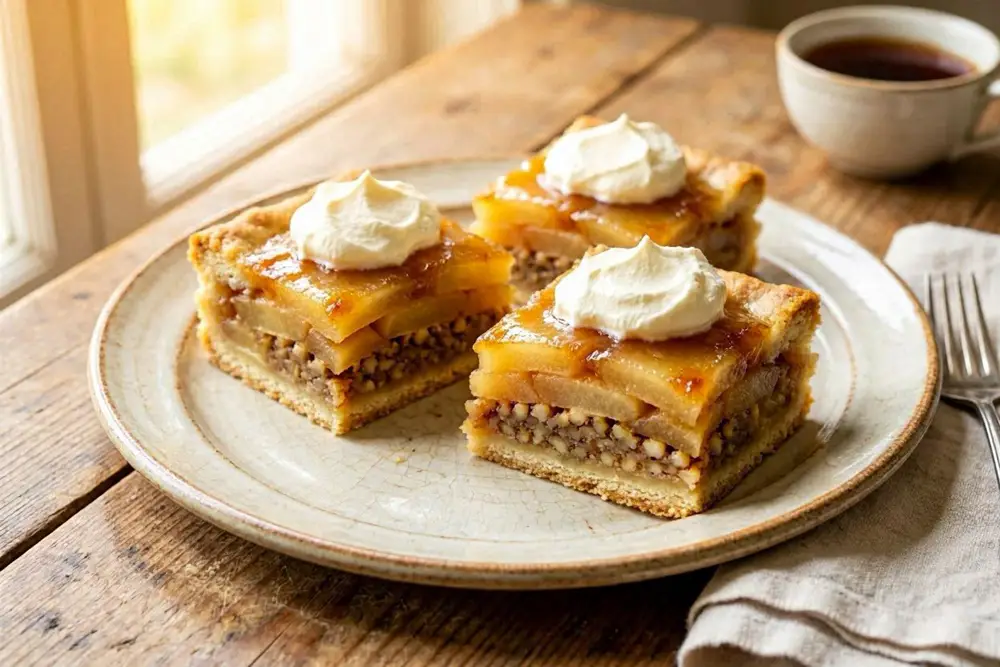
Apple Pie with Whipped Cream
A crisp almond shortcrust base layered with ground walnuts, poached apples, apricot jam, and a thick cloud of sweetened whipped cream.
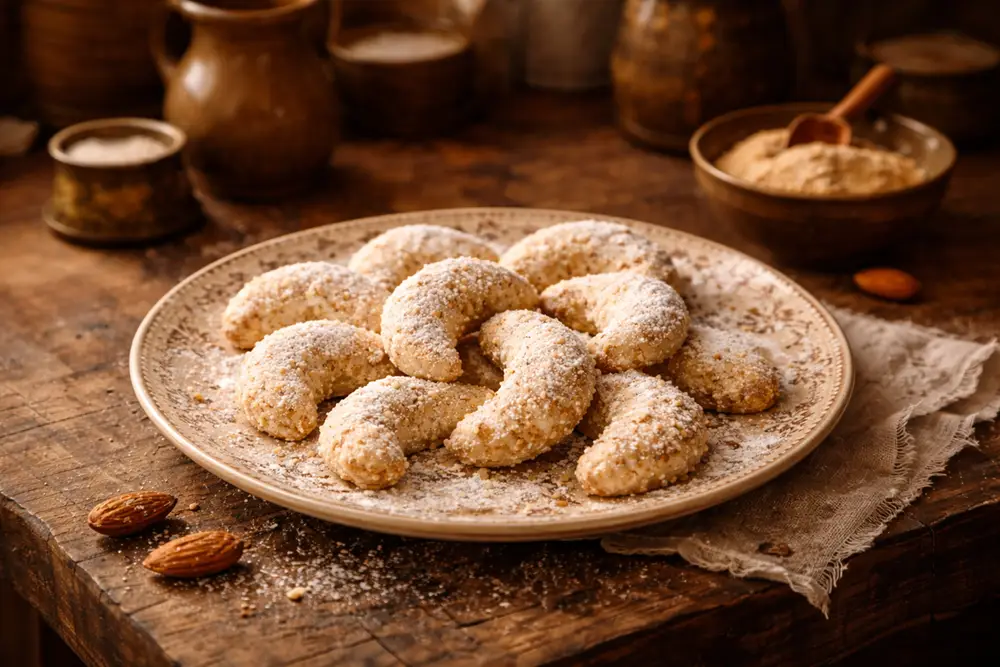
Almond Meringue Crescents
Crisp Central European confections of Swiss meringue shaped into crescents, coated in ground almonds, oven-dried until white and firm.
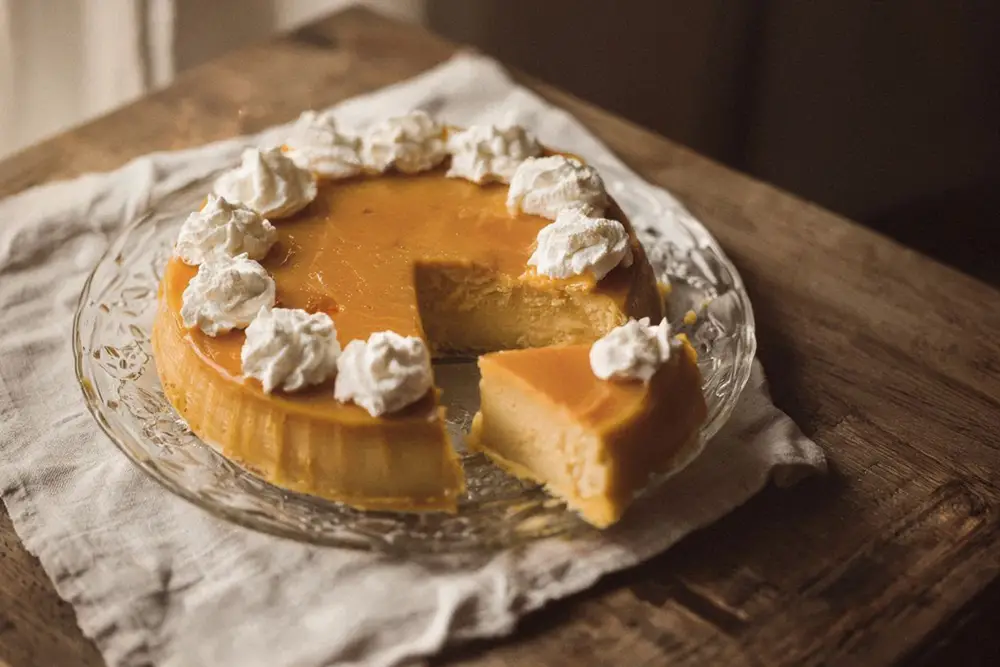
Apricot Cream
A rich chilled cream of apricot marmalade, egg yolks, sugar, and gelatin, set in a mould and served unmoulded with whipped cream.