Walnut and Custard Crêpe Torte
Sixteen crêpes layered with a baked vanilla custard filling, walnuts, and biscuit crumbs, then glazed with chocolate for a rich, sliceable torte.
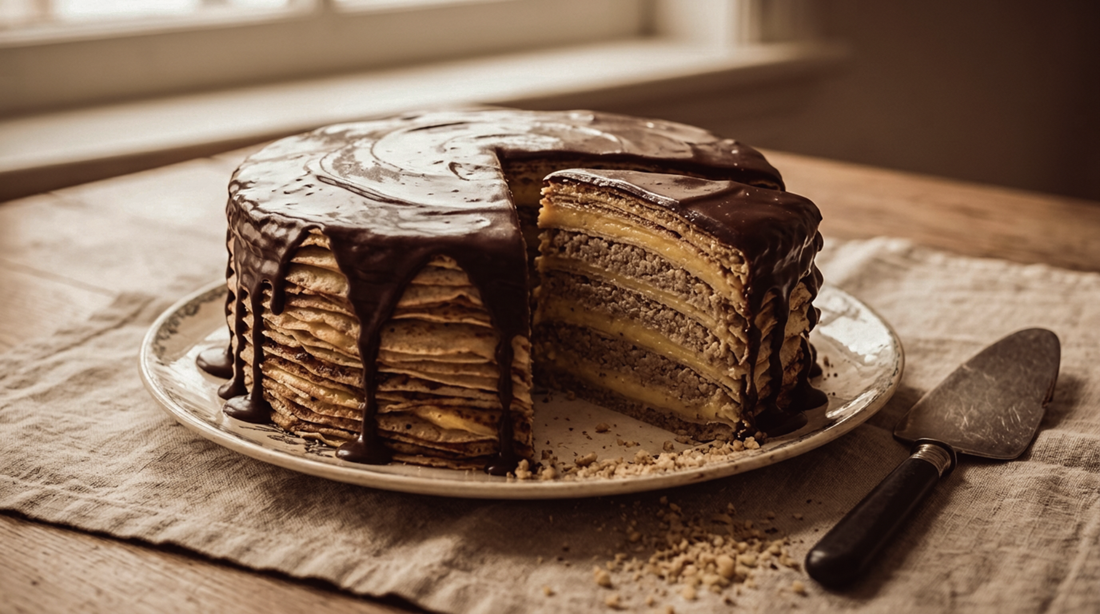
Quick Summary
Sixteen crêpes are layered with whipped egg-and-vanilla custard, sugar, and ground walnuts, then baked until set. Once cool, the torte is glazed with chocolate and sliced like a cake—a rich, impressive dessert worth the extra time.
Historical recipe
Modernised adaptation of an early 20th‑century source. Not independently kitchen-tested by Attic Recipes. Quantities, temperatures, and food safety guidance have been updated for a contemporary kitchen — results may vary and errors may exist. Nutritional values, where provided, are estimates only and have not been laboratory tested. Always follow current food safety guidelines for your region. If you have a health condition, allergy, or dietary requirement, consult a qualified professional before preparing this recipe.
Use of this recipe is entirely at your own risk and subject to our Terms of Service and Privacy Policy. Attic Recipes accepts no liability for any adverse outcome.
- Gluten
- Eggs
- Dairy
- Tree Nuts
Additional notes
-
Note
High in saturated fat per serving due to the butter, eggs, and chocolate throughout the layers. Those managing cholesterol or heart health — particularly older adults — may want to keep portions small.
-
Note
Contains walnuts. Not suitable for anyone with a tree nut allergy.
-
Note
The custard filling is raw when assembled and cooks through during baking. Make sure the center of the finished torte is fully set, not wobbly or runny, before serving — a dense, layered dessert like this can bake unevenly.
- 1
Make the crêpe batter by whisking together the 250g of flour, 3 eggs, 500ml of milk, the salt, and about 30g of the melted butter until smooth.
- 2
Fry 16 crêpes from the batter, a little thicker than usual, greasing the pan lightly with butter as needed between batches.
Tip Thicker crêpes hold up better under the weight of the layers than very thin ones. - 3
Spread each crêpe with a thin layer of butter (about 30g total across all 16) and sprinkle with the biscuit crumbs.
- 4
For the custard filling, whip the 5 egg yolks with 50g of the sugar and the vanilla until pale and foamy.
- 5
Whip 50g of the butter separately until light and foamy, then fold it into the egg yolk mixture along with 50g of the flour.
- 6
In a separate bowl, whip the 5 egg whites to stiff peaks, then gently fold them into the yolk mixture.
- 7
In a cake mold, spread a layer of the custard filling on the bottom, then place 4 crêpes on top, unrolled, one over another.
- 8
Sprinkle each of these 4 crêpes with some of the remaining 60g of sugar and some of the 100g of ground walnuts.
- 9
Spread a layer of the custard filling over the top crêpe, then repeat the layering — 4 crêpes, sugar and walnuts, filling — until all 16 crêpes are used, finishing with a layer of filling on top.
- 10
Bake in the oven for about 30 minutes, until the filling is set rather than wobbly.
Tip Because the filling is raw when assembled, check that the center has fully set before taking it out — a dense, layered dessert like this can bake unevenly. - 11
Let the torte cool, then turn it out onto a round serving plate.
- 12
Melt the 150g of chocolate with the remaining 30g of butter over a double boiler or in short bursts in the microwave, then pour the glaze over the torte.
Nutrition Information per 1 slice (approx 150g)
Nutritional values are approximate estimates and may vary based on specific ingredients used, preparation methods, and portion sizes.
Serving Suggestions
Serve chilled or at room temperature, sliced thin since it's quite rich. A dollop of unsweetened whipped cream on the side helps cut through the richness.
About This Recipe
This torte builds sixteen crêpes into a single dense, sliceable cake — each one buttered, sprinkled with biscuit crumbs, and layered with a baked vanilla custard filling, sugar, and ground walnuts, all held together by a final bake in the oven. Once cooled and unmolded, it’s finished with a chocolate glaze poured over the top.
It’s a project dessert rather than a weeknight one: between frying sixteen crêpes, making a separated-egg custard filling, and layering everything precisely, this takes real time and attention. The result is closer to a torte than anything resembling a stack of pancakes.
Why It Works
Separating the eggs for the custard filling and whipping the whites to stiff peaks before folding them in gives the filling enough structure to set into distinct layers during baking, rather than soaking entirely into the crêpes. The biscuit crumbs between the buttered layers add a bit of textural contrast against the soft crêpes and custard, while the final bake sets everything into a single cohesive torte that holds together when sliced, much like a baked cheesecake sets from a loose batter into something sliceable.
Modern Kitchen Tips
- Fry the crêpes a day ahead if it helps — they layer just as well once cooled and stored between sheets of parchment.
- A springform pan makes both the assembly and the unmolding considerably easier than a solid cake mold.
- Let the torte cool completely before glazing, or the warm chocolate will slide right off instead of setting into a smooth coating.
A classic of early 20th century home cooking, preserved and adapted for the modern kitchen.
The Story Behind This Recipe
Historical Context
Layered, nut-and-sugar desserts like this one reflect a tradition that entered Central European baking through the region's long exposure to Ottoman cuisine, similar to how baklava-style layering spread well beyond its origin. Building a torte from stacked crêpes rather than pastry sheets was a practical variation using ingredients any home kitchen already had on hand for making palačinke.
Modern Kitchen Adaptation
The traditional method assumes a standard crêpe batter without giving its own ingredients, so a typical batter has been estimated here at a quantity suited to sixteen medium-thick crêpes. Every other unspecified amount — butter across its several uses, the biscuit crumbs, the sugar used between layers, and the ground walnuts — has also been estimated as a reasonable starting point. The chocolate glaze, described in the traditional method only as 'chocolate glaze,' is built here as a simple mixture of melted chocolate and butter for a pourable, glossy finish.
This recipe is an independent modern adaptation developed from historical sources in the public domain. It is provided for informational and educational purposes only and does not constitute professional dietary, nutritional, or medical advice. Food preparation involves inherent risks. The reader assumes full responsibility for safe food handling, ingredient sourcing, and adherence to current local food safety guidelines. The site operator accepts no liability for outcomes resulting from the preparation or consumption of this recipe.
One recipe.
Every week.
You Might Also Like
More recipes you'll enjoy
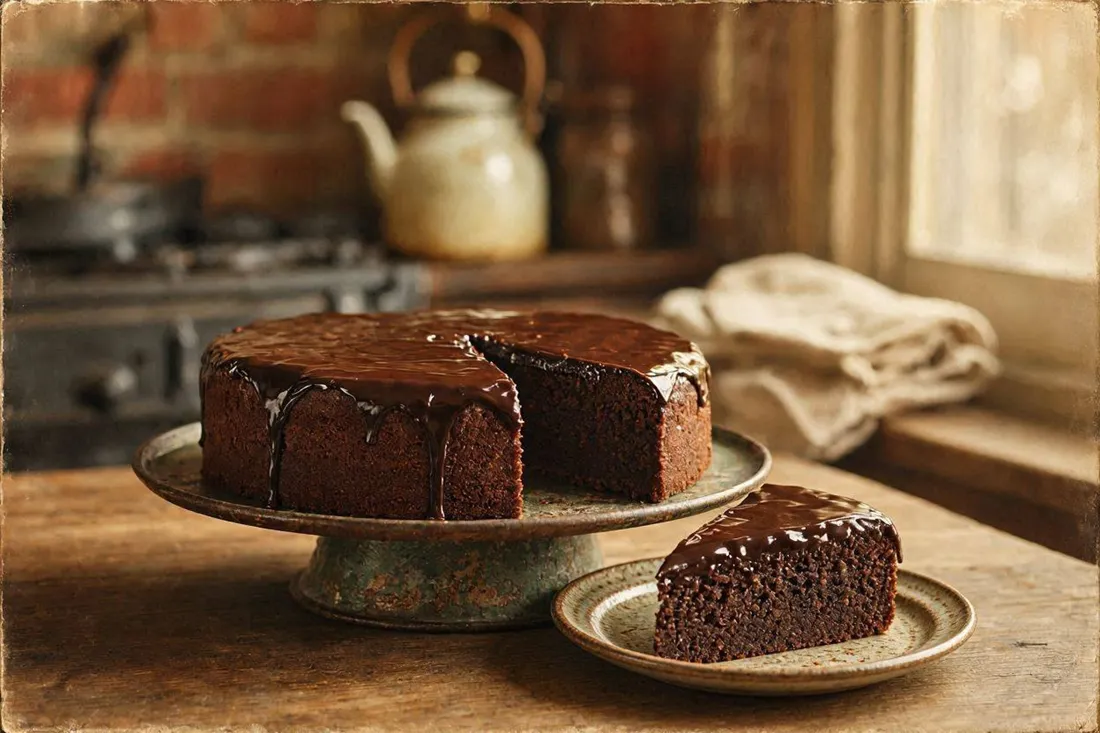
Flourless Chocolate Almond Torte
A rich, dense torte of whipped egg yolks, grated chocolate, and ground almonds, lightened with egg whites and finished with a glossy chocolate glaze.
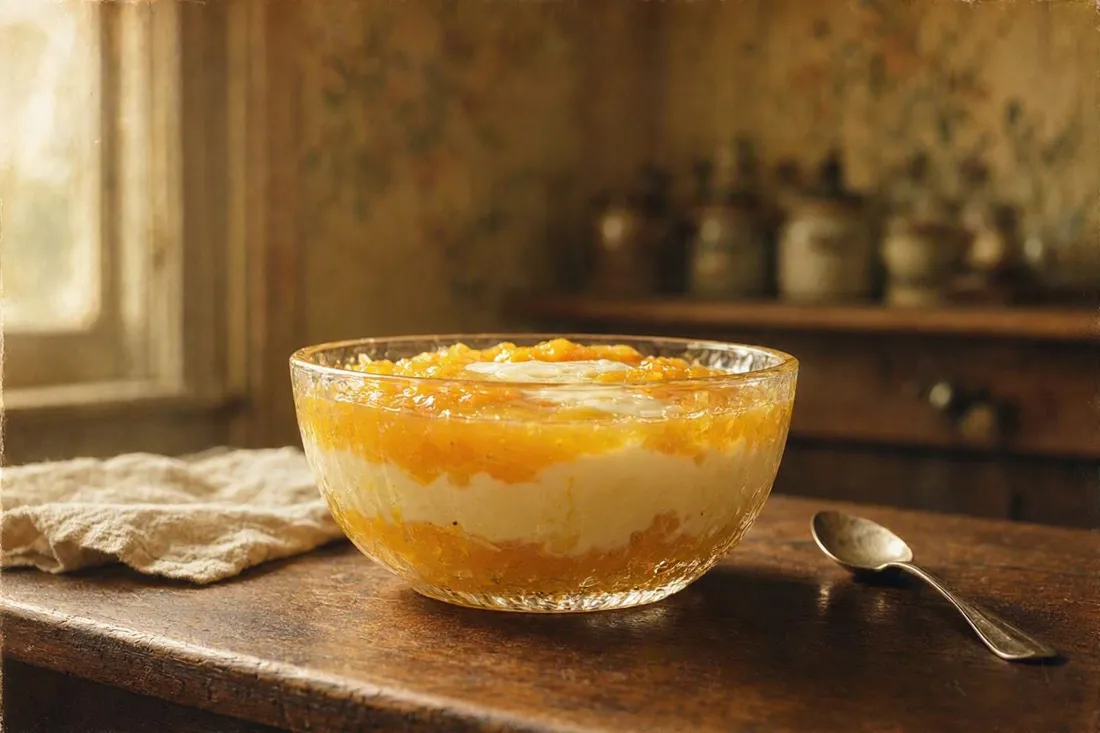
Chilled Fruit Cream with Apricot Compote
A light, gelatin-set cream layered with apricot compote, made with a cooked meringue and custard base for a safe, silky texture.
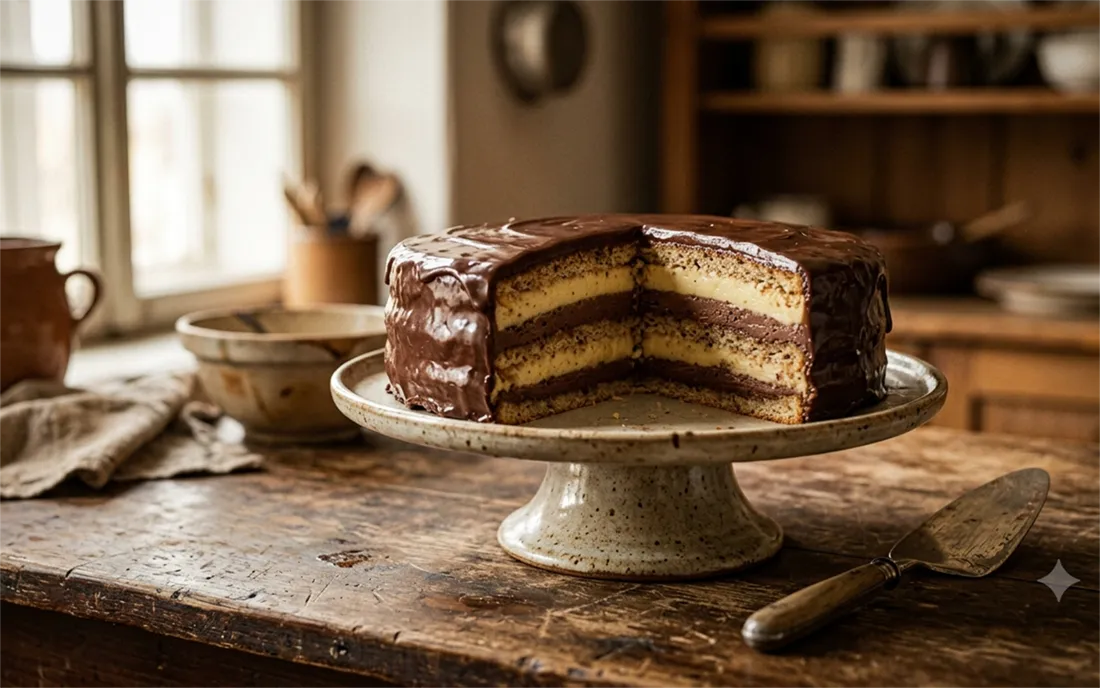
Layered Almond Torte with Two Fillings
A rich four-layer almond torte with two contrasting fillings — vanilla custard and chocolate-hazelnut — finished in a poured chocolate glaze.