Veal Kidney with Marjoram
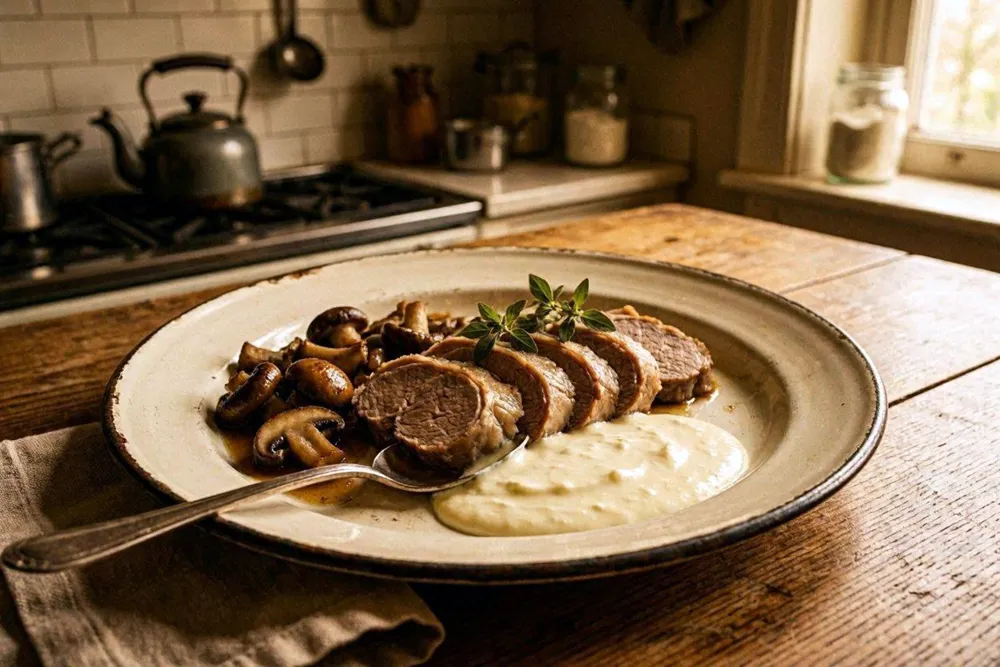
A whole veal kidney rubbed with marjoram, wrapped in a thin veal cutlet, braised in white wine, and roasted with mushrooms in a rich sour cream sauce.
Historical recipe
Modernised adaptation of an early 20th‑century source. Not independently kitchen-tested by Attic Recipes. Quantities, temperatures, and food safety guidance have been updated for a contemporary kitchen — results may vary and errors may exist. Nutritional values, where provided, are estimates only and have not been laboratory tested. Always follow current food safety guidelines for your region. If you have a health condition, allergy, or dietary requirement, consult a qualified professional before preparing this recipe.
Use of this recipe is entirely at your own risk and subject to our Terms of Service and Privacy Policy. Attic Recipes accepts no liability for any adverse outcome.
- Dairy
- Sulphites
Additional notes
-
Note
Kidney is an organ meat that is naturally very high in cholesterol, and this dish is also rich in saturated fat from the cooking fat and sour cream. It's best enjoyed as an occasional dish rather than a regular one, and those managing cholesterol or cardiovascular health may want to be mindful of portion size.
-
Caution
Make sure the kidney is fully cooked through and tender before serving, with no pink remaining at the center.
- 1
Rinse the {0001} thoroughly in several changes of cold water. Then soak it in a bowl of cold water with the {0011} for about 30 minutes to help neutralize its odor. Drain and pat dry.
- 2
Leave the fat on the kidney intact, but score it in cuts reaching down to the kidney itself — do not remove it.
- 3
Rub the kidney all over with the {0003}, {0004}, and {0005}, working the seasoning well into the scored fat.
- 4
Lay the {0002} flat on a board and wrap it completely around the seasoned kidney, enclosing it fully.
- 5
Tie the wrapped kidney securely with kitchen twine so it holds its shape.
- 6
Heat the {0006} in a heavy pan and sear the wrapped kidney on all sides until browned. Add the {0007} and {0008}, cover, and let simmer gently, turning occasionally, until the meat is tender, about 15-20 minutes.
- 7
Preheat the oven to 180°C (350°F) / 160°C fan. Transfer the kidney to a baking dish. Stir the {0009} into the braising liquid, pour it over the kidney, and roast for a further 30 minutes.
- 8
Once the meat is fully cooked through, stir the {0010} into the sauce.
- 9
Remove the kidney from the dish, slice into pieces, and arrange in a serving dish. Serve the sauce separately alongside.
Nutrition Information per 1 serving (approx. 300g)
Nutritional values are approximate estimates and may vary based on specific ingredients used, preparation methods, and portion sizes.
Serving Suggestions
Serve the sliced kidney with the mushroom and sour cream sauce spooned over or offered on the side, alongside boiled potatoes, rice, or crusty bread to soak up the sauce.
About This Recipe
This is a dish built around a whole veal kidney, treated with real care rather than the quick pan-fry organ meat sometimes gets. Wrapping it in a thin veal cutlet and tying it into shape protects the delicate kidney through searing, while marjoram — an old, slightly resinous, aromatic herb — cuts through its distinctive flavor without masking it.
The kidney is browned and briefly simmered on the stovetop first, then finished slowly in the oven with mushrooms, before a generous stir of sour cream turns the pan juices into a rich, tangy sauce right at the end.
Why It Works
Organ meat like kidney has a naturally strong flavor and can turn tough or rubbery if handled carelessly. Searing it while still wrapped in the veal cutlet protects it from direct high heat, while the slow braise-then-roast method gives the meat time to become tender without drying out. Marjoram’s slightly bitter, floral quality is a classic pairing with kidney across Central European cooking, balancing the richness rather than competing with it. Adding the sour cream only at the very end, off the direct heat of a long cook, keeps it from splitting.
Modern Kitchen Tips
If this is your first time cooking kidney, the soaking step really matters — don’t rush or skip it. A short soak in acidulated water (or milk, if you prefer a milder result) draws out much of the compound responsible for kidney’s characteristic strong smell, without affecting how the meat cooks.
A classic of early 20th century home cooking, preserved and adapted for the modern kitchen.
The Story Behind This Recipe
Historical Context
Home cooks of the period did not remove the fat naturally surrounding the kidney, believing it kept the meat moist through a long braise and roast — it was simply scored, not trimmed away. Wrapping the seasoned kidney in a thin cutlet before tying it was a common way to protect delicate organ meat during searing. After browning and an initial simmer on the stovetop, the dish was traditionally finished in a deep, oven-safe earthenware dish — in some regional kitchens known as a đuvec — before the sour cream was stirred in at the very end.
Modern Kitchen Adaptation
Quantities for the kidney, veal wrap, seasoning, wine, and cooking fat were not specified in the original and have been estimated based on standard proportions for a dish of this type; these are marked as estimated. A thorough rinse followed by a short soak in water with a little vinegar (or milk) has been added before seasoning — this step wasn't detailed in the original, but it meaningfully reduces the strong odor that fresh kidney can otherwise have, and is well worth the extra 30 minutes. Oven temperature was also not given and has been estimated for a moderate roast. If you prefer a lighter dish, the fat surrounding the kidney can be trimmed away instead of left intact, though this was not the traditional approach.
This recipe is an independent modern adaptation developed from historical sources in the public domain. It is provided for informational and educational purposes only and does not constitute professional dietary, nutritional, or medical advice. Food preparation involves inherent risks. The reader assumes full responsibility for safe food handling, ingredient sourcing, and adherence to current local food safety guidelines. The site operator accepts no liability for outcomes resulting from the preparation or consumption of this recipe.
One recipe.
Every week.
You Might Also Like
More recipes from the same category

Baked Fish with Tomatoes
Whole fish baked over ripe tomatoes with generous olive oil and lemon — a simple, fragrant Central European oven dish.

Baked Tongue in Green Sauce
Beef tongue braised with herbs, larded with bacon and roasted until golden, served in a green sauce of capers, anchovy, parsley and sour cream.
Beef Kidney with Wine
Beef kidney marinated in red wine, braised with herbs, finished with sour cream. Tender, rich, and deeply flavored.