Stuffed Potatoes with Mushroom and Leek Filling
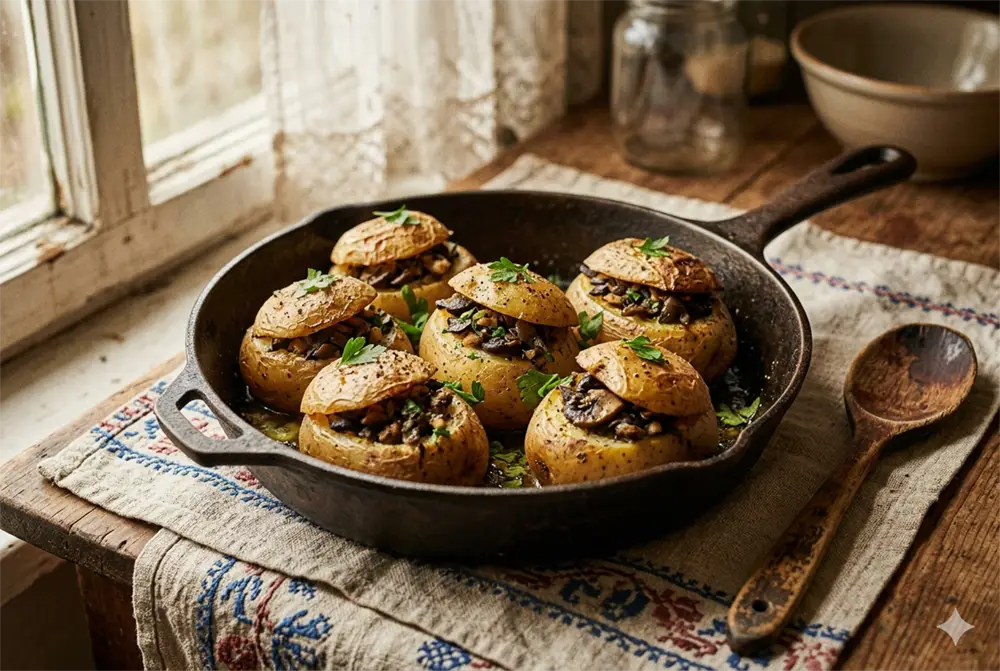
Whole potatoes hollowed out and filled with a savory mushroom, leek and breadcrumb mixture, then braised on the stovetop in butter and beef broth.
Quick Summary
Whole potatoes hollowed out and filled with a savory mushroom, leek and breadcrumb mixture, then braised on the stovetop in butter and beef broth.
Historical recipe
Modernised adaptation of an early 20th‑century source. Not independently kitchen-tested by Attic Recipes. Quantities, temperatures, and food safety guidance have been updated for a contemporary kitchen — results may vary and errors may exist. Nutritional values, where provided, are estimates only and have not been laboratory tested. Always follow current food safety guidelines for your region. If you have a health condition, allergy, or dietary requirement, consult a qualified professional before preparing this recipe.
Use of this recipe is entirely at your own risk and subject to our Terms of Service and Privacy Policy. Attic Recipes accepts no liability for any adverse outcome.
- Gluten
- Eggs
- Dairy
Additional notes
-
Warning
This recipe contains a whole egg in the filling that is cooked inside the potato. Ensure the internal temperature of the filling reaches at least 74°C (165°F) before serving — verify with an instant-read thermometer inserted into the centre of the filling. Do not serve undercooked egg-containing filling to pregnant women, children under 18, elderly individuals, or immunocompromised persons.
-
Note
If using lard instead of butter, the saturated fat content per serving will increase. Those monitoring saturated fat intake should opt for the neutral oil alternative.
-
Warning
This recipe calls for dried mushrooms, which should always be purchased from a reputable commercial source. Never use home-foraged mushrooms unless you are completely certain of their identification — many toxic species closely resemble edible ones, and drying does not neutralise mushroom toxins. If foraging, consult an expert or a verified field guide before use.
- 1
If using dried mushrooms: place 100g dried mushrooms in a bowl, cover with cold water and soak for 30 minutes until fully softened. Drain, reserving the soaking liquid. Bring a small saucepan of water to a boil, add the soaked mushrooms and simmer for 15 minutes. Drain and finely chop. Strain the reserved soaking liquid through a fine sieve or coffee filter and set aside — it can replace part of the water in the braising liquid for a deeper flavour.
Tip Never discard the mushroom soaking liquid. It carries more flavour than the mushrooms themselves and is one of the most valuable aromatics in this dish. - 2
If using fresh mushrooms: heat a dry frying pan over high heat. Add 300g finely chopped fresh mushrooms in a single layer — work in batches if needed — and cook without stirring for 2–3 minutes until the moisture releases and evaporates. The mushrooms should shrink and begin to colour. Remove from heat and set aside.
Tip Do not add fat to the pan at this stage. Fresh mushrooms release significant moisture; cooking them dry first concentrates their flavour before they go into the filling. - 3
Melt 25g butter or lard in a frying pan over medium heat. Add 2 finely sliced leeks and a pinch of salt. Cook, stirring occasionally, for 8–10 minutes until the leeks are fully softened and sweet but not browned.
- 4
Combine the cooked mushrooms and softened leeks in a large bowl. Add 75g fine dry breadcrumbs, 1 lightly beaten egg, and ½ tsp salt. Mix thoroughly until the filling holds together when pressed. Taste and adjust seasoning — the filling should be well-seasoned, as it will season the potato from the inside.
Tip The filling should be moist but not wet. If it feels too dry to hold together, add a tablespoon of the mushroom soaking liquid or broth. If too wet, add a spoonful of extra breadcrumbs. - 5
Peel the potatoes. Using a small sharp knife, cut a thin lid off the top of each potato — approximately 1–1.5 cm thick. Set the lids aside. Using a small knife, melon baller, or sturdy teaspoon, hollow out the centre of each potato, leaving walls approximately 1 cm thick. Reserve the scooped-out potato flesh for another use (soups, mash).
Tip Work slowly and steadily — the goal is a uniform cavity with no holes in the base or sides. A potato that cracks during hollowing can be used as a tester for doneness. - 6
Fill each hollowed potato firmly with the mushroom filling, pressing it in gently to avoid air pockets. Do not overfill — leave just enough space to replace the lid flat. Place the cut potato top back on each stuffed potato.
- 7
Arrange the stuffed potatoes upright and snugly in a large deep saucepan or Dutch oven — they should support each other. Pour 75ml melted butter (or oil), 75ml water and 75ml beef broth over and around the potatoes. If using mushroom soaking liquid, substitute it for all or part of the water. Add a pinch of salt to the braising liquid. Cover with a tight-fitting lid.
Tip The potatoes standing upright and close together is intentional — they hold each other in place and the lids stay on during cooking. A pan that is too large will cause them to tip. - 8
Place the covered pan over medium-low heat. Once you hear the liquid begin to simmer — about 5 minutes — reduce to low heat and cook, covered, for 45–60 minutes. Check every 20 minutes: the liquid should be gently bubbling, not rapidly boiling. Add a splash of water if the pan looks dry.
Tip Oven method (modern alternative): instead of the stovetop, transfer the covered ovenproof casserole to a preheated oven at 180°C (350°F) / 160°C fan and bake for 60–75 minutes. No checking required — the oven provides even, consistent heat and frees you from the stovetop entirely. Check doneness at the 60-minute mark. - 9
Test doneness by piercing the thickest part of a potato with a thin skewer or sharp knife — it should slide in without resistance. The internal temperature of the filling should reach at least 74°C (165°F). When done, carefully transfer the potatoes to a serving bowl using a wide spatula, keeping the lids in place. Spoon the pan juices over the top, scatter with 10g chopped fresh parsley, and serve immediately.
Nutrition Information per 1 stuffed potato (approx. 220g)
Nutritional values are approximate estimates and may vary based on specific ingredients used, preparation methods, and portion sizes.
Serving Suggestions
Serve as a main course with a simple green salad or pickled vegetables alongside. The pan juices are mild and should be spooned generously over the potatoes at serving. A spoonful of sour cream on the side is a natural accompaniment in the Central European tradition. Leftovers reheat well — place in a covered dish with a splash of broth and warm over low heat for 15 minutes.
About This Recipe
The technique is simple but the result is not. Each potato is hollowed out raw, filled with a mixture of cooked mushroom, softened leek and breadcrumb, capped with its own lid, and braised upright in a covered pan with a small quantity of butter, water and broth. The potato steams from outside and cooks the filling from within simultaneously. After an hour on low heat, the exterior is tender and the interior is dense with the flavour of whatever mushrooms you used.
Dried mushrooms are the period-original choice, and they produce a more intensely flavoured filling than fresh. Their soaking liquid — dark, earthy, concentrated — can replace the water in the braising liquid entirely, in which case the pan juices develop a depth that is difficult to achieve any other way. Fresh mushrooms work well too, particularly cremini or mixed forest varieties, but require a dry-pan sauté first to drive off their moisture before they can be incorporated into the filling.
This is a stovetop dish, not an oven dish. The original recipe specifies a covered saucepan on the fire, and that method remains the correct one — the gentle, even heat of a covered pan on low flame produces a more uniformly cooked potato than oven roasting would.
Why It Works
Hollowing the potatoes raw rather than after parboiling gives the filling more surface contact with the potato flesh during cooking. As the potato cooks, it absorbs the flavours of the filling from the inside, and the filling in turn absorbs some of the starch released by the potato. The result is an integrated dish rather than a potato with something placed inside it.
Breadcrumbs in the filling serve two purposes. They absorb the moisture released by the mushrooms and leeks during cooking, preventing the filling from becoming waterlogged inside the potato, and they act as a binder alongside the egg, giving the filling enough cohesion to hold its shape when the potato is sliced open.
The braising liquid — butter or oil, water, broth — serves as the cooking medium and the sauce simultaneously. There is just enough to create steam inside the covered pan without submerging the potatoes. As it reduces during the cooking time, it concentrates and the butter separates slightly, producing a small quantity of intensely flavoured pan juice that is spooned over at serving.
Leeks rather than onion produce a sweeter, milder filling that does not overpower the mushroom. In a dish where the potato is the vehicle and the filling is the flavour, restraint in the aromatics is correct.
Modern Kitchen Tips
Choose potatoes of similar size — this is more important than the variety. Uneven sizes mean some will be overcooked before others are done. Medium potatoes, approximately 200–220g each before hollowing, are ideal.
When hollowing, work from the cut top downward with a small knife, cutting around the interior in a circular motion and then scooping out the centre in pieces. A melon baller or sturdy teaspoon works for the final shaping. Leave walls of at least 1 cm — thinner than this and the potato will crack during cooking.
If the potatoes tip during cooking, wedge a crumpled piece of parchment paper between them to stabilise. They will firm up once the exteriors begin to cook and will hold their position for the remainder of the cooking time.
The reserved potato flesh should not be discarded. It is already salted and flavoured from its time near the filling — it makes excellent mash or can be fried as a simple potato cake.
A note on mushrooms: always use commercially sourced dried mushrooms for this recipe. Drying does not neutralise the toxins in poisonous species, and many toxic mushrooms closely resemble edible ones even after drying. If you forage your own, see our guides to edible and poisonous mushrooms before use.
A classic of early 20th century home cooking, preserved and adapted for the modern kitchen.
The Story Behind This Recipe
Historical Context
Stuffed whole vegetables were a staple of Central European home cooking throughout the early 20th century, and the potato — abundant, storable, and filling — was one of the most frequently used vessels. The technique of hollowing raw potatoes, filling them and cooking them covered in a small quantity of fat and liquid on the stovetop rather than in the oven reflects the practical constraints of period kitchens, where stovetop cooking was easier to control than oven temperature. Dried mushrooms were a common pantry ingredient across the region, valued precisely because they could replace fresh mushrooms in any season. The filling combination of mushroom, leek and breadcrumb appears frequently in period recipes for stuffed vegetables, as breadcrumbs served both as binder and as bulk, stretching the filling across a larger number of portions. Quantities for the filling were given in cup measures without standardised volumes; the braising liquid quantities were similarly expressed as half-cups without specification.
Modern Kitchen Adaptation
All cup measures have been standardised to 150ml per cup (the period regional standard for 'šolja za čaj'), giving 75g dry breadcrumbs and 75ml each of butter, water and broth. The quantity of fresh mushrooms has been estimated at 300g as a practical equivalent for 'one small plate' — the original specified this only as an alternative to 100g dried mushrooms without giving a weight. Butter for frying the leeks was not specified in the original; 25g has been added as a standard quantity for this volume of leeks. A dry-pan sauté technique has been specified for fresh mushrooms in place of the period instruction to boil them — boiling fresh mushrooms dilutes their flavour significantly. For a vegetarian version, replace beef broth with vegetable broth and butter with neutral oil; the dish is otherwise meat-free. Lard is noted as the period-original frying fat; butter or neutral oil are the modern default. The original method calls for stovetop cooking in a covered saucepan — the modern equivalent is a covered ovenproof casserole at 180°C / 160°C fan for 60–75 minutes, which produces the same gentle, steamed result with less attention required. The stovetop method remains valid and is described in the instructions.
This recipe is an independent modern adaptation developed from historical sources in the public domain. It is provided for informational and educational purposes only and does not constitute professional dietary, nutritional, or medical advice. Food preparation involves inherent risks. The reader assumes full responsibility for safe food handling, ingredient sourcing, and adherence to current local food safety guidelines. The site operator accepts no liability for outcomes resulting from the preparation or consumption of this recipe.
One recipe.
Every week.
You Might Also Like
More recipes you'll enjoy
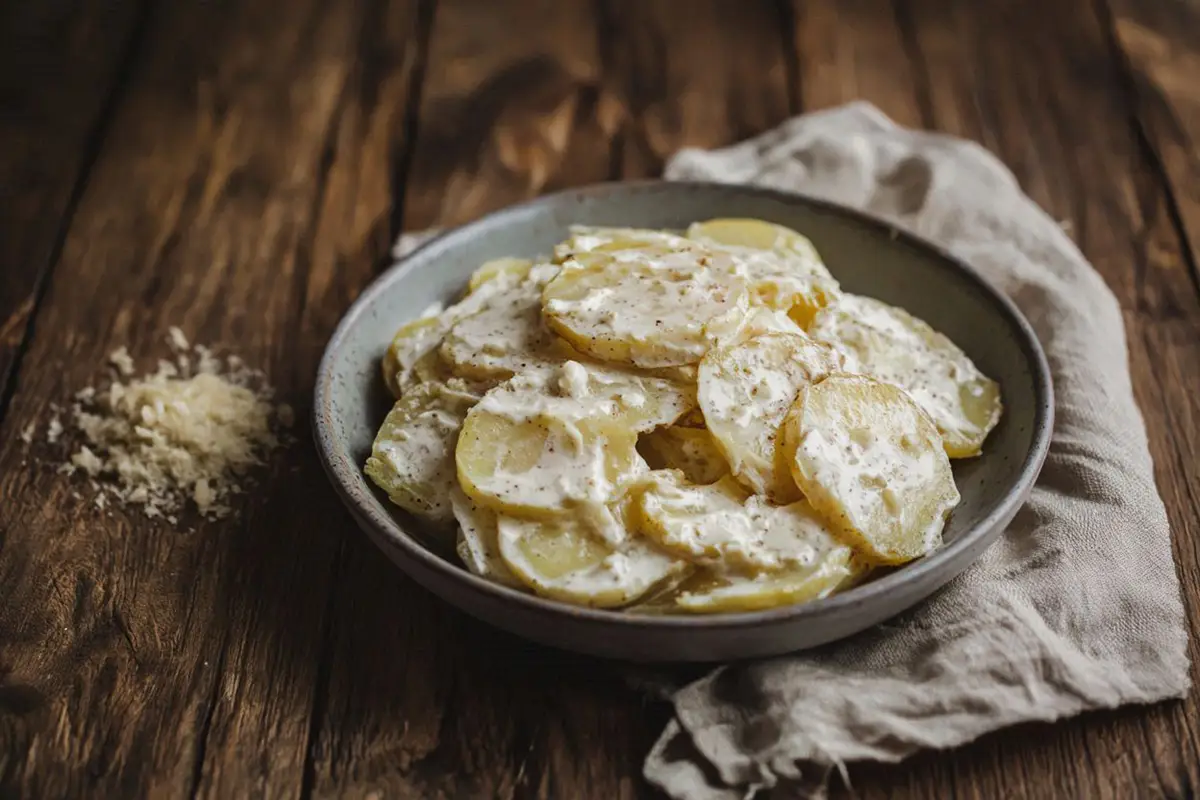
Boiled Potatoes with Horseradish Sauce
Skin-on boiled potatoes with a white horseradish roux sauce and vinegar — a simple, honest Central European classic.
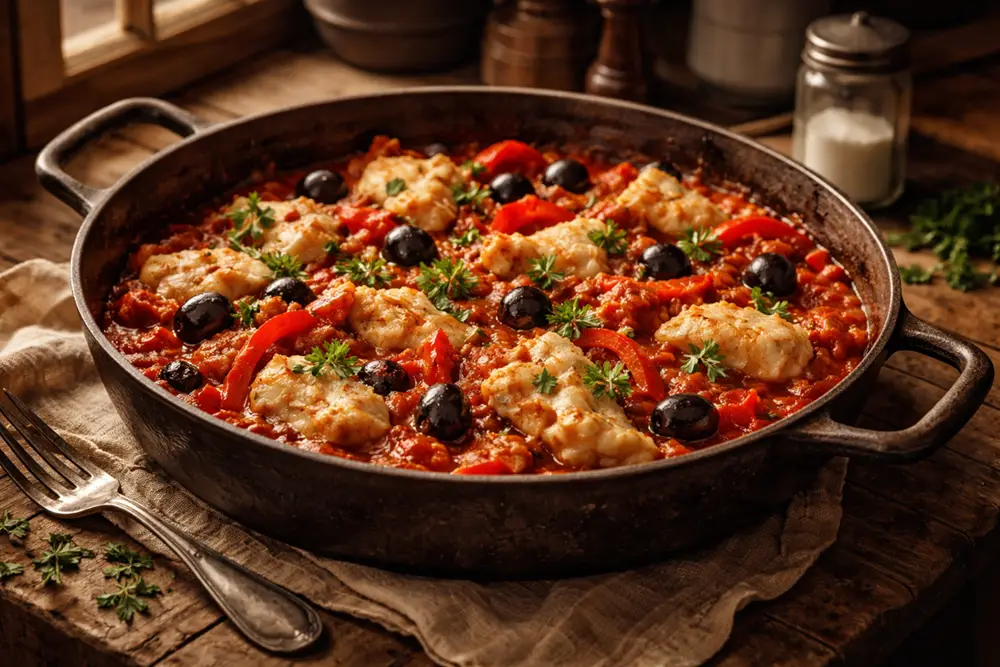
Cod with Tomatoes, Peppers and Black Olives
Salt cod braised with fresh tomatoes, red onion, garlic, bell peppers and black olives in olive oil.
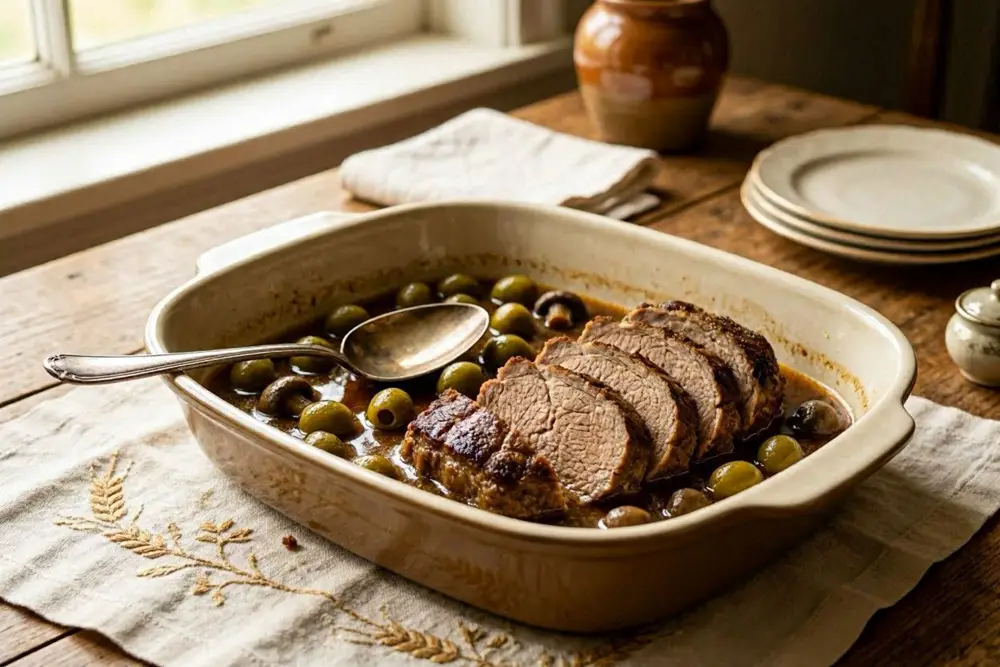
Entrecôte with Olives
Beef rump roasted in a white wine, rum and broth sauce with sliced mushrooms, whole yellow onions and pitted green olives added in stages.