Sourdough Roses with Caramel Cream
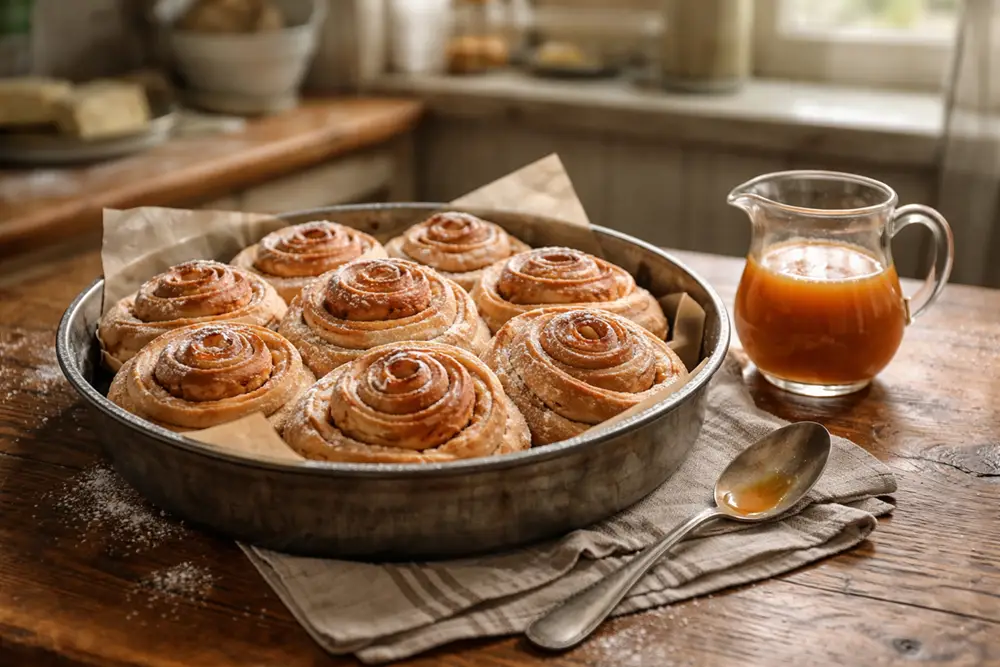
Enriched yeast dough rolled with butter and sugar, cut into roses, baked with a vanilla milk glaze, and served with a poured caramel custard cream.
Quick Summary
Enriched yeast dough rolled with butter and sugar, cut into roses, baked with a vanilla milk glaze, and served with a poured caramel custard cream.
Historical recipe
Modernised adaptation of an early 20th‑century source. Not independently kitchen-tested by Attic Recipes. Quantities, temperatures, and food safety guidance have been updated for a contemporary kitchen — results may vary and errors may exist. Nutritional values, where provided, are estimates only and have not been laboratory tested. Always follow current food safety guidelines for your region. If you have a health condition, allergy, or dietary requirement, consult a qualified professional before preparing this recipe.
Use of this recipe is entirely at your own risk and subject to our Terms of Service and Privacy Policy. Attic Recipes accepts no liability for any adverse outcome.
- Gluten
- Eggs
- Dairy
Additional notes
-
Warning
The caramel cream contains egg yolks that must reach 74°C (165°F) during cooking to be safe for consumption. Use an instant-read thermometer to verify the temperature. Do not serve undercooked custard to pregnant women, children under 18, elderly individuals, or immunocompromised persons.
-
Warning
Dry caramel reaches temperatures above 170°C and will cause severe burns on contact with skin. Keep children away from the stove during caramel preparation. When adding milk to hot caramel, stand back and pour slowly — the mixture will bubble and spatter violently.
-
Note
Each serving contains approximately 10g saturated fat from butter, egg yolks, and whole milk. Those monitoring saturated fat intake should be mindful of portion size.
- 1
Warm 200ml milk to approximately 37°C — it should feel comfortably warm on the inside of your wrist, not hot. Crumble 30g fresh yeast into the milk, stir to dissolve, and leave in a warm place for 8–10 minutes until the surface begins to foam. If using instant dry yeast (10g), whisk directly into the flour — no proofing needed.
Tip Milk above 43°C will kill the yeast. If in doubt, go cooler rather than hotter. - 2
In a large bowl, whisk 3 egg yolks until smooth. Pour in the foamy yeast mixture and stir to combine. Add 300g flour and ¼ tsp salt. Mix with a wooden spoon or your hands until a cohesive dough forms, then turn out onto a lightly floured surface and knead for 5–7 minutes until the dough is smooth and slightly tacky but not sticky. It will be softer than a bread dough.
Tip This is an enriched dough — the egg yolks make it richer and more tender than plain yeast dough. Do not add extra flour to tighten it; a slightly soft dough produces lighter, more tender roses. - 3
On a lightly floured surface, roll the dough out with a rolling pin into a thin, even rectangle — approximately 30×40cm and 3–4mm thick.
- 4
Mix 4g vanilla sugar into 100g melted butter. Brush the entire surface of the rolled dough evenly with the butter mixture, leaving a 1cm border along one long edge. Scatter 100g granulated sugar evenly over the buttered surface.
Tip A thin, even butter layer is key — thick patches will cause the filling to leak and pool in the pan during baking. - 5
Starting from the long edge opposite the bare border, roll the dough tightly into a log. Press the bare edge gently to seal. Using a sharp knife, cut the log into 8 equal pieces, each approximately 5cm wide.
- 6
Grease a 20×30cm baking pan with 15g softened butter. Place each rose cut-side up in the pan, arranging in 2 rows of 4. The roses should sit snugly next to each other but not be compressed. Brush the sides of each rose with a little melted butter to prevent them from sticking together as they rise.
Tip Placing them cut-side up exposes the spiral — this is what gives the 'rose' appearance after baking. - 7
Cover the pan loosely with a clean tea towel and leave in a warm, draught-free place for 50–60 minutes until the roses have visibly puffed and nearly doubled in size. Preheat the oven to 180°C (350°F) / 160°C fan during the last 15 minutes of rising.
- 8
Place the pan in the preheated oven and bake for 12–15 minutes, until the roses are just beginning to turn golden on top.
- 9
While the roses are in the oven, prepare the mid-bake glaze: heat 100ml milk with 5g sugar and 1ml vanilla extract until just below boiling. After the first 12–15 minutes of baking, quickly pour the hot sweetened milk evenly over the roses. Return immediately to the oven and continue baking for a further 12–15 minutes until the roses are deep golden brown and the milk has been absorbed.
Tip Pour the milk quickly and close the oven door immediately to avoid losing heat. The milk caramelises slightly on top of the roses, giving them their characteristic colour and moist texture. - 10
Remove the pan from the oven and allow the roses to cool in the pan for 10 minutes before serving. They are best served warm.
- 11
Make the caramel cream while the roses bake or cool. Place 40g sugar cubes in a small, heavy-bottomed saucepan without any water. Heat over medium heat, without stirring, until the sugar begins to melt at the edges. Then gently swirl the pan — do not stir with a spoon — until all the sugar has melted and turned a deep amber colour.
Tip Watch closely once the sugar begins to colour — it goes from golden to burnt in seconds. Remove from heat the moment it reaches a rich amber. - 12
Remove the pan from the heat. Carefully and slowly pour in 500ml whole milk — it will bubble and sputter vigorously. Return the pan to medium heat and stir continuously until the hardened caramel has completely dissolved into the milk, about 5–8 minutes. Remove from heat and allow to cool to approximately 60°C — warm to the touch but not steaming heavily.
Tip The caramel will seize and harden when the milk hits it — this is normal. Keep stirring over heat and it will dissolve completely. - 13
Temper the egg yolks: whisk 3 egg yolks in a separate bowl until smooth. Slowly ladle 3–4 tablespoons of the warm caramel milk into the yolks, whisking constantly. Pour the tempered yolk mixture back into the saucepan with the remaining caramel milk, whisking to combine.
Tip Never add cold yolks directly to hot liquid — the protein shock causes curdling. Tempering brings them to a similar temperature first, allowing a smooth, even custard. - 14
Return the saucepan to low heat. Cook, stirring constantly with a whisk or wooden spoon, until the cream thickens enough to coat the back of a spoon and reaches 74°C (165°F) on an instant-read thermometer. Do not allow it to boil. Remove from heat immediately.
Tip If you see the first signs of bubbling around the edges, remove from heat and continue stirring off the heat — residual heat will finish the job. A curdled custard cannot be rescued. - 15
Serve the warm roses pull-apart style directly from the pan, with the caramel cream poured over or served alongside for dipping.
Nutrition Information per 1 rose with caramel cream (approx. 130g)
Nutritional values are approximate estimates and may vary based on specific ingredients used, preparation methods, and portion sizes.
Serving Suggestions
Serve the roses warm, directly from the pan — they are pull-apart by design. The caramel cream can be poured over the top for a more indulgent presentation, or served in a small jug alongside for dipping. Leftovers keep for one day covered at room temperature; reheat briefly in a low oven (140°C) for 8–10 minutes to restore the texture. The caramel cream does not keep well — make it fresh on the day.
About This Recipe
The name is literal. When the rolled and cut dough rises in the pan, each spiral piece opens slightly at the top, the layers fanning outward like the petals of a rose. They bake together into a pull-apart arrangement — connected at the base, individual at the crown — and the pour of hot sweetened milk halfway through baking lacquers the surface to a deep, even gold.
The caramel cream that accompanies them is a proper cooked custard: dry sugar caramelised without water, milk stirred in and cooked until the caramel dissolves, then egg yolks tempered in and cooked slowly to a silky, pourable consistency. It is not thick like a pudding; it drapes.
These two things together — the warm, tender, pull-apart dough and the cool, lightly bitter caramel cream — are an old combination. The richness of the enriched dough (egg yolks, butter, sugar in the filling) is balanced by the slight bitterness of the caramel and the custard’s restraint. Neither element is excessive on its own. Together they are complete.
Why It Works
Enriched yeast doughs behave differently from lean bread doughs. The egg yolks add fat and emulsifiers that coat the gluten strands, keeping the crumb tender and slowing the staling process. The result is a dough that stays soft longer than plain flour-and-water dough would — important for a recipe meant to be made the day it is served, but still pleasant the following morning.
The mid-bake milk pour is the most distinctive technical element. Added when the exterior of the roses has just set but before they have fully coloured, the sweetened milk penetrates the partially baked layers and steams the interior from the inside out. On the surface, the milk sugar caramelises against the hot dough, creating the dark, almost lacquered finish that distinguishes these roses from a plain sweet roll.
Dry caramel — sugar melted without water — reaches a higher temperature more quickly than wet caramel and produces a deeper, more complex flavour. The absence of water means there is no dissolution stage; the sugar goes from solid to liquid to caramel directly. The downside is that it moves fast: the window between perfect amber and burnt is narrow, and the cook must be watching.
Tempering the egg yolks into the caramel milk is not optional. Cold yolks added to hot liquid coagulate on contact, producing scrambled egg rather than custard. The tempering step — introducing a small quantity of hot liquid into the yolks first, then combining — brings both elements to a similar temperature before the final cooking stage, allowing the proteins to thicken gradually and evenly.
Modern Kitchen Tips
The dough should be soft and slightly tacky after kneading — resist the temptation to add more flour. A firmer dough produces denser, less tender roses. If it sticks to your hands, oil your hands lightly rather than flouring the dough further.
When rolling the log, roll tightly from the start. A loosely rolled log produces roses where the layers separate during baking, losing their shape. One firm, consistent roll from edge to edge is sufficient.
For the caramel, use a light-coloured or stainless steel saucepan so you can see the colour of the sugar clearly. Dark pans make it impossible to judge the caramel’s progress until it is too late.
A thermometer is strongly recommended for the custard — the difference between 70°C and 74°C is invisible to the eye but significant for food safety. If you do not have one, the spoon test is a reliable secondary check: the cream is ready when it coats the back of a spoon and a line drawn through it with your finger holds its shape cleanly.
A classic of early 20th century home cooking, preserved and adapted for the modern kitchen.
The Story Behind This Recipe
Historical Context
Enriched yeast doughs rolled with butter and sugar, then cut into spiral portions and baked together in a single pan, appear consistently in Central European home baking from the early 20th century onward. The technique of adding a pour of hot sweetened milk partway through baking — rather than before or after — is a period-specific detail that serves a dual purpose: it steams the interior of the rolls and caramelises the surface simultaneously, producing a characteristically moist crumb beneath a lacquered top. The accompanying caramel cream follows the classic custard-building method of the era: dry caramel, milk added in stages, yolks stirred in off the heat and then cooked gently to thicken. The quantity of milk for the dough was given as 'two cups' without specifying a volume, and the sugar for the caramel was expressed in cubes rather than grams, both typical of a period when measures were assumed rather than standardised.
Modern Kitchen Adaptation
Milk quantity has been standardised to 200ml — two cups at the regional period standard of approximately 200ml each would produce a dough too wet to roll, suggesting one cup (200ml total) was the likely original intent. Vanilla sugar quantity specified as 4g (half of a standard 8g packet). The mid-bake milk glaze has been specified as 100ml milk with 5g sugar and vanilla extract — the original described only 'sweetened and scented milk' without quantities or flavouring. Oven temperature estimated at 180°C / 160°C fan from 'warm oven'; baking time split into two stages around the milk pour. Sugar cubes for the caramel standardised to 40g (10 × 4g cubes). The original caramel cream instructed the cook to cool the mixture to room temperature before adding the yolks and then return to heat — this has been corrected to cool only to approximately 60°C, followed by a tempering step, to ensure the yolks reach a safe temperature of 74°C (165°F) during the final cooking stage. Room-temperature addition followed by brief heating risks insufficient pasteurisation.
This recipe is an independent modern adaptation developed from historical sources in the public domain. It is provided for informational and educational purposes only and does not constitute professional dietary, nutritional, or medical advice. Food preparation involves inherent risks. The reader assumes full responsibility for safe food handling, ingredient sourcing, and adherence to current local food safety guidelines. The site operator accepts no liability for outcomes resulting from the preparation or consumption of this recipe.
One recipe.
Every week.
You Might Also Like
More recipes you'll enjoy
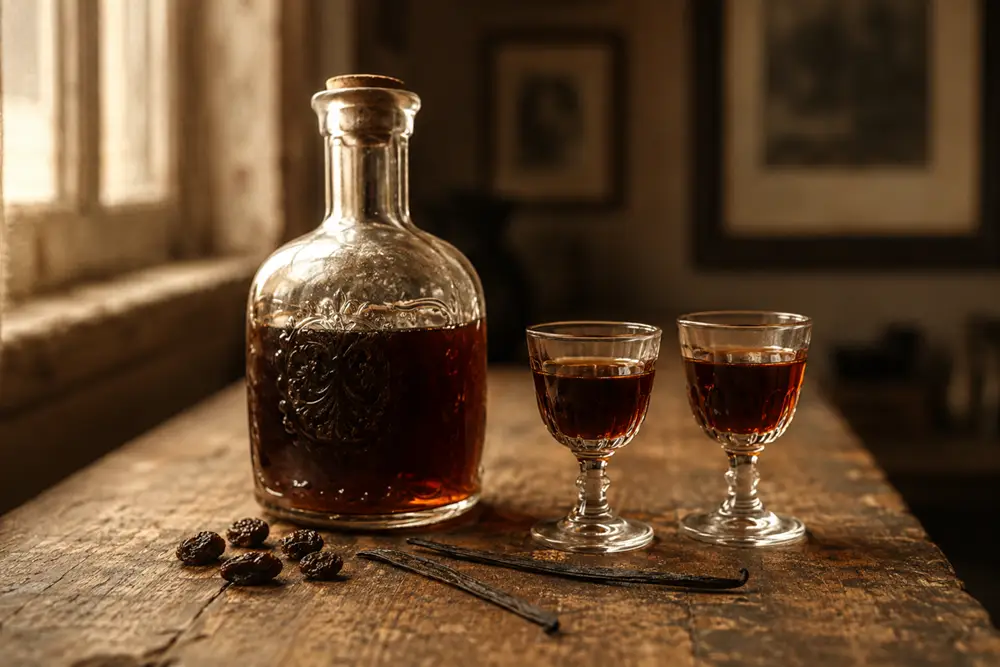
Malaga Wine
A rich, caramel-infused homemade liqueur that replicates the deep, sweet character of Malaga wine using red wine, dark rum, vanilla, and raisins.
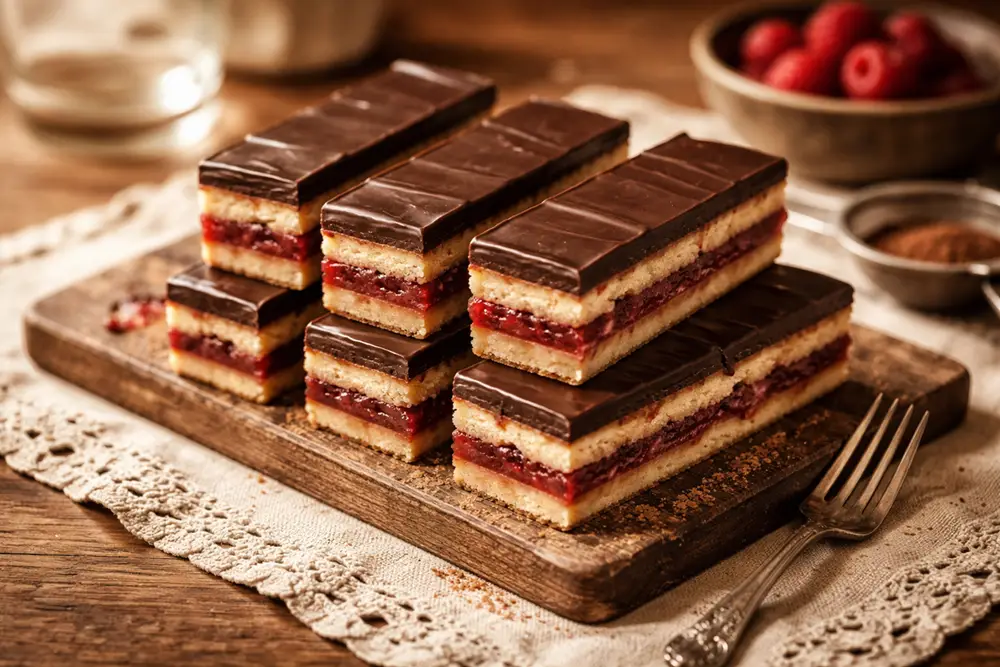
Raspberry Bars with Chocolate Glaze
Crisp almond shortcrust stacked in three layers with raspberry jam and finished with a dark chocolate glaze — a classic Central European bar cookie.
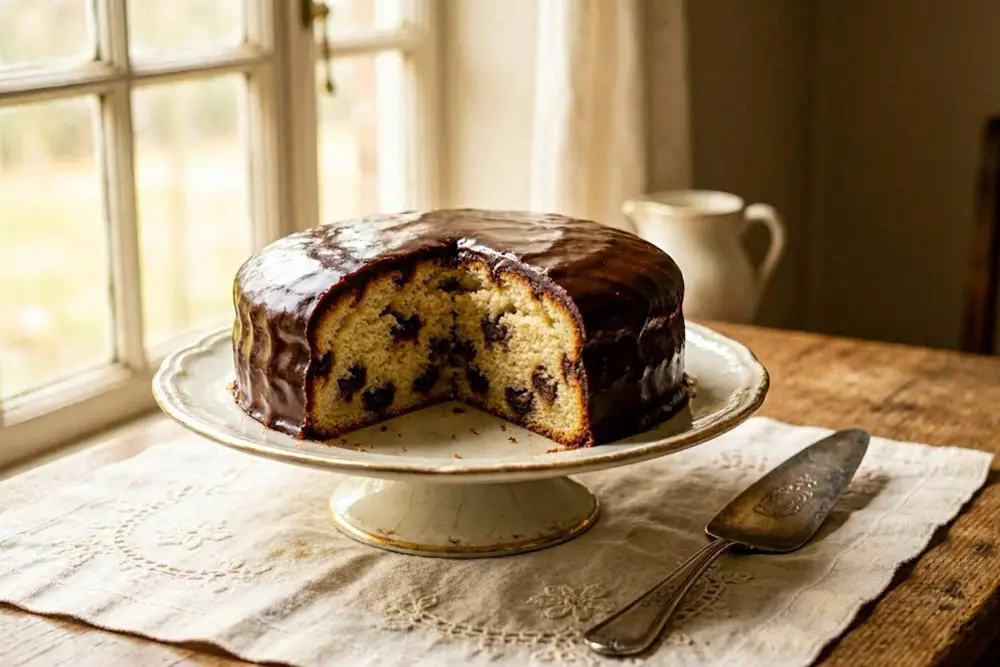
Snow Cake with Chocolate
Flourless almond meringue cake with dark chocolate, candied orange peel, and a poured chocolate glaze — light as snow, rich as the season.