Quinces Stuffed with Walnuts and Raisins
Whole quinces hollowed out and filled with ground walnuts, raisins, and sugar, baked in butter and finished with whipped sour cream.
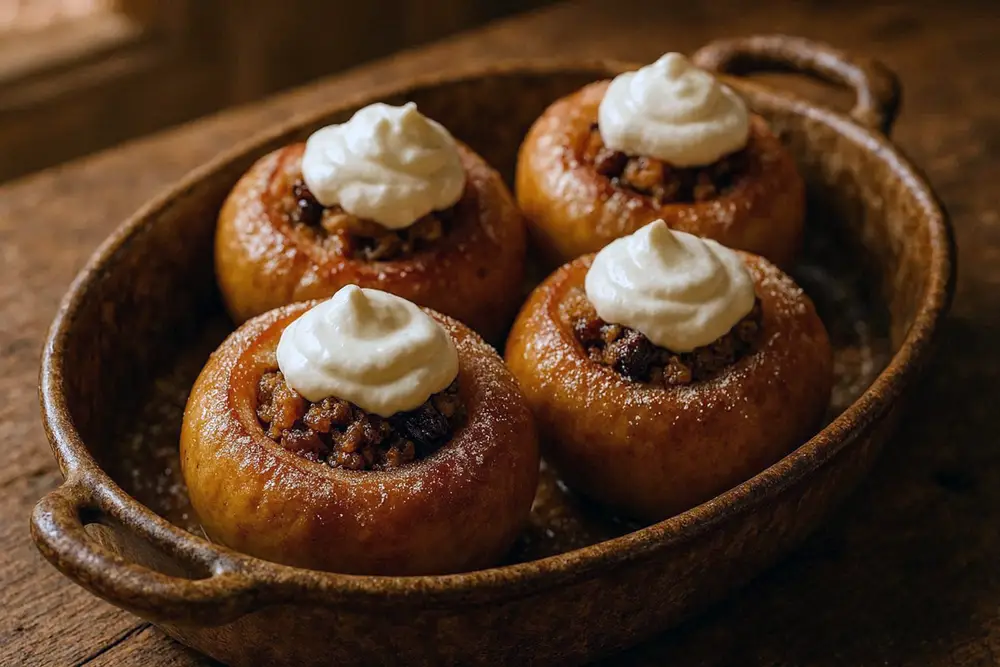
Historical recipe
Modernised adaptation of an early 20th‑century source. Not independently kitchen-tested by Attic Recipes. Quantities, temperatures, and food safety guidance have been updated for a contemporary kitchen — results may vary and errors may exist. Nutritional values, where provided, are estimates only and have not been laboratory tested. Always follow current food safety guidelines for your region. If you have a health condition, allergy, or dietary requirement, consult a qualified professional before preparing this recipe.
Use of this recipe is entirely at your own risk and subject to our Terms of Service and Privacy Policy. Attic Recipes accepts no liability for any adverse outcome.
- Dairy
- Tree Nuts
- Sulphites
Additional notes
-
Note
Contains sulphites from raisins. Individuals with sulphite sensitivity should substitute fresh seedless grapes, chopped.
-
Note
Contains dairy (butter, sour cream). Omit sour cream topping and substitute plant-based butter for a dairy-free version.
- 1
Preheat the oven to 175°C (350°F) / 155°C fan. Wash the quinces well to remove the surface fuzz. Peel them with a sturdy peeler. Slice a thin cap off the top of each quince and set aside. Using a melon baller or teaspoon, hollow out the core and seeds, leaving a wall of about 1.5 cm. Rub all exposed flesh with lemon juice to prevent browning.
- 2
In a bowl, combine the 125g ground walnuts, 125g raisins, 50g granulated sugar, and cinnamon or vanilla if using. Mix thoroughly until uniform.
- 3
Pack the filling firmly into each hollowed quince. Stand them upright in a baking dish. Place the quince peels and any offcuts around them in the dish — these help colour and flavour the cooking liquid. Pour the 120ml water into the bottom of the dish. Drizzle the 100g melted butter evenly over the stuffed quinces.
Tip Cover the dish tightly with foil for the first hour of baking to trap steam and encourage the quinces to turn deep red. - 4
Bake for 75–90 minutes, removing the foil for the last 15–20 minutes to allow the tops to caramelise slightly. The quinces are done when a skewer or fork pierces the flesh with no resistance.
- 5
Transfer the baked quinces to a glass or ceramic serving plate. Dust with the 2 tbsp granulated sugar while still warm.
- 6
Allow to cool to room temperature. Just before serving, whip the 200ml cold sour cream with the 1 tbsp powdered sugar until it holds soft peaks. Spoon over the quinces or serve alongside.
Nutrition Information per 1 stuffed quince with topping (approx. 280g)
Nutritional values are approximate estimates and may vary based on specific ingredients used, preparation methods, and portion sizes.
Serving Suggestions
Serve at room temperature with whipped sour cream, clotted cream, or thick Greek yogurt. Pairs well with a glass of sweet wine or a strong black tea. Leftover baked quinces keep well refrigerated for two to three days and are excellent cold.
About This Recipe
Quinces are one of the few fruits that insist on being cooked. Raw, they are hard, astringent, and barely edible — but heat transforms them into something deeply fragrant, their flesh softening and turning rose-pink, releasing the perfume of honey and flowers that they keep entirely to themselves when raw. Stuffing them is an old idea, practical and beautiful: the hollow left by the core becomes a vessel for a simple filling of ground walnuts, raisins, and sugar, and the whole thing roasts slowly in butter until the fruit collapses into tenderness around a sweet, dense centre.
This recipe belongs to a tradition of baked stuffed quince found across Central Europe and the eastern Mediterranean, where the fruit was abundant in autumn and the filling was assembled from what the pantry reliably held. Home cooks of the period fixed the filling quantities — an eighth of a kilogram each of walnuts and raisins — and left the number of quinces to whatever the season and the household provided.
The whipped sour cream served alongside is optional in the original, but it is the right choice: its mild acidity cuts the richness of the walnut filling and echoes the quince’s own tartness before cooking.
Why It Works
Quinces are exceptionally high in pectin, which means they hold their shape through long baking rather than collapsing entirely, even as the flesh softens. The slow oven time — covered for most of the bake — traps steam and encourages the anthocyanin compounds in the skin and core to migrate into the flesh, producing the characteristic deep pink to red colour. Keeping the peels in the dish amplifies this effect.
The filling ratio of equal parts walnuts and raisins is well-balanced: the raisins provide moisture and concentrated sweetness that prevents the ground walnut filling from drying out during the long bake, while the walnuts give it enough body to hold its shape when the quince is cut or served whole.
Modern Kitchen Tips
Quinces oxidise quickly once peeled and cut — have a bowl of cold water with lemon juice ready and drop each hollowed quince in as you work. Dry them before filling.
The baking time can range from 75 to 90 minutes depending on the size and ripeness of the fruit. Start checking at 70 minutes with a skewer. The quince should feel completely yielding with no resistance in the thickest part of the wall.
If sour cream is unavailable, clotted cream, thick crème fraîche, or unsweetened Greek yogurt all work well as a finish.
A classic of early 20th century Central European home cooking, preserved and adapted for the modern kitchen.
The Story Behind This Recipe
Historical Context
Early 20th century recipes for this dish rarely specified the number of quinces — the fruit was treated as a variable determined by what was on hand, while the filling quantities were fixed. The original proportions called for one-eighth of a kilogram each of ground walnuts and raisins, which maps closely to a filling for four to six medium fruits. Whipped sour cream was listed as an optional but natural finish, reflecting the Central European habit of tempering sweet baked fruit with something slightly acidic.
Modern Kitchen Adaptation
The original recipe did not specify an oven temperature — 175°C (350°F) is an estimate based on standard baking temperatures for dense fruit and is marked accordingly. Baking time has been extended slightly from some period versions to account for modern oven variation and the size of commercially grown quinces, which tend to be larger than heritage varieties. Butter quantity is unchanged from the original. Water added to the base of the baking dish is standard practice to prevent scorching — particularly important given the sugar content of the filling — though period recipes for this style of baked fruit did not typically make it explicit.
This recipe is an independent modern adaptation developed from historical sources in the public domain. It is provided for informational and educational purposes only and does not constitute professional dietary, nutritional, or medical advice. Food preparation involves inherent risks. The reader assumes full responsibility for safe food handling, ingredient sourcing, and adherence to current local food safety guidelines. The site operator accepts no liability for outcomes resulting from the preparation or consumption of this recipe.
One recipe.
Every week.
You Might Also Like
More recipes from the same category
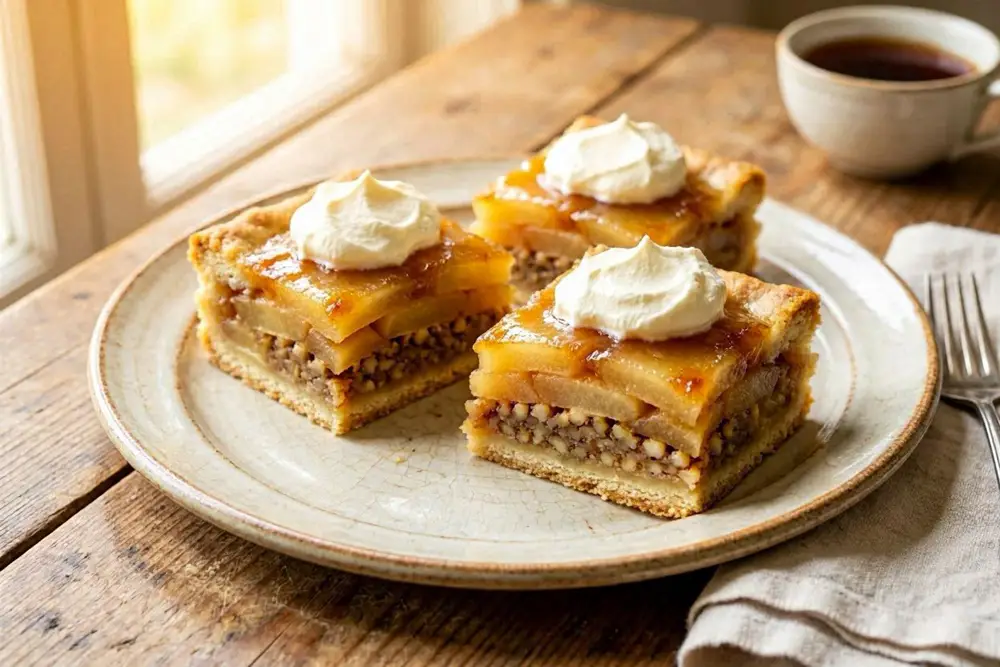
Apple Pie with Whipped Cream
A crisp almond shortcrust base layered with ground walnuts, poached apples, apricot jam, and a thick cloud of sweetened whipped cream.
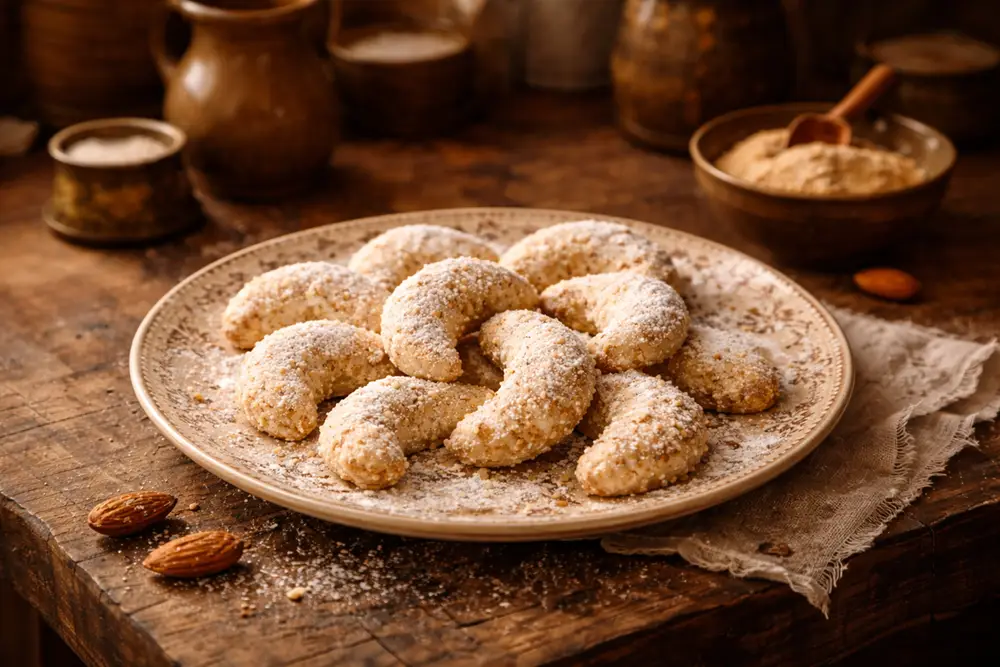
Almond Meringue Crescents
Crisp Central European confections of Swiss meringue shaped into crescents, coated in ground almonds, oven-dried until white and firm.
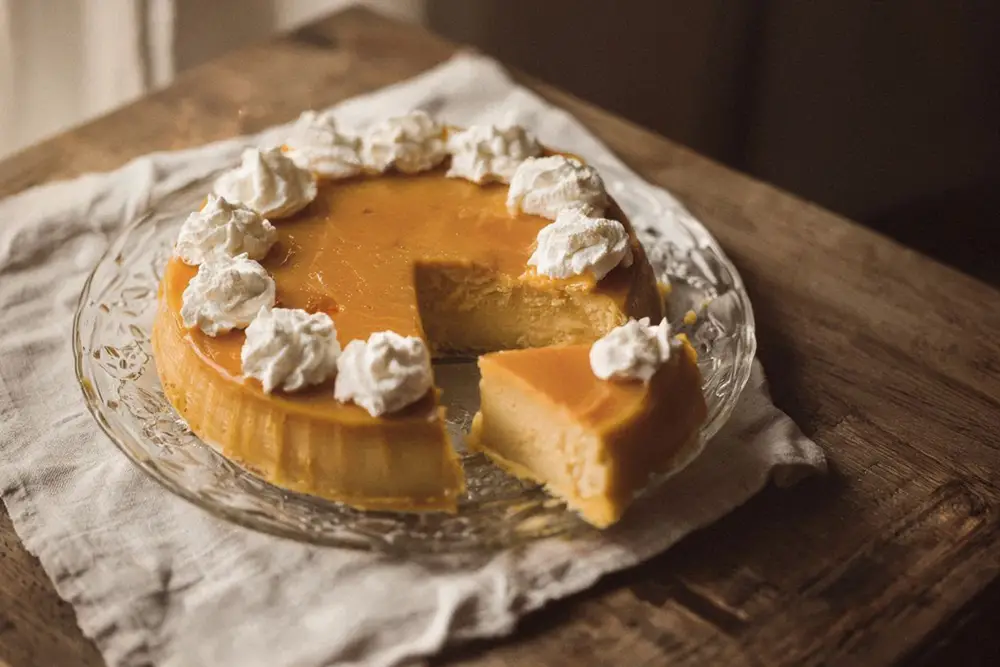
Apricot Cream
A rich chilled cream of apricot marmalade, egg yolks, sugar, and gelatin, set in a mould and served unmoulded with whipped cream.