Candied Pumpkin Spoon Sweet in Vanilla Syrup
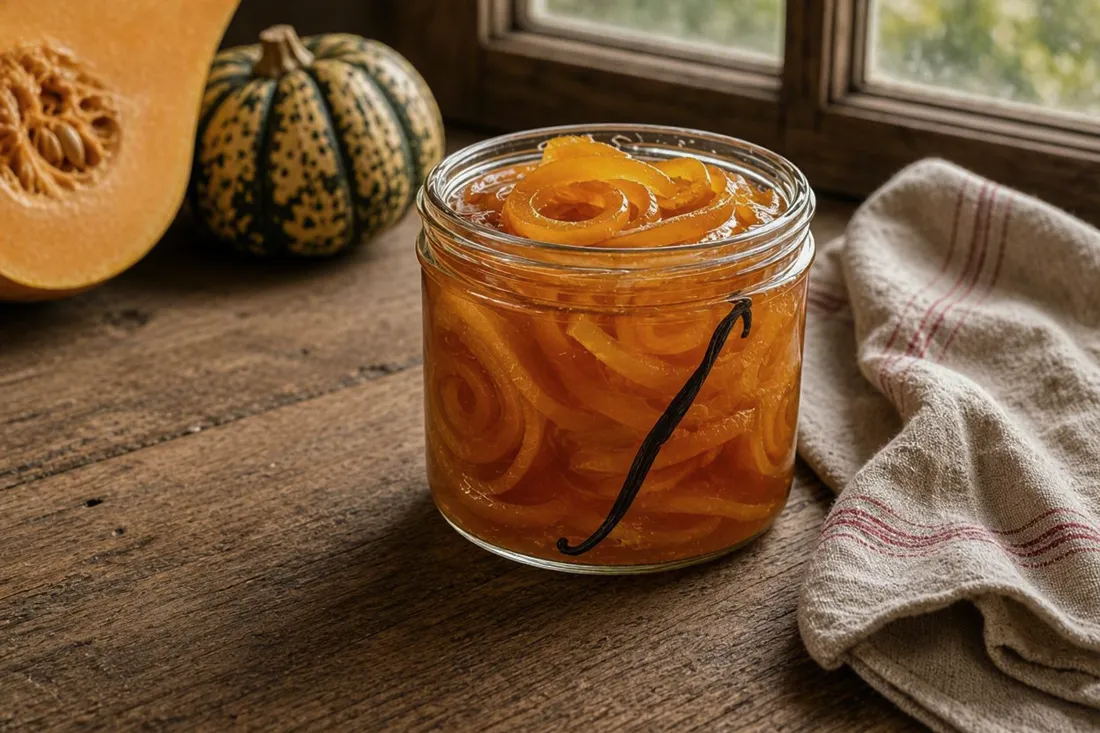
Firm pumpkin spirals, blanched tender, slowly candied in a vanilla-lemon sugar syrup until the syrup reaches the thickness of honey.
Quick Summary
Firm-fleshed pumpkin is cut into spirals, briefly treated in a lime-water solution to hold its shape, then blanched tender and slowly candied in a vanilla-lemon syrup that thickens to a honey-like consistency — a traditional spoon sweet.
Historical recipe
Modernised adaptation of an early 20th‑century source. Not independently kitchen-tested by Attic Recipes. Quantities, temperatures, and food safety guidance have been updated for a contemporary kitchen — results may vary and errors may exist. Nutritional values, where provided, are estimates only and have not been laboratory tested. Always follow current food safety guidelines for your region. If you have a health condition, allergy, or dietary requirement, consult a qualified professional before preparing this recipe.
Use of this recipe is entirely at your own risk and subject to our Terms of Service and Privacy Policy. Attic Recipes accepts no liability for any adverse outcome.
Additional notes
-
Warning
This recipe uses pickling lime (calcium hydroxide) to firm the squash before cooking. Use only food-grade pickling lime, sold specifically for food preservation — never garden or agricultural lime, which is not safe to consume. Rinse the squash pieces thoroughly and repeatedly after the lime soak, as described, to remove all residue before proceeding. This step deserves particular care when preparing food for children, older adults, pregnant people, or anyone immunocompromised.
-
Warning
Pumpkin is a low-acid vegetable. If canning this preserve for shelf-stable storage rather than refrigerating it, sterilized jars and boiling water bath processing are both necessary to prevent the risk of botulism, even with the high sugar content of the syrup.
-
Warning
This recipe involves a sugar syrup cooked for a long time at a high temperature. Hot sugar syrup causes severe burns on contact and clings to skin far more than boiling water does. Keep children away from the stove during the syrup stage, and take care when testing consistency or ladling the hot preserve into jars.
- 1
Peel the squash, wash it, and use a channel knife or corer to cut the flesh into spiral-shaped pieces.
- 2
Dissolve the pickling lime in the 2l of cold water to make a lime-water solution. Submerge the squash spirals in it and let them sit for 20 minutes.
Tip Use only food-grade pickling lime here, never garden or agricultural lime — the latter isn't safe for food use. - 3
After 20 minutes, remove the pieces from the lime water and place them on a sieve or colander. Rinse thoroughly and continuously under cold running water to remove all traces of lime, then let them drain well.
- 4
Place the rinsed pieces in a pot, cover with cold water, and bring to a boil. Once boiling, drain the water off completely and refill with a fresh batch of cold water; bring to a boil again. Repeat this 4-5 times in total, until the squash pieces are tender.
- 5
After the final blanching, drain the pieces well and set them aside.
- 6
In a large pot, dissolve the sugar in the 400ml of water over medium heat and bring to a boil to form a syrup.
- 7
Carefully lower the squash pieces into the boiling syrup, one at a time. Add the vanilla pods and the lemon juice. Return to a gentle boil.
- 8
Continue cooking over low heat, adding the reserved cold water in three additions of about 200ml each, spaced out through the cooking time.
Tip The staggered water additions keep the syrup from concentrating too fast on the outside before it has fully penetrated the squash pieces. - 9
Keep cooking gently until the syrup reaches the thickness of honey — this can take a couple of hours. Test occasionally by cooling a small spoonful.
- 10
Remove the pot from the heat and skim off any foam from the surface.
- 11
For shelf-stable storage, ladle the hot preserve into sterilized jars, leaving appropriate headspace, seal, and process in a boiling water bath for 15 minutes — pumpkin is a low-acid vegetable, so water bath processing is needed even with the high sugar content. For shorter-term storage, transfer to a clean, covered container and keep refrigerated, using within a few weeks.
Nutrition Information per 1 tablespoon (about 40g)
Nutritional values are approximate estimates and may vary based on specific ingredients used, preparation methods, and portion sizes.
Serving Suggestions
Serve a small spoonful in a shallow dish, traditionally alongside a glass of cold water, as you would any spoon sweet.
About This Recipe
Spoon sweets like this one turn an ordinary vegetable into something closer to candy — firm pieces of pumpkin, cut into decorative spirals, held together through hours of cooking by a clever bit of food chemistry before being slowly candied in a fragrant vanilla and lemon syrup.
The lime-water soak at the start looks unusual next to the rest of the method, but it does real work: it firms the squash’s flesh just enough that the pieces can survive the repeated blanching and the long simmer in sugar syrup without falling apart into mush. Everything that follows — the careful rinsing, the multiple changes of boiling water, the staggered additions of cold water during the syrup stage — exists to support that one early decision.
The result is a preserve meant to be served a spoonful at a time, syrup and all, rather than spread on bread like a jam.
Why It Works
Calcium in the lime-water solution binds with pectin in the squash’s cell walls, firming the flesh before any heat is applied. That firmness is what lets the spiral-cut pieces hold their decorative shape through blanching and a long simmer in syrup — without it, the pieces would break down into a shapeless mass well before the syrup had time to fully candy them.
The staggered additions of cold water during the syrup stage slow down how fast the sugar concentrates. Left alone, the syrup would thicken quickly and seal the outside of each piece before the sugar had penetrated all the way through, leaving a candied shell around an undercooked center. Diluting the syrup periodically gives the sugar time to work its way fully into the squash before the final reduction to honey-like thickness.
Modern Kitchen Tips
- A julienne peeler or apple corer can substitute for a traditional channel knife if you don’t have one specifically for spirals.
- Don’t rush the lime rinse — err on the side of rinsing longer rather than shorter.
- The finished syrup will continue to thicken slightly as it cools, so pull it from the heat just shy of your target consistency.
A classic of early 20th century home cooking, preserved and adapted for the modern kitchen.
The Story Behind This Recipe
Historical Context
Treating firm vegetables and fruits with a lime-water soak before candying was a well-established technique for keeping delicate pieces intact through hours of cooking in sugar syrup, since it firms the flesh before the long simmer softens it again. Cutting the squash into spirals rather than simple cubes turned a practical preserve into something decorative enough to serve as a spoon sweet — offered in small dishes, often alongside coffee or a glass of water, as a gesture of hospitality.
Modern Kitchen Adaptation
The original calls for a 'special yellow pumpkin' without naming a variety; the technique described here — spiral-cut pieces that need to hold their shape through an extended lime treatment and a long simmer in syrup — only works with a dense, firm-fleshed winter squash. A wetter or more stringy variety would fall apart. Butternut squash is used here as a reliable, widely available substitute. The pumpkin weight, the lime and water quantities for the soak, the water used across the repeated blanching, and the water used to dissolve the sugar into syrup are all estimated, since none of these were specified in the original. Most importantly: the original doesn't specify what kind of lime to use. This version calls specifically for food-grade pickling lime (calcium hydroxide), since agricultural or garden lime is not safe for food use and the two are easy to confuse. Thorough rinsing after the lime soak, as described in the original, remains essential. For anyone canning this for shelf-stable storage rather than refrigerating it, a boiling water bath is added, since pumpkin is a low-acid vegetable and the original's instruction to simply 'cover well' isn't sufficient for safe long-term storage outside the refrigerator.
This recipe is an independent modern adaptation developed from historical sources in the public domain. It is provided for informational and educational purposes only and does not constitute professional dietary, nutritional, or medical advice. Food preparation involves inherent risks. The reader assumes full responsibility for safe food handling, ingredient sourcing, and adherence to current local food safety guidelines. The site operator accepts no liability for outcomes resulting from the preparation or consumption of this recipe.
One recipe.
Every week.
You Might Also Like
More recipes you'll enjoy
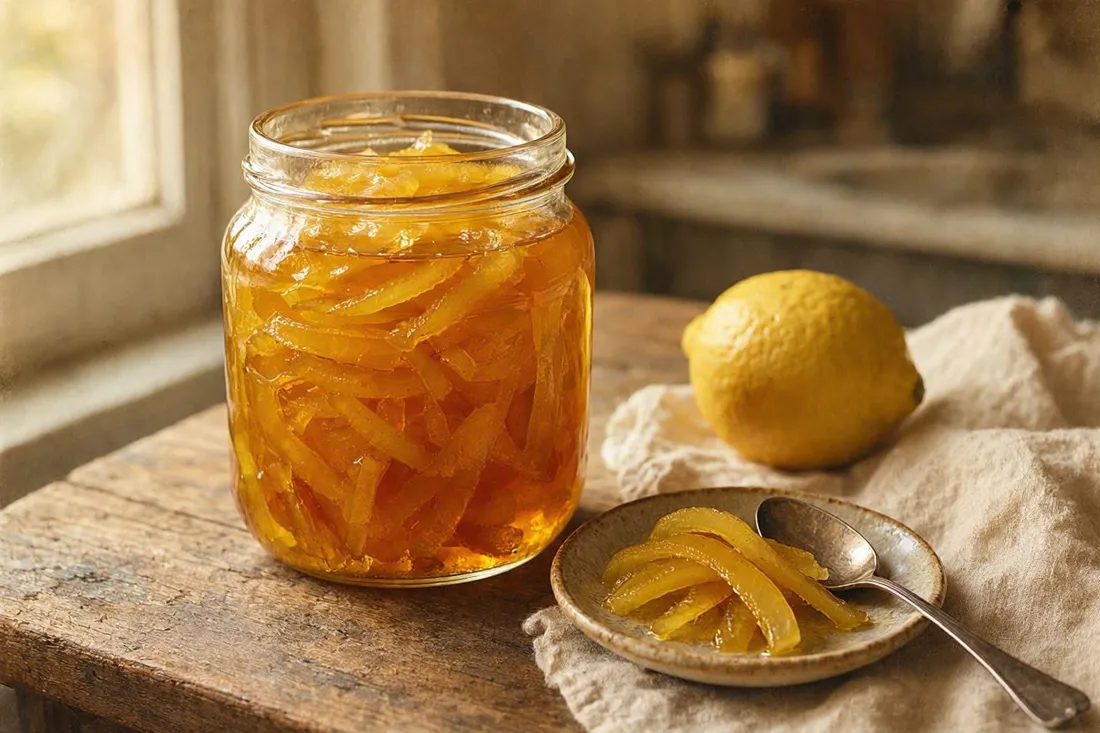
Candied Lemon Peel Spoon Sweet
Lemon peel cut into decorative strips or rounds, blanched to mellow its bitterness, then candied in a thick lemon-scented sugar syrup.
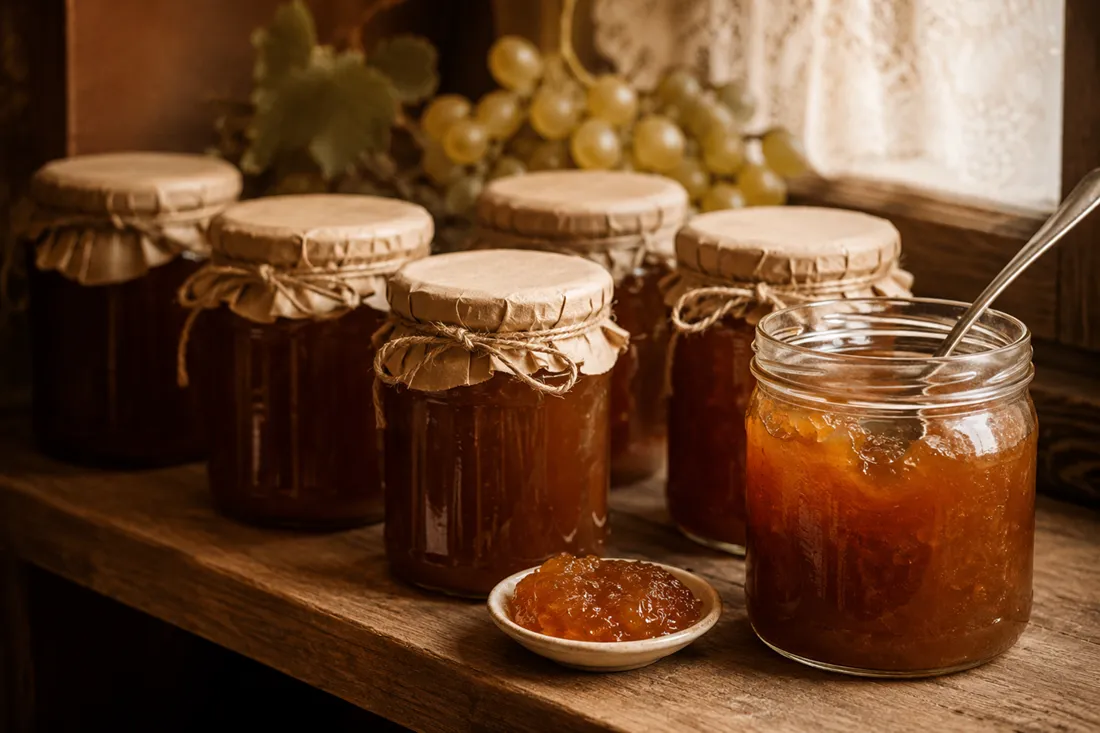
Grape and Quince Jam
White grape juice and pureed quince are simmered with sugar into a thick, spreadable jam, then jarred for keeping through the winter.
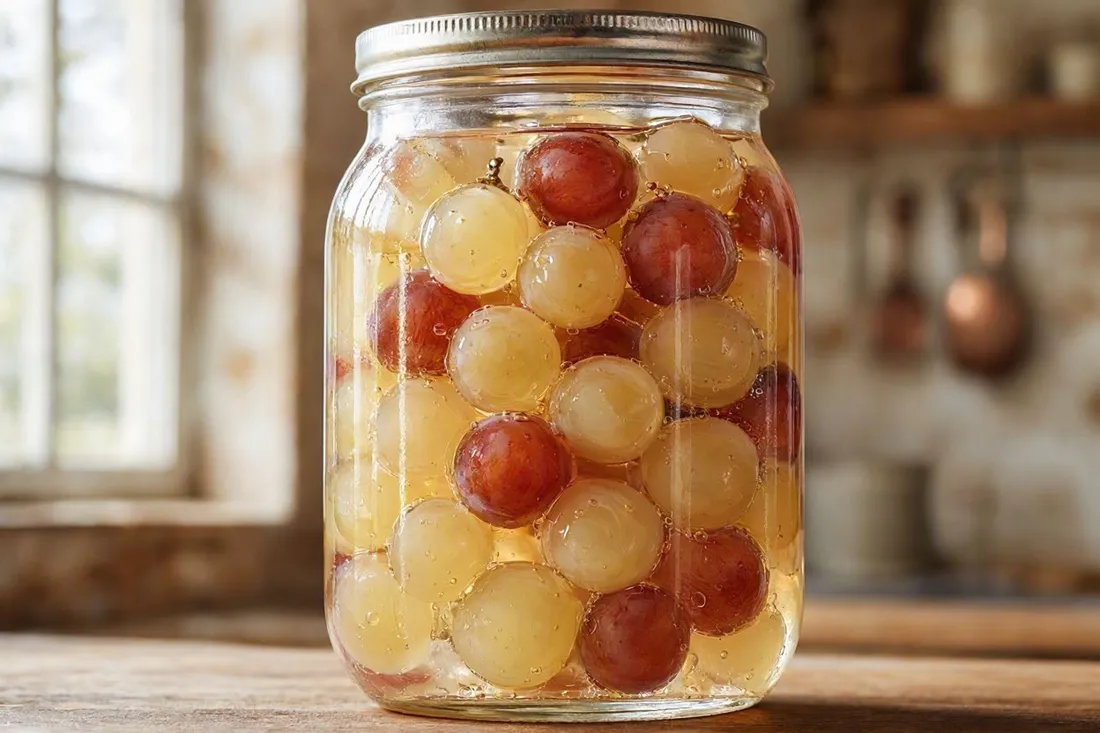
Grape Compote in Syrup
Small clusters of grapes are packed into jars and covered with a light sugar syrup, then home-canned for a stable preserve to enjoy through the colder months.