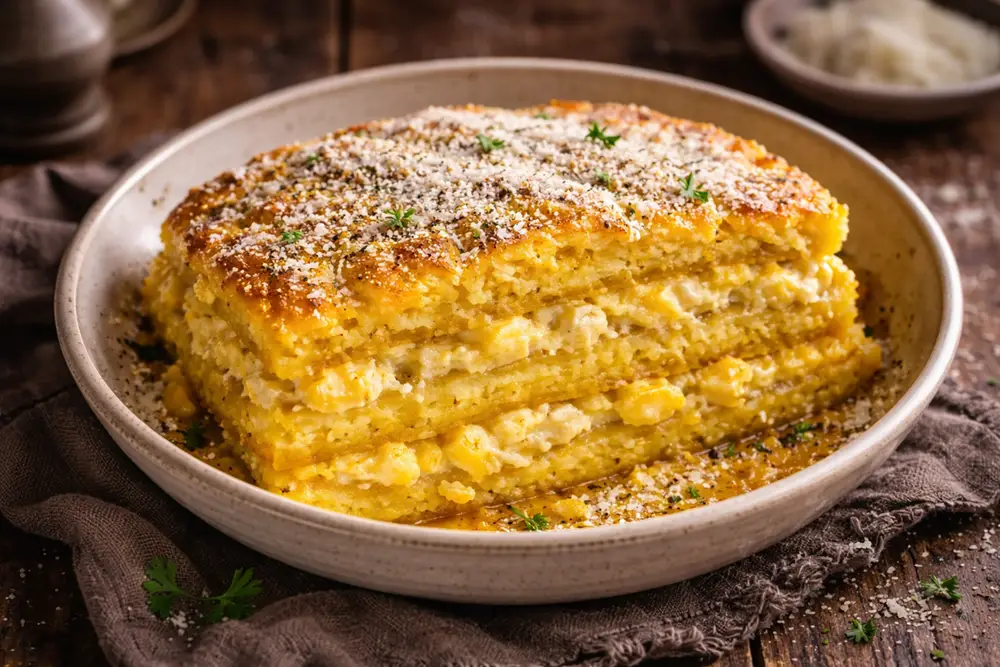
Layered Polenta with Parmesan and Scrambled Eggs
Firm polenta layered with grated hard cheese and soft scrambled eggs. A Central European home dish that turns humble cornmeal into a rich, satisfying meal.
Historical recipe
Modernised adaptation of an early 20th‑century source. Not independently kitchen-tested by Attic Recipes. Quantities, temperatures, and food safety guidance have been updated for a contemporary kitchen — results may vary and errors may exist. Nutritional values, where provided, are estimates only and have not been laboratory tested. Always follow current food safety guidelines for your region. If you have a health condition, allergy, or dietary requirement, consult a qualified professional before preparing this recipe.
Use of this recipe is entirely at your own risk and subject to our Terms of Service and Privacy Policy. Attic Recipes accepts no liability for any adverse outcome.
- Eggs
- Dairy
Additional notes
-
Warning
The scrambled eggs in this recipe are intentionally undercooked before layering and finish cooking only from the residual heat of the polenta. Final egg temperature may not consistently reach 74°C (165°F). Pregnant women, children under 18, the elderly, and immunocompromised individuals should use pasteurized eggs or ensure eggs are fully cooked before layering.
Use commercially pasteurized eggs, or cook scrambled eggs fully to 74°C (165°F) before layering — the texture will be firmer but the dish remains satisfying.
-
Note
This dish contains approximately 11g of saturated fat per serving, primarily from hard cheese and eggs. Those managing cardiovascular health or following a low saturated fat diet should consider reducing the cheese quantity or using a lower-fat hard cheese.
- 1
Bring the 2000ml water to a rolling boil in a large heavy-bottomed saucepan. Reduce the heat to medium-low. Slowly pour in the 500g sifted cornmeal in a thin, steady stream, whisking constantly to prevent lumps.
Tip Whisk without stopping for the first 2–3 minutes. Once the polenta thickens enough to hold a spoon upright, switch to a wooden spoon. - 2
Cook the polenta over low heat for 30 minutes, stirring frequently with a wooden spoon. After 30 minutes, add the 1 tsp salt and stir vigorously until the mass is smooth, thick, and pulls cleanly away from the sides of the pan. It should be firm enough to hold a layered shape.
Tip If the polenta absorbs all the water and is still grainy before 30 minutes, add a splash of hot water and continue cooking. Fine-ground cornmeal may be ready sooner than coarse. - 3
While the polenta finishes, prepare the first batch of scrambled eggs. Whisk 3 eggs together. Melt half the butter (½ tbsp) in a small non-stick pan over the lowest possible heat. Add the eggs and stir slowly and continuously with a silicone spatula. Pull the pan off the heat while the eggs are still visibly wet and creamy — they will finish cooking from the heat of the polenta.
Tip Do not season the scrambled eggs with salt — the cheese provides all the saltiness needed. - 4
In a wide, deep serving bowl (one that can go directly to the table), spread the first layer of polenta approximately 4 cm (2 fingers) deep. Sprinkle with one third of the 150g grated cheese. Spread the first batch of soft scrambled eggs evenly over the cheese.
- 5
Repeat: add a second layer of polenta, one third of the cheese, and a second batch of scrambled eggs prepared the same way as the first (using the remaining 3 eggs and ½ tbsp butter).
Tip Prepare the second egg batch during assembly, not in advance — they should go onto the polenta immediately after being pulled from the heat. - 6
Add the final layer of polenta. Sprinkle the remaining cheese over the top. Do not add eggs to the top layer.
- 7
Take the dish immediately to the table and serve hot, with a green salad alongside.
Nutrition Information per 1 portion (approx. 400g)
Nutritional values are approximate estimates and may vary based on specific ingredients used, preparation methods, and portion sizes.
Serving Suggestions
Serve immediately, hot, directly from the assembly bowl. A simple green salad with a light vinaigrette is the traditional accompaniment — the acidity cuts through the richness of the cheese and eggs. Leftovers can be sliced cold the following day and pan-fried in butter until a crust forms on each side.
About This Recipe
This is polenta treated not as a side dish but as a structure — built up in layers like a lasagna, each stratum of firm cornmeal separated by a thin mantle of grated hard cheese and a spoonful of soft, barely-set scrambled eggs. The result is simultaneously humble and surprisingly rich: the cornmeal provides the base, the cheese provides salt and depth, and the eggs — pulled from the heat while still wet — melt into the layers as the dish is assembled, finishing in the residual heat.
The cheese list tells you something about the geography of this recipe. Parmesan is named first, but Pag, kashkaval, and Livno follow immediately as alternatives — a practical acknowledgment that hard aged cheeses varied by region and what was available in the market that week. All of them work by the same principle: a sharp, salty hard cheese that grates finely and melts partially into the warm polenta without turning greasy.
What makes the technique interesting is the deliberate undercooking of the eggs. Soft scrambled eggs at the point of layering finish cooking from the heat of the polenta itself. This keeps them creamy rather than rubbery, and it is the kind of detail that only makes sense once you understand that the dish is assembled and served immediately — no resting, no reheating.
Why It Works
Polenta at the 1:4 ratio (corn flour to water by weight) produces a mass firm enough to hold its shape in layers but still soft enough to eat with a spoon. Coarser grinds take longer to hydrate; fine-ground cornmeal is ready closer to 25–30 minutes. The salt is added partway through cooking — an old practice that modern food science confirms: salt added at the start of cooking can slow starch gelatinization slightly, producing a grainier texture.
The layering sequence — polenta, cheese, eggs, polenta, cheese, eggs, polenta, cheese — mirrors the logic of lasagna: the carbohydrate layer provides structure, the fat and protein layers provide richness, and the topmost layer of cheese browns slightly from the heat of the polenta beneath it, adding texture contrast.
Modern Kitchen Tips
Use the finest cornmeal you can find for this recipe. Coarse polenta produces a more rustic texture and requires longer cooking, but fine-ground cornmeal gives cleaner, more cohesive layers.
Have the cheese grated and the eggs whisked before the polenta finishes cooking. Assembly must happen quickly — polenta starts to set as soon as it leaves the heat, and working slowly will produce uneven layers.
The serving bowl matters: use something wide and deep enough to hold three full layers without the polenta reaching the rim. Ceramic retains heat well and goes directly to the table.
A classic of early 20th century home cooking, preserved and adapted for the modern kitchen.
The Story Behind This Recipe
Historical Context
Home cooks of the period served this dish in the same bowl used for cooking or assembly, brought directly to the table while still hot. The technique of layering polenta with cheese and eggs mirrors lasagna construction and was common in Central European households where polenta was a staple weekday dish. The cheese alternatives listed — Pag, kashkaval, Livno — reflect the regional variety of hard aged cheeses available across the Austro-Hungarian successor states; Parmesan was the aspirational choice, while local hard cheeses were the everyday reality. Salt was added only partway through cooking — standard practice of the period, before the science of starch gelatinization was widely understood — salt added at the start can slightly slow water absorption in cornmeal.
Modern Kitchen Adaptation
Water quantity is estimated at 2000ml based on the standard 1:4 corn flour to water ratio for firm, sliceable polenta — the original specifies only 'pour water.' Parmesan quantity is estimated at 150g total (approximately 50g per layer) — the original specifies only 'sprinkle.' Butter for scrambled eggs is estimated at 1 tbsp total and is not present in the original, which gives no cooking fat for the eggs; a dry non-stick pan could be used instead. Kashkaval is noted as the most widely available substitute for Pag and Livno cheese; aged Pecorino Romano or aged Manchego are international alternatives with a similar salt and sharpness profile. Scrambled eggs should be cooked to a soft, wet curd and finished by residual heat from the polenta — this keeps them creamy rather than rubbery. Pasteurized eggs are recommended for vulnerable groups (see safety warnings).
This recipe is an independent modern adaptation developed from historical sources in the public domain. It is provided for informational and educational purposes only and does not constitute professional dietary, nutritional, or medical advice. Food preparation involves inherent risks. The reader assumes full responsibility for safe food handling, ingredient sourcing, and adherence to current local food safety guidelines. The site operator accepts no liability for outcomes resulting from the preparation or consumption of this recipe.
One recipe.
Every week.
You Might Also Like
More recipes from the same category
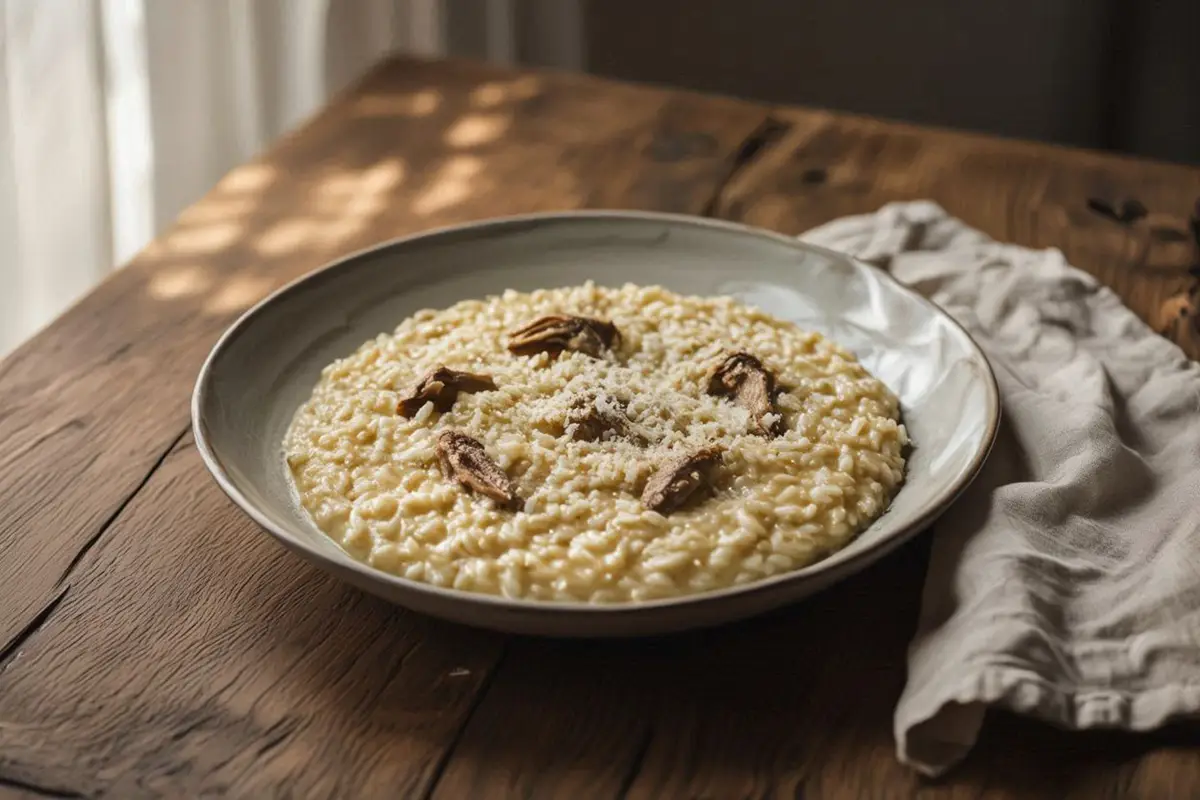
Frog Risotto (Risotto di Rane)
A rich pureed frog broth with tomato and aromatic vegetables, used as the cooking base for a deeply flavored Central European risotto.
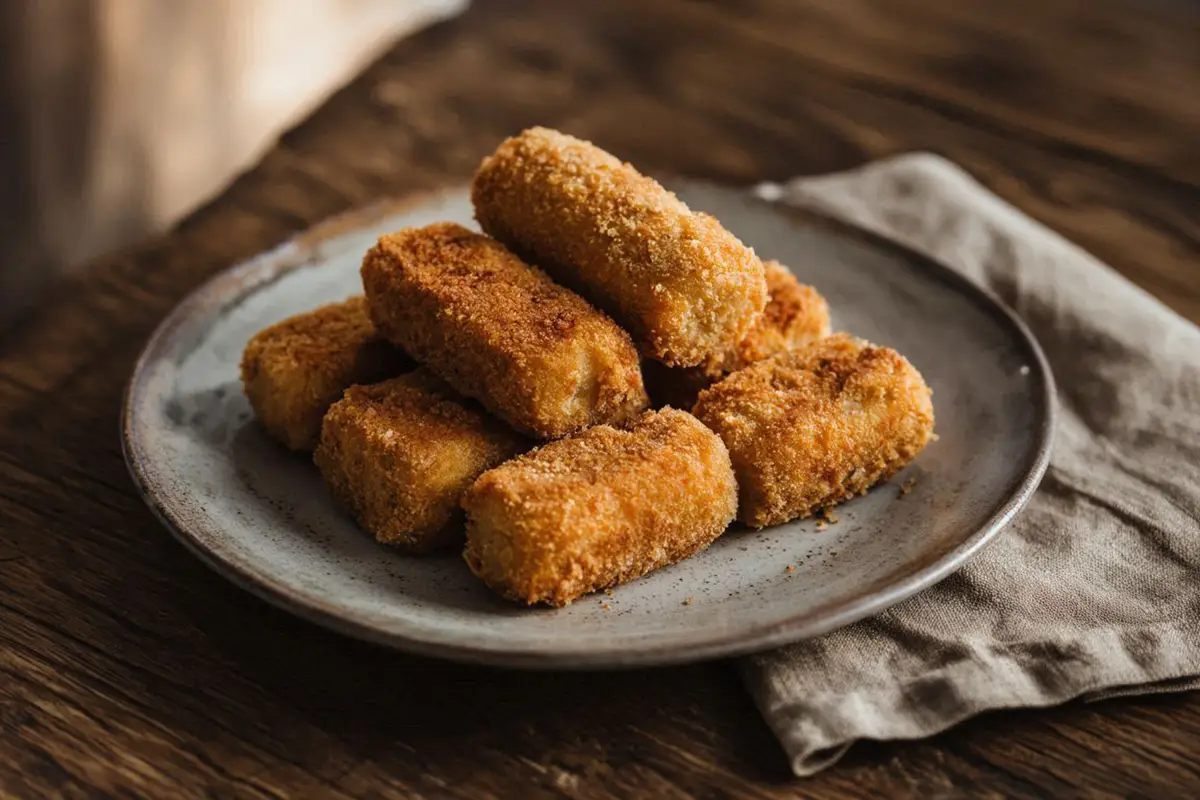
Mushroom and Rice Rolls
Crispy breaded rolls of earthy mushrooms and rice, bound with egg and parsley — a classic Central European side served alongside roast meats.
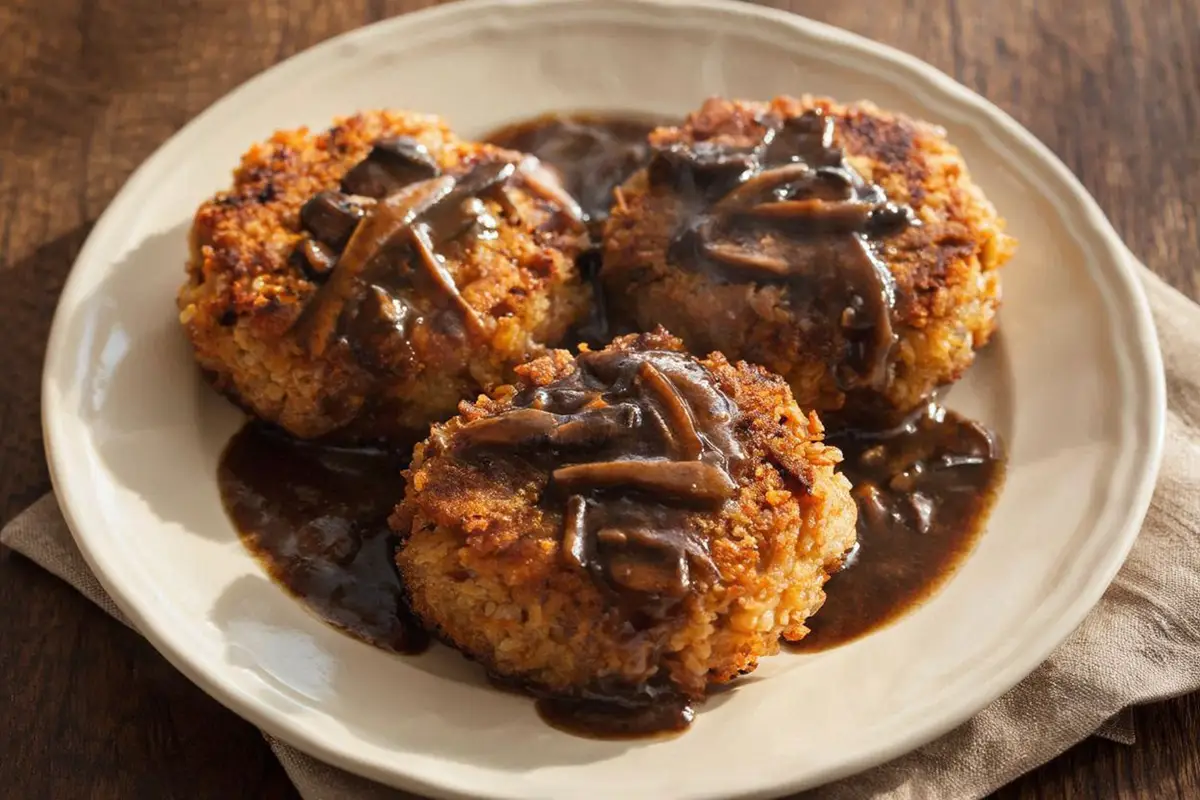
Rice Steaks with Mushroom Sauce
Crispy fried rice patties seasoned with pepper, served with a rich, creamy dried mushroom sauce — a satisfying Central European vegetarian main.