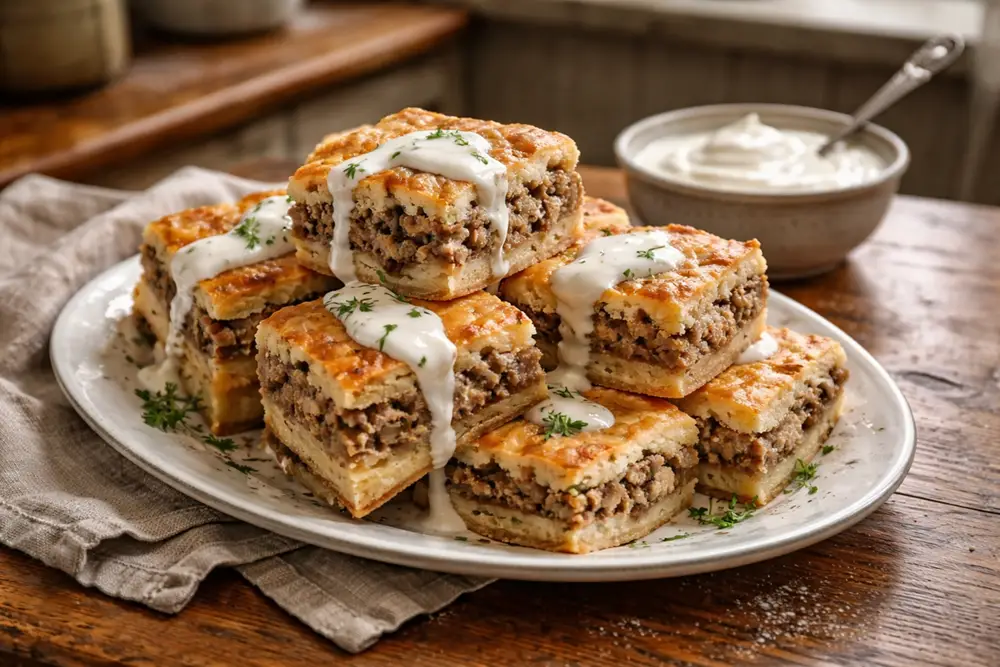
Layered Meat Pie
Egg dough baked in two layers around a braised ground pork filling, finished with warm sour cream and grated cheese — a satisfying Central European savory pie.
Historical recipe
Modernised adaptation of an early 20th‑century source. Not independently kitchen-tested by Attic Recipes. Quantities, temperatures, and food safety guidance have been updated for a contemporary kitchen — results may vary and errors may exist. Nutritional values, where provided, are estimates only and have not been laboratory tested. Always follow current food safety guidelines for your region. If you have a health condition, allergy, or dietary requirement, consult a qualified professional before preparing this recipe.
Use of this recipe is entirely at your own risk and subject to our Terms of Service and Privacy Policy. Attic Recipes accepts no liability for any adverse outcome.
- Eggs
- Dairy
- Gluten
Additional notes
-
Warning
This recipe contains raw egg whites used in a soufflé-style batter that is baked to an internal temperature of at least 74°C (165°F). Verify the internal temperature with a thermometer before serving. Pregnant women, elderly individuals, children under 18, and immunocompromised people should ensure the pie is fully cooked through before consuming.
-
Note
This recipe is high in saturated fat (approximately 14.6g per serving). Individuals managing cardiovascular health or following a low-saturated-fat diet should be aware.
-
Note
The filling contains pork mince cooked to above 74°C (165°F). Do not serve the pie lukewarm — reheat thoroughly if made in advance. Ground meat must reach 74°C throughout, not just at the surface.
- 1
Make the filling first so it has time to cool completely. Melt the lard in a wide saucepan over medium heat. Add the finely chopped onions and cook, stirring occasionally, for 8–10 minutes until soft and lightly golden.
- 2
Add the ground pork to the onions and break it up well with a wooden spoon. Fry over medium-high heat until the meat is no longer pink and has begun to brown, about 5–6 minutes.
- 3
Reduce the heat to low. Begin adding the milk in a thin, gradual stream — a few tablespoons at a time — stirring after each addition. The goal is to braise rather than fry: the meat should absorb the milk slowly and become tender rather than crisp. Continue until all 150 ml of milk has been incorporated and the filling is moist but not wet. Season with salt and pepper.
Tip The finished filling should be almost dry — any excess liquid will make the dough soggy. If the filling is still wet after all the milk is absorbed, cook uncovered for 2–3 more minutes over low heat. - 4
Remove the filling from the heat and spread it on a wide plate to cool completely. The filling must be at room temperature before assembly — a warm filling will collapse the dough. This step can be done 30–60 minutes ahead.
- 5
When ready to bake, preheat the oven to 180°C (350°F) / 160°C fan. Grease the baking sheet generously with softened butter, then dust lightly with flour, tapping out the excess.
- 6
Separate the eggs. Place the egg whites in a large, completely clean and dry bowl. Beat with a hand mixer or stand mixer on high speed until stiff, glossy peaks form — the whites should hold their shape when you lift the beaters and not slide when the bowl is tilted.
Tip Any trace of yolk or fat in the bowl will prevent the whites from reaching full volume. Wipe the bowl and beaters with a little lemon juice on a paper towel before starting. - 7
In a separate bowl, whisk the egg yolks with the sour cream until pale, smooth, and slightly thickened, about 2–3 minutes. The mixture will not become stiff — it should be creamy and homogenous.
- 8
Add the sifted flour and salt to the yolk-sour cream mixture and stir until just combined — do not overmix.
- 9
Using a large spatula, gently fold the yolk mixture into the beaten egg whites in three additions. Work from the bottom of the bowl upward in slow, deliberate strokes to preserve as much air as possible. The finished batter will be pale, airy, and slightly streaky — this is correct.
- 10
Pour exactly half of the batter onto the prepared baking sheet and spread evenly with a palette knife or the back of a spoon to an even thickness of about 1 cm. Place in the preheated oven and bake for 12–15 minutes, until the surface is set, lightly golden, and a skewer inserted into the centre comes out clean. The dough will be puffed but not fully cooked through — this is the first baking phase.
Tip Do not open the oven door during the first 10 minutes. - 11
Remove the baking sheet from the oven. Working quickly and gently, spread the cooled meat filling evenly over the half-baked dough layer, leaving a 1 cm border around the edges.
- 12
Pour and spread the remaining batter over the meat filling, covering it completely. Return the baking sheet to the oven and bake for a further 18–22 minutes, until the top is deep golden and a thermometer inserted into the centre of the pie reads at least 74°C (165°F).
Tip The internal temperature is important here — both egg and pork must reach 74°C for food safety. - 13
Remove from the oven and rest for 5 minutes. Meanwhile, warm the sour cream in a small saucepan over the lowest heat, stirring, until just warmed through — do not let it simmer or it will separate.
- 14
Cut the pie into small squares directly in the baking sheet. Transfer to a serving platter, pour the warmed sour cream evenly over the top, and finish with a generous shower of finely grated cheese. Serve immediately.
Nutrition Information per 1 serving (approx. 260g)
Nutritional values are approximate estimates and may vary based on specific ingredients used, preparation methods, and portion sizes.
Serving Suggestions
Serve hot from the oven on a warmed platter. Works well as a main course with a simple green salad or pickled vegetables alongside. Leftovers reheat well in the oven at 160°C for 10 minutes — avoid the microwave, which will make the dough rubbery.
About This Recipe
This pie belongs to a category of Central European baking that sits somewhere between a soufflé and a flat pastry — neither quite one thing nor the other. The dough is built from beaten egg whites folded together with yolks, sour cream, and just enough flour to hold its shape on a baking sheet. The result is light, slightly springy, and entirely unlike any conventional pastry crust. It bakes in two stages: the first layer goes into the oven alone to set partially, then comes out to receive the filling, is covered with the second layer of batter, and returns to the oven to finish.
The filling is a simple braised ground pork — onions softened in lard, pork cooked until browned, then brought slowly to tenderness with gradual additions of milk. The technique is important: this is not a fried mince filling, it is a braised one. The milk absorbed slowly during cooking keeps the meat moist and prevents it from drying out against the warm dough. The whole thing finishes with warmed sour cream poured over the cut squares and a generous covering of grated hard cheese.
It is the kind of dish that requires a little attention to technique but rewards it: the dough behaves differently from anything a modern cook might encounter in a standard recipe book, and getting the egg whites right is the key to the whole thing.
Why It Works
The egg white structure is load-bearing here. Beaten egg whites are a foam — millions of tiny air bubbles stabilised by protein — and when they go into a hot oven, those bubbles expand and the proteins set around them, creating a light, rigid structure. The flour and yolks in the batter add richness and stability without weighing the foam down too much. The sour cream contributes fat and acidity, which tenderises the dough and gives it a slight tang that balances the richness of the pork filling.
The two-stage baking is a structural solution: a raw batter poured over a meat filling would either absorb the meat juices before it could set, or collapse under the weight. By setting the base layer first, you create a platform that can support the filling and hold the top layer of batter in place during the second bake.
Modern Kitchen Tips
On the egg whites: Use a clean, dry bowl — fat is the enemy of egg white foam. Even a trace of yolk (which contains fat) will prevent the whites from reaching full volume. Separate eggs one at a time into a small cup before adding to the bowl, so a broken yolk doesn’t ruin the whole batch.
On the filling: Cool it completely. Spreading warm filling over the half-baked dough layer will begin to cook the proteins in the bottom layer from above, causing the dough to toughen and the structure to collapse. Thirty minutes on a wide plate at room temperature is usually enough.
On the dough consistency: The batter should be airy but pourable — somewhere between thick pancake batter and a mousse. If it seems very stiff, your egg whites may have been over-beaten (dry peaks rather than glossy peaks). If it seems very runny, the folding may have deflated too much air. Both will still bake, but the texture of the finished pie will suffer.
On the thermometer: Do not skip the internal temperature check (74°C / 165°F). This pie contains both egg and pork, and the visual cue of a golden top does not guarantee that the centre has reached a safe temperature.
A classic of early 20th century Central European home cooking, preserved and adapted for the modern kitchen.
The Story Behind This Recipe
Historical Context
Home cooks of the period prepared this pie on baking sheets placed directly into wood-fired range ovens, which produced intense bottom heat and gentler top heat — ideal for a soufflé-style dough that needed to set from below without collapsing. No oven temperature was specified in early 20th century recipes for this dish, as familiarity with the stove's heat zones was assumed. The cheese used for finishing was not specified by variety — in middle-class Central European households of the era, hard regional cheeses similar to Emmental or aged Gouda would have been the standard pantry item.
Modern Kitchen Adaptation
Lard was the standard everyday cooking fat of the period and is used here for the filling. A neutral oil (sunflower or rapeseed, 1 tablespoon) is a direct substitute with no change to quantity or technique; unsalted butter also works but will brown more quickly and add a slightly different flavour. The oven temperature and baking times are estimated — early recipes for this dish gave no temperature, specifying only that the dough should be 'baked halfway through' in the first phase. Modern fan-assisted ovens at 160°C produce consistent results.
This recipe is an independent modern adaptation developed from historical sources in the public domain. It is provided for informational and educational purposes only and does not constitute professional dietary, nutritional, or medical advice. Food preparation involves inherent risks. The reader assumes full responsibility for safe food handling, ingredient sourcing, and adherence to current local food safety guidelines. The site operator accepts no liability for outcomes resulting from the preparation or consumption of this recipe.
One recipe.
Every week.
You Might Also Like
More recipes from the same category
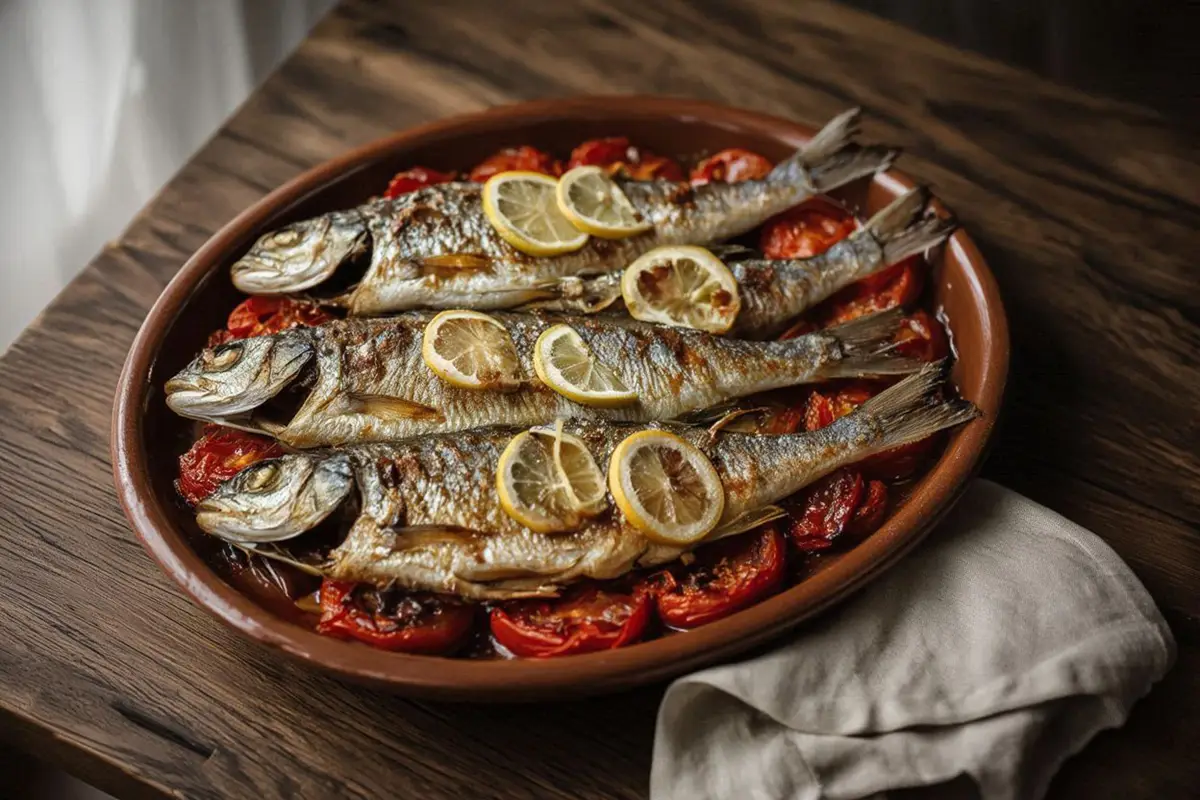
Baked Fish with Tomatoes
Whole fish baked over ripe tomatoes with generous olive oil and lemon — a simple, fragrant Central European oven dish.
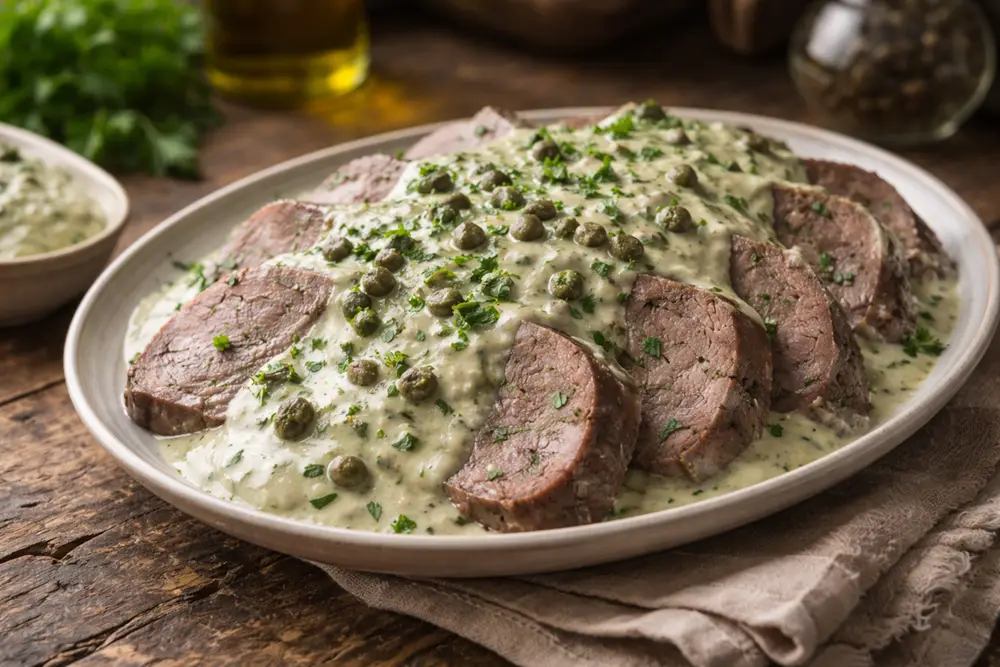
Baked Tongue in Green Sauce
Beef tongue braised with herbs, larded with bacon and roasted until golden, served in a green sauce of capers, anchovy, parsley and sour cream.
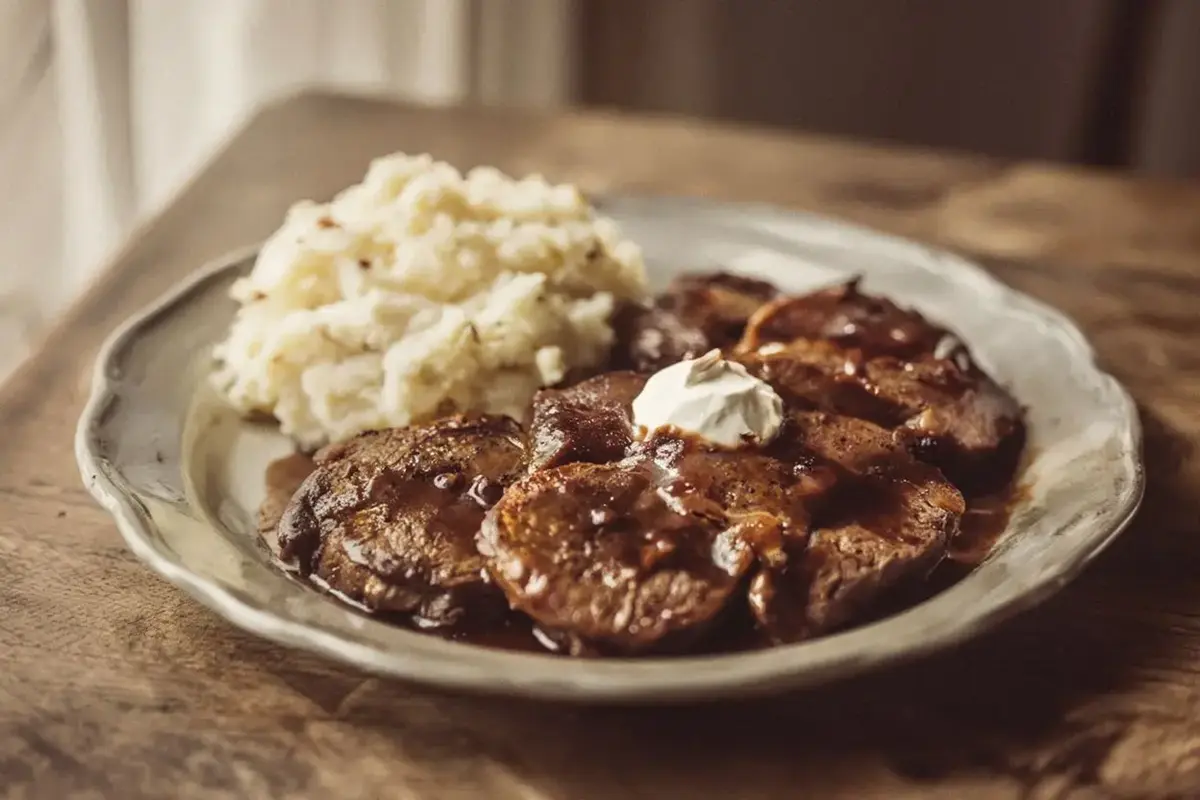
Beef Kidney with Wine
Beef kidney marinated in red wine, braised with herbs, finished with sour cream. Tender, rich, and deeply flavored.