Grapefruit Marmalade
A bitter-sweet marmalade of grapefruit and lemon, slow-cooked after an overnight soak — a classic Central European preserve from the early 20th century.
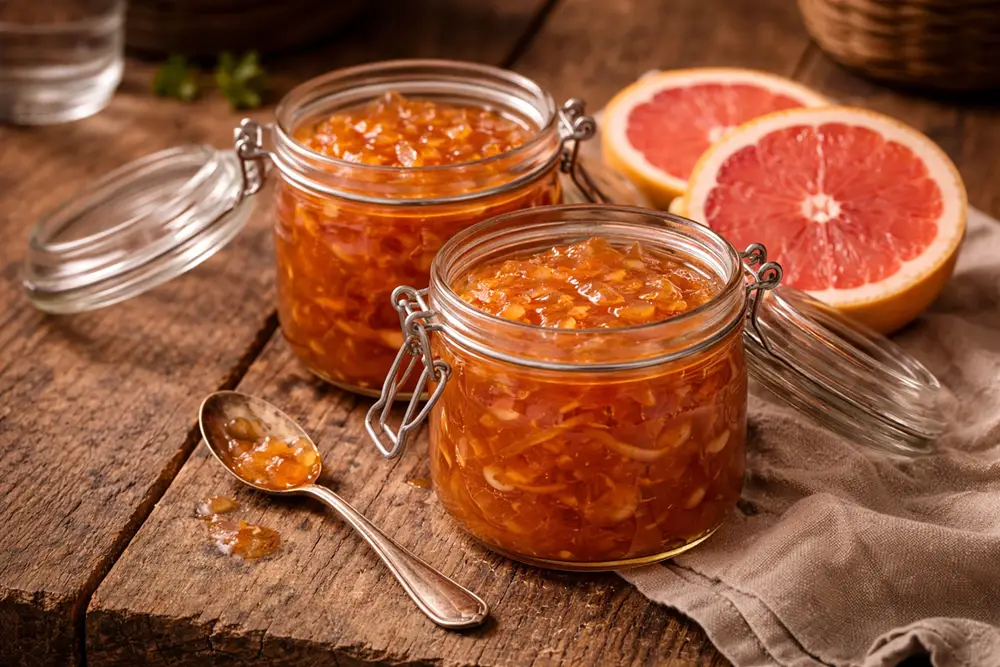
Historical recipe
Modernised adaptation of an early 20th‑century source. Not independently kitchen-tested by Attic Recipes. Quantities, temperatures, and food safety guidance have been updated for a contemporary kitchen — results may vary and errors may exist. Nutritional values, where provided, are estimates only and have not been laboratory tested. Always follow current food safety guidelines for your region. If you have a health condition, allergy, or dietary requirement, consult a qualified professional before preparing this recipe.
Use of this recipe is entirely at your own risk and subject to our Terms of Service and Privacy Policy. Attic Recipes accepts no liability for any adverse outcome.
Additional notes
-
Warning
Hot marmalade reaches temperatures above 104°C and will cause serious burns on contact with skin. Use a long-handled spoon when stirring and exercise caution when pouring into jars. Keep children away from the stove during the boiling stage.
-
Warning
Jars must be sterilized before filling. Unsterilized jars risk mold growth even in a high-sugar preserve. To sterilize: wash thoroughly, then place in an oven at 120°C for 15 minutes. Fill while still warm.
-
Note
If the sugar quantity is reduced from the original, the marmalade will not keep safely at room temperature. Store reduced-sugar marmalade in the refrigerator (up to 4 weeks) or freezer (up to 12 months).
- 1
Wash and dry all the grapefruits and lemons thoroughly. Cut each fruit in half and squeeze out the juice, saving every drop. Remove and discard the seeds and the tough central membrane of each grapefruit. Collect the seeds and membranes in a small bowl — they will be used in the next step.
- 2
Cut the outer and inner peel of all the fruit into very thin strips — the thinner the better for texture. Place the strips into a large non-reactive pot of at least 12L capacity together with all the saved juice and the 6L of water. Tie the seeds and membranes loosely in a piece of cheesecloth and add the bundle to the pot.
- 3
Cover the pot and leave to soak overnight — a minimum of 8 hours. The soak softens the peel, extracts natural pectin from the seeds and membranes, and develops the flavour of the finished marmalade. The pot may be left at room temperature in a cool kitchen, or refrigerated if the kitchen is warm.
- 4
The next day, bring the pot to a boil over medium heat, then reduce to a gentle simmer. Cook uncovered for approximately 3 hours, stirring occasionally, until the liquid has reduced by half and the peel strips are completely tender and translucent. Remove and discard the cheesecloth bundle.
Tip Do not add the sugar before this reduction is complete. The peel must be fully softened before sugar goes in — sugar added too early will cause the peel to toughen and prevent it from becoming tender. - 5
Add the 4500g of sugar to the pot and stir over low heat until completely dissolved. Increase the heat to medium-high and bring to a rolling boil. Boil steadily for 20 to 30 minutes, stirring frequently to prevent scorching, until the marmalade reaches setting point.
- 6
Test for set: drop a small spoonful of marmalade onto a chilled plate and leave for 30 seconds. Push it gently with your finger — if it wrinkles and holds its shape, the marmalade is ready. Alternatively, use a thermometer: the marmalade is ready at 104°C (220°F). If it has not yet reached setting point, continue boiling and test again every 5 minutes.
- 7
Remove the pot from the heat. Skim any white foam from the surface using a spoon. Allow the marmalade to rest for 5 minutes — this helps distribute the peel evenly rather than having it float to the top of the jars.
- 8
Pour the hot marmalade into warm, sterilized jars, filling to within 0.5cm of the rim. Wipe the rims clean, seal immediately with sterilized lids, and invert the jars for 5 minutes, then turn upright. Allow to cool completely at room temperature — do not disturb the jars while they are cooling and setting.
Tip Jars must be sterilized before filling. To sterilize: wash in hot soapy water, rinse, then place in an oven at 120°C for 15 minutes. Fill jars while they are still warm to prevent thermal shock. - 9
Label jars with the date. Store in a cool, dark place for up to 12 months unopened. Once opened, refrigerate and use within 4 weeks.
Nutrition Information per 1 tablespoon (approx. 20g)
Nutritional values are approximate estimates and may vary based on specific ingredients used, preparation methods, and portion sizes.
Serving Suggestions
Spread on toasted bread, brioche, or buttered scones. Pairs well with sharp aged cheese. Can be used as a glaze for roast duck or pork.
About This Recipe
Grapefruit marmalade is a more assertive preserve than its orange counterpart — the bitterness of the grapefruit peel sits alongside the sugar rather than being softened by it, which is precisely what makes it interesting. Early 20th century home cooks understood this and leaned into it: the sugar quantities in period recipes are high by modern standards, but they serve a purpose. Sugar was the preservative, and a properly made marmalade sealed in a clean jar kept on the pantry shelf through the winter without refrigeration.
This recipe uses both grapefruit and lemon. The lemon adds acidity and pectin, both of which help the marmalade set cleanly and give it a brighter, sharper edge. The ratio here — four grapefruits to five lemons — produces a marmalade with good body and a clean, balanced bitterness.
The overnight soak is not optional. It softens the tough citrus peel before the long cook begins, extracts natural pectin from the seeds and membranes, and starts the process of mellowing the raw bitterness of the pith. What goes into the pot in the morning is already partway to becoming marmalade.
Why It Works
Citrus peel is high in pectin — particularly the white pith and the seeds — which is why citrus marmalade sets reliably without added pectin when made with the full sugar quantity. The pectin in citrus requires both sugar and acid to form a gel; all three elements are present in this recipe in abundance.
The two-stage cooking process — first a long, low reduction without sugar, then a short, fierce boil after the sugar goes in — is essential. Sugar added to raw or undercooked peel will cause it to toughen, preventing it from becoming tender no matter how long it is subsequently cooked. The first stage cooks the peel through completely; the second stage sets the gel.
The set point test at 104°C is reliable because it marks the concentration at which dissolved sugar and pectin form a stable network. Below this temperature the gel will not hold; above it, the marmalade risks overcooking and becoming rubbery or overly dark.
Modern Kitchen Tips
A thermometer removes guesswork from the set point — 104°C is the target. If you do not have one, the wrinkle test on a chilled plate works just as well and requires no equipment beyond a small plate kept in the freezer during the boiling stage.
The cheesecloth bundle of seeds and membranes is worth doing. It adds measurable pectin to the cook and improves the set without affecting the flavour or clarity of the finished marmalade. Remove it before adding the sugar.
If reducing the sugar from the original quantity, follow the dosage instructions on the commercial pectin package precisely — different products have different ratios, and the manufacturer’s guidance is calibrated for their specific formulation.
A classic of early 20th century home cooking, preserved and adapted for the modern kitchen.
The Story Behind This Recipe
Historical Context
Early 20th century marmalade recipes routinely called for sugar quantities at or above a 2:1 ratio relative to the fruit — in this recipe, 4.5kg of sugar to approximately 2kg of fruit. This was not excess but calculation: sugar was the only preservative available to the home cook, and a high-sugar marmalade sealed in a clean jar would keep on the pantry shelf through the winter without spoiling. The overnight soak before cooking was standard practice for citrus preserves, understood empirically to soften the tough peel and produce a clearer, better-set result.
Modern Kitchen Adaptation
The original sugar quantity of 4.5kg is retained as written — it produces a firmly set, intensely flavoured marmalade that keeps well at room temperature. If you prefer a less sweet result, the sugar may be reduced, but adding commercial pectin according to the manufacturer's instructions is necessary to ensure a reliable set; reduced-sugar marmalade should be stored in the refrigerator or freezer rather than at room temperature. The cheesecloth bundle for seeds and membranes is a modern technique not specified in the original but consistent with the period practice of using the whole fruit; it is recommended for a better set. The original gave no sterilization instructions — modern food safety standards require sterilized jars and proper sealing. For additional shelf stability, sealed jars may be processed in a boiling water bath for 10 minutes, though this is not strictly necessary for a high-sugar, high-acid citrus marmalade.
This recipe is an independent modern adaptation developed from historical sources in the public domain. It is provided for informational and educational purposes only and does not constitute professional dietary, nutritional, or medical advice. Food preparation involves inherent risks. The reader assumes full responsibility for safe food handling, ingredient sourcing, and adherence to current local food safety guidelines. The site operator accepts no liability for outcomes resulting from the preparation or consumption of this recipe.
One recipe.
Every week.
You Might Also Like
More recipes from the same category
Whipped Apricot or Peach Preserve (No-Cook)
A silky, pale fruit spread made by whipping raw apricot or peach puree with sugar - no cooking required.
Apricot Fruit Paste
Sieved ripe apricots cooked with equal weight sugar and lemon juice, poured into molds and air-dried — from early 20th century Central European kitchens.
Blackberry and Cornelian Cherry Marmalade
Rich preserve combining tart cornelian cherries with sweet blackberries, cooked to thick consistency with a traditional two-fruit method.