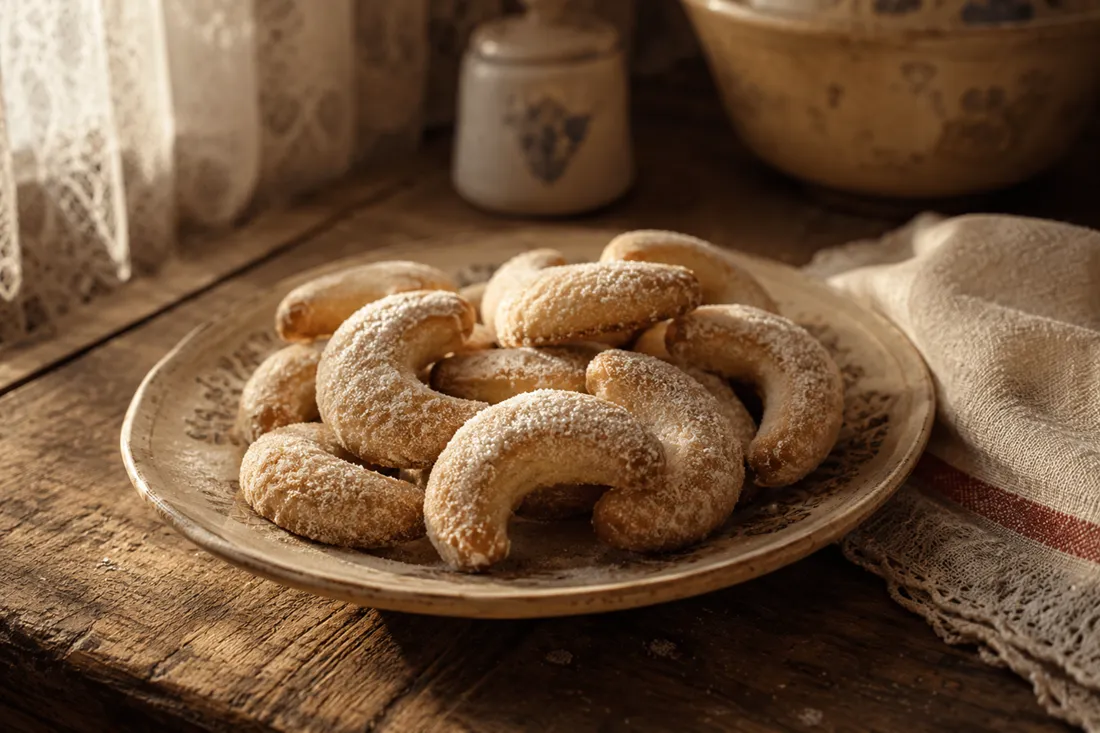
Cooked Egg Yolk Crescent Cookies
Delicate butter cookies made with hard-boiled egg yolks, rolled into crescents and coated in vanilla sugar — a forgotten Central European baking technique.
Quick Summary
A Central European butter cookie made by sieving hard-boiled egg yolks into the dough instead of using raw eggs, giving an unusually fine, crumbly texture. Ready in under an hour, including baking, and finished warm in vanilla sugar.
Historical recipe
Modernised adaptation of an early 20th‑century source. Not independently kitchen-tested by Attic Recipes. Quantities, temperatures, and food safety guidance have been updated for a contemporary kitchen — results may vary and errors may exist. Nutritional values, where provided, are estimates only and have not been laboratory tested. Always follow current food safety guidelines for your region. If you have a health condition, allergy, or dietary requirement, consult a qualified professional before preparing this recipe.
Use of this recipe is entirely at your own risk and subject to our Terms of Service and Privacy Policy. Attic Recipes accepts no liability for any adverse outcome.
- Eggs
- Dairy
- Gluten
- 1
Place the 6 eggs in a pot, cover with cold water, and hard-boil for 10-12 minutes. Cool completely, then separate the yolks and press them through a fine sieve or food mill until smooth.
- 2
In a mixing bowl, beat the 250g softened butter until light, pale, and fluffy, similar to whipped snow.
Tip The lighter the butter is whipped, the more tender the finished cookie. - 3
Fold the sieved egg yolks, 125g fine sugar, the juice of 1 medium lemon, and 0.25 tsp fine salt into the whipped butter, mixing until fully combined.
- 4
Add the 320g flour gradually, a little at a time, mixing until the dough just comes together and feels firm but not stiff.
Tip Stop adding flour as soon as the dough holds together — overworking makes the cookies tough. - 5
On a lightly floured surface, roll the dough out into a thin sheet. Cut into small squares and shape each square into a crescent.
- 6
Arrange the crescents on a buttered baking sheet, leaving space between each for slight spreading.
- 7
Bake at 180°C (350°F) / 160°C fan for 12-15 minutes, until lightly golden.
- 8
While still warm, roll each cookie in the 50g vanilla sugar to coat completely.
- 9
Transfer to a wire rack and cool completely before serving or storing.
Serving Suggestions
Serve alongside coffee or tea as part of a holiday cookie plate; the vanilla sugar coating pairs especially well with black tea or a light dessert wine.
About This Recipe
Long before electric mixers and instant-read thermometers, home bakers found clever ways to coax tenderness out of simple butter doughs. This recipe uses a technique that feels almost like a kitchen trick: hard-boiling the egg yolks first, then sieving them into the butter instead of adding raw yolks. The cooked yolks act less like a binder and more like a fine, dry enrichment — closer in effect to a starch than to a liquid egg — which is exactly what gives these crescents their signature sandy, melt-away crumb.
It’s a technique that has largely fallen out of home baking, overshadowed by simpler creamed-butter cookie doughs that use raw eggs. But the extra step of boiling and sieving the yolks rewards the baker with a texture that’s genuinely hard to replicate any other way.
Why It Works
Raw egg yolks contain both fat and water, and that water content activates gluten development when mixed into flour, which can make a dough chewier or more elastic. Hard-boiling the yolks first drives off most of that moisture and denatures the proteins, so when the sieved yolk is worked into the dough, it behaves almost like a fine powder rather than a liquid enrichment. The result is a shorter, more crumbly texture — the same principle used in some classic European sablé and shortbread doughs, just achieved through a period-appropriate technique rather than modern ingredient substitutions.
Modern Kitchen Tips
Sieve the cooled yolks while they’re still slightly warm — they pass through a fine mesh far more easily than once fully cooled. If the dough feels too soft to roll after adding all the flour, chill it for 15-20 minutes before shaping; this isn’t part of the original method, but it makes the crescents easier to handle in a warm kitchen. Store cooled, coated cookies in an airtight container for up to a week; they also freeze well unglazed for up to two months.
A classic of early 20th century home baking, preserved and adapted for the modern kitchen.
The Story Behind This Recipe
Historical Context
Early 20th century recipes for this dish typically called for hard-boiled egg yolks pressed through a sieve rather than raw yolks, a technique that gave shortbread-style doughs a especially fine, sandy crumb. The traditional approach did not specify an exact flour quantity or oven temperature — flour was added by feel until the dough reached the right firmness, and the oven was judged by hand as 'moderate' heat, standard practice before household oven thermostats.
Modern Kitchen Adaptation
The flour quantity (320g) and oven temperature (180°C / 350°F) are estimated based on standard shortbread-style dough ratios and period baking practice, since the original gave neither a fixed amount nor a temperature. A small pinch of salt has been added, which was commonly omitted in period sweet doughs but improves flavor balance in the modern version. The vanilla sugar quantity for coating is also estimated. Because the egg yolks are fully cooked before being incorporated into the dough, there is no raw-egg food safety concern with this recipe.
This recipe is an independent modern adaptation developed from historical sources in the public domain. It is provided for informational and educational purposes only and does not constitute professional dietary, nutritional, or medical advice. Food preparation involves inherent risks. The reader assumes full responsibility for safe food handling, ingredient sourcing, and adherence to current local food safety guidelines. The site operator accepts no liability for outcomes resulting from the preparation or consumption of this recipe.
One recipe.
Every week.
You Might Also Like
More recipes you'll enjoy

Honey Spice Tea Cookies with Almonds
Honey and spice tea cookies, spiced with cinnamon and clove, brushed with egg yolk and topped with almond halves — they only get better with time.
Classic Jam-Filled Crepes
Thin, delicate egg crepes with very little flour, pan-fried and rolled around jam, finished with vanilla sugar — a simple Central European classic.
Layered Almond Torte with Two Fillings
A rich four-layer almond torte with two contrasting fillings — vanilla custard and chocolate-hazelnut — finished in a poured chocolate glaze.