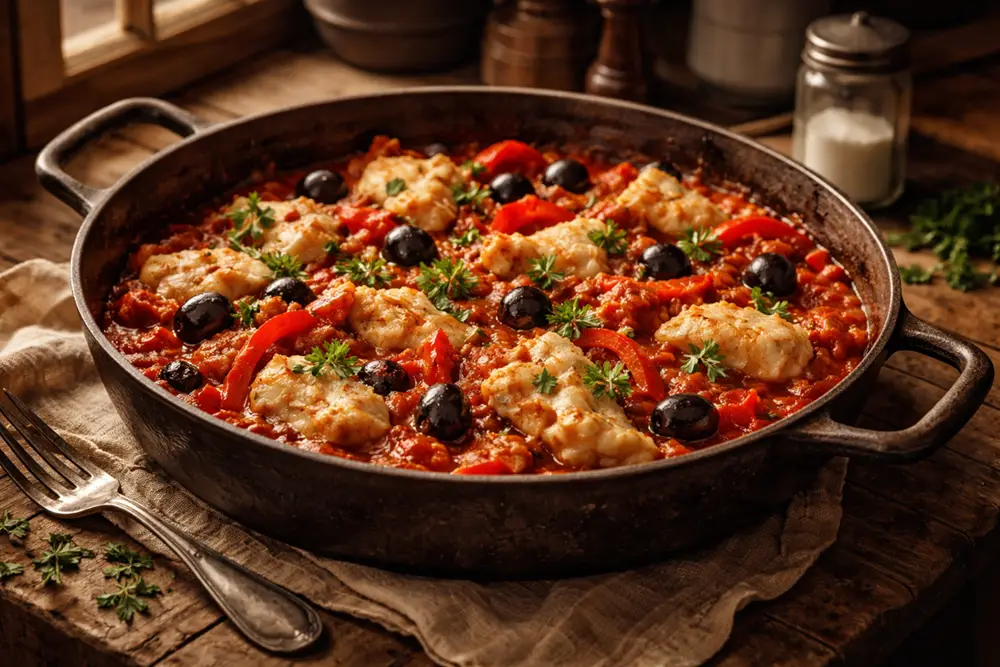
Cod with Tomatoes, Peppers and Black Olives
Salt cod braised with fresh tomatoes, red onion, garlic, bell peppers and black olives in olive oil.
Historical recipe
Modernised adaptation of an early 20th‑century source. Not independently kitchen-tested by Attic Recipes. Quantities, temperatures, and food safety guidance have been updated for a contemporary kitchen — results may vary and errors may exist. Nutritional values, where provided, are estimates only and have not been laboratory tested. Always follow current food safety guidelines for your region. If you have a health condition, allergy, or dietary requirement, consult a qualified professional before preparing this recipe.
Use of this recipe is entirely at your own risk and subject to our Terms of Service and Privacy Policy. Attic Recipes accepts no liability for any adverse outcome.
- Fish
- Sulphites
Additional notes
-
Warning
Salt cod must be soaked for a minimum of 48 hours with multiple water changes before cooking to reduce sodium to safe levels. Inadequately desalted cod can contain extremely high sodium concentrations. Do not shorten the soaking time. Individuals on low-sodium diets, those with hypertension, kidney disease, or heart conditions should consult a healthcare provider before consuming salt cod dishes.
-
Caution
Check the flaked cod carefully for small bones before adding to the sauce — salt cod often retains pin bones after the main skeleton is removed. This is especially important when serving to children under 18, elderly individuals, or anyone at risk of choking.
-
Note
Black olives packed in brine may contain sulphites (SO₂). Check the label if sulphite sensitivity is a concern. Rinse olives briefly under cold water before use to reduce sodium and sulphite content.
- 1
If using salt cod: place the cod pieces in a large bowl and cover completely with cold water. Refrigerate for a minimum of 48 hours, changing the water 3–4 times per day. The fish is ready when it has lost most of its salt and the flesh feels pliable rather than stiff. Taste a small piece — it should be pleasantly seasoned, not aggressively salty.
Tip The soaking time depends heavily on the thickness of the fish. Thick centre cuts may need 72 hours; thin tail pieces may be ready in 36. Change the water more frequently in warmer weather. - 2
After soaking, drain the cod and place in a saucepan. Cover completely with fresh cold water. Bring to the point of boiling over medium heat — as soon as the water reaches a full boil, move the pan to the lowest possible heat, cover, and cook at a bare simmer for 20 minutes. The water should tremble, not bubble.
Tip Boiling cod vigorously makes it tough and stringy. The moment it reaches a boil, reduce the heat. This gentle poaching keeps the flesh tender. - 3
Remove the cod pieces with a slotted spoon and set on a plate to cool slightly. Remove and discard all skin and bones. Using your fingers, break the flesh into large flakes — it should pull apart naturally along the muscle fibres. Set aside.
- 4
Heat 80ml olive oil in a large deep frying pan or wide saucepan over medium heat. Add 160g finely chopped red onion and cook, stirring occasionally, for 8–10 minutes until softened and lightly golden.
- 5
Add 800g peeled, deseeded and chopped tomatoes and 2 crushed garlic cloves to the pan. Stir to combine. Add 2 red bell peppers cut into strips and ¼ tsp white pepper. Cook over medium heat for 5 minutes, stirring occasionally, until the tomatoes begin to break down.
- 6
Add the flaked cod and 125g pitted black olives to the pan. Stir gently to combine — do not break the fish into smaller pieces than necessary. Reduce the heat to low, cover, and simmer for 20 minutes until the sauce has thickened and the flavours have come together.
Tip Taste for salt only after the full 20 minutes — the cod releases residual salt during cooking and will season the sauce from within. Add salt only if genuinely needed. If using fresh or frozen cod: cook until the fish is opaque and reaches an internal temperature of 63°C (145°F), approximately 12–15 minutes. - 7
Scatter with 10g chopped fresh parsley and serve immediately with white rice (pilaf without meat) or boiled potatoes sprinkled with parsley.
Nutrition Information per 1 portion (approx. 280g)
Nutritional values are approximate estimates and may vary based on specific ingredients used, preparation methods, and portion sizes.
Serving Suggestions
Serve with plain white rice or boiled potatoes scattered with parsley — both are specified in the original recipe and both are correct. The rice should be unseasoned to balance the salt in the fish. Crusty bread alongside is also appropriate. The dish reheats well the following day; the sauce thickens overnight and the flavours deepen. Store covered in the refrigerator and reheat gently over low heat with a splash of water.
About This Recipe
The title requires an explanation. In the archaic usage of the Adriatic coast, patlidžan — a word that today means aubergine — once referred to the tomato. This recipe has no aubergine in it. “Cod with patlidžan” means cod with tomatoes, and the confusion is a small linguistic fossil from the period when the dish travelled inland with coastal communities.
Dried and salted cod was historically rare away from the coast, until communities from those regions brought their cooking inland with them. The fish was economical precisely because it could survive the journey. Salted, dried, transported, and then rehydrated in cold water over two days — it arrived at the table transformed, its texture softened, its salt drawn down to a level that could season an entire sauce without any additional salt being added.
What follows the rehydration and poaching is simple. Onion in olive oil, tomatoes, garlic, pepper strips, the flaked fish, and black olives — all simmered together until the sauce tightens and the flavours merge. It is a braise in the old sense: not dry heat, not deep liquid, but something in between, the fish and the sauce becoming each other.
Why It Works
Desalting cod is not merely about removing salt — it is about restoring moisture to a product that has been deliberately desiccated. As the fish soaks, water moves back into the muscle fibres by osmosis, gradually displacing the salt outward into the soaking water. The repeated water changes maintain the osmotic gradient; stale soaking water, saturated with salt, slows the process significantly. This is why changing the water matters and why the timing is not optional.
Poaching the desalted cod in fresh cold water brought slowly to the point of boiling, then held at a bare simmer, does two things. It completes the heat treatment that kills any remaining bacteria from the salting and storage process, and it loosens the muscle fibres just enough to flake cleanly without becoming dry. Vigorous boiling contracts the proteins too hard and results in a rubbery, stringy texture.
The residual salt in the cod after soaking and poaching is not a flaw — it is the seasoning of the dish. Added to a sauce that contains no additional salt, the cod releases what it retains during the 20 minutes of final simmering, seasoning the tomatoes, peppers and olives from within. This is why the recipe specifies tasting for salt only at the end.
White pepper rather than black is specified in the original. In the period, white pepper was the standard for fish and pale sauces, its flavour considered cleaner and less visually intrusive than the coarser grind of black.
Modern Kitchen Tips
The most common mistake with salt cod is under-soaking. Two days is a minimum, not a target. Taste a raw piece before cooking — it should be mildly salty, not intensely so. If it is still very salty after 48 hours, change the water again and wait another 12.
When desalting, keep the cod refrigerated. At room temperature, the fish is in a warm, moist environment — ideal conditions for bacterial growth. The fridge slows this down without interfering with the osmotic desalting process.
Check the flaked cod for pin bones before it goes into the sauce. Run your fingers slowly through each piece against the direction of the flake — small bones will catch. This step cannot be skipped when serving to children or elderly guests.
Fresh or frozen cod fillets can replace salt cod entirely. Add them to the sauce in step 6 without prior soaking or poaching, cooking until opaque and just cooked through — approximately 12–15 minutes. The dish will be lighter and less intensely flavoured, but still good.
A classic of early 20th century home cooking, preserved and adapted for the modern kitchen.
The Story Behind This Recipe
Historical Context
The title of this recipe uses the archaic regional term 'patlidžan' — a word that today refers to aubergine but historically was applied to tomatoes along parts of the Adriatic coast. The recipe contains no aubergine; 'cod with patlidžan' means cod with tomatoes. This linguistic artefact reflects the coastal origin of the dish and its gradual spread inland, carried by communities who brought their preparation methods with them as they moved away from the coast. Dried and salted cod was historically uncommon far from the coast, and became familiar in inland kitchens only as these communities settled further from the sea. The fish was considered economical and abundant precisely because it could be transported inland in preserved form and rehydrated as needed. The instruction to beat the soaked cod with a thick rod before cooking is a traditional technique for breaking down the dried muscle fibres and accelerating rehydration — standard practice in period coastal cooking. No salt is specified in the sauce, as the residual salt in the cod was understood to season the entire dish.
Modern Kitchen Adaptation
The beating technique for dried cod has been omitted — adequate soaking with regular water changes achieves the same result without the physical preparation step. Fresh or frozen cod fillets can be substituted for salt cod entirely; in this case, skip the soaking and poaching steps and add the raw cod directly to the sauce in step 6, cooking until the fish is opaque and flakes easily, approximately 12–15 minutes. Salt has been listed as a finishing seasoning rather than a sauce ingredient, as the residual salt from the cod is sufficient in most cases. Olive oil quantity standardised to 80ml from the original '5–6 tablespoons'. Tomato quantity standardised to 800g from '5–6 peeled tomatoes'; canned whole peeled tomatoes (400g drained) are a reliable year-round substitute. Garlic quantity specified as 2 cloves from the original 'a little crushed garlic'.
This recipe is an independent modern adaptation developed from historical sources in the public domain. It is provided for informational and educational purposes only and does not constitute professional dietary, nutritional, or medical advice. Food preparation involves inherent risks. The reader assumes full responsibility for safe food handling, ingredient sourcing, and adherence to current local food safety guidelines. The site operator accepts no liability for outcomes resulting from the preparation or consumption of this recipe.
One recipe.
Every week.
You Might Also Like
More recipes from the same category
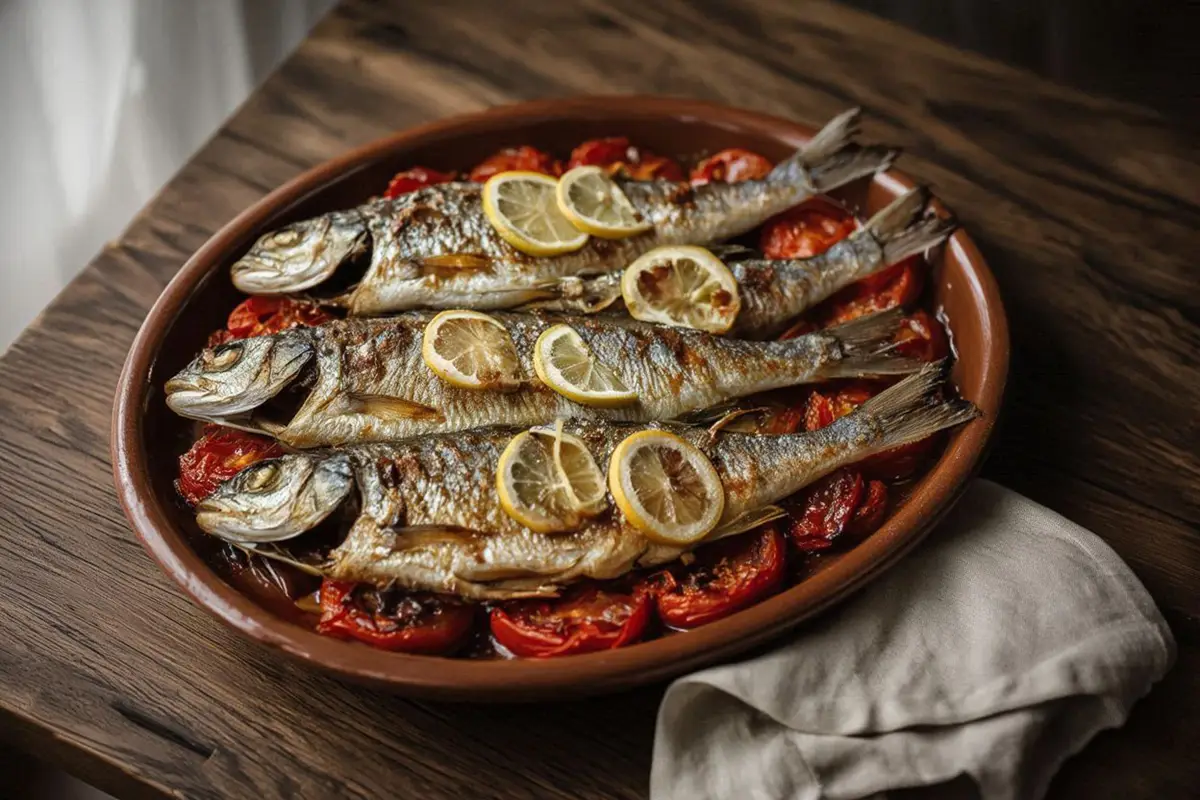
Baked Fish with Tomatoes
Whole fish baked over ripe tomatoes with generous olive oil and lemon — a simple, fragrant Central European oven dish.
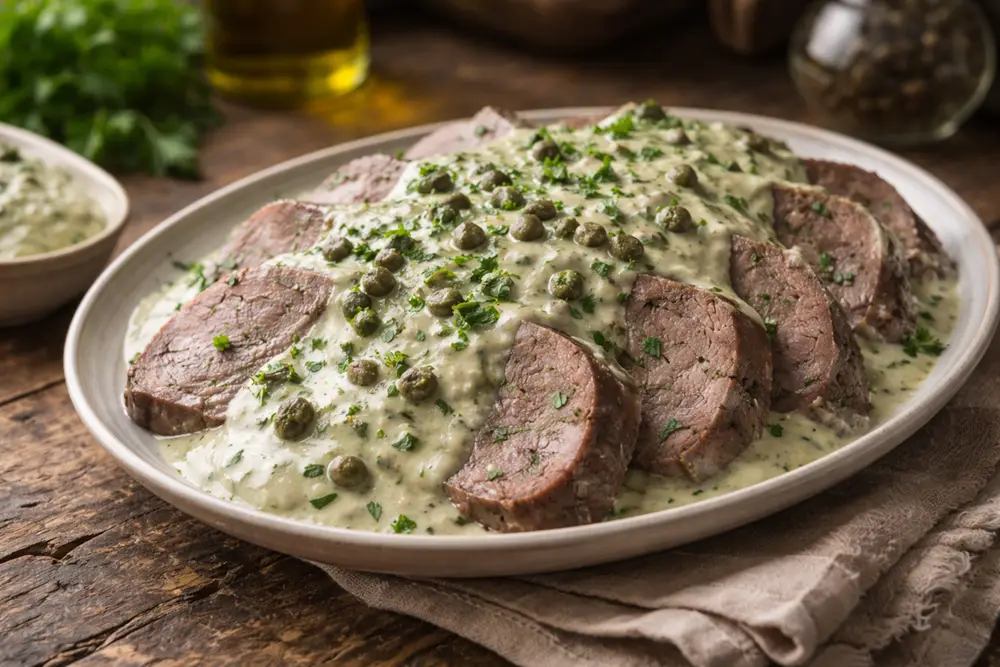
Baked Tongue in Green Sauce
Beef tongue braised with herbs, larded with bacon and roasted until golden, served in a green sauce of capers, anchovy, parsley and sour cream.
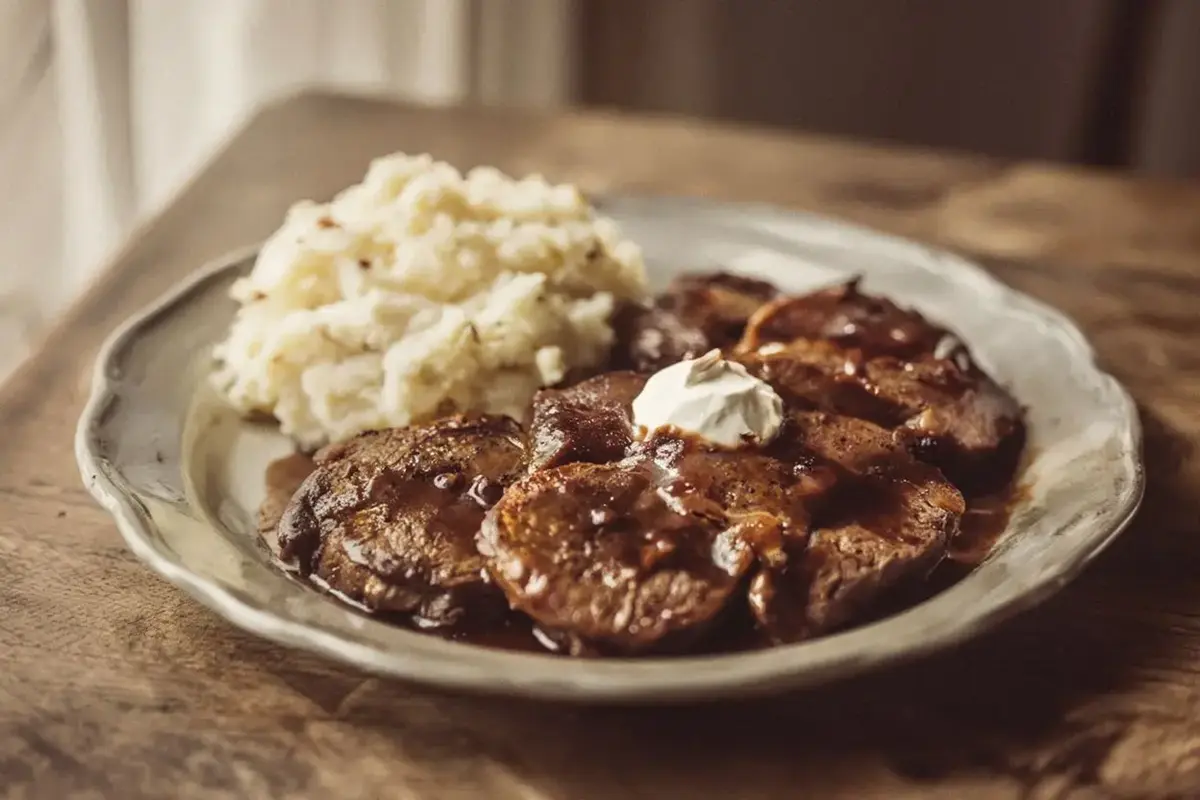
Beef Kidney with Wine
Beef kidney marinated in red wine, braised with herbs, finished with sour cream. Tender, rich, and deeply flavored.