Yeast in the Home Kitchen: A History
From ancient fermentation to the compressed cakes that transformed baking: explore the history of yeast and why early 20th-century recipes insisted on fresh.
Introduction
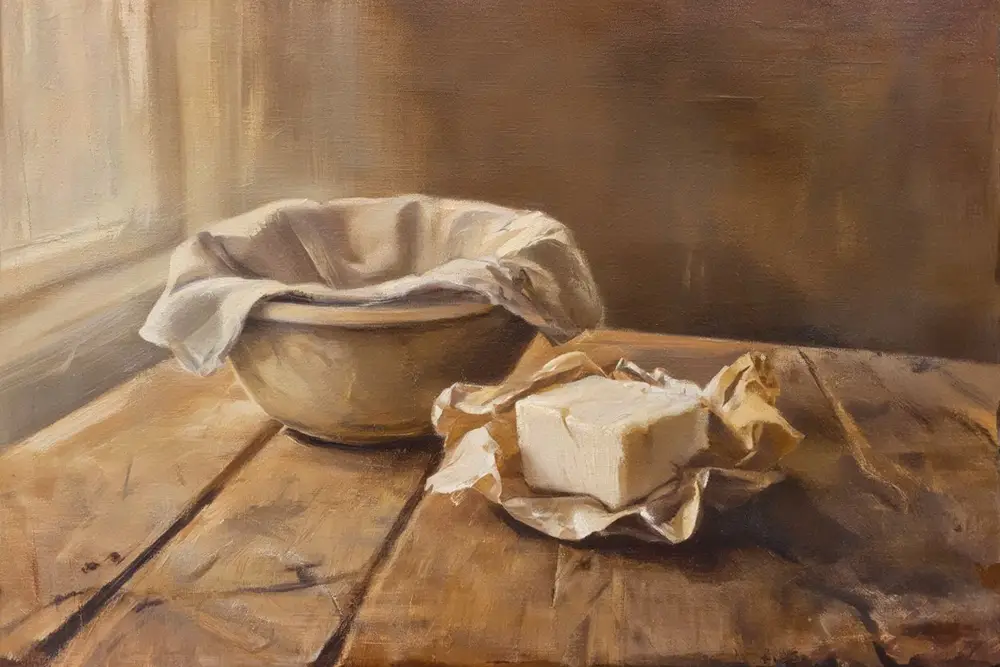
Every yeast-leavened recipe in the early 20th century home kitchen assumed one thing: fresh compressed yeast, bought that day or kept no more than a few days in a cool place. The granulated dry yeast familiar from modern supermarket shelves did not exist yet. The instruction was written for a specific object — a soft, pale, slightly earthy-smelling block that came wrapped in paper from a baker or a grocer — and it assumed the cook knew how to use it.
That object had itself only been available for a few decades at that point. The compressed yeast cake was a 19th century industrial invention, one of several developments that brought previously unreliable leavening under consistent control. Before it, home bakers had depended on whatever sources of living yeast were available to them — sourdough starters, the frothy skimmings from fermenting beer, or simply dough held over from a previous bake.
Understanding where the compressed yeast cake came from, and what it replaced, is also a way of understanding why the recipes read the way they do.
Before the Cake: Wild Fermentation and the Brewer’s Connection
Yeast as a baking agent is ancient. The earliest documented evidence of yeast-leavened bread comes from ancient Egypt — archaeological records and analysis of baking vessels suggest organized production of leavened bread was underway by around 1300–1500 BCE, and likely considerably earlier. The organism responsible was the same one at work today: Saccharomyces cerevisiae, a single-celled fungus that consumes sugars and produces carbon dioxide and alcohol as byproducts. In dough, that carbon dioxide is what makes the structure rise.
What ancient Egyptian bakers could not have known, because the microbiology would not be understood for another three millennia, was the precise mechanism. What they understood was the pattern: left dough ferments and rises; fresh dough mixed with a piece of fermented dough rises faster and more reliably than dough left alone. The practice of keeping and sharing starters — maintaining a culture by feeding it flour and water — was the dominant method of leavened baking across Europe for centuries.
The connection to brewing was fundamental. Bakers and brewers worked with the same organism, and the industries were intertwined. The frothy foam that rose to the top of fermenting beer — called barm in English — was a concentrated source of active yeast, and bakers regularly obtained it from breweries. This was not a secondhand solution; it was a deliberate practice. The yeast from ale fermentation was vigorous and reliable, and in regions with active brewing traditions, bakers depended on a steady supply.
Louis Pasteur’s work in 1857, which demonstrated conclusively that fermentation was the work of living microorganisms rather than a spontaneous chemical process, gave scientific foundation to what bakers had practiced empirically for millennia. It also opened the door to controlled production.
The Compressed Cake: A Central European Development
The transition from brewer’s barm and sourdough starters to purpose-produced compressed yeast cakes happened in the mid-19th century, and the industrial center of that development was Vienna.
The process — refining and concentrating yeast from grain fermentation, then pressing it into dense, semi-solid blocks — was formalized in the 1860s and came to be known as the Viennese process. It produced a standardized, highly active yeast that could be wrapped, distributed, and used by bakers without the variability of a homemade culture. The compressed cake had a short life — perishable within days without refrigeration — but for the first time it made reliable leavening available outside the brewery or the bakery.
The reach of this development is illustrated by one well-documented case. Charles Fleischmann, born in 1835 in what is now the Czech Republic, trained in yeast production in Vienna and Prague before emigrating to the United States in the 1860s. Observing the poor quality of American baked goods relative to what he had known in Central Europe, he and his brother Maximilian established a yeast manufacturing operation in Cincinnati in 1868. Their compressed yeast cakes — produced using the Viennese methods Fleischmann had learned — introduced a new standard to American baking. The knowledge and the technique had traveled west, taking with them the assumptions embedded in the recipes of the Central European kitchen.
By the interwar period — the years between the two world wars that are the source era for the recipes on this site — compressed fresh yeast was the standard leavening agent in home kitchens across Central Europe. It was bought, it was used quickly, and it was the only form of commercial yeast most cooks had ever encountered.
The Dry Revolution: A Military Necessity
The compressed cake’s limitation — its short shelf life and requirement for cold storage — became a practical problem on a large scale during the Second World War. Military logistics demanded a yeast that did not perish in transit. Fleischmann Laboratories, by then a major industrial operation, developed a solution in the early 1940s: a granulated, dehydrated yeast produced at low temperatures that sent the live cells into partial dormancy. The result was active dry yeast — shelf-stable at room temperature, with a usable life measured in months rather than days, and reactivated by dissolving in warm water before use.
This was not a refinement of compressed yeast. It was a fundamentally different product, designed to solve a different problem. It became available to civilian consumers after the war, and it gradually displaced fresh yeast in supermarkets across much of the world — though in Central Europe, fresh compressed yeast remained widely available and continued to be the baker’s preference in home kitchens.
Instant yeast, which can be added directly to dry ingredients without prior proofing, followed later — developed by the French company Lesaffre in 1973. It is finer-grained than active dry yeast, requires no rehydration step, and has become the most common form in contemporary home baking in many markets.
What This Means for Old Recipes
A recipe from the 1920s or 1930s that calls for a piece of yeast or a cube of yeast is specifying fresh compressed yeast. At the time of writing, no other form existed for a home cook. The amounts are calibrated to that product — its activity level, its moisture content, its relatively slow and steady fermentation profile.
Both active dry yeast and instant yeast substitute reliably, with adjustment. The widely used ratio is approximately 1 part instant yeast to 3 parts fresh yeast by weight — meaning 20g of fresh yeast is replaced by around 7g of instant dry yeast. Active dry yeast uses the same ratio but requires proofing: dissolving in a small amount of the recipe’s warm liquid with a pinch of sugar and allowing it to become visibly foamy before proceeding. This step confirms the yeast is alive — something fresh yeast, if recently purchased, can be assumed to be without testing.
Fresh yeast, where it remains available, still has advocates for enriched doughs — the kind used in the layered pastries and yeasted cakes of the Central European tradition. The fermentation is slightly different in character, producing a flavor that some bakers find cleaner and more complex. For a home cook working from an early 20th century recipe, using fresh yeast is not a nostalgic gesture; it is using the ingredient the recipe was designed for.
Practical Takeaways
The compressed fresh yeast cube that appears in early 20th century recipes was the product of a specific 19th century industrial development, centered in Vienna and spread through Central Europe in the decades before the recipes were written. Dry yeast — the granulated form now standard in supermarkets — did not exist until the 1940s, developed for military logistics, and only reached civilian kitchens after the war.
When converting old recipes: 20g fresh yeast equals approximately 7g instant dry yeast. Active dry yeast requires proofing in warm liquid first; instant yeast does not. Fresh compressed yeast, where available, remains the most direct substitute for what the original recipe specified.
Attic Recipes — digitizing and adapting Central European home cooking from the early twentieth century.
Frequently Asked Questions
01What is the difference between fresh yeast and dry yeast?▶
Fresh yeast is a living, compressed block with around 70% moisture content — highly active but perishable, lasting only a week or two under refrigeration. Dry yeast is dehydrated to partial dormancy, giving it a shelf life of up to two years at room temperature. Both contain the same organism, Saccharomyces cerevisiae; the practical difference is one of storage and activation.
02Why do older recipes always specify fresh yeast?▶
Because dry yeast did not exist as a consumer product until the 1940s. Recipes written before World War II were composed for the only form of commercial yeast available to home cooks: the compressed fresh cake. A recipe from the 1920s calling for 'a piece of yeast' means fresh yeast — there was simply no alternative.
03Can I substitute dry yeast for fresh yeast in old recipes?▶
Yes. The standard conversion is 1 part instant dry yeast to 3 parts fresh yeast by weight — so 30g of fresh yeast becomes around 10g of instant dry. Active dry yeast should be proofed first in warm liquid; instant yeast can be added directly to the flour.
04Why do early 20th-century recipes call for much more yeast than modern ones?▶
Home bakers of the period typically sourced fresh yeast from local breweries or markets, and its leavening strength could not be guaranteed. Higher quantities compensated for inconsistency. Modern commercial yeast is standardized and considerably more active, which is why old quantities often seem excessive by today's standards.
05At what temperature does yeast die?▶
Yeast begins to slow significantly above 38°C (100°F) and is killed at around 60°C (140°F). For proofing in liquid, the ideal range is 35–38°C (95–100°F) — warm to the touch but not hot. Water that feels uncomfortably hot will damage or destroy the yeast before it has a chance to activate.
06How do I know if my yeast is still active?▶
Dissolve the yeast in warm water (35–38°C) with a small amount of sugar and leave it for 10 minutes. Active yeast will produce visible foam or bubbles on the surface. If there is no activity after 10–15 minutes, the yeast is likely dead or expired and should not be used.
07Why does dough from old recipes often take longer to rise than expected?▶
A slower rise is not a sign of failure. Several factors extend rise time: a cooler kitchen, less active yeast than modern equivalents, denser flours common in the period, or dough enriched with fat and eggs — all of which slow fermentation. A longer, slower rise often produces better flavor.
08How long has yeast been used in baking?▶
The earliest documented evidence of yeast-leavened bread comes from ancient Egypt, with records dating to around 1300–1500 BCE, though fermentation for brewing is almost certainly older. The same organism responsible for beer fermentation — Saccharomyces cerevisiae — has been the foundation of bread baking ever since.
09When was commercial yeast first produced?▶
Commercial production of compressed yeast cakes began in the mid-19th century, with the industrial process formalized in Vienna in the 1860s. This Viennese method spread across Europe and became the foundation for the compressed fresh yeast blocks that home bakers used throughout the early 20th century.