Which Cake Goes with Which Coffee: A Practical Pairing Guide
Espresso, filter, Turkish coffee, or a milky latte — each rewards a different kind of cake. Here is how to match them, and why it works.
The Problem with Pairing Coffee and Cake Without Thinking
Most of us choose our coffee first and our cake second — or pick them entirely independently — and then wonder why the combination feels flat, too sweet, or somehow off. The coffee tastes fine on its own. The cake tastes fine on its own. Together, something is missing.
The issue is almost never about quality. It is about how different coffee styles interact with fat, sugar, and acid in ways that either amplify or cancel each other out. Match them well and both become better. Match them badly and each diminishes the other.
This guide is organized around four coffee styles that cover most of what people actually drink: espresso, filter (pour-over and drip), Turkish coffee, and milk-based coffees like cappuccino and latte. For each one, the pairing logic comes first — the why — and then specific cake types that follow from it.
Espresso: Bitterness That Needs a Partner
Espresso is concentrated, bitter, and short. A single shot runs through roughly seven grams of finely ground coffee under nine bars of pressure, extracting oils and solids that never make it into a filtered cup. The result is a beverage with a flavor profile that, despite being small in volume, is intense enough to hold its own against very assertive flavors.
The primary principle for espresso pairing is contrast. A very sweet pastry or cake creates a productive tension with espresso’s bitterness — each sip pulls the coffee’s edges back into balance, and the sweetness of the cake becomes more interesting against the dark backdrop of the coffee rather than sitting on its own. This is why the Italian tradition pairs espresso with biscotti (dry, slightly sweet, often almond or anise) and the broader European café tradition routinely reaches for chocolate: a piece of dark chocolate alongside espresso softens the chocolate’s sharpness while the coffee’s natural sweetness balances the cocoa.
For cakes specifically, espresso rewards:
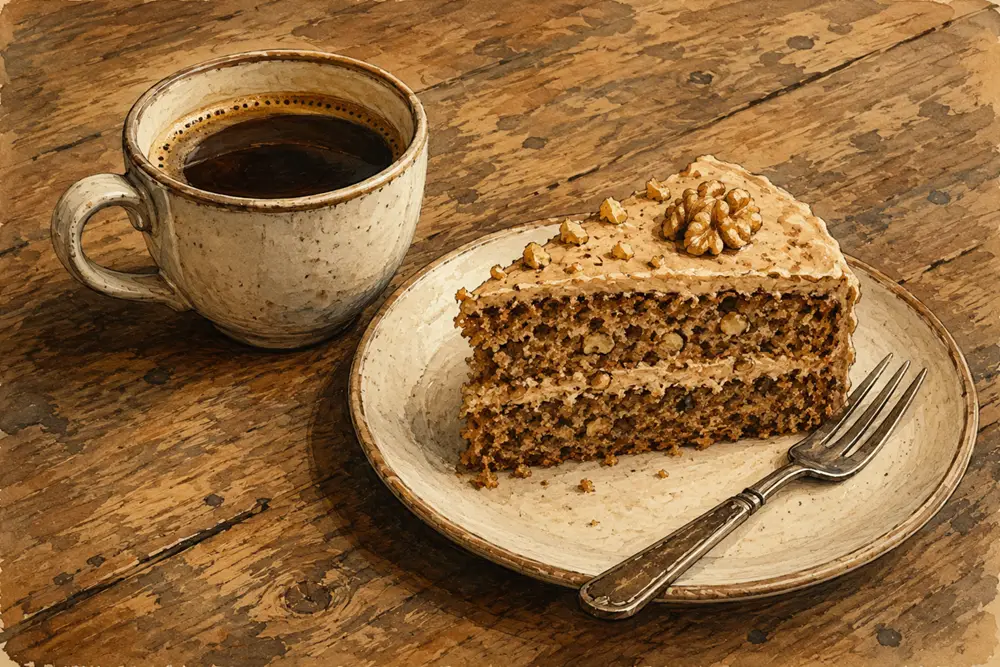
Dense nut cakes. Walnut cake, hazelnut torte, or a layered almond cake. The roasted quality of the nuts mirrors the roasted quality of the coffee; the sugar provides contrast; the fat in the nuts softens the bite. This is a complementary pairing — shared flavor families, structural contrast.
Chocolate cakes. From a simple cocoa sponge to a richer torte. Espresso and chocolate share many of the same flavor compounds produced by roasting, and the bitterness in both does not compete — it reinforces. If the chocolate cake carries caramel, coffee cream, or burnt sugar notes, the pairing becomes even more coherent.
Honey cake (medivnik or similar). The layered structure and intense sweetness of a honey cake, which softens over days as the cream absorbs into the sponge, gives espresso something to cut through. The result is less overwhelming than eating honey cake with a mild coffee, where the sweetness simply dominates.
Caramel or toffee sponge. The Maillard-adjacent flavors in caramel — slightly bitter, complex, sweet — are a natural match for the Maillard-derived flavors in dark-roasted espresso. These are not similar tastes in the sense of being the same; they are in the same flavor family, produced by overlapping chemistry.
What to avoid: delicate cakes with subtle flavors — plain sponge, light lemon cream cake, anything where the primary pleasure is in fragrance and restraint. Espresso will overpower them entirely. The bitterness will fill all available space and the cake will taste like nothing.
Filter Coffee: The Pairing Most Worth Getting Right
Filter coffee — whether brewed as pour-over, through a drip machine, or in a Chemex — passes through paper, which strips most of the oils and fine particles from the cup.Paper filtration produces a cleaner, brighter cup where acidity, fruit tones, and delicate aromatics become more pronounced, compared to unfiltered methods. This is why a well-made pour-over can taste like stone fruit, bergamot, or red berries — flavors that would be muted or obscured in espresso or Turkish coffee.
This clarity makes filter coffee both more specific and more flexible as a pairing partner, depending on the origin and roast. The general principle:acidic coffees pair well with citrus or berry-based cakes, where the tart notes in both enhance each other’s brightness. A Latin American medium roast — balanced, with soft fruit and caramel notes — is versatile and works across a wider range of cakes.
Filter coffee pairs well with:
Fruit-based cakes and tarts. Apple cake, plum cake, sour cherry sponge — anything where acidity is part of the structure. The acidity in a light roast filter coffee brings out the brightness of fruit and citrus. These are complementary partners in a chemical sense: the organic acids in the fruit and the chlorogenic acids in the coffee are in conversation rather than conflict.
Nut and poppy seed rolls. Central European baked goods built on a filling of ground walnuts or poppy seeds, sweetened with honey or sugar and rolled in soft dough. A medium roast filter coffee provides enough body to match the filling without competing with the subtlety of the dough.
Plain sponge or pound cake. This is where filter coffee truly earns its place. A simple vanilla sponge or a buttery pound cake, which would disappear next to an espresso, finds a comfortable partner in a mild filter coffee. Neither dominates; both are present. This is the pairing behind the classic slice of Gugelhupf or a plain Bundt cake at a Central European afternoon table.
Shortbread and butter cookies. The butter fat in shortbread behaves similarly to milk fat — it softens the coffee’s brightness slightly — but because the coffee has no milk of its own, the interaction remains controlled. A slightly nutty medium roast next to good shortbread is one of the most reliable pairings across all styles.
What to avoid: very rich, intensely sweet cakes. A filter coffee simply lacks the structural weight to stand next to a syrup-soaked cake or a heavily ganached torte. The coffee will taste thin and the cake will taste cloying.
Turkish Coffee: The Most Demanding Partner
Turkish coffee is prepared by simmering very finely ground coffee in water — sometimes with sugar added during brewing — in a small pot called a cezve, then poured unfiltered into a small cup. The grounds remain partially in suspension, settle slowly, and contribute a texture unlike any filtered coffee. The result is concentrated, heavy-bodied, and intensely bitter, with a characteristic sediment at the bottom of the cup.
This style spread through Central Europe via Ottoman trade routes, and the coffeehouse cultures of Vienna, Budapest, and Belgrade all developed traditions around it — eventually producing their own conventions about what to serve alongside it, independent of the Anatolian originals.The traditional pairing of Turkish coffee with something intensely sweet — such as lokum, baklava, or dense syrup-soaked pastry — developed because the sweetness cuts through the coffee’s considerable weight without competing with its complexity.
The structural logic: Turkish coffee carries a bitterness level that overwhelms mild or subtle flavors. A very sweet, dense accompaniment operates as a counterweight rather than a complement — and the contrast, rather than harmony, is the point. A small piece of something very sweet makes the next sip of coffee taste less aggressive and more dimensional.
Turkish coffee rewards:
Walnut or almond pastries. Dense, not overly flaky, with enough structural weight to slow the eating. A walnut-filled roll or a pressed nut pastry works where a croissant would not — the croissant’s delicacy would be erased.
Honey cake in small portions. The concentrated sweetness of a honey-heavy cake provides the contrast Turkish coffee needs. A thin slice rather than a generous one — the point is the first bite alongside the first sip, not working through a large portion.
Dried fruit and nut accompaniments. Not strictly cake, but dried figs, dates, and walnuts have historically accompanied coffee across the region precisely because their natural sugars, concentrated by drying, provide the sweetness contrast in a shelf-stable form. Dried figs and similar stone fruits offer a deep, honey-like sweetness that works well against the coffee’s intensity.
Dark chocolate in small amounts. A square of dark chocolate — not milk chocolate — beside Turkish coffee is a pairing found across the region. The bitterness of both aligns, but the cocoa fat softens the coffee’s rougher edges. This works best with chocolate that carries some sweetness; pure cocoa would be overwhelming.
What to avoid: anything delicate or subtly flavored. Filter-style cakes, light cream cakes, anything fruity and delicate. Turkish coffee has too much mass. It will bury these flavors without noticing them.
Milk-Based Coffees: Cappuccino, Latte, and Their Relatives
Cappuccino and latte sit in their own category because milk fundamentally changes what coffee is doing to your palate. Milk fat globules coat the tongue and suppress the perception of bitterness and acidity, producing a softer, rounder cup. Simultaneously, heating milk to around 60°C develops natural sweetness from lactose breaking down into smaller, sweeter compounds, so a well-steamed flat white or cappuccino carries genuine sweetness without any added sugar.
This has specific consequences for pairing. Because the coffee itself is already softer, less acidic, and gently sweet, the range of appropriate cakes is different. A latte can partner with things that would be overwhelmed by espresso or erased by Turkish coffee. But it cannot partner well with anything fruity or acidic, because milk fat suppresses acidity and brightness — precisely the qualities that make fruit-forward cakes interesting.
Milk-based coffees pair well with:
Spiced cakes. Cinnamon cake, carrot cake with warm spice, gingerbread. The spice in the cake echoes the warmth already present in steamed milk; the sweetness of the milk rounds out any sharpness from the spice. The smoothness of steamed milk balances the heat of spices like cinnamon and nutmeg in a way that black coffee cannot quite manage without the pairing feeling lopsided.
Buttery simple cakes. A plain butter sponge, a vanilla slice, a moist pound cake. The creamy character of the latte and the fat in the cake are complementary without being redundant — they operate in the same register without competing.
Almond cake. A moist almond cake or frangipane-style tart shares a nutty sweetness with steamed milk’s caramel notes. This is a low-contrast, harmonious pairing — everything in the same warm register.
Cream-filled pastries. A cappuccino next to a cream-filled puff or a choux pastry is a texture contrast pairing: the thick foam against the airy cream, the espresso intensity just barely visible under the milk. The pastry’s cream is softened by the coffee’s warmth; the coffee’s bitterness is barely perceptible but present enough to prevent the combination from becoming cloying.
What to avoid: anything acidic or fruit-forward.Milk fat masks the characteristics that make a citrus or berry cake work. A latte will not destroy a slice of raspberry cake, but it will flatten it, making both the coffee and the cake taste like less than they are.
Practical Takeaways
The underlying logic across all four styles comes down to two principles: match intensity, and think about what the coffee is doing to your palate before it meets the cake.
Espresso is intense and bitter — it needs contrast, specifically sweetness and fat. Filter coffee is clean and often bright — it rewards fruits, subtle flavors, and plain baked goods that would disappear next to anything heavier. Turkish coffee is the heaviest and most unfiltered — only dense, intensely sweet accompaniments survive contact with it. Milk-based coffees are already soft, warm, and gently sweet — spice and butter are the natural partners; fruit and acid are not.
None of this requires memorizing a chart. It requires one question before pouring: how heavy is this coffee, and does the cake match or contrast that weight appropriately? Most mismatched pairings fail not because the flavors are wrong for each other but because the intensities are misaligned — one erases the other before the combination has a chance to work.
Attic Recipes — digitizing and adapting Central European home cooking from the early twentieth century.
Frequently Asked Questions
01Why does espresso pair well with very sweet cakes?▶
Espresso is intensely bitter and concentrated, and that bitterness contrasts with sweetness rather than competing with it. A very sweet cake — syrup-soaked or heavily frosted — pulls the espresso's sharper edges back into balance, making both taste rounder.
02Can I pair a fruity cake with a milky coffee like a latte?▶
It tends not to work well. Milk fat coats the palate and suppresses acidity and brightness, which are exactly the qualities that make fruit-forward cakes interesting. A latte flattens them. Filter coffee or even a black Americano is a better match for anything built on berries or citrus.
03What is the logic behind serving something sweet with Turkish coffee?▶
Turkish coffee is unfiltered, finely ground, and very concentrated — its bitterness and body are significantly heavier than drip coffee. A small, intensely sweet accompaniment cuts through that weight without competing with the coffee's complexity. This is why the tradition of serving it with something like lokum or dense nut pastry developed naturally.
04Does roast level matter more than brewing method for pairing purposes?▶
Both matter, but brewing method shapes the character of the cup more dramatically for pairing. Turkish coffee and espresso concentrate oils and bitterness regardless of roast; filter coffee, because it passes through paper, strips oils and produces a cleaner, brighter cup. Roast level adjusts the specific flavor notes within that framework.