How Home Cooks Judged Sugar Syrup Without a Thermometer
Long before candy thermometers, cooks read sugar syrup by hand — a spoon drip, a wire loop, a soaking test. Here's what each one was really measuring.
Introduction
A surprising number of classic Central European desserts come down to the same underlying problem: getting sugar syrup to exactly the right concentration. Too little, and the syrup stays thin and watery. Too much, and it turns brittle, grainy, or forms a shell instead of doing its job. The margin between “not quite” and “gone too far” is often only a couple of minutes of boiling.
Today a candy thermometer solves this in seconds. Early 20th century kitchens didn’t have one on hand, so cooks developed a set of manual tests instead — each suited to a different dessert, each reading the syrup a slightly different way. Looking at several of these tests side by side makes it easier to see what they actually have in common: they’re all measuring the same thing — how much water is left in the syrup — just through different physical cues.
Why Concentration Is the Whole Story
Sugar syrup starts as sugar dissolved in water. As it boils, water evaporates and the syrup becomes more concentrated. That single variable — how much water remains — determines almost everything about how the syrup will behave once it cools: whether it stays liquid, sets soft, turns brittle, or crystallizes.
Because there’s no easy way to see water content directly, cooks relied on how the syrup behaved when cooled quickly, dripped, or blown through a loop. Each test was really a proxy for concentration, calibrated to the stage a particular dessert needed.
Four Tests, Four Purposes
Preserving Fruit in Syrup: The Spoon-Drip Test
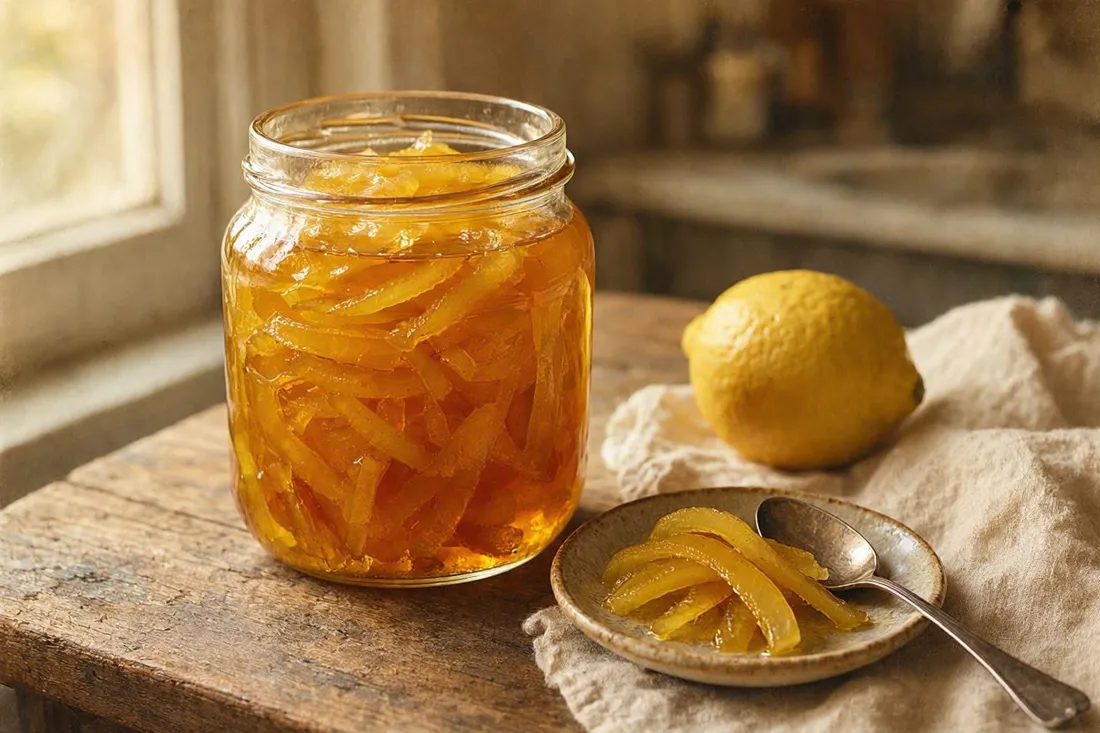
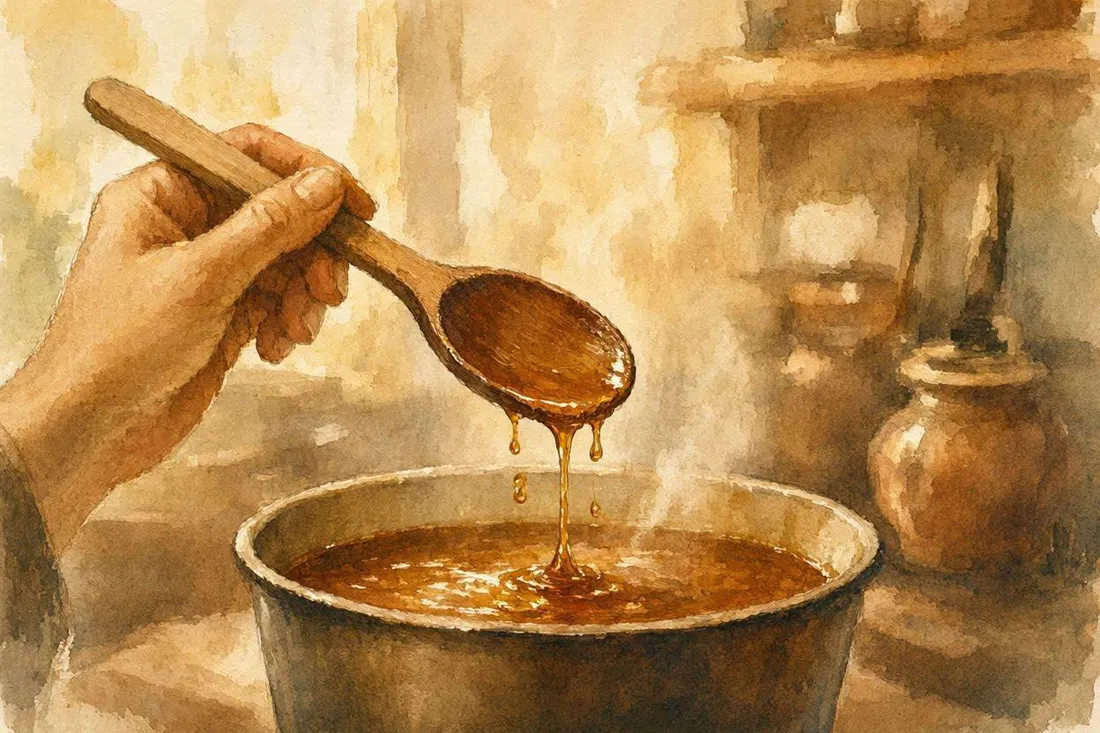
For fruit preserved whole in syrup, the syrup needs to stay thin enough to be poured and to not set solid, but concentrated enough to keep properly. Period instructions describe testing this by lifting a spoon out of the syrup and watching how it drips: when two drops fall together rather than a steady stream, the syrup is ready.
This is one of the lightest concentrations in the group — closer to a syrup stage than a candy stage. Cooks were also warned against a specific failure mode here: skimming the syrup while foam from the fruit was still forming would leave that foam in the syrup, causing it to crystallize prematurely once stored.
Meringue-Based Fillings: The Wire-Loop Bubble Test
For sugar used in meringue-based pastry fillings, a thin wire is bent into a small loop, dipped into the syrup, and blown through gently. A bubble or thin film that holds its shape signals the syrup has reached the right concentration. This sits at a noticeably firmer stage than the fruit syrup above, closer to what modern candy making would call the soft-ball range.
The same basic test — sometimes described with a spoon-drip instead of a blown bubble — shows up across several confectionery uses of the period, including fondant, where syrup is cooked to a similar stage before being cooled and worked into a smooth paste.
Fondant: Concentration Plus Crystallization Control
Fondant complicates the picture slightly, because concentration alone isn’t the whole story — a second syrup is deliberately added to control how the sugar crystallizes once cooled and worked. That process is covered in more depth in [a separate post on fondant crystallization], but the starting point is the same family of syrup tests described here.
Soaking Syrup for Layered Pastries: Judged by Outcome, Not by Test
Walnut-filled pastries, layered nut cakes, and similar syrup-soaked desserts present a different challenge entirely. Here, the goal isn’t a texture the syrup itself will hold — it’s how well the syrup gets absorbed into the baked pastry.
Get the syrup too thin, and it won’t be absorbed properly, leaving the pastry undesirably wet. Get it too concentrated, and the syrup can’t soak through at all — instead it sits on the surface and hardens into a shell, leaving the inside dry. Unlike the other three cases, this one doesn’t have a simple mechanical test attached to it in period instructions. Judging it correctly was described as real skill, built through repetition rather than a fixed rule — and every pastry in a batch needed the same syrup concentration, since even small inconsistencies would show up as some pieces staying dry and others turning soggy.
Practical Takeaways
- Every one of these tests is really measuring water content, indirectly, through how the syrup behaves.
- Lighter syrups (fruit preserves) sit at the low end of the concentration range; firmer syrups (meringue fillings, fondant) sit higher.
- Soaking syrups for layered pastries are the outlier: there’s no simple physical test, only the outcome — even absorption versus a hard, dry shell.
- A modern candy thermometer can substitute for most of these tests, though matching old instructions to exact temperatures takes some trial and error.
Attic Recipes — digitizing and adapting Central European home cooking from the early twentieth century.
Frequently Asked Questions
01Why did different desserts need different syrup concentrations?▶
Each use has a different goal. A thin syrup preserves fruit without setting hard; a firmer syrup holds shape in a meringue filling or fondant; a carefully balanced syrup soaks fully into layered pastry without leaving it soggy or forming a hard crust.
02How does the wire-loop bubble test work?▶
A thin wire loop is dipped into the hot syrup, then someone blows gently through it. If a bubble or thin film forms and holds, the syrup has concentrated enough to be ready. It's a way of judging syrup thickness without a thermometer.
03Why is it hard to judge syrup for soaking pastries correctly?▶
There's no simple mechanical test for it. Too thin, and the pastry stays wet and doesn't keep well. Too concentrated, and the syrup sits on top as a hard shell instead of soaking through, leaving the center dry. Cooks judged this mostly through experience.
04Can a candy thermometer replace these older tests?▶
Yes, largely. Each traditional test corresponds to a rough temperature range, and a thermometer can substitute for most of them today. The soaking-syrup judgment is the exception, since it depends on how the syrup behaves once poured, not just its temperature.
05Is a wire-loop or spoon test as accurate as a thermometer?▶
Not as precise, but accurate enough for the job. These tests were developed and refined by cooks who used them daily, and they reliably hit the right range for each dessert even without exact numbers.