Buttertajh: How Central European Laminated Dough Works
A step-by-step look at buttertajh, the historic Central European technique for folding butter into dough to build flaky, layered pastry.
Introduction
Laminated dough is built from two components that start out completely separate: a block of butter worked with a small amount of flour, and a simple egg dough. Neither one is very interesting on its own. What makes the technique work is what happens when the two are folded together, over and over, with careful resting in between.
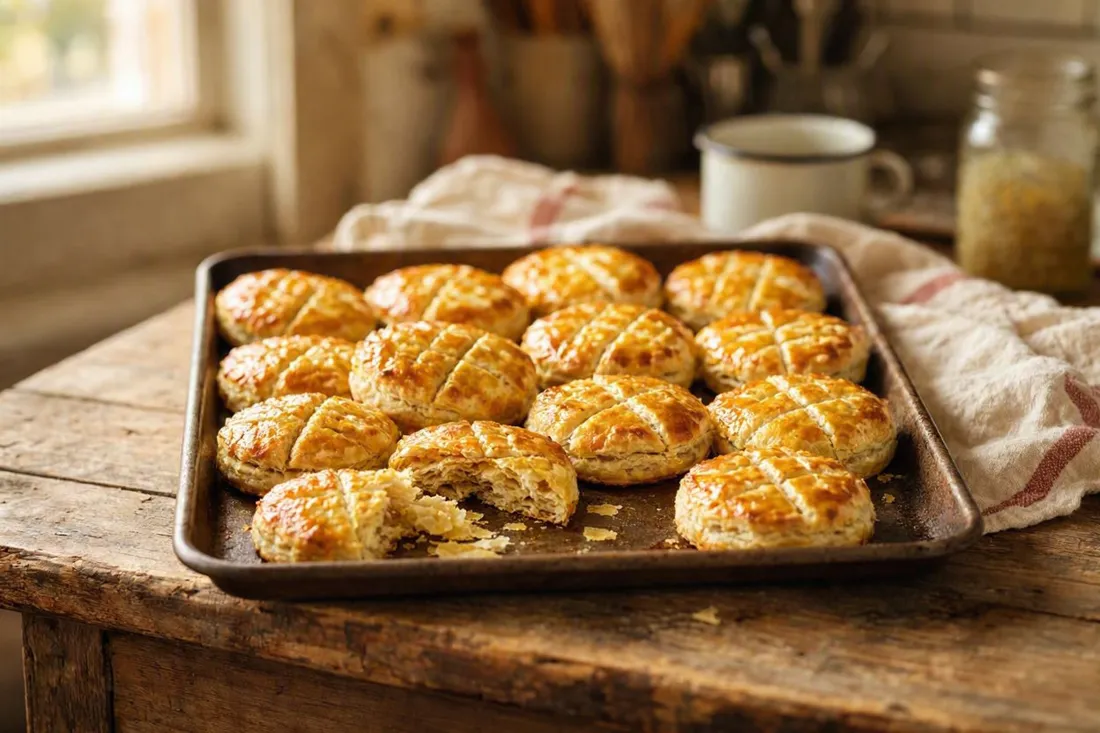
Central European home kitchens of the early 20th century relied on this method - known as buttertajh - as the base for a wide range of layered pastries, both savory and sweet. It shows up under different fillings and shapes across the region, but the underlying folding technique stays largely the same.
This post breaks down how buttertajh comes together: the two doughs, the folding sequence, and the handful of rules that determine whether the finished pastry shatters into flaky layers or bakes up dense and heavy.
The Two Components
Buttertajh starts with a batch of soft, low-protein flour, split into two unequal portions with two different jobs.
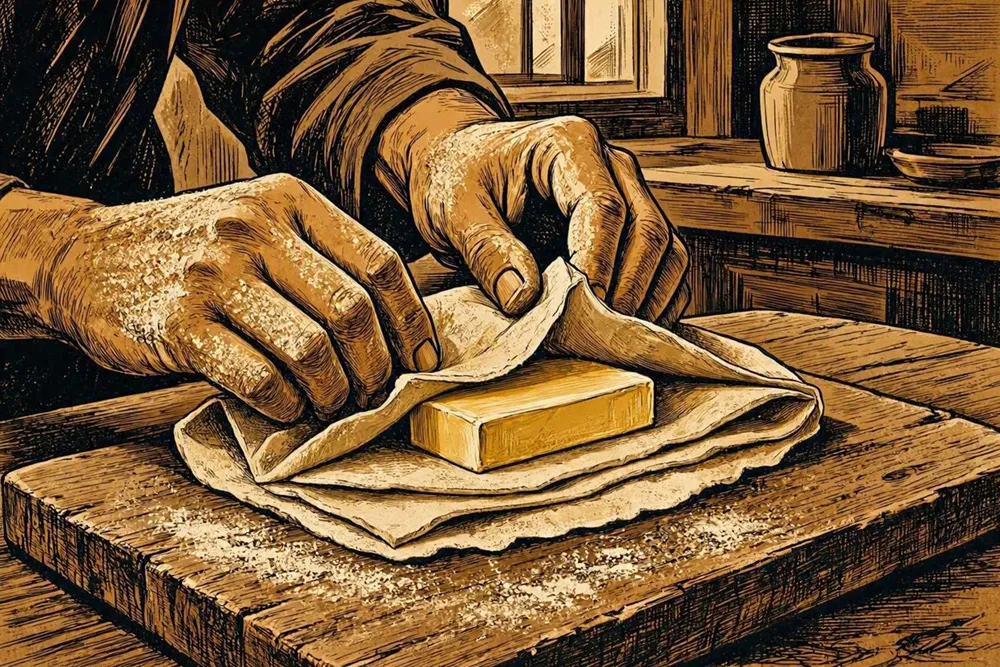
A small portion of the flour - roughly a sixth of the total - is worked together with an equal weight of cold butter. This butter block is not a dough in the usual sense; it is kneaded only enough to become a smooth, cohesive mass, then set aside in a cold place. The added flour helps the butter hold together and resist breaking apart once it is enclosed in the main dough.
The remaining flour becomes the base dough, enriched with a whole egg, a little salt, and a few drops of lemon juice, brought together with cold water. This dough is worked by hand until it develops visible air bubbles and pulls cleanly away from the hands - a sign that it has enough structure to survive the rolling and folding ahead without tearing. Once shaped into a ball, it rests for at least fifteen minutes before rolling begins.
A useful rule of thumb from the period: butter and flour in roughly equal weight overall, with just enough cold water to bring the dough together as you would for any pie crust.
Folding the Layers
Once the base dough has rested, it is rolled out into a sheet about half a finger thick. The chilled butter block goes in the center, and the sheet is folded over it from all four sides - top, bottom, left, and right - so the dough encloses the butter completely, like closing a book around it.
At this stage, a thick rolling pin is used to gently press over the folded parcel, just enough to begin stretching it without tearing the dough or letting butter push through to the surface. If butter breaks through, the dough needs to go back into the cold rather than continuing.
The parcel is folded closed again, moved to a plate, and rested in a cold place for at least thirty minutes. This roll-fold-rest sequence is repeated a total of three times. Each round of resting matters as much as the rolling itself - the layering and eventual rise of the pastry depend on it. On the third and final round, the dough is rolled to about one centimeter thick and ready to be cut into pieces for filling, using a hot knife so the layers aren’t dragged or compressed at the edges.
Rules That Make or Break the Dough
A handful of practical rules governed buttertajh in period kitchens, and most still hold:
- Use the best quality butter available - it is doing structural work, not just flavoring the dough.
- Work in a cold room. A warm kitchen softens the butter block before it should soften, and the layers merge instead of staying distinct.
- Rest the dough between every fold, without exception.
- Fold as often as reasonably possible - more folding builds more layers, and more layers mean more rise and finer flaking.
- Cut the finished dough with a hot knife rather than a cold one, to keep the cut edges clean.
- Bake in a very hot oven. If the oven isn’t hot enough, the whole effort of laminating can fail at the last step - the layers won’t separate properly.
- Don’t open the oven door early in baking; the sudden loss of heat interrupts the steam that pushes the layers apart.
A common piece of period kitchen advice was to prepare the dough the evening before, let it rest in a cold place overnight, and fill and bake it only the next day - giving the butter and dough time to fully equalize before the real work of folding even begins.
Why the Resting Matters
The whole structure depends on the butter staying as distinct, unbroken layers within the dough rather than blending into it. Cold, firm butter holds its shape between folds; warm butter starts to absorb into the flour, and the sharp separation between layers is lost - the result bakes up denser and less flaky.
The dough itself works against the process in a different way: each pass of the rolling pin builds tension in the gluten network, making the dough more elastic and more likely to spring back. Resting allows that tension to relax, which is why the dough becomes easier to roll with each successive fold rather than harder.
Temperature and time are the two things this technique doesn’t allow you to rush.
Practical Takeaways
Buttertajh is less about any single difficult step and more about discipline across many ordinary ones: keeping everything cold, resting the dough fully between folds, and folding as many times as reasonably possible. The three-fold, three-rest sequence described here is a traditional baseline - once the technique is familiar, it becomes the base for pastetes, savory pies, volovani, rolled pastries, and pogačice alike.
Attic Recipes — digitizing and adapting Central European home cooking from the early twentieth century.
Frequently Asked Questions
01What is buttertajh?▶
Buttertajh is a Central European laminated dough made by enclosing a butter block inside a simple egg dough, then folding and resting it in stages. It is the base for flaky pastries such as savory pies, rolls, and layered sweets.
02Why does laminated dough need to rest between folds?▶
Resting lets the gluten in the dough relax after being stretched by the rolling pin. Without rest, the dough becomes tight and elastic, resists rolling, and springs back instead of holding its shape.
03Can I substitute margarine for butter in laminated dough?▶
Butter is traditional and gives the best flavor and texture, but a high-fat margarine formulated for lamination can work similarly in terms of structure. The flavor and richness will differ noticeably from a butter-based dough.
04What can I make with buttertajh?▶
Historically it was used for savory pies, large and small volovani, sweet and savory šaum-rolne, tea pastries, savory rolls, and pogačice, among other layered doughs.
05Why does the oven need to be very hot for laminated pastry?▶
A hot oven creates a burst of steam from the water in the dough almost immediately, which pushes the butter layers apart before the structure can set. If the oven is not hot enough, the layers can collapse instead of separating.