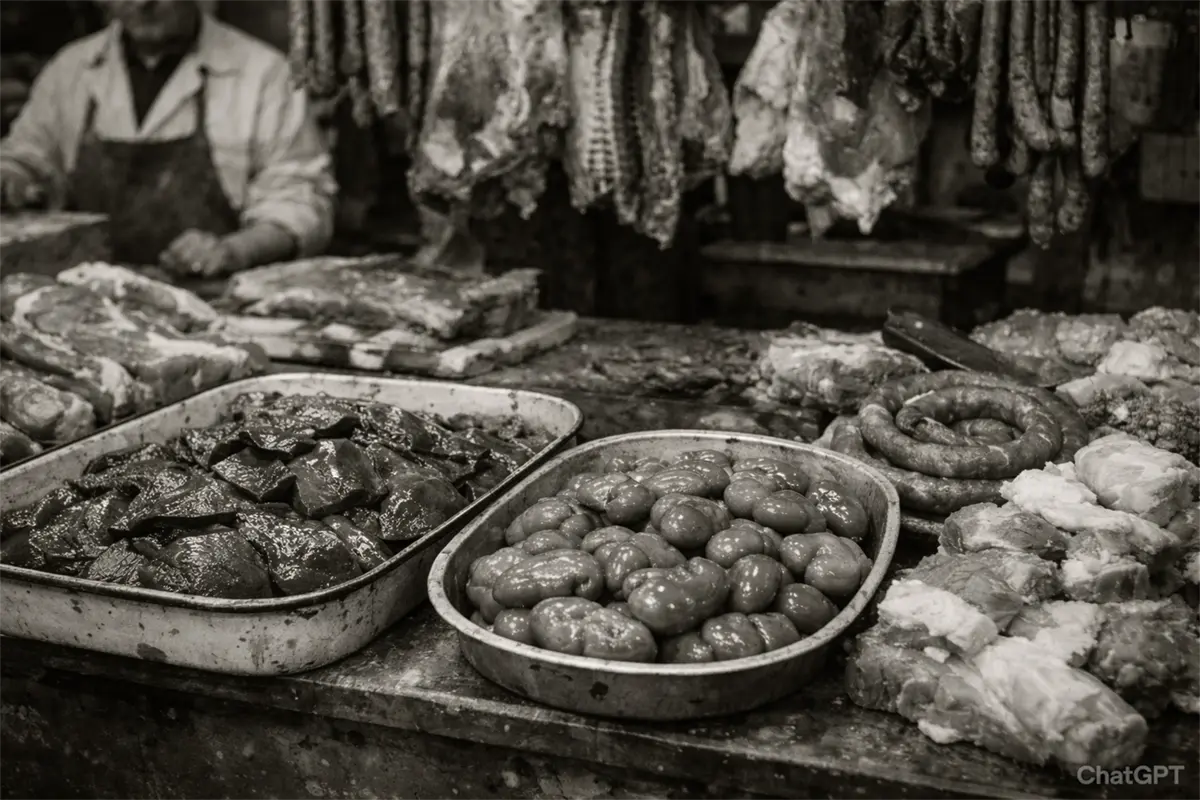
When Organ Meats Were Not "Offal" — They Were Dinner
In pre-war European households, liver, kidney, tongue, and brain were not niche ingredients. They were weekly staples cooked with serious technical skill.
The Word “Offal” Was Not Always a Category to Avoid
In contemporary food culture, the word “offal” carries specific weight. It implies challenge, acquired taste, and a certain kind of culinary bravery. Restaurants serve it to demonstrate range. Food writers treat it as a statement.
None of that framing existed before the mid-20th century.
For most of European culinary history, liver, kidney, tongue, heart, brain, and lungs were not categorized separately from other meat. They were meat. They appeared weekly in household cooking, had dedicated preparation methods in every regional tradition, and were in many cases more prized than muscle cuts.
Old cookbooks of that period do not have a special section for organ meats. Organ meat recipes are distributed throughout, categorized by the dish type — soups, roasts, filled preparations, quick-fry dishes — because the assumption was that the cook knew how to work with all parts of an animal as a matter of basic competence.
An Economic Reality, Not a Philosophy
The modern framing of nose-to-tail cooking as an ethical stance is historically reversed.
Before the second half of the 20th century, using every part of a slaughtered animal was not an ethical choice or a culinary trend. It was a practical and economic necessity. Animals were expensive. Feed, labor, and slaughter all represented real costs. Wasting the liver while eating only the loin was economically irrational in a way that most households could not afford.
Beyond cost, organ meats had specific practical advantages:
Speed. Liver, kidney, and brain cook in minutes. When fuel was expensive and stove time was limited, a quick liver preparation was more practical than a long braise.
Perishability as a feature. Organs spoil faster than muscle meat and therefore were cooked and eaten first after slaughter. This built them into the weekly and seasonal rhythm of household cooking. The day after slaughter: liver and kidneys. The following days: the cuts that would keep longer.
Nutrient concentration. Without the vocabulary of nutritional science, cooks observed that feeding liver to convalescing family members, children, and pregnant women produced visible results. Liver is among the most nutrient-dense whole foods available — it contains high concentrations of B12, iron, folate, and fat-soluble vitamins in forms that are readily absorbed by the body.
What Techniques Made Organ Meats Work
The technical skill gap is the main reason organ meats fail in modern home kitchens. People apply the wrong methods to ingredients that require specific handling.
Liver. The most common error is overcooking. Old recipes consistently specified fast, high-heat cooking in fat — 2–3 minutes per side in a very hot pan — with the goal of developing a seared crust while preserving interior moisture. Liver cooked beyond this point develops a grainy, chalky texture and a sharp, intensely bitter edge. Current food safety guidelines specify a minimum internal temperature of 71°C (160°F); a meat thermometer is the reliable way to hit this without overcooking.
Soaking liver in milk for 30–60 minutes before cooking was a common step in many regional traditions. The milk draws out some of the blood through osmosis and may moderate the strongest flavor compounds, making the taste more accessible to those unfamiliar with it.
Kidney. Beef kidney in particular has a strong ammonia-like odor when raw, caused by urea compounds concentrated in this organ. Old recipes consistently directed cooks to cut, soak in cold salted water for at least one hour (some specified overnight), then rinse and dry before cooking. This step is not optional if you want a palatable result. Like liver, kidney cooks quickly — extended heat makes it tough.
Tongue. The opposite of kidney and liver: tongue is a high-collagen muscle that improves dramatically with extended low, moist heat. A beef tongue braised for 2.5–3 hours at low heat becomes silky and tender. The outer skin peels cleanly when cooked correctly and is removed before serving. Tongue requires patience, not precision.
Brain. Brain has almost no connective tissue, meaning there is no collagen conversion to exploit and no structure to develop. It is essentially a fat-and-protein matrix that sets quickly. Old recipes typically called for poaching briefly in acidulated water (vinegar or lemon juice prevents discoloration), then coating and pan-frying quickly, or incorporating into stuffed preparations where texture was part of a mix. Overcooking produces a crumbly, watery result.
A note on sourcing: beef brain is subject to food safety regulations in many countries due to BSE (bovine spongiform encephalopathy) concerns, and is not recommended for home cooking. Lamb and pork brain carry no such restriction and are the appropriate choice for the preparations described in this archive.
Regional Distribution in Central European Cooking
The recipes in this archive are from the Central and Eastern European tradition, and organ meat use reflects that specific culinary geography.
Liver soup. Found across the region. Liver is grated raw into a dumpling or custard preparation that is then poached in broth. The result is a liver preparation without the direct liver texture — accessible to people who find it challenging.
Stuffed preparations. Brain-stuffed potatoes, liver-stuffed cabbage, kidney incorporated into filled dumplings. Organ meats used as filling material appear regularly because the strong flavor was diluted by the neutral starch wrapper, and the texture was modified by the cooking of the surrounding ingredient.
Brain with eggs. A common quick preparation — brain broken into a pan with egg, scrambled lightly with onion and fat. Fast, economical, complete as a one-pan meal. Lamb or pork brain is the appropriate choice for this dish.
Tongue in sour cream sauce or broth. Tongue prepared as a formal dish, sliced thinly, served with an acid-forward sauce. Found in both everyday and festive versions, the difference being the quality of the sauce and the accompaniments.
These were not restaurant dishes or special-occasion preparations. They were weekly cooking.
Why This Knowledge Disappeared
The disappearance of routine organ meat cooking in Western households happened in a compressed period between roughly 1950 and 1980, driven by converging forces.
Post-war economic growth made muscle meat affordable for middle-class households that had previously cooked all cuts by necessity. Organs became associated with poverty cooking and were abandoned as households moved up economically.
Industrial meat processing restructured the supply chain. Retail butcher counters declined. Supermarkets prioritized cuts with longer shelf life and lower handling complexity. Organs that require rapid sale and skilled butchery were pushed to the margin.
The generational break was decisive. When the cohort of cooks who had learned organ meat preparation in childhood stopped cooking at scale — roughly from the 1960s onward — the techniques were not passed to the next generation. Knowledge that had been transmitted through practice for centuries was interrupted within two or three generations.
What Recovering This Knowledge Looks Like
This site does not treat organ meat recipes as a novelty or a challenge dish. It treats them as normal cooking that requires adequate explanation.
Every organ meat recipe in this archive includes the original preparation method, an explanation of the specific technique and why it works, current food safety temperatures, sourcing notes, and the social and culinary context in which this dish was eaten. Sourcing matters more for organs than for muscle meat — freshness, animal husbandry, and species all affect both safety and flavor.
The old books were matter-of-fact about all of this. That is the right approach.
Organ meat recipes in this archive are tagged and filterable. Each one includes safety notes and sourcing guidance alongside the original method.
Frequently Asked Questions
01Are organ meats safe to eat today?▶
Yes, when properly sourced and cooked through. Liver and kidney should reach an internal temperature of 71°C (160°F). Where possible, choose animals raised without routine antibiotics or hormones — quality matters more with organ meats than with muscle cuts, since the liver and kidney are the body's filtration organs.
02Why did organ meats fall out of fashion in the 20th century?▶
Several things happened at once. Post-war prosperity made muscle meat cheap enough for everyday tables. Industrial food processing quietly removed organ meats from retail display. And as food culture shifted, the kitchen knowledge needed to cook them well simply stopped being passed down. Within a generation, cuts that had been unremarkable became unfamiliar.
03What is the hardest organ meat to cook well?▶
Brain and sweetbreads demand the most care — both overcook in minutes and lose their delicate texture at high heat. Liver and kidney are more forgiving, though neither benefits from overcooking either.
04Is beef brain safe to eat?▶
Beef brain is regulated or restricted in many countries due to BSE concerns and is best avoided for home cooking. Lamb and pork brain carry no such restriction and are the better choice for anyone curious about the ingredient.