Strange and Useful: Kitchen Tools of the Early Twentieth Century
A look at the specialized tools that filled Central European kitchens a century ago, from a fruit press called an ala to a sand-timer for boiling eggs.
Introduction
A well-equipped kitchen a century ago looked less like a set of interchangeable gadgets and more like a specialist’s toolkit. Nearly every task — puréeing fruit, timing an egg, grating something pungent, cutting a sheet of stretched dough — had its own purpose-built tool, often one that couldn’t do much of anything else. Some of these tools are instantly familiar today. Others have all but disappeared from the modern kitchen, even though the jobs they did haven’t gone anywhere.
This post looks at a handful of the more unusual ones, alongside the everyday staples they shared shelf space with.
The Everyday Backbone
Every kitchen of the period was built around a core set of tools that would still look familiar today: a scale and a clock, valued as the two instruments that kept cooking accurate rather than approximate; a full range of pots and shallow pans in graduated sizes, each with a matching lid; several sharp knives divided by task — one for meat, several for bread and cake, one for onions and greens; scissors for portioning roasted meat cleanly; a funnel for bottling liquids; a strainer reserved only for tea; and a mortar for grinding sugar, nuts, and spices by hand. These were the tools in constant use, unremarkable at the time precisely because they were so essential.
It’s the tools built for a single, narrower task that tend to surprise a modern reader.
Purpose-Built and Unusual
The Ala: A Press for the Whole Season’s Harvest
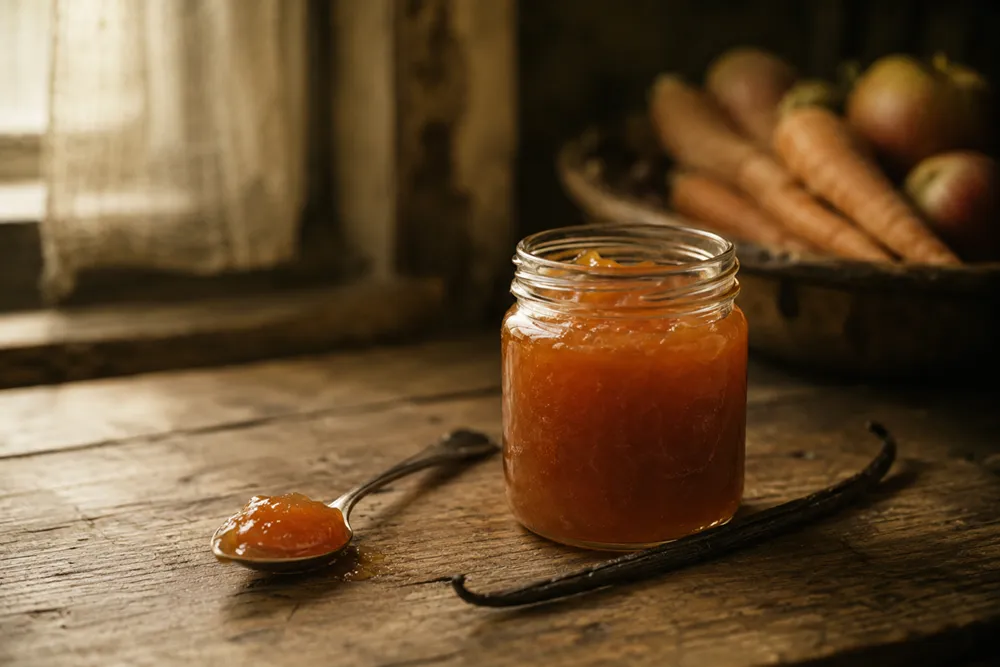
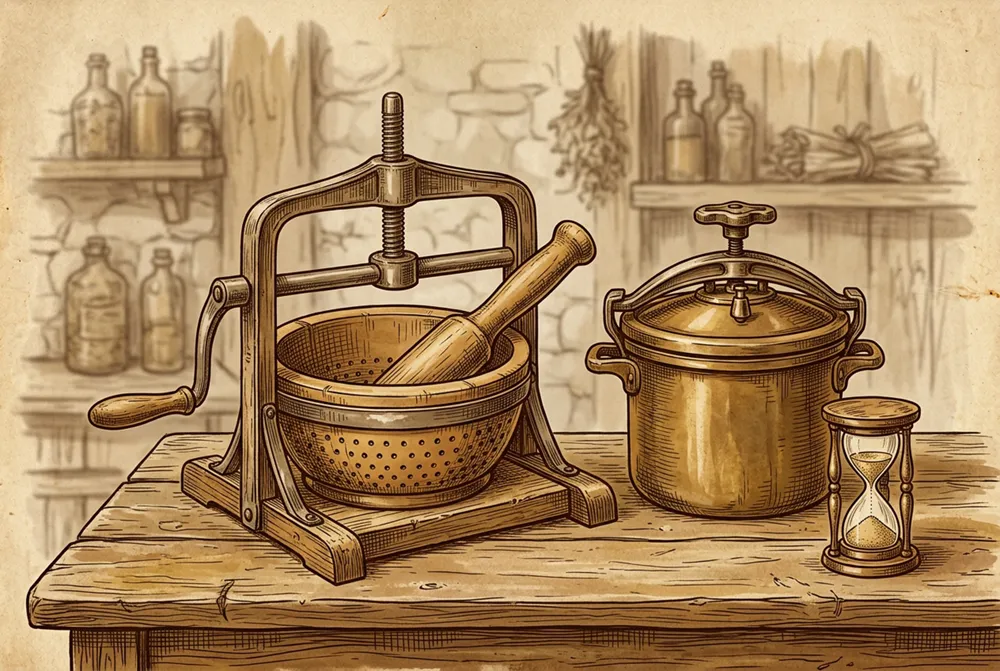
Among the tools singled out as a genuinely new addition to the kitchen was the ala — a perforated trough paired with a wooden pestle. Cooks pressed cooked tomatoes through it when preparing large batches for the season, and used the same tool for fruit destined for marmalade, boiled potatoes, and other cooked vegetables. It’s the direct ancestor of the food mill sitting in a modern kitchen drawer, and it shows up again in our carrot and sour apple jam, where it was the tool used to purée the cooked fruit and vegetables before the sugar and vanilla went in.
An Airtight Pot, Long Before the Pressure Cooker
One pot broke from all the others on the shelf: a hermetically sealed vessel made of cast bronze, reserved for dishes that needed to cook fully enclosed, soups and slow-simmered stews among them. Sealing a pot completely during cooking wasn’t the norm — most cookware of the period was built to let steam escape freely — which made this one worth naming separately from the rest of the pot collection.
Timing an Egg by the Sand
Before mechanical kitchen timers, some households kept a small hourglass made specifically for boiling eggs. The moment the egg went into the boiling water, the timer was flipped; once the sand had fully run to the other side, the egg was done. A separate slicing tool — a thin aluminum frame strung with wire — was used afterward to cut the boiled egg into clean, thin slices without crumbling it.
Whisking Snow
A wide metal bowl, paired with a wire whisk, was used specifically for beating egg whites into stiff peaks — described at the time as “whisking snow.” The same bowl did double duty for whipping mayonnaise by hand and preparing sweet creams and hot and cold sauces, all tasks that depended on getting air into an emulsion before electric mixers existed.
A Grater Reserved for Strong Smells
The trenica was a grater set aside specifically for pungent or strongly flavored ingredients: horseradish, onion, lemon, and chocolate. Because a grater used for one could easily carry its smell into the next, period kitchen advice was to scrub it thoroughly with hot water after every use.
A Toothed Wheel for Pastry
For cutting sheets of hand-stretched dough, cooks used a small wheel lined with teeth — pressed and rolled along the dough to cut noodles, portion pastry, and shape other stretched doughs cleanly and quickly, well before a rolling pastry cutter became a standard baking-aisle item.
Why So Many Specialized Tools
Most of these tools trace back to the same underlying reality: cooking was done from whole, unprocessed ingredients, often in large seasonal batches meant to last through the year, without refrigeration to fall back on. Pressing a season’s worth of tomatoes or fruit called for a tool built to do exactly that, quickly and in volume — not a general-purpose gadget adapted to the job. Specialization was less a luxury than a form of efficiency.
Practical Takeaways
A few of these ideas still hold up well in a modern kitchen: a dedicated grater for pungent ingredients keeps flavors from bleeding into one another, and a food mill or ricer remains one of the fastest ways to purée a large batch of cooked fruit or vegetables — the same job the ala was built for a century ago.
Attic Recipes — digitizing and adapting Central European home cooking from the early twentieth century.
Frequently Asked Questions
01What was an ala used for in old Central European kitchens?▶
An ala was a hand-operated press made of a perforated trough and a wooden pestle. Cooks used it to purée cooked tomatoes, fruit for preserves, and boiled root vegetables in bulk.
02How did cooks time a boiled egg before kitchen timers existed?▶
Some households used a small hourglass-style sand timer made specifically for eggs. It was flipped the moment the egg went into boiling water, and the egg came out once the sand had run through.
03Why did period kitchens have so many single-purpose tools?▶
Most cooking was done from raw, unprocessed ingredients and in large seasonal batches, so specialized tools for tasks like puréeing, grating, or pastry-cutting saved real time and effort over general-purpose equipment.
04What was a trenica used for?▶
A trenica was a grater reserved for strong-smelling ingredients — horseradish, onion, lemon zest, and chocolate. Period advice was to wash it thoroughly after each use so it wouldn't carry odors between foods.