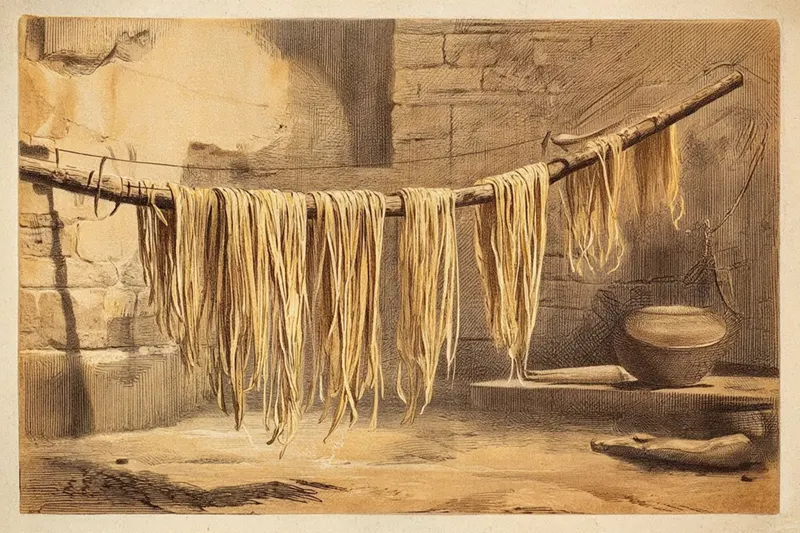
Dried Pasta: From Desert Trade Routes to Everyday Kitchens
How dried pasta developed as a durable staple and became part of everyday cooking across Europe.
Introduction
Before refrigeration made perishability a manageable inconvenience, the durability of food was a serious practical concern. Techniques like salting, fermenting, smoking, and drying shaped not only what people ate but how they organised their kitchens and their trade. Dried pasta belongs to this category — not as a curiosity, but as one of the more elegant solutions to the problem of keeping a staple food usable over time.
The logic is simple: remove water, and the conditions that support microbial growth largely disappear. What remains is a product that can be stored for months, transported across long distances, and prepared quickly when needed. By the early twentieth century, that product had found its way into kitchens across Central Europe as a matter of course.
Drying as Preservation
At its core, dried pasta is a preservation technique applied to a basic dough. Made from durum wheat semolina and water, the dough forms a dense, protein-rich structure that tolerates drying without crumbling. Once dried, it remains stable under the right conditions; once boiled, it returns to a firm, cohesive texture.
Durum wheat is not incidental to this. Its high gluten content is what allows the dough to hold its shape during drying and cooking. Softer wheat varieties produce a more fragile structure that breaks down more easily — which is why traditional dried pasta and fresh egg pasta, made from softer flour, are functionally and culinarily different things.
This combination of simple ingredients and practical durability is what allowed dried pasta to travel far beyond the kitchens where it was first made.
From Sicily to the Mediterranean
The earliest documented reference to something recognisable as dried pasta comes from a 9th-century dictionary compiled by the Arab physician and lexicographer Isho bar Ali, which defines itriyya as string-like shapes made from semolina and dried before cooking. Two centuries later, the Arab geographer Muhammad al-Idrisi, writing in 1154 for the Norman king Roger II of Sicily, described a settlement called Trabia near Palermo where itriyya was produced in large quantities and exported by ship to Calabria and beyond, to both Muslim and Christian territories.
This is not a minor detail. Al-Idrisi’s account describes an established export industry, not a local curiosity — which means the techniques for producing, drying, and trading pasta at scale were already well developed by the mid-12th century. Sicily under Arab influence had the climate for efficient sun-drying, the durum wheat cultivation, and the trade connections to make this viable.
From Sicily, dried pasta spread across the Mediterranean trade networks. By the 13th century it appears in Genoese household inventories and Italian cookbooks, and its use continued to diversify in shape and preparation as it moved through different regional kitchens.
Mechanisation and the Factory
The shift from craft production to industrial manufacture began earlier than is often assumed. By the 17th century, pasta production in Naples was already using the torchio — a mechanical press that extruded long shapes like vermicelli and macaroni with far greater speed and consistency than hand methods. In 1740, a licence for the first pasta factory was issued in Venice.
The 19th century completed the transformation. Water mills improved semolina separation from bran, lowering the cost of the raw material. Controlled drying environments replaced dependence on outdoor sun and wind. By the end of the century, the entire process — mixing, kneading, pressing, and drying — had been fully mechanised. What had been a regional craft product, its quality dependent on local conditions and skilled labour, became a standardised, purchasable commodity.
This standardisation changed the position of pasta in everyday cooking. It was no longer tied to Italian-influenced production centres or seasonal drying conditions. It became a shelf-stable ingredient available to a broad market — including households far from the Mediterranean.
Dried Pasta in Early 20th Century Kitchens
In Central European households of the early twentieth century, dried pasta appears as a practical, flexible ingredient rather than a centrepiece. It could be stored without urgency, prepared quickly, and combined with a wide range of other staples depending on what was available — broth, dairy, vegetables, or meat-based sauces.
Its role was rarely the focus of a meal. More often it functioned as a component: a base, a filler, a structure around which other elements were arranged. Recipes from the period treat it matter-of-factly, without the cultural weight it carries in Italian cooking. It was simply there, in the pantry, reliable in the way that only preserved foods can be.
The macaroni gibanica on this site is one example of that pragmatic approach — pasta incorporated into a pastry format, treated not as an Italian import but as an available ingredient to be used within a familiar local structure.
Attic Recipes — digitizing and adapting Central European home cooking from the early twentieth century.
Sources
-
Serventi, S. & Sabban, F. (2002). Pasta: The Story of a Universal Food. Columbia University Press. https://cup.columbia.edu/book/pasta/9780231124423
-
Wright, C.A. (1999). A Mediterranean Feast. William Morrow. https://worldcat.org/isbn/0688152147
-
Davidson, A. (2014). The Oxford Companion to Food (3rd ed.). Oxford University Press. https://worldcat.org/isbn/9780199677337
-
Capatti, A. & Montanari, M. (2003). Italian Cuisine: A Cultural History. Columbia University Press. https://cup.columbia.edu/book/italian-cuisine/9780231122320
-
Wikipedia contributors. Pasta. Wikipedia. https://en.wikipedia.org/wiki/Pasta
Frequently Asked Questions
01When was dried pasta first made?▶
The earliest clear written reference to dried pasta is from a 9th-century dictionary by the Arab physician Isho bar Ali, which defines itriyya as string-like shapes made from semolina and dried before cooking. By 1154, the Arab geographer al-Idrisi described large-scale itriyya production and export from Trabia, Sicily.
02Why was pasta dried instead of eaten fresh?▶
Drying removed moisture, which inhibited microbial growth and made pasta shelf-stable for months or longer. This made it practical for storage, transport, and long sea voyages — essential qualities in a pre-refrigeration world.
03Was dried pasta common in Central Europe in the early 20th century?▶
Yes. By the early twentieth century, industrially produced dried pasta was widely available across Central Europe as a reliable, shelf-stable pantry ingredient, appearing in both modest everyday cooking and more elaborate household recipes.
04What kind of wheat is used for dried pasta?▶
Dried pasta is traditionally made from durum wheat semolina, which has a high protein content and forms a dense, elastic structure that survives drying and rehydrates well during cooking.