The Columbian Exchange and the Balkan Table
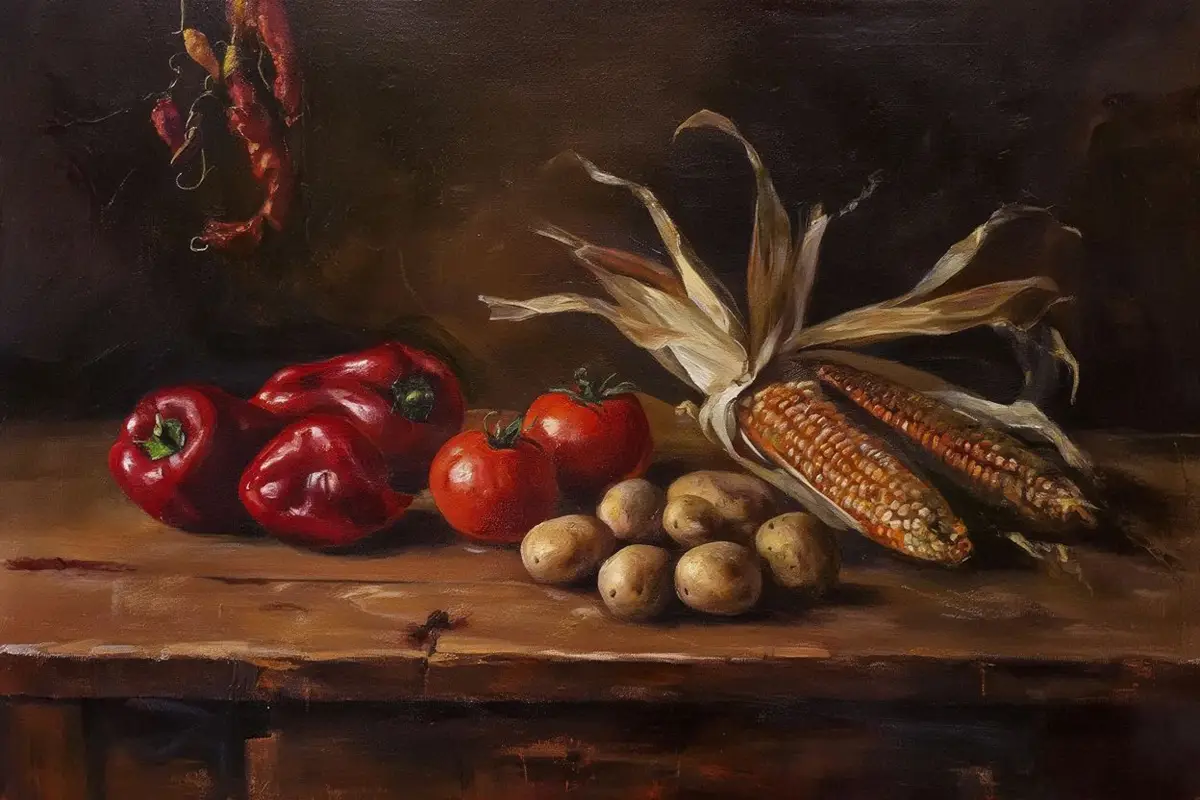
Tomatoes, peppers, potatoes, maize — Balkan cooking is built on American crops. The story of how they arrived and why they stayed.
Introduction
Consider the food that feels most essentially Balkan: the deep red of a paprikaš, the smokiness of roasted peppers in ajvar, the stuffed pepper in tomato sauce that appears, under different names, on virtually every table from Slovenia to North Macedonia. Now consider this: none of it existed before the end of the 15th century. The peppers, the tomatoes, the potatoes, the maize that became polenta and palenta — all of them come from the Americas, and none of them reached the Balkans until well into the 16th century at the earliest.
This is the central fact of the Columbian Exchange as it applies to Balkan and Central European cooking: the ingredients that now feel oldest and most native arrived last. The spice rack built on paprika, the winter stores built on dried peppers, the autumn ritual of making ajvar — all of this rests on a biological transfer that began in 1492, when Columbus returned from the Caribbean carrying, among other things, a handful of chili peppers he had never seen before.
The story of how those crops moved from the Americas to the Balkans is not a simple one. It passes through Spain and Portugal, through the Mediterranean, through Ottoman administrative networks and trade routes, through years of suspicion and slow acceptance, through the kitchens of people who had no name for what they were cooking. But the end result is visible on every table and in every recipe in our archive: these ingredients arrived as strangers and became the home.
The Route: Spain, the Mediterranean, the Ottomans
The Columbian Exchange did not deposit American crops directly into the Balkans. It moved in stages, through a chain of cultural and commercial contact that took the better part of two centuries to complete.
Chili peppers arrived in Spain with Columbus as early as 1493. The Turks introduced American plants into the Balkans during their 16th-century presence in the region. This is the key link: the Ottoman Empire, which controlled much of the Balkan Peninsula from the late 14th century through the 19th century, functioned as both a conduit and an amplifier for new crops. What reached Istanbul through Mediterranean trade was distributed through Ottoman administrative networks across the Balkans, Anatolia, and North Africa.
Peppers were known in Hungary by 1569, and paprika was taken up in the Ottoman Empire, which for much of the 16th and 17th centuries ruled the central region of Hungary. The route was not from north to south but the opposite: Iberian Peninsula to the Mediterranean, Mediterranean to Ottoman lands, Ottoman lands northward into Central Europe and the Balkans. The trade in paprika expanded from the Iberian Peninsula to Africa and Asia and ultimately reached central Europe through the Balkans.
Maize followed a similar path but moved faster. Within twenty years of Columbus’s last voyage, maize had established itself in North Africa and Spain, spreading to Egypt and from there to the Ottoman Empire, especially the Balkans. By 1800, maize was the major grain in large parts of what is now Romania and Serbia. For rural and mountain communities across the region, maize represented something important: a calorie-dense grain that grew in soils and elevations where wheat struggled.
The Nightshade Problem
Not every crop was welcomed. Tomatoes, peppers, and potatoes all belong to the Solanaceae family — the nightshades — and their arrival in Europe coincided with a period of deep suspicion toward that botanical group. Europeans were already familiar with some poisonous members of this group, such as mandrake, henbane, and belladonna — hallucinogenic plants used by witches and sorcerers of the time. They recognised these three plants as members of the same plant family by their leaves and flowers and were suspicious of them.
The tomato that arrived in the Mediterranean in the 16th century did not help its own case. It was not the bright red, smooth, juicy fruit we know today, but rather a pale fruit with an acid flavour and unpleasant smell. Early botanical illustrations show a small, hard, ridged fruit that inspired little culinary enthusiasm. It took generations of cultivation — particularly in Italian gardens — to develop the tomato into something worth eating. The pepper fared better: it was recognisable as a spice and flavouring agent from early contact, and its heat made it immediately useful as a substitute for black pepper, which was expensive and imported.
The potato took longest of all to gain acceptance as human food, spending decades classified as livestock feed or curiosity. It was only through combination of agronomic argument, practical necessity during famines, and — as in France, where Parmentier’s campaign was decisive — deliberate advocacy that it became a staple. In the Balkans, its penetration came largely through practical need in mountain communities and through Ottoman administrative encouragement of calorie-dense crops.
What the Balkans Had Before
Understanding what these crops replaced requires a picture of pre-Columbian Balkan cooking — a cuisine that existed and fed people for centuries, but looked dramatically different from what came after.
The grains were wheat, millet, and barley. Legumes were central: fava beans, lentils, and dried peas provided protein through long winters. The vegetable palette was built on cabbage, turnips, parsnips, onions, garlic, and leafy greens foraged from fields and forests. Soured milk, cheese, and preserved meats carried nutritional weight. Spicing came from caraway, black pepper (for those who could afford it), local herbs, and wild plants.
This was not a poor or monotonous cuisine — but it was a colourless one, in the literal sense. There was no red. No paprika, no tomato, no deep-coloured pepper paste. The warm amber and crimson tones that define modern Balkan food — the colour of ajvar, of paprikaš, of the pepper-rich stews in the archive recipes — are all post-Columbian. All of them arrived after 1492.
The stuffed pepper, one of the most emblematic dishes of the region, is a double Columbian artifact: the pepper itself is American, and the tomato sauce it is cooked in is also American. Even sarma — arguably the most ancient-feeling dish in the Balkan repertoire, with its Ottoman name and its presence from the Caucasus to Scandinavia — is now typically cooked in a tomato-enriched broth that would have been impossible before the Exchange.
Paprika: The Defining Transformation
Of all the American imports, none reshaped Balkan and Central European cooking more completely than the chili pepper — and specifically, the sweet varieties developed through centuries of selective cultivation that became paprika.
Arriving in Europe after 1493, capsicum spread throughout South and East Asia and was adopted into the traditional cuisines of many European and Asian countries, including Hungary (paprika) and Korea (kimchi). In the Balkans, the pepper did something that no other spice had done before: it became cheap, local, and abundant. Black pepper was an import, subject to trade routes and prices. Chili peppers grew in the soil. They could be dried, ground, fermented, and preserved. They became democratic flavour.
The result was a culinary transformation that is still visible in every recipe. Today, the Hungarian chili pepper called paprika is one of the predominant flavours in Balkan cooking. Maize, squash, and tomatoes also play an important role. In the early 20th-century notebooks and household manuals that form the basis of this archive, paprika appears in nearly every savoury recipe — not as an accent but as a primary flavour. It is present in quantities that assume abundance, that assume a pantry stocked with dried peppers in multiple forms. That pantry was a Columbian Exchange creation, built from a plant that grew wild in Mexico and Bolivia thousands of years before a Spanish ship carried it across the Atlantic.
The Archive and Its Ingredients
The recipes in our archive were written down between roughly 1900 and 1940. To a reader in that period, the ingredients would have felt timeless — the peppers were simply what you grew, the tomatoes simply what you preserved for winter, the potatoes simply what sustained you through the cold months. The distance between those ingredients and their American origin was four centuries and several layers of cultural adoption. They were Balkan food. They had always been Balkan food.
This is the subtlest lesson of the Columbian Exchange as food history: adoption is complete when origin is forgotten. No one making paprikaš in 1920 was thinking about the Amazon basin. No one stuffing peppers was conscious of the Aztec garden. The ingredients had been absorbed so thoroughly that they seemed to have been there forever — which is, in culinary terms, the highest form of naturalization.
What the Exchange actually shows, when examined in the kitchen rather than in the history book, is that cuisines are not fixed things. They are responses to availability, to climate, to trade, to need. The Balkan table looked radically different in 1490 and radically different again in 1600 and different still in 1800. The archive captures it at a particular moment — early 20th century, with the Columbian crops fully integrated and the pre-Columbian palette mostly forgotten. That moment feels like tradition. It was also, in a larger frame, a relatively recent adaptation.
Practical Takeaways
- The ingredients most associated with Balkan and Central European cooking — peppers, tomatoes, potatoes, maize — all arrived from the Americas after 1492, reaching the region primarily through the Ottoman Empire over the 16th and 17th centuries.
- Paprika, now the defining spice of the region, was derived from American chili peppers through centuries of cultivation that made them milder, sweeter, and suited to European taste and climate.
- Before these crops arrived, Balkan cooking relied on grains, legumes, cabbage, turnips, and fava beans. There was no red in the colour palette — no tomato, no pepper, no paprika.
- Maize became a dietary staple in lowland and mountain communities across the region, providing calories in climates and soils where wheat struggled. Palenta and similar preparations are a direct result.
- When old recipes in our archive say “add pepper” or “season with paprika,” they are drawing on an ingredient chain that begins in pre-Columbian Mexico and passed through four centuries and three continents before reaching the notebook.
Frequently Asked Questions
Further Reading
- McNeill, J.R. — The Columbian Exchange (overview, Khan Academy)
- Crosby, Alfred W. — The Columbian Exchange: Biological and Cultural Consequences of 1492 (1972) — the foundational text
- Balkan Insight — Delicious Histories of Favourite Balkan Foods
- Wikipedia — Paprika: History — detailed sourcing on the pepper’s route through the Ottomans to Central Europe
Attic Recipes — digitizing and adapting Central European home cooking from the early twentieth century.