Zucchini Soup
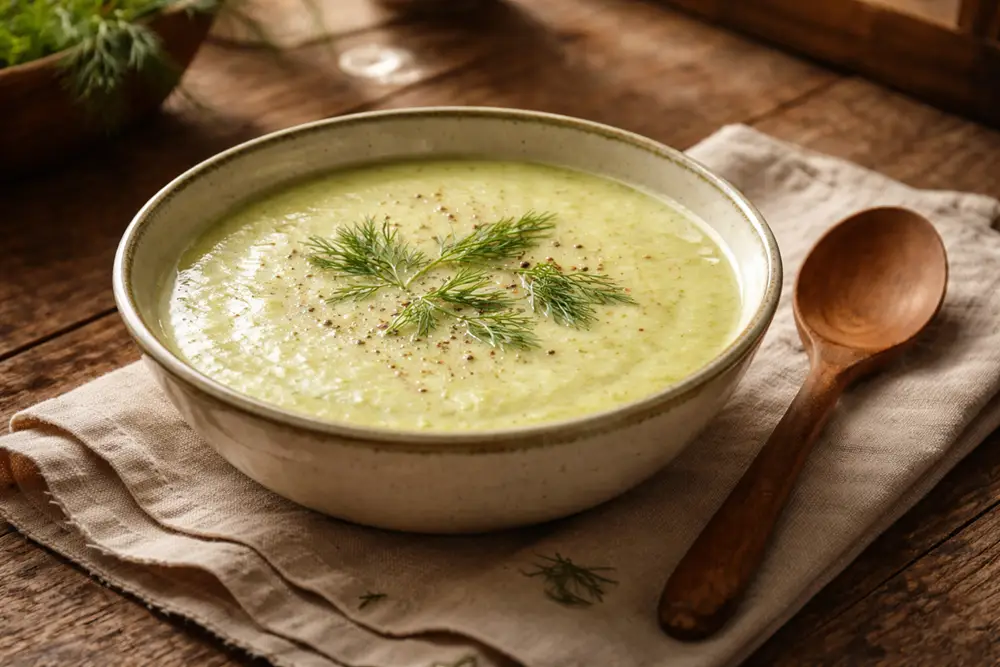
Young zucchini and spring onion soup built on a butter roux, finished with fresh dill and a tempered yogurt and egg yolk liaison. Serve with black pepper.
Quick Summary
Light Central European zucchini soup recipe with spring onions, butter roux, fresh dill, and a yogurt–egg yolk liaison. Ready in 55 minutes (20 min prep). Uses both zucchini core and diced flesh for a creamy yet textured result.
Historical recipe
Modernised adaptation of an early 20th‑century source. Not independently kitchen-tested by Attic Recipes. Quantities, temperatures, and food safety guidance have been updated for a contemporary kitchen — results may vary and errors may exist. Nutritional values, where provided, are estimates only and have not been laboratory tested. Always follow current food safety guidelines for your region. If you have a health condition, allergy, or dietary requirement, consult a qualified professional before preparing this recipe.
Use of this recipe is entirely at your own risk and subject to our Terms of Service and Privacy Policy. Attic Recipes accepts no liability for any adverse outcome.
- Gluten
- Eggs
- Dairy
Additional notes
-
Warning
This recipe uses egg yolks as a liaison. The tempered yolks must reach 74°C (165°F) to be safely cooked through. Ensure the soup is very hot before tempering, and do not return the pot to the boil after adding the liaison. Pregnant women, children under 18, elderly individuals, and people who are immunocompromised should ensure the yolks are fully cooked to this temperature.
Pasteurised egg yolks may be used in place of standard egg yolks and carry a lower risk for sensitive groups.
- 1
Prepare the zucchini: cut each zucchini in half lengthways and use a spoon to scrape out the soft, seedy inner core. Set the inner cores aside — these go into the pan first with the onion. Cut the remaining firm outer flesh into small cubes of approximately 1cm. Set the cubes aside separately.
- 2
Melt the 45g of butter in a large soup pot over medium heat. Add the 150g of sliced spring onion whites and the reserved zucchini cores. Fry gently, stirring occasionally, until the onion is soft and translucent and the zucchini cores have broken down into the butter — about 8 minutes.
- 3
Add the 2 tbsp of flour to the pot. Stir continuously for 1 to 2 minutes, until the flour smells lightly nutty and has turned pale golden. This is the roux that will give the soup its body.
- 4
Gradually pour in the 1000ml of water, a ladleful at a time, stirring constantly to prevent lumps from forming. Once all the water is added, bring the soup to a steady simmer over medium heat and cook for 10 minutes, stirring occasionally.
- 5
Add the 1 tsp of salt and the cubed zucchini flesh. Stir to combine. Continue simmering for a further 10 to 12 minutes, until the zucchini cubes are completely tender when pierced with a knife but still holding their shape.
- 6
Remove the pot from the heat. Stir in the 10g of finely chopped dill.
Tip Adding dill off the heat preserves its fragrance — dill loses its aroma quickly when boiled. - 7
In a small bowl, whisk together the 2 egg yolks and the 100ml of plain yogurt until smooth. To temper the mixture and prevent the yolks from scrambling, slowly ladle approximately 150ml of the hot soup into the yogurt and egg mixture while whisking constantly. Repeat with a second ladleful, whisking continuously.
Tip The soup should be off the heat and no longer boiling before adding the egg and yogurt mixture. The target temperature for safe egg yolk liaison is 74°C (165°F) — hot enough to cook the yolks through, not so hot that they scramble. - 8
Pour the tempered yogurt and egg mixture back into the soup pot in a slow, steady stream, stirring constantly. Do not return the pot to the heat after this point — the residual heat of the soup is sufficient to finish the liaison. Taste and adjust salt.
- 9
Ladle into bowls immediately and serve sprinkled with the freshly ground black pepper.
Nutrition Information per 1 serving (approx. 320ml)
Nutritional values are approximate estimates and may vary based on specific ingredients used, preparation methods, and portion sizes.
Serving Suggestions
Serve as a light main course with crusty white bread or rye bread. The soup does not reheat well after the egg and yogurt liaison has been added — the yolks will scramble if brought to a boil. If making ahead, prepare the soup base up to the end of step 6 and add the liaison only just before serving.
About This Recipe
This soup is built around a technique rather than a single ingredient: the roux gives it body, the double use of the zucchini gives it depth, and the egg and yogurt liaison at the end gives it a silkiness that water-based vegetable soups rarely achieve. It is a light soup but not a thin one — the kind that works as a summer first course or a simple weeknight main when zucchini are plentiful and the appetite is not heavy.
The zucchini is used in two ways. The soft inner core — the seedy, watery part that most recipes discard — goes into the pot first with the spring onion, where it breaks down in the butter and becomes part of the flavour base. The firmer outer flesh is cut into cubes and added later, so it retains its shape and texture in the finished soup. It is a small detail that makes a noticeable difference to both the flavour and the texture of the result.
The liaison of egg yolks and yogurt is the finishing step that defines the character of the soup. Added off the heat and tempered carefully, it transforms the texture from a pleasant vegetable broth into something closer to a velouté — smooth, slightly creamy, and faintly tangy from the yogurt. The dill, added just before the liaison, holds its fragrance through the residual heat without cooking away.
Why It Works
The roux — flour cooked in butter before the liquid is added — serves two purposes here. It thickens the soup gradually as the water is added, producing a smooth, uniform body without the chalky texture of raw starch stirred in at the end. It also adds a faint nuttiness from the lightly browned flour, which rounds out the mild flavour of the zucchini.
The egg yolk and yogurt liaison works by a different mechanism than a simple roux thickener. The yolk proteins, when heated gently to 74°C (165°F), unfold and form a loose network that adds body and richness without the heaviness of cream. The yogurt contributes both acidity and protein, which together stabilise the liaison and give it its characteristic slight tang. This is why the soup must not be boiled after the liaison is added — above 82°C, the yolk proteins over-coagulate and the emulsion breaks, producing scrambled egg in soup rather than a smooth finish.
Modern Kitchen Tips
A kitchen thermometer removes the guesswork from the liaison step. The soup should be between 74°C and 80°C when the tempered mixture is added — hot enough to finish cooking the yolks, cool enough not to scramble them. If you do not have a thermometer, remove the pot from the heat and wait 2 minutes before adding the liaison.
The soup base — everything up to and including the dill — can be made several hours ahead and refrigerated. Reheat gently to just below a simmer before tempering and adding the liaison. Do not prepare the full soup in advance; the liaison does not survive refrigeration and reheating.
Young, small zucchini with firm flesh and barely developed seeds give the best result. If only large zucchini are available, scoop out more of the seedy core than usual and salt the cubed flesh lightly, leaving it to drain in a colander for 15 minutes before adding to the soup — this removes excess water that would otherwise dilute the broth.
A classic of early 20th century home cooking, preserved and adapted for the modern kitchen.
The Story Behind This Recipe
Historical Context
Vegetable soups thickened with a flour and butter roux were a standard part of the Central European home cook's repertoire in the early 20th century, representing a practical technique for turning modest garden vegetables into a substantial first course or light main. The use of both the soft inner core and the firmer outer flesh of the zucchini — cooked separately and at different stages — reflects the economy of the period kitchen, where no part of a vegetable was routinely discarded. Finishing a soup with egg yolks and yogurt, rather than cream, was common practice in households where cream was a luxury but yogurt was produced at home or easily available; the technique produced a similar silkiness and body at a fraction of the cost. Quantities in recipes of this type were typically given in household measures — spoonfuls and tea cups — rather than by weight, with the size of those vessels understood to be smaller than their modern equivalents.
Modern Kitchen Adaptation
Water quantities are estimated based on a period tea cup of approximately 150ml — modern tea cups tend to be larger, so this has been converted to a fixed 1000ml measurement. Full-fat yogurt is recommended for stability in the liaison; low-fat yogurt has a higher water content and is more likely to curdle when added to hot soup. The egg yolk and yogurt liaison requires the soup to be off the heat before combining — this is both a food safety measure and a textural one, as boiling after adding the yolks will cause them to scramble and break the soup. Young zucchini with small, undeveloped seeds produce the best result; large, mature zucchini have a coarser texture and more water, which dilutes the flavour of the finished soup.
This recipe is an independent modern adaptation developed from historical sources in the public domain. It is provided for informational and educational purposes only and does not constitute professional dietary, nutritional, or medical advice. Food preparation involves inherent risks. The reader assumes full responsibility for safe food handling, ingredient sourcing, and adherence to current local food safety guidelines. The site operator accepts no liability for outcomes resulting from the preparation or consumption of this recipe.
One recipe.
Every week.
You Might Also Like
More recipes you'll enjoy
Baked Zucchini with Sour Cream and Breadcrumbs
Sweet-sour boiled zucchini baked with a golden butter, sour cream & breadcrumb topping. Simple, creamy, and satisfying.

Zucchini Stuffed with Grated Cheese
Young zucchini hollowed and filled with a light mixture of butter, egg, grated cheese, and parsley, then slowly baked.

Beef Broth with Stuffed Dough Dumplings
Rich beef bone broth simmered with golden pan-fried dumplings stuffed with seasoned ground beef, finished with a light roux and fresh lemon juice.