Young Vine Leaves Moussaka
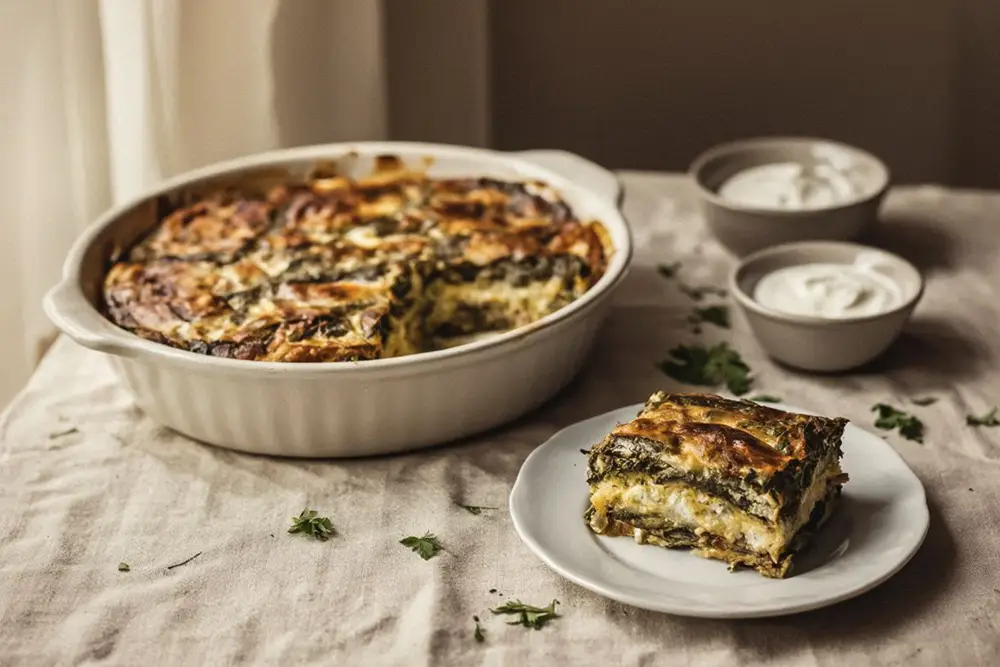
Battered and fried vine leaves layered with minced chicken, sautéed onion, and parsley, finished with an egg and sour cream custard baked until golden.
Quick Summary
Central European moussaka with battered vine leaves, minced chicken, and sour cream custard. Total time 120 minutes. Vine leaves are battered and lightly fried first for structure and a distinctive texture during baking.
Historical recipe
Modernised adaptation of an early 20th‑century source. Not independently kitchen-tested by Attic Recipes. Quantities, temperatures, and food safety guidance have been updated for a contemporary kitchen — results may vary and errors may exist. Nutritional values, where provided, are estimates only and have not been laboratory tested. Always follow current food safety guidelines for your region. If you have a health condition, allergy, or dietary requirement, consult a qualified professional before preparing this recipe.
Use of this recipe is entirely at your own risk and subject to our Terms of Service and Privacy Policy. Attic Recipes accepts no liability for any adverse outcome.
- Eggs
- Dairy
- Gluten
Additional notes
-
Warning
This dish contains eggs in three separate components: batter, filling, and custard topping. The egg in the filling is added off the heat to a warm mixture before baking — it must reach a safe internal temperature during baking. Always verify that the centre of the dish has reached at least 74°C (165°F) using an instant-read thermometer before serving. This is particularly important for pregnant women, elderly individuals, children under 18, and immunocompromised individuals.
-
Note
This dish contains approximately 11g of saturated fat per serving due to lard used for frying and the sour cream content of the custard and filling.
Substitute lard with sunflower oil in both the frying step and the sauté to reduce saturated fat to approximately 4g per serving.
- 1
Bring a large pot of unsalted water to a boil. Working in batches, blanch the vine leaves for 1–2 minutes, then immediately transfer them to a bowl of cold water to stop cooking and preserve colour. Drain and spread on a clean towel; pat thoroughly dry. Surface moisture will prevent the batter from adhering.
- 2
Make the batter: whisk together the 2 eggs and a pinch of salt. Add the 80g of flour and whisk to a smooth paste, then gradually whisk in the 200ml of milk until the batter is thin and loose — noticeably thinner than pancake batter. It should coat a leaf in a very light film. Rest for 10 minutes.
- 3
Heat the 175g of lard or oil in a wide frying pan over medium-high heat until shimmering. Dip each vine leaf in the batter, allow excess to drip off, and fry in batches for 1–2 minutes per side until light golden. Do not crowd the pan. Transfer to a rack or paper-lined tray. Replenish fat between batches as needed.
Tip The fat must be hot enough that the batter sets immediately on contact — if it soaks in and spreads, the fat is not hot enough. - 4
Make the chicken filling: heat the 15g of lard or oil in a saucepan over medium heat. Add the 300g of finely chopped onion and sauté until soft and translucent, about 8–10 minutes. Add the 650g of minced cooked chicken and stir to combine. Fry together for 2–3 minutes. Remove the saucepan from the heat.
- 5
While the filling is still warm but off the heat, stir in the 1 whole egg, 30g of sour cream, and 15g of chopped parsley. Season with salt and black pepper. The residual heat will partially set the egg — this is correct and safe as the filling will bake fully in the oven.
- 6
Preheat the oven to 180°C (350°F) / 160°C fan. Grease the baking dish generously with fat. Assemble in layers: a layer of fried vine leaves, then a layer of chicken filling, then 2–3 tablespoons of sour cream (from the 200g topping allocation). Repeat until the dish is full, finishing with a final layer of fried vine leaves.
- 7
Make the custard topping: whisk together the 2 eggs, remaining sour cream (200g minus what was used between layers), 100ml of milk, and 100ml of chicken stock until smooth. Pour evenly over the top of the assembled moussaka.
- 8
Bake for approximately 60 minutes, until the custard topping is fully set, lightly golden on the surface, and the internal temperature of the centre reads at least 74°C (165°F) on an instant-read thermometer. If the surface browns too quickly, cover loosely with foil and continue baking.
Tip The custard is done when it no longer jiggles in the centre and a skewer inserted in the middle comes out with no liquid egg clinging to it. - 9
Remove from the oven and rest for 10 minutes before slicing and serving. The layers will hold better after resting.
Nutrition Information per 1 serving (approx. 320g)
Nutritional values are approximate estimates and may vary based on specific ingredients used, preparation methods, and portion sizes.
Serving Suggestions
Serve warm, cut into squares directly from the baking dish. A spoonful of cold sour cream on the side is the natural accompaniment. A simple cucumber salad dressed with vinegar and dill balances the richness of the fried leaves and custard.
About This Recipe
Most people know vine leaves as a wrapper — something you roll around rice or meat and serve in neat little cylinders. This dish turns that expectation over entirely. Here the leaves are blanched, dipped in a thin egg batter, and fried until golden before being layered into a baking dish with minced chicken and a sour cream custard poured over the top. The result is something between a gratin and a terrine — rich, golden on top, the fried leaves holding their structure through the bake while the custard sets around them.
The chicken in this recipe is always cooked first, which is itself a detail worth noting. The bird is boiled — the stock reserved for the custard — and the meat minced fine and returned to the pan with onion, an egg, and a spoonful of sour cream. This was practical household cooking: nothing from the pot went unused, and a boiled chicken produced both the meat for the filling and the liquid for the topping in a single step.
What makes the dish unusual is the battered vine leaf. It adds a layer of texture that unlayered moussaka does not have — slightly crisp at the edges where the batter caught the heat, soft where the custard soaked through during baking. It is a dish that rewards patience in the frying step; leaves that are insufficiently dry or fried in fat that is not hot enough will be sodden rather than structured.
Why It Works
The two-stage cooking — boiling the chicken first, then frying the filling briefly — is what keeps the chicken moist inside a long bake. Raw minced meat in a layered dish baked for an hour would either dry out or render fat into the custard. Pre-cooked and only briefly sautéed meat holds its texture and remains distinct from the surrounding sauce.
The batter on the vine leaves serves the same structural purpose as pasta sheets in a lasagne or potato slices in a gratin: it provides a defined layer that resists compression under the weight of the filling and custard. Without the batter, blanched vine leaves would compress to a thin, slippery stratum. The fried batter holds the stack together and gives each serving a clean cross-section when cut.
The custard of eggs, sour cream, milk, and stock is intentionally thin when poured — thin enough to seep between the layers and coat the interior of the dish before it sets in the oven. The stock addition — described simply as “a little soup” in period recipes of this type — is the detail that prevents the topping from setting too solid: it thins the custard just enough to give it a loose, creamy texture rather than a firm egg-set.
Modern Kitchen Tips
If you are using vine leaves from a jar rather than fresh, skip the blanching step entirely — jarred leaves are already blanched and preserved in brine. Rinse them well in cold water, then soak in fresh cold water for 20 minutes to draw out excess salt before patting dry. The texture will be slightly softer than fresh blanched leaves but will hold adequately through frying.
The internal temperature check at step 8 is not optional for anyone cooking for vulnerable groups. A deep baking dish with dense layers can pass the visual tests — set surface, no liquid visible — while the centre is still below safe temperature. A thermometer removes the guesswork entirely.
The dish reheats well the following day. Cover with foil and warm at 160°C for 20 minutes. The custard firms a little on cooling and actually holds together better for serving cold or at room temperature as part of a spread.
A layered bake from the vine-growing season: battered leaves, boiled chicken, and a sour cream custard that sets everything in place.
The Story Behind This Recipe
Historical Context
Early 20th century Central European home cooking included a number of dishes that used fresh vine leaves as a structural element in layered bakes — a practice distinct from the stuffed-leaf tradition more commonly associated with the region. This recipe represents an unusual variation in which the leaves are battered and fried before layering, giving the dish both textural contrast and richness that the unbattered version lacks. The use of cooked chicken rather than raw meat reflects a practical period approach: a bird would be boiled for stock, and the meat then repurposed in secondary dishes such as this one. The custard topping of eggs, sour cream, milk, and a little stock is structurally similar to the custard layer found in period layered meat bakes across Central Europe, though the specific combination of fried vine leaves with chicken is not a common formula. Home cooks of the period did not specify oven temperature; the original instruction was simply 'moderate heat' for approximately one hour.
Modern Kitchen Adaptation
All quantities for the batter, custard topping, frying fat, onion, chicken meat, and sour cream in the filling were absent or given only as imprecise measures in the original text ('a little', 'a tablespoon', 'a little more', 'a little soup'). All quantities used here are estimated based on the dish volume, standard period ratios, and food technology standards, and are marked accordingly with # estimated. Oven temperature was not specified; 180°C (350°F) / 160°C fan is estimated as appropriate for a custard-topped baked dish of this depth. Lard is the historically correct frying fat; sunflower oil is a direct substitute in both the frying step and the sauté. The egg in the chicken filling is added off the heat and then fully baked — this is safe and consistent with the original method. An internal temperature check of 74°C at the centre is recommended as the definitive doneness test given the depth of the dish and the egg content of both the filling and the topping.
This recipe is an independent modern adaptation developed from historical sources in the public domain. It is provided for informational and educational purposes only and does not constitute professional dietary, nutritional, or medical advice. Food preparation involves inherent risks. The reader assumes full responsibility for safe food handling, ingredient sourcing, and adherence to current local food safety guidelines. The site operator accepts no liability for outcomes resulting from the preparation or consumption of this recipe.
One recipe.
Every week.
You Might Also Like
More recipes from the same category
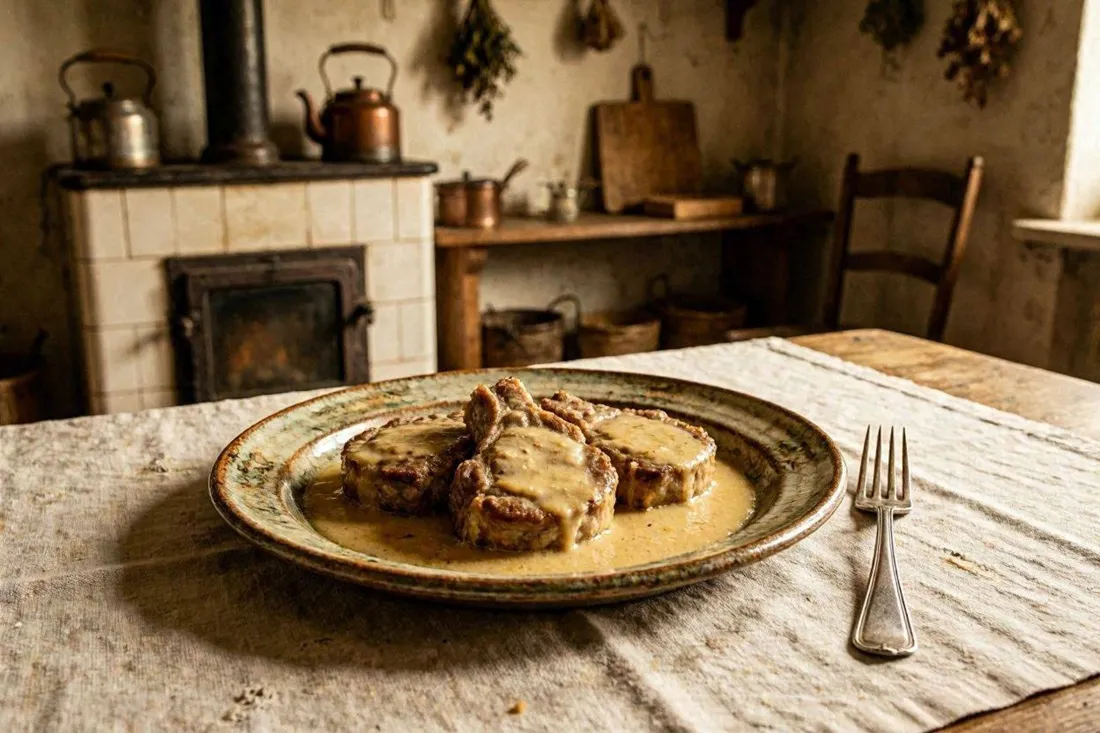
Braised Pork Chops in White Wine and Sour Cream Sauce
Pork loin chops braised with onion, carrot, parsley root, and celery root in white wine, then finished with a strained sour cream sauce.
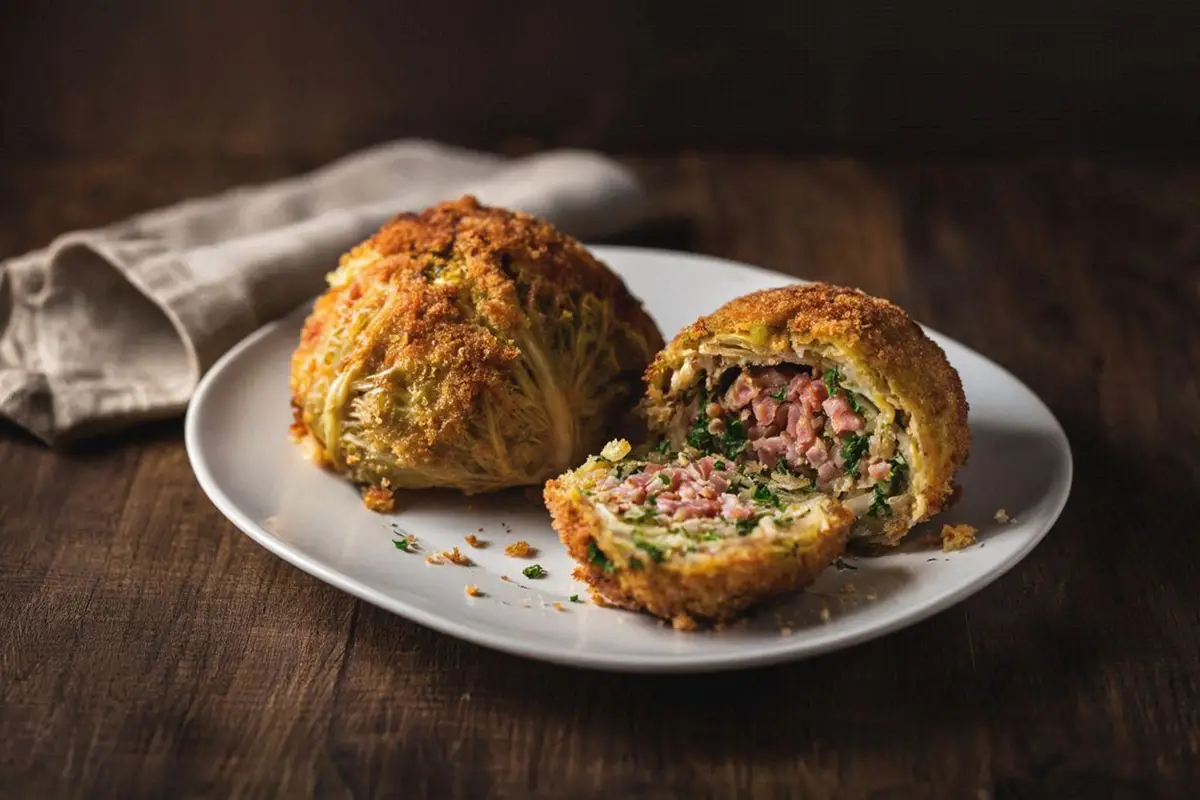
Breaded Savoy Cabbage Stuffed with Ham
Tender young savoy cabbage heads filled with ground ham, fried onion, and herbs, breaded and pan-fried until golden. A hearty Central European classic.
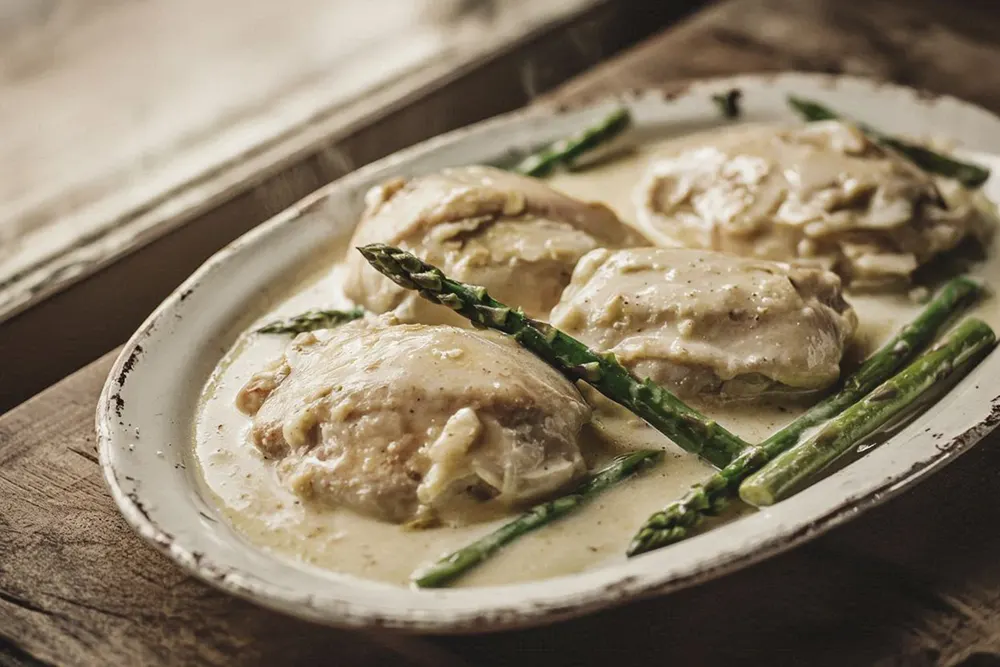
Chicken in Asparagus Sauce
A whole chicken poached in spiced broth, then finished in a silky velouté enriched with egg yolks and cream, garnished with tender asparagus tips.