Veal Heart in Wine Sauce
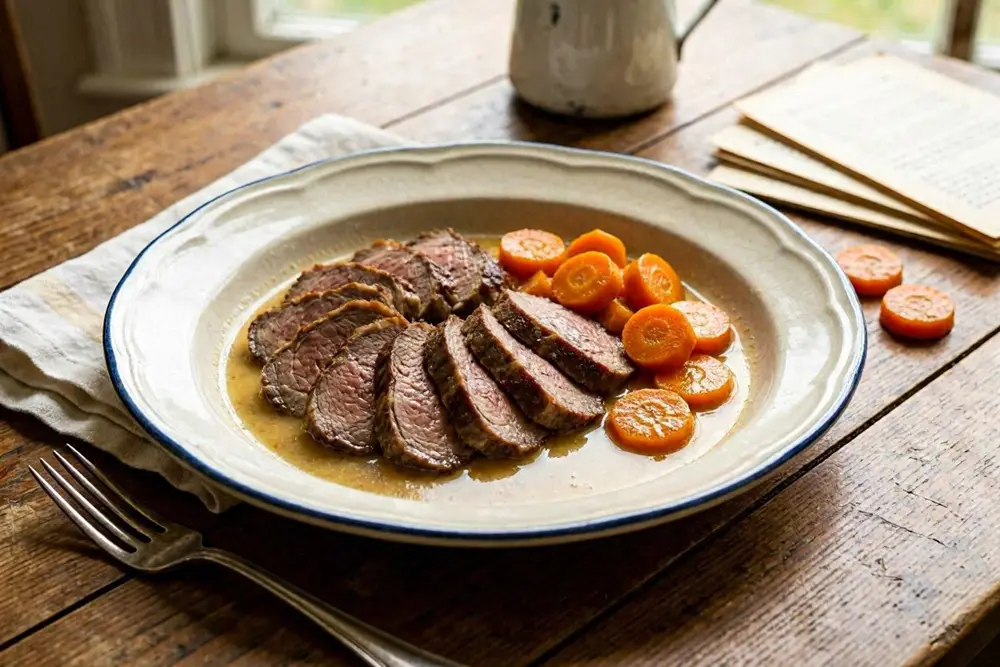
Veal hearts larded with fresh bacon, braised in butter with vegetables and peppercorns, then finished with a white wine and lemon pan sauce.
Quick Summary
Veal Heart in Wine Sauce is a Central European dish of veal heart larded with bacon, braised in butter and finished with a white wine and lemon sauce. It takes about 110 minutes total. Distinct for its larding method and a rich sauce from braising juices.
Historical recipe
Modernised adaptation of an early 20th‑century source. Not independently kitchen-tested by Attic Recipes. Quantities, temperatures, and food safety guidance have been updated for a contemporary kitchen — results may vary and errors may exist. Nutritional values, where provided, are estimates only and have not been laboratory tested. Always follow current food safety guidelines for your region. If you have a health condition, allergy, or dietary requirement, consult a qualified professional before preparing this recipe.
Use of this recipe is entirely at your own risk and subject to our Terms of Service and Privacy Policy. Attic Recipes accepts no liability for any adverse outcome.
- Gluten
- Dairy
Additional notes
-
Warning
Veal heart is offal and must reach an internal temperature of 71°C (160°F) throughout before serving. Use a meat thermometer to verify — visual colour alone is not a reliable indicator. This is particularly important when serving to pregnant women, children under 18, elderly individuals, and people who are immunocompromised.
-
Note
Veal heart is very high in cholesterol (approximately 310mg per serving). Those managing cardiovascular conditions or dietary cholesterol intake should be aware of this. The dish is also high in saturated fat at approximately 11g per serving due to the butter and bacon used in braising.
-
Note
This recipe contains alcohol (white wine). The sauce is brought to a boil, which reduces but does not eliminate alcohol content. Individuals avoiding alcohol — including pregnant women and children under 18 — should be aware.
Replace white wine with an equal quantity of good-quality chicken or veal stock with a squeeze of additional lemon juice.
- 1
Prepare the veal hearts: trim away all visible veins, arteries, and excess fat. Rinse thoroughly under cold running water, then pat completely dry with kitchen paper. Using a larding needle or a thin sharp knife, insert strips of the 100g of fresh bacon deep into the flesh of each heart, spacing them evenly across the surface. This is called larding — the bacon bastes the meat from the inside during the long braise, keeping it moist.
Tip If you do not have a larding needle, make deep incisions with a thin knife and push the bacon strips in with your finger. They do not need to be perfectly even — just distributed through the meat. - 2
Melt the 100g of butter in a heavy-bottomed saucepan or Dutch oven over medium heat. Add the larded hearts and brown on all sides — about 8 to 10 minutes total. Do not rush this step; the colour built here contributes to the depth of the braising liquid.
- 3
Add the 300g of quartered red onion, 200g of sliced carrots, 8 black peppercorns, and the bay leaf to the pan. Stir to combine with the butter and any juices from the hearts. Reduce the heat to low, cover, and braise gently for 60 to 75 minutes, turning the hearts occasionally, until they are nearly tender when pierced with a knife. Top up with a small splash of water if the pan becomes dry.
Tip The braise should be a very gentle simmer — barely a bubble. High heat will toughen the heart muscle. - 4
When the hearts are nearly tender, pour the 2 tbsp of white wine into the pan. Cover and continue braising for a further 10 minutes.
- 5
Remove the hearts from the pan and set aside to rest. Strain the braising liquid through a fine-mesh sieve, pressing the vegetables to extract all the juice. Discard the solids. Reserve the strained liquid — this forms the base of the sauce.
- 6
Slice the rested hearts into pieces of approximately 1cm thickness. Arrange in a serving dish and keep warm.
- 7
Make the sauce: in the same saucepan, melt the 20g of butter for the sauce over medium heat. Add the 20g of flour and stir continuously for 2 to 3 minutes, until the roux turns lightly golden and smells nutty.
- 8
Pour in the 100ml of white wine and stir briskly to combine with the roux. Add the reserved strained braising liquid and the 1 tbsp of lemon juice. Season with the 1 tsp of salt, taste, and adjust. Bring to a boil, stirring, and cook for 3 to 4 minutes until the sauce is smooth, glossy, and has a light coating consistency.
Tip If the sauce is too thick, thin with a splash of warm water. If too thin, simmer for a further 2 to 3 minutes. - 9
Pour the hot sauce over the sliced hearts in the serving dish. Serve immediately. Before serving, verify that the internal temperature of the heart has reached at least 71°C (160°F) using a meat thermometer.
Nutrition Information per 1 serving (approx. 280g)
Nutritional values are approximate estimates and may vary based on specific ingredients used, preparation methods, and portion sizes.
Serving Suggestions
Serve with buttered egg noodles, mashed potatoes, or boiled potatoes to absorb the sauce. A simple green salad or braised red cabbage alongside balances the richness of the dish. The sauce is the centrepiece — spoon it generously over both the meat and any accompanying starch.
About This Recipe
Veal heart is one of those cuts that rewards the cook who is willing to look past an unfamiliar name. It is dense, deeply flavoured muscle — closer in taste and texture to a well-braised beef cheek than to liver or kidney — and it takes long, slow heat and a good sauce the way any lean braise does. The larding technique, inserting strips of fresh bacon into the flesh before cooking, solves the main challenge of cooking a very lean cut: the bacon melts slowly from the inside, basting the meat throughout the braise and keeping it from drying out.
The sauce is built directly from the braising juices — the butter, the onion and carrot, the peppercorns, the small measure of wine added near the end. These are strained, combined with a simple butter roux and a fresh measure of white wine, sharpened with lemon, and poured back over the sliced meat. It is a sauce with backbone: glossy, faintly acidic, and rich from the braising fat without being heavy.
This is a dish that requires time but not difficulty. The technique is straightforward; the braise is largely unattended. What it asks of the cook is patience with the low heat and attention to the sauce at the end.
Why It Works
Heart is working muscle — it beats continuously and is therefore composed of dense, tightly packed fibres with very little intramuscular fat. This makes it tough if cooked quickly over high heat (as you would a steak) and tender if cooked slowly over low heat in a covered pan, which is exactly what the long braise achieves. The collagen in the connective tissue surrounding the muscle fibres slowly converts to gelatin during the braise, which gives the meat a silky quality and contributes body to the braising liquid.
Larding addresses the lack of internal fat directly. The bacon strips, distributed through the flesh, provide continuous internal moisture as their fat renders during the long cooking time — the same effect that intramuscular marbling provides in fattier cuts.
The roux-based sauce thickens the braising liquid without changing its flavour. Making the roux in the same pan used for braising means the browned residue left behind — concentrated meat juices and caramelised butter — is incorporated into the sauce from the first moment, giving it depth that a separately made sauce cannot replicate.
Modern Kitchen Tips
Ask your butcher to trim the hearts for you — removing the large veins and arteries at the top is straightforward with the right knife, but easier if done at the source. If trimming yourself, use kitchen scissors for the tough connective tissue at the top of the heart and a sharp knife for the fat.
The braising time will vary depending on the age of the animal and the size of the hearts. Begin checking for tenderness at 60 minutes by inserting a thin knife into the thickest part — it should meet some resistance but not be firm. Full tenderness comes between 75 and 90 minutes for most veal hearts.
The sauce can be made slightly ahead and kept warm over very low heat; stir occasionally to prevent a skin from forming. Add a small knob of cold butter off the heat just before serving for extra gloss.
A classic of early 20th century home cooking, preserved and adapted for the modern kitchen.
The Story Behind This Recipe
Historical Context
Braised veal heart was a well-established dish in Central European middle-class cooking of the early 20th century, appearing alongside other offal preparations at a time when whole-animal cooking was standard household practice rather than a culinary statement. The technique of larding — inserting strips of fresh bacon into the flesh of a lean cut before braising — was applied to any meat considered too lean to braise without drying out, and the heart, being dense muscle with very little internal fat, benefited significantly from it. The addition of a small quantity of white wine toward the end of the braise, rather than at the start, reflects a period approach to wine in cooking: used sparingly as a finishing note rather than as a primary braising liquid. The pan sauce built from the strained braising juices, a butter roux, and lemon juice is a straightforward example of the Central European approach to offal sauces — restrained in acidity, glossy from butter, and built on the cooking juices of the meat itself.
Modern Kitchen Adaptation
Veal hearts are available from butchers and specialist suppliers; they may need to be ordered in advance. Beef heart can be substituted — use one heart of approximately 600–800g in place of two veal hearts and extend the braising time by 20 to 30 minutes, as beef heart is denser. The larding technique requires either a larding needle or patience with a thin knife; the step is important for keeping the lean heart muscle moist during the long braise and should not be skipped. All quantity estimates for the sauce (butter, flour, wine, lemon juice) are reconstructed from the original proportions, which were not precisely stated — adjust to taste and desired consistency. The original recipe did not specify braising time; 60 to 90 minutes reflects standard practice for veal heart until completely tender.
This recipe is an independent modern adaptation developed from historical sources in the public domain. It is provided for informational and educational purposes only and does not constitute professional dietary, nutritional, or medical advice. Food preparation involves inherent risks. The reader assumes full responsibility for safe food handling, ingredient sourcing, and adherence to current local food safety guidelines. The site operator accepts no liability for outcomes resulting from the preparation or consumption of this recipe.
One recipe.
Every week.
You Might Also Like
More recipes you'll enjoy
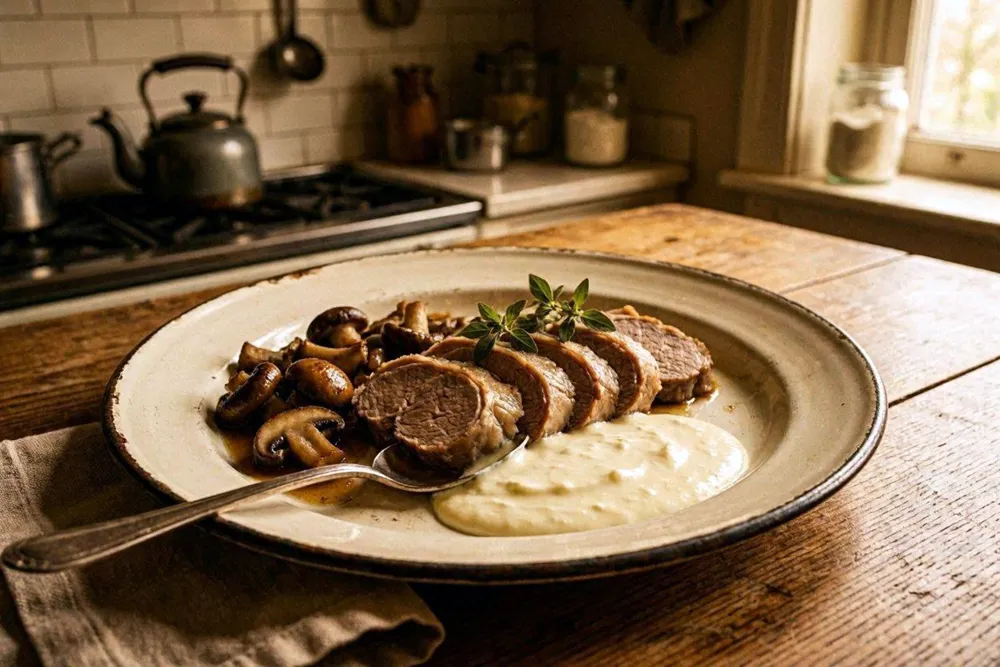
Veal Kidney with Marjoram
A whole veal kidney rubbed with marjoram, wrapped in a thin veal cutlet, braised in white wine, and roasted with mushrooms in a rich sour cream sauce.
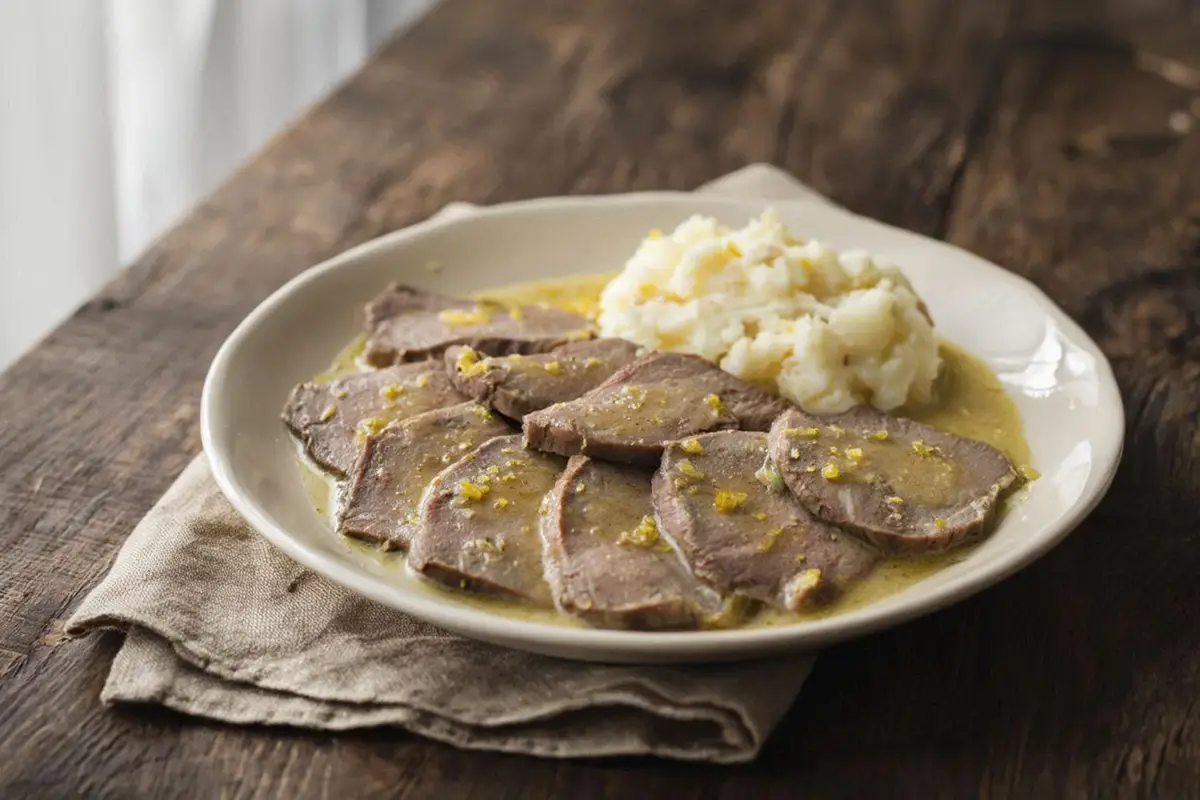
Veal Tongue in Sardinate Sauce
Tender boiled veal tongue sliced and finished in a rich anchovy-butter sauce with white wine and lemon — a refined Central European classic.
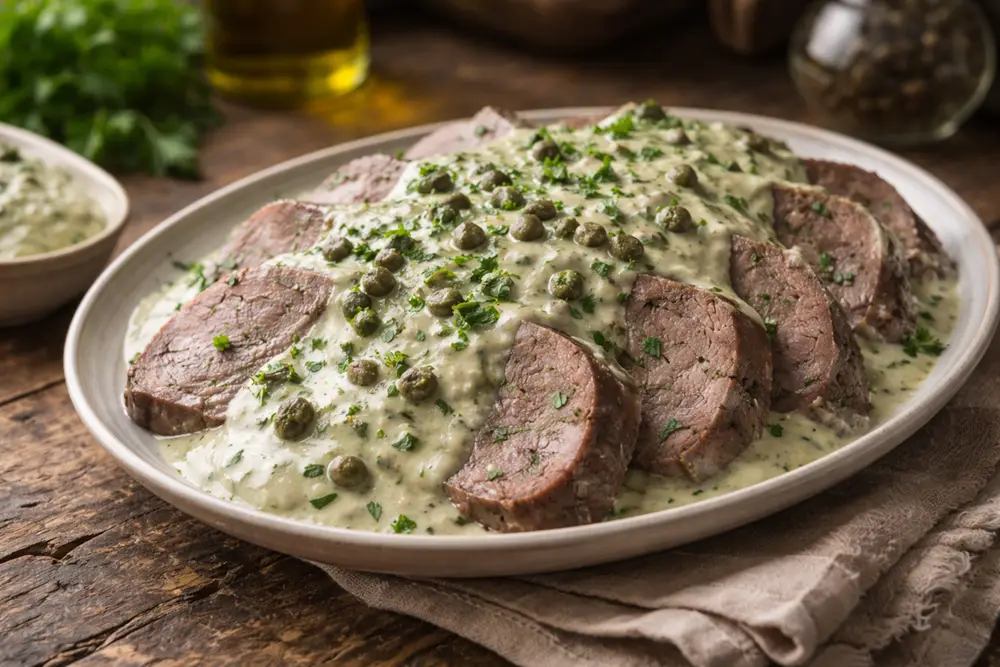
Baked Tongue in Green Sauce
Beef tongue braised with herbs, larded with bacon and roasted until golden, served in a green sauce of capers, anchovy, parsley and sour cream.