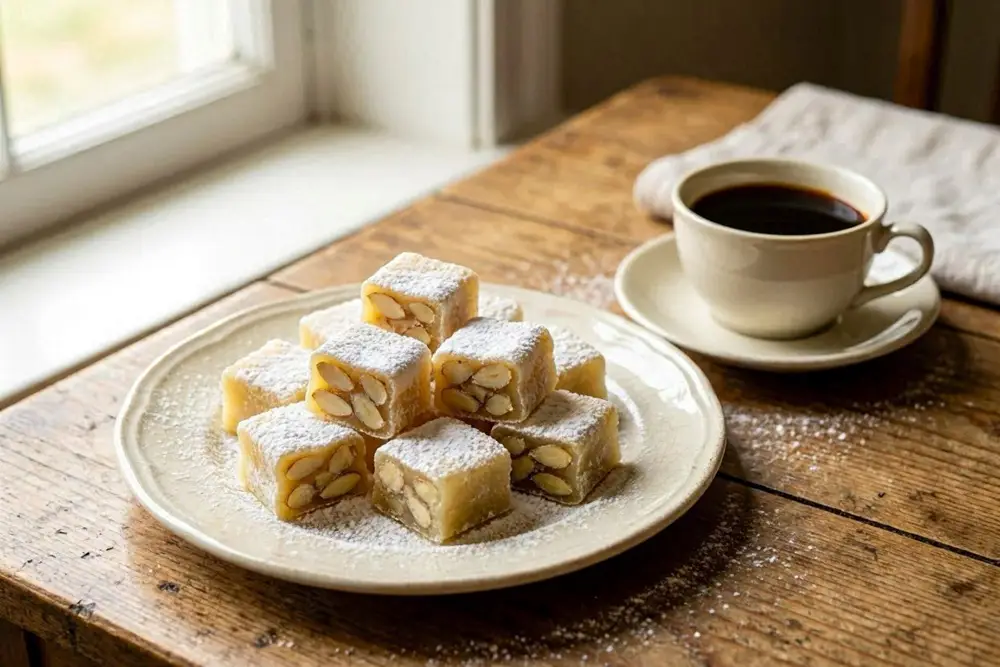
Turkish Delight with Almonds and Bergamot
A slow-cooked Central European confection made with potato starch, bergamot essence, lemon, and whole almonds.
Historical recipe
Modernised adaptation of an early 20th‑century source. Not independently kitchen-tested by Attic Recipes. Quantities, temperatures, and food safety guidance have been updated for a contemporary kitchen — results may vary and errors may exist. Nutritional values, where provided, are estimates only and have not been laboratory tested. Always follow current food safety guidelines for your region. If you have a health condition, allergy, or dietary requirement, consult a qualified professional before preparing this recipe.
Use of this recipe is entirely at your own risk and subject to our Terms of Service and Privacy Policy. Attic Recipes accepts no liability for any adverse outcome.
- Tree Nuts
Additional notes
-
Warning
Hot sugar syrup reaches temperatures above 115°C (239°F) and causes severe burns on contact with skin. Keep children away from the stove during syrup preparation. Do not touch or taste the syrup directly.
-
Warning
High sugar content: approximately 21g of sugar per cube. People managing blood sugar levels or following a reduced-sugar diet should be aware of portion size.
-
Note
Bergamot flavouring: use only food-grade oil or konditorska esencija labelled safe for consumption. Aromatherapy-grade bergamot essential oil is not formulated for ingestion and must not be used. The correct culinary dose is 10–15 drops (0.3–0.5ml) per 1kg of sugar — exceeding this does not increase safety risk but will produce an unpleasant soapy flavour. Food-grade bergamot is considered safe for the general population in these quantities. People with citrus allergies should exercise caution.
- 1
Prepare the almonds: briefly blanch 125g whole almonds in boiling water for 1–2 minutes, drain, and slip off the skins. Pat completely dry with a clean cloth, then slice thinly. Set aside.
- 2
Make the sugar syrup: combine 1000g of sugar with 250ml of cold water in a heavy-bottomed saucepan. Bring to the boil over medium heat, stirring until the sugar is fully dissolved. Continue cooking without stirring until the syrup reaches 115°C (239°F) — the soft ball stage. Remove from the heat.
Tip Use a candy thermometer for accuracy. At 115°C, a small drop of syrup pressed between wet fingers will form a soft, pliable ball. Do not allow the syrup to go beyond this stage or the finished turkish delight will be grainy. - 3
Dissolve the starch: in a separate bowl, whisk 150g of potato starch into 1000ml of cold water until completely smooth with no lumps. The mixture should look like thin milk.
Tip The starch settles quickly — re-stir immediately before pouring. - 4
Combine: with the saucepan off the heat, slowly pour the dissolved starch mixture into the hot sugar syrup in a thin, steady stream, whisking constantly. Return the saucepan to medium-low heat.
- 5
Cook the mixture, stirring continuously with a clean whisk, for approximately 60–90 minutes. Do not stop stirring at any point once the mixture begins to thicken. The mixture is ready when it falls from the spoon in a single heavy, continuous sheet rather than in drops, and when it begins to pull away from the sides of the pan.
Tip Reduce the heat as the mixture thickens. A scorched bottom will ruin the entire batch. The colour should remain pale golden — if it starts to darken significantly, the heat is too high. - 6
Remove from the heat. Add 20ml of lemon juice. Add bergamot food-grade flavouring drop by drop — start with 10 drops (approximately 0.3ml), stir thoroughly, and taste before adding more. The maximum is around 15 drops for this quantity. Stir well to combine. Fold in the 125g of sliced almonds.
Tip Adding flavouring off the heat is essential — high temperatures destroy delicate aromatic compounds. Bergamot is extremely potent; too much gives a soapy, overpowering result that cannot be corrected once it is in the mixture. - 7
Prepare the mould: using a pastry brush, coat a clean enamel or metal baking dish (approximately 20×30 cm) with 20ml of food-grade almond oil, covering the base, sides, and corners thoroughly. Invert the dish over the sink for 1–2 minutes to allow excess oil to drip out, leaving only a thin film. For extra insurance against sticking, dust the oiled surface lightly with a mix of equal parts powdered sugar and cornstarch.
- 8
Pour the still-warm turkish delight mixture into the prepared dish. Smooth the surface with a lightly oiled knife or spatula so the layer is even and 3–4 cm thick.
- 9
Leave in a cool place uncovered for at least 8 hours, or overnight. The turkish delight must be fully set and firm before cutting — it will not hold its shape if cut while warm.
Tip Do not refrigerate — cold temperatures affect the texture. A cool kitchen or pantry is ideal. - 10
The next day, sift 150g of powdered sugar into a shallow bowl or tray. Turn the set turkish delight out onto a clean board. Cut into cubes with a sharp knife, wiping the blade clean between cuts — or lightly brush the blade with almond oil for even cleaner cuts. Roll each cube thoroughly in the powdered sugar until completely coated on all sides.
Tip As an alternative to powdered sugar, roll the cubes in finely desiccated coconut — it prevents sticking just as well and adds a different dimension. For flavour variations, see the notes below. - 11
Store in an airtight tin layered with parchment paper or extra powdered sugar. Keep at room temperature in a cool, dry place for up to 2 weeks.
Nutrition Information per 1 cube (approx. 38g)
Nutritional values are approximate estimates and may vary based on specific ingredients used, preparation methods, and portion sizes.
Serving Suggestions
Turkish delight is a traditional confection served alongside coffee — particularly thick, strong coffee — or as part of a sweet table at celebrations. It keeps well in a tin and is traditionally offered to guests as part of holiday hospitality, alongside other small confections. The bergamot aroma pairs well with a glass of cold water or mint tea.
About This Recipe
Ratluk or lokum is the Central European name for what the wider world knows as Turkish delight — a slow-cooked confection of sugar syrup and starch, set into a firm, translucent slab and cut into cubes dusted with powdered sugar. This version, made with potato starch and bergamot essence, is a faithful reconstruction of how the confection was made at home in the early 20th century, before cornstarch became the universal pantry staple and commercial Turkish delight replaced homemade.
The process is not complicated, but it demands patience and constant attention. The mixture must be stirred without interruption for the better part of an hour and a half as it thickens — stop for even a moment once the starch has fully gelatinized, and the bottom will scorch. The reward is a confection with a texture that commercial versions rarely achieve: firm but yielding, with a clean sweetness balanced by the sharp floral note of bergamot and the brightness of lemon.
The almonds — sliced thin, briefly boiled to loosen the skins, and folded in at the end — distribute through the set slab in the way that only a slow-poured, hand-stirred mixture allows. Each cube is different.
Why It Works
The chemistry of turkish delight is straightforward once understood. The sugar syrup cooked to 115°C has a precise water content — the soft ball stage — which, combined with the gelatinized starch, creates a stable gel that sets firm at room temperature without refrigeration. Too low a temperature in the syrup and the finished turkish delight will be too soft; too high and it will be grainy or chewy.
The lemon juice serves two functions: it adds acidity that brightens the flavour, and it prevents the inversion of sucrose into glucose and fructose during cooking — which would cause the sugar to crystallize and the texture to turn grainy. It is not optional.
Potato starch gelatinizes at a slightly lower temperature than cornstarch and produces a somewhat softer, more delicate gel. This is why period recipes call for it specifically — the texture of potato starch turkish delight has a characteristic tenderness that cornstarch versions approach but do not quite replicate.
Modern Kitchen Tips
The most critical moment is the final stage of cooking, when the mixture has thickened to the point where it falls in sheets from the spoon. At this point the heat must be at its lowest and the stirring must be constant and reaching every part of the base of the pan. A flat-bottomed whisk or a wooden spoon with a flat edge works better here than a round-headed whisk.
The overnight rest is not negotiable. Turkish delight cut before it is fully set will not hold its cube shape and will collapse into sticky fragments. In a warm kitchen, allow 12 hours rather than 8.
In humid conditions, the powdered sugar coating will absorb moisture and turn sticky within a day. Rolling the cubes in a mixture of equal parts powdered sugar and cornstarch solves this. Finely desiccated coconut is an excellent alternative coating entirely — it does not absorb moisture as readily and pairs well with vanilla or lemon-flavoured variations.
Flavour variations: The base recipe is easily adapted. Rose water (1–2 tablespoons) is the most traditional alternative to bergamot and gives the classic Turkish delight flavour. Orange blossom water works in the same quantity. For nuts, lightly toasted walnuts or whole unsalted pistachios can replace or supplement the almonds — pistachios in particular are visually striking in the cut slab. All flavourings and additions go in off the heat, immediately before pouring into the mould.
A patient confection — made slowly, set overnight, and best shared with strong coffee.
The Story Behind This Recipe
Historical Context
Home confectionery recipes of this type from the early 20th century consistently used potato starch rather than cornstarch as the thickener — potato starch was the standard pantry ingredient of the era in Central European households. The flavouring specified was bergamot essence purchased from a pharmacy, which at the time stocked konditorska esencija (confectionery flavouring extracts) alongside medicines — a common source for home bakers before specialty food shops were widespread. The sugar quantity in the original is given as 'sugar in cubes,' which was the standard retail form of refined sugar in this period: cube sugar was considered purer and cleaner-dissolving than loose granulated sugar. The original recipe calls for a new enamel casserole dish greased with almond oil and then inverted to drain — a careful technique to achieve the thinnest possible non-stick film without any pooling, which would affect the texture of the base.
Modern Kitchen Adaptation
Potato starch is the period-correct ingredient and remains in the recipe as specified; cornstarch (kukuruzni skrob) is an acceptable modern substitute in the same quantity and produces a very similar result, though the texture of the finished turkish delight is slightly more elastic with cornstarch than with potato starch. The original specifies bergamot essence from a pharmacy — this is equivalent to modern food-grade konditorska esencija or food-grade bergamot essential oil, available in baking supply shops and specialist food stores. Do not substitute aromatherapy-grade bergamot essential oil, which is not formulated for ingestion and is far more concentrated. The correct quantity is 10–15 drops (approximately 0.3–0.5ml) per 1kg of sugar — bergamot is extremely potent and excess gives a soapy, unpleasant result. Always add off the heat. Food-grade almond oil for greasing the mould requires 15–30ml depending on dish size; the technique of inverting the oiled dish to drain is important to avoid pooling at the base, which would affect texture. The base recipe is highly adaptable: rose water (1–2 tablespoons, added off the heat) is the most traditional alternative to bergamot and is the classic flavouring for Turkish delight across the region. Orange blossom water works in the same quantity. For nut additions, 150–250g of lightly toasted walnuts, whole unsalted pistachios, or hazelnuts can replace or supplement the almonds — fold in with the nuts at the end of cooking. Desiccated coconut can replace powdered sugar as the coating; it prevents sticking equally well and pairs particularly well with a vanilla or lemon-flavoured base. Lemon zest with a small amount of fresh ginger juice is a refreshing modern variation. All additions and flavourings go in off the heat, immediately before pouring into the mould.
This recipe is an independent modern adaptation developed from historical sources in the public domain. It is provided for informational and educational purposes only and does not constitute professional dietary, nutritional, or medical advice. Food preparation involves inherent risks. The reader assumes full responsibility for safe food handling, ingredient sourcing, and adherence to current local food safety guidelines. The site operator accepts no liability for outcomes resulting from the preparation or consumption of this recipe.
One recipe.
Every week.
You Might Also Like
More recipes from the same category
Apple Pie with Whipped Cream
A crisp almond shortcrust base layered with ground walnuts, poached apples, apricot jam, and a thick cloud of sweetened whipped cream.
Almond Meringue Crescents
Crisp Central European confections of Swiss meringue shaped into crescents, coated in ground almonds, oven-dried until white and firm.
Apricot Cream
A rich chilled cream of apricot marmalade, egg yolks, sugar, and gelatin, set in a mould and served unmoulded with whipped cream.