Stuffed Mushrooms
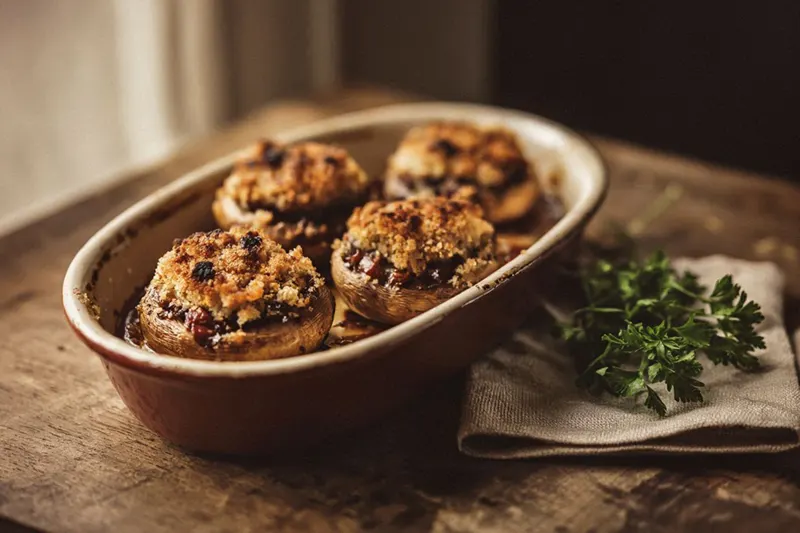
Large mushroom caps stuffed with a wine, tomato and garlic filling made from the stems and skins, gratinated with breadcrumbs.
Quick Summary
Large mushroom caps stuffed with a wine, tomato and garlic filling made from the stems and skins, gratinated with breadcrumbs.
Historical recipe
Modernised adaptation of an early 20th‑century source. Not independently kitchen-tested by Attic Recipes. Quantities, temperatures, and food safety guidance have been updated for a contemporary kitchen — results may vary and errors may exist. Nutritional values, where provided, are estimates only and have not been laboratory tested. Always follow current food safety guidelines for your region. If you have a health condition, allergy, or dietary requirement, consult a qualified professional before preparing this recipe.
Use of this recipe is entirely at your own risk and subject to our Terms of Service and Privacy Policy. Attic Recipes accepts no liability for any adverse outcome.
- Gluten
- Dairy
- Sulphites
Additional notes
-
Note
This recipe contains alcohol (white wine). Most of the alcohol evaporates during cooking. The finished dish contains only trace amounts, but it is unsuitable for those who must avoid alcohol entirely, including children and pregnant women.
- 1
Preheat the oven to 200°C (400°F) / 180°C fan. Wash and peel the 10 mushrooms. Remove the stems. Set the peeled caps aside. Finely chop the stems and reserved skins together — these form the base of the filling.
Tip Peeling the mushrooms and using the skins in the filling is the traditional technique here. The peeled caps hold their shape better during baking and present more cleanly at the table. - 2
Heat 3 tablespoons of olive oil in a saucepan over medium heat. Add the finely chopped onion and sweat until softened and translucent, about 5 minutes.
- 3
Add the chopped mushroom stems and skins to the pan. Sauté with the onion, stirring occasionally, until the mushrooms release their liquid and it comes to a boil.
- 4
Add 10g chopped parsley, 100ml white wine, 30g cooked tomato, and 2 crushed garlic cloves. Stir to combine and simmer over medium-low heat until the liquid has mostly reduced and the filling is thick and cohesive, about 10 minutes.
Tip If the filling is still watery after 10 minutes, stir in 1 tablespoon of the breadcrumbs directly into the filling to bind it. - 5
Grease an oven-safe serving dish with 1 tablespoon of olive oil and 10g butter. Spoon a thin layer of the filling across the base of the dish. Arrange the mushroom caps on top, hollow side up.
- 6
Fill each mushroom cap with the remaining filling, pressing it in gently. Sprinkle 40g breadcrumbs evenly over the tops of all the mushrooms.
- 7
Bake in the preheated oven for 15–20 minutes, until the mushroom caps are tender and the breadcrumbs are golden brown and crisp. Serve immediately in the same dish.
Nutrition Information per 2 mushrooms (approx. 150g)
Nutritional values are approximate estimates and may vary based on specific ingredients used, preparation methods, and portion sizes.
Serving Suggestions
Serve hot, straight from the oven dish, as an appetizer or a light starter. These are also good as a side dish alongside roasted meat or grilled fish. A crisp dry white wine — an Aligoté, a Pinot Grigio, or a Welschriesling — pairs well with the wine and tomato base of the filling.
About This Recipe
Most stuffed mushroom recipes treat the stems as an afterthought or discard them entirely. This one uses them — along with the peeled skins — as the foundation of a filling that is more flavourful than the caps themselves. Chopped fine and sautéed until their moisture evaporates, then simmered with wine, tomato and garlic, the mushroom trimmings become a concentrated, deeply savoury stuffing that holds together well and fills the caps without drowning them.
The technique of peeling the caps is unusual by modern standards. In early 20th century Central European home cooking it was considered the refined approach — a smooth, uniformly coloured cap presented more elegantly at the table than an unpeeled one. The skins went straight into the pan, so the extra step involved no waste.
The dish is baked and served in the same vessel, which was both practical and characteristic of the period. There is no transfer, no re-plating — just the dish from oven to table, still bubbling.
Why It Works
Using the skins and stems in the filling rather than discarding them concentrates the mushroom flavour significantly. When the chopped trimmings hit the hot oil with the onion, they release a considerable amount of liquid; allowing this to fully evaporate before adding the wine means the final filling has depth rather than wateriness. The wine then deglazes the pan, lifting the browned bits and adding acidity. The small amount of cooked tomato functions as a binder and adds a subtle sweetness that balances the wine.
Breadcrumbs on top serve two purposes: they form the gratinated crust that gives the dish its texture contrast, and any crumbs that fall into the filling during baking absorb the remaining moisture and keep the stuffing from becoming loose.
Modern Kitchen Tips
Choose mushrooms that are large enough to hold a generous spoonful of filling — cremini or portobello mushrooms work particularly well and have a more robust flavour than standard white button mushrooms. Avoid mushrooms that are already open and flat; they will not hold the filling.
The filling can be made a day ahead and kept refrigerated. Bring it back to room temperature before stuffing the caps and baking — cold filling will lower the internal temperature and extend the baking time unpredictably.
If the filling reduces too quickly before the flavours have had time to meld, add a splash of water or additional wine and continue simmering.
A classic of early 20th century Central European home entertaining, preserved and adapted for the modern kitchen.
The Story Behind This Recipe
Historical Context
Early 20th century recipes for stuffed mushrooms in Central European cooking frequently called for peeling the caps — a practice that seems counterintuitive today but was standard in refined home cooking of the period, where a smooth, uniform appearance was valued. The skins, rather than being discarded, were chopped and returned to the filling along with the stems, so nothing was wasted. The filling technique — sautéing the chopped mushroom trimmings with onion until the moisture evaporated, then deglazing with wine and adding tomato and garlic — reflects the influence of French and Italian cooking methods that were widely adopted in Central European bourgeois kitchens by the early 20th century. The instruction to serve and bake in the same dish, brought directly to the table, was also characteristic of the period's approach to elegant but practical home entertaining.
Modern Kitchen Adaptation
The original recipe did not specify an oven temperature; 200°C (400°F) / 180°C fan is used here as a standard gratinating temperature for this style of dish. Quantities for parsley, oil, butter, and breadcrumbs were not given in the original — all have been estimated based on the number of mushrooms and the size of the dish, and are marked accordingly. Cremini or portobello mushrooms work well in place of standard large white mushrooms and give a more pronounced flavour. If the filling is made ahead and refrigerated, bring it to room temperature before stuffing the caps, as cold filling will extend the baking time.
This recipe is an independent modern adaptation developed from historical sources in the public domain. It is provided for informational and educational purposes only and does not constitute professional dietary, nutritional, or medical advice. Food preparation involves inherent risks. The reader assumes full responsibility for safe food handling, ingredient sourcing, and adherence to current local food safety guidelines. The site operator accepts no liability for outcomes resulting from the preparation or consumption of this recipe.
One recipe.
Every week.
You Might Also Like
More recipes you'll enjoy
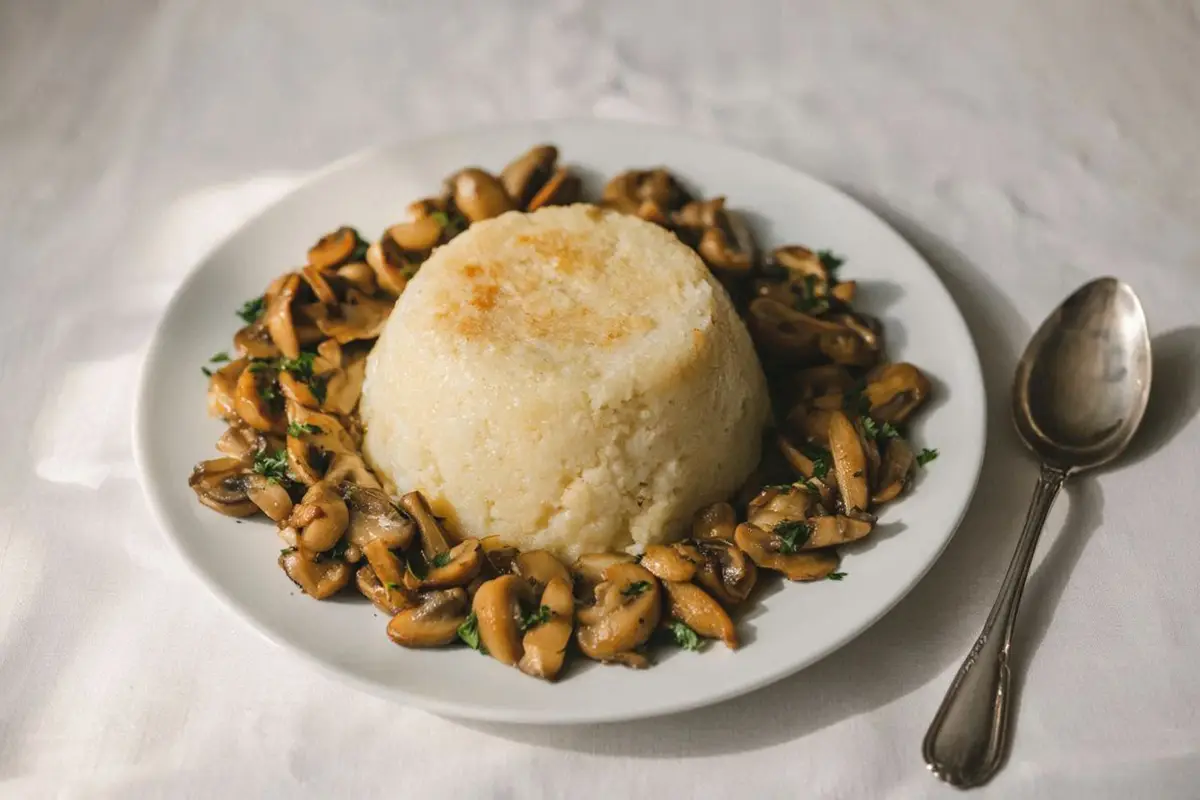
Steamed Cauliflower Pudding with Mushrooms
A light, airy steamed pudding of cauliflower and beaten eggs, filled with sautéed mushrooms and garnished with the rest. An elegant Central European appetizer.
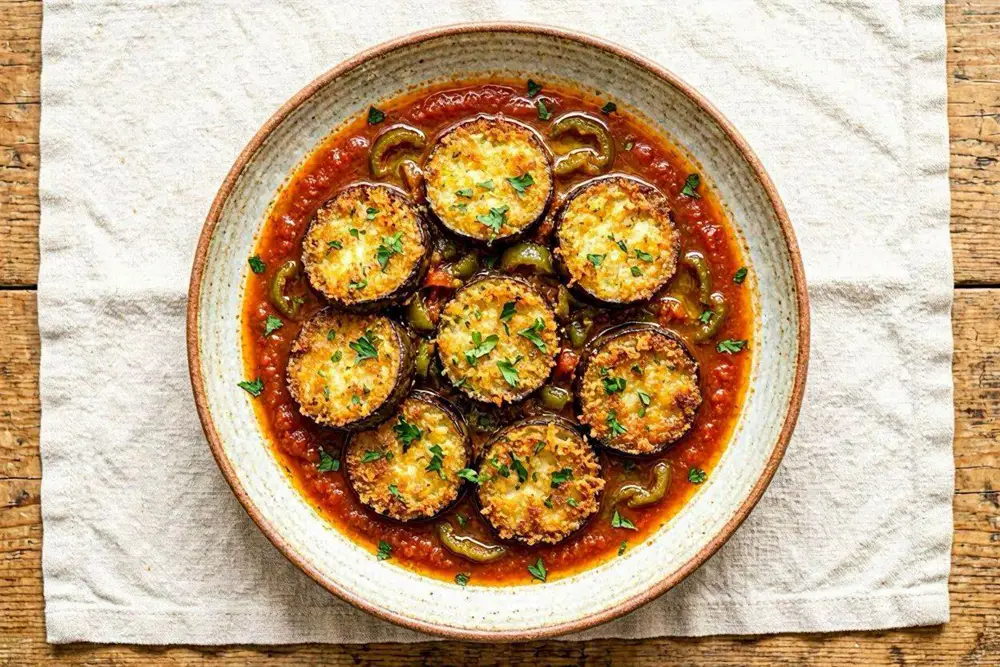
Lenten Eggplant & Tomato Stew
Thick rounds of salted, pan-fried eggplant simmered in a rich fresh-tomato sauce with green pepper and parsley — a traditional fasting dish served warm or cold.
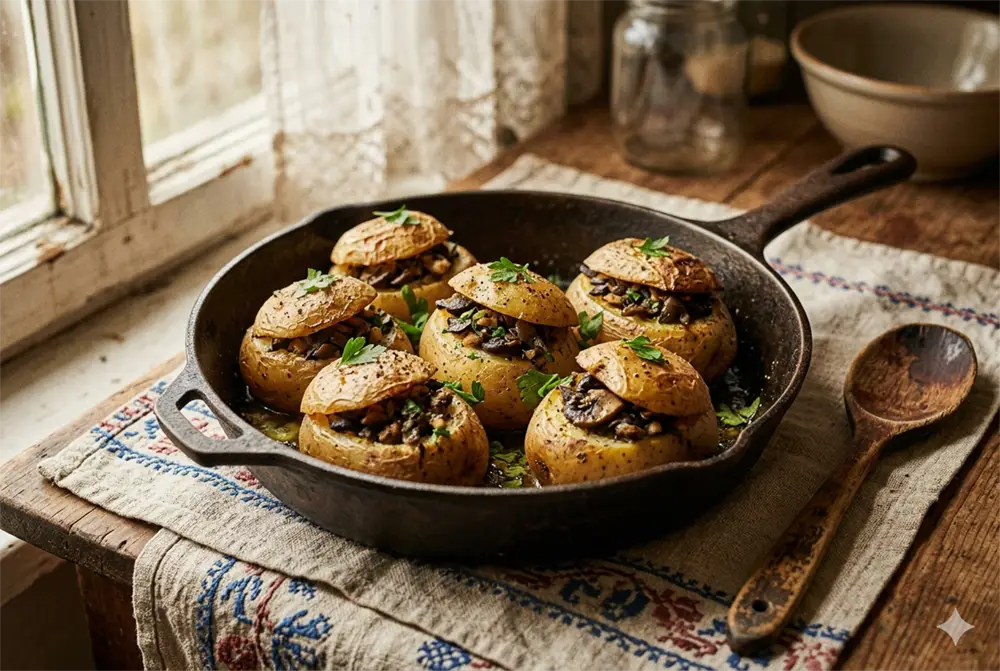
Stuffed Potatoes with Mushroom and Leek Filling
Whole potatoes hollowed out and filled with a savory mushroom, leek and breadcrumb mixture, then braised on the stovetop in butter and beef broth.