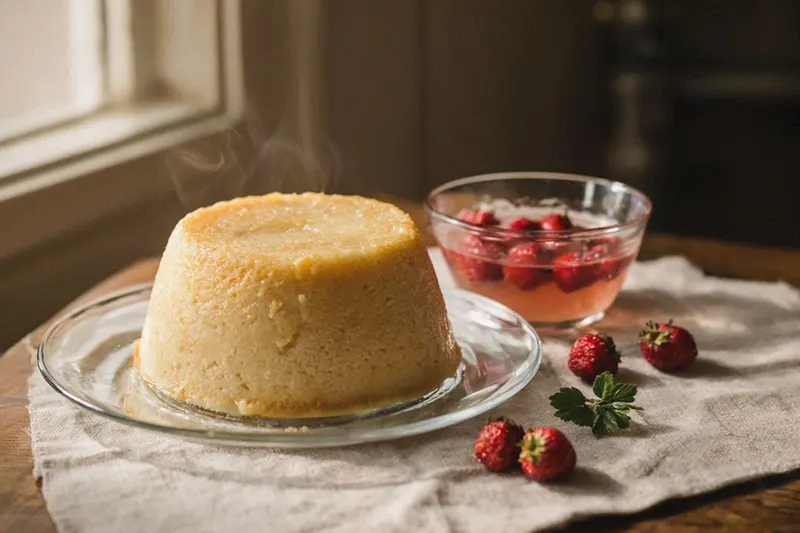
Steamed Pudding with Sour Cream and Strawberries
A rich steamed almond pudding lightened with egg whites and served flambéed with rum, paired with wild strawberry juice poured over fresh strawberries.
Historical recipe
Modernised adaptation of an early 20th‑century source. Not independently kitchen-tested by Attic Recipes. Quantities, temperatures, and food safety guidance have been updated for a contemporary kitchen — results may vary and errors may exist. Nutritional values, where provided, are estimates only and have not been laboratory tested. Always follow current food safety guidelines for your region. If you have a health condition, allergy, or dietary requirement, consult a qualified professional before preparing this recipe.
Use of this recipe is entirely at your own risk and subject to our Terms of Service and Privacy Policy. Attic Recipes accepts no liability for any adverse outcome.
- Eggs
- Dairy
- Gluten
- Tree Nuts
Additional notes
-
Warning
This recipe involves flambeeing with rum. Keep a lid nearby to smother the flame, ensure nothing flammable is overhead, and stand back when igniting. Do not attempt the flambe near children.
-
Note
This recipe contains alcohol (rum). The flambe burns off most but not all of the alcohol. Unsuitable for children under 18, pregnant women, and those avoiding alcohol.
-
Note
This dessert is relatively high in saturated fat. Enjoy as an occasional treat.
- 1
Prepare the strawberry accompaniment first, as it needs at least 2 hours to chill. Wash the 250g wild strawberries and pass them through a fine-mesh sieve or food mill to extract the juice, discarding the pulp.
- 2
Add 200g powdered sugar to the wild strawberry juice and beat with a hand mixer or stand mixer for at least 15 minutes, until the mixture is pale, aerated, and slightly thickened.
- 3
Wash the 250g large strawberries, drain well, and arrange them in a glass serving bowl. Pour the beaten wild strawberry juice over the strawberries. Place the bowl on ice or in the refrigerator and leave to stand for at least 2 hours before serving.
- 4
When ready to make the pudding, generously grease the pudding mould with 15g butter and dust evenly with 10g flour. Tap out any excess.
- 5
Soak the 60g biscuit crumbs in 2–3 tablespoons of rum and set aside. Beat the 4 egg yolks with the 500ml sour cream until smooth and well combined.
- 6
Add the 150g ground almonds, the rum-soaked biscuit crumbs, 100g flour, and a pinch of bicarbonate of soda to the sour cream mixture. Stir until just combined — do not overmix.
- 7
In a clean, dry bowl, beat the 4 egg whites to stiff peaks. Gently fold them into the pudding batter in two or three additions, taking care to keep as much volume as possible.
- 8
Pour the batter into the prepared pudding mould. Cover tightly with a lid or a double layer of foil secured with string. Place the mould in a large pot, add enough boiling water to come halfway up the sides of the mould, cover the pot, and steam over medium heat for 1 hour. Top up the water as needed.
Tip Do not lift the lid during steaming — a sudden drop in temperature can cause the pudding to collapse. - 9
Carefully remove the mould from the pot. Run a thin knife around the edge and unmould the pudding onto a heatproof glass serving plate.
- 10
Warm the 60ml rum briefly (do not boil), pour it over the pudding, and immediately ignite it with a long match or lighter. Carry the flaming pudding to the table and serve at once with the chilled strawberry accompaniment.
Tip Stand back when igniting the rum and keep a lid nearby to smother the flame if needed.
Nutrition Information per 1 portion pudding (approx. 180g)
Nutritional values are approximate estimates and may vary based on specific ingredients used, preparation methods, and portion sizes.
Serving Suggestions
Serve immediately after flambeeing, with the chilled strawberry accompaniment alongside. The contrast between the warm, nutty pudding and the cold, fragrant strawberry juice is central to the dish. A small jug of additional sour cream or lightly whipped cream can be offered on the side. The strawberry accompaniment is also excellent served alone as a chilled summer dessert.
About This Recipe
Few desserts capture the drama and generosity of early 20th century Central European entertaining quite like a steamed pudding brought flaming to the table. This one is built on a foundation of sour cream and finely ground almonds, lightened with beaten egg whites and scented with rum — rich and tender, with a faintly nutty crumb. The real revelation is the accompaniment: wild strawberry juice, beaten to a pale, airy consistency with powdered sugar, poured over fresh large strawberries and left to chill on ice until the flavours meld together.
The combination is deliberately contrasted — warm, dense pudding against cold, intensely fragrant strawberries. It was the kind of dessert that required planning and several hours of preparation, which is exactly why it appeared at celebrations and formal Sunday dinners rather than on weekday tables. The strawberry component was written for quantities that would serve a large household, and scaled down it becomes something far more practical without losing any of its character.
Wild strawberries have a perfume and acidity that cultivated varieties rarely match. If you can find them — at a farmers’ market or in the forest in June and July — this is the recipe to use them in.
Why It Works
The pudding relies on two separate leavening mechanisms working together: beaten egg whites provide most of the lift, while a pinch of bicarbonate of soda helps neutralise the acidity of the sour cream and contributes a small amount of additional rise. Steaming rather than baking keeps the interior moist and custardy — the enclosed, humid environment prevents the crust from setting too quickly and the egg proteins from tightening too much.
The beaten wild strawberry juice is an unusual technique. Passing the berries through a sieve extracts only the juice, which is then aerated by extended beating with powdered sugar — similar in principle to a fruit fool or a very light fruit mousse, but without cream. The result is lighter than a syrup and more fragrant than a puree, and the 2-hour chill on ice allows the large strawberries to absorb some of the juice while the mixture settles into a loose, glossy sauce.
Modern Kitchen Tips
A standard 1-litre pudding basin with a clip-on lid works perfectly here; alternatively, a heatproof bowl covered tightly with foil and secured with kitchen string will do the job. Make sure the water in the steaming pot never drops below halfway up the mould — check it every 20 minutes and top up with boiling water.
Ground almonds from a packet can be used in place of blanching and grinding whole almonds, though the flavour of freshly ground almonds is noticeably better. If using packaged ground almonds, check that they are fine rather than coarse.
The strawberry accompaniment can be made a day ahead and kept refrigerated, which actually improves the flavour. Remove it from the refrigerator 15 minutes before serving so it is cold but not icy.
A classic of early 20th century festive home cooking, preserved and adapted for the modern kitchen.
The Story Behind This Recipe
Historical Context
Early 20th century Central European home cooking made extensive use of steamed puddings as a festive dessert — a technique inherited partly from Austro-Hungarian culinary culture and partly from the influence of English and French cookery books circulating at the time. The method of lightening a rich cream-and-almond base with beaten egg whites was standard practice before baking powder became ubiquitous, and bicarbonate of soda was used sparingly as a lift agent. The strawberry accompaniment reflects the seasonal nature of pre-refrigeration cooking: wild strawberries were prized for their intense flavour and aroma, and passing them through a sieve to extract the juice — then beating it extensively with sugar to create a light, aerated sauce — was a technique for preserving their character without heat. The original quantities for the strawberry component were very large, characteristic of recipes written for households with domestic staff or for entertaining.
Modern Kitchen Adaptation
Wild strawberries are not always easy to find outside their short season; small cultivated strawberries (fragola varieties or any intensely flavoured small variety) make a reasonable substitute, though the flavour of the juice will be less concentrated. In that case, reduce the powdered sugar to 150g and taste before adding more. The flambe is authentic and spectacular but entirely optional — the pudding is excellent served without it. If omitting the flambe, consider stirring 1–2 tablespoons of rum directly into the batter for flavour. Sour cream can be substituted with full-fat creme fraiche, or with a mixture of heavy cream and a teaspoon of lemon juice.
This recipe is an independent modern adaptation developed from historical sources in the public domain. It is provided for informational and educational purposes only and does not constitute professional dietary, nutritional, or medical advice. Food preparation involves inherent risks. The reader assumes full responsibility for safe food handling, ingredient sourcing, and adherence to current local food safety guidelines. The site operator accepts no liability for outcomes resulting from the preparation or consumption of this recipe.
One recipe.
Every week.
You Might Also Like
More recipes from the same category

Baked Apricot and Rice Trumpet Pancakes
Delicate pancakes filled with creamy rice porridge and layered with rich apricot marmalade, baked in a sweet milk custard.
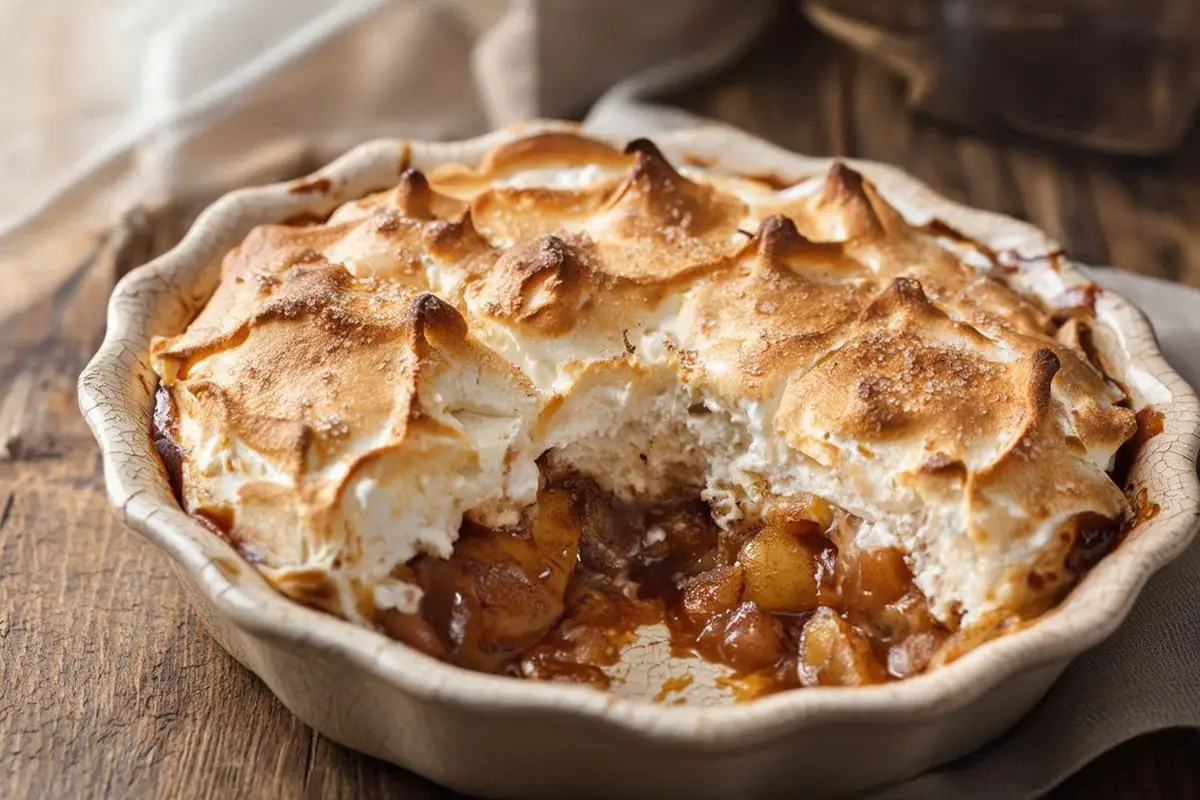
Velvet Apple & Meringue Gratin
A decadent vintage dessert featuring apples slow-cooked in a butter-sugar syrup, topped with a cloud of lemon-scented meringue.
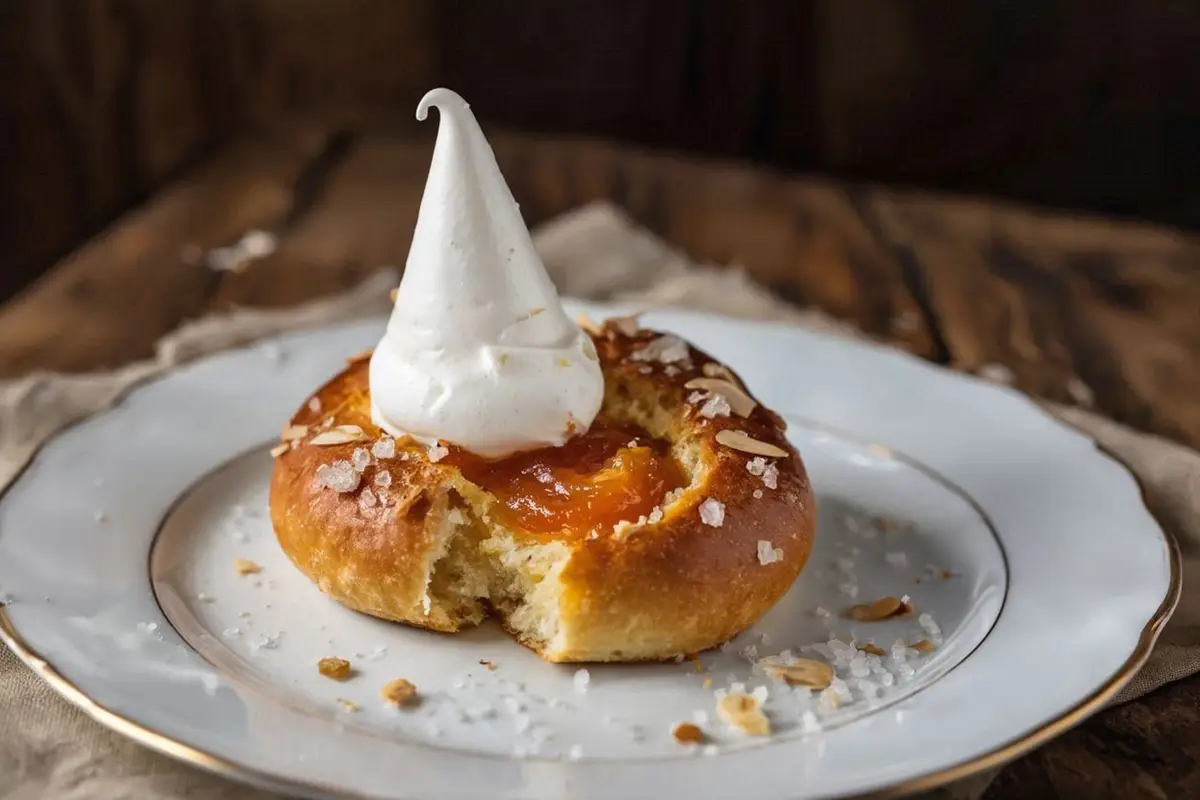
Carlsbad Imperial Cakes
A luxurious Bohemian yeast pastry featuring a rich butter dough, apricot jam centers, and a towering 'snow' meringue crown.