Steaks with Mushroom Sauce
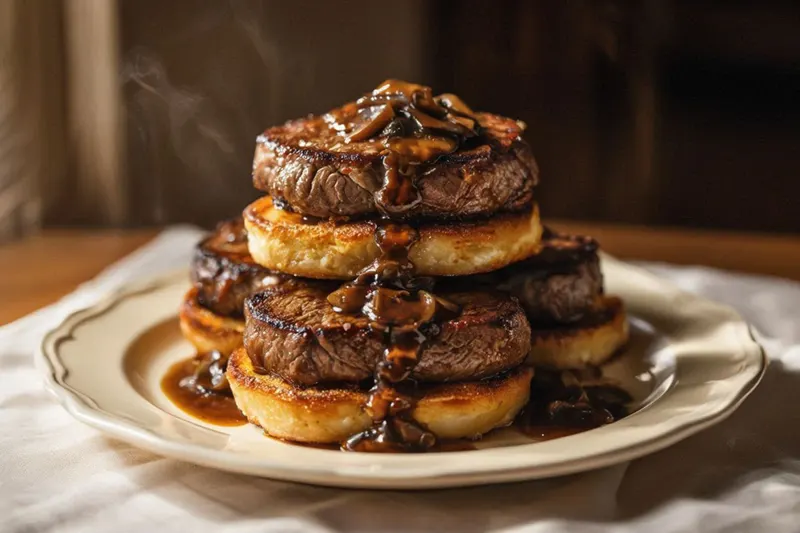
Pan-fried beef rounds on buttered egg croutons, topped with a white wine mushroom sauce — a vintage Central European dinner-party dish.
Quick Summary
Pan-fried beef rounds on buttered egg croutons, topped with a white wine mushroom sauce — a vintage Central European dinner-party dish.
Historical recipe
Modernised adaptation of an early 20th‑century source. Not independently kitchen-tested by Attic Recipes. Quantities, temperatures, and food safety guidance have been updated for a contemporary kitchen — results may vary and errors may exist. Nutritional values, where provided, are estimates only and have not been laboratory tested. Always follow current food safety guidelines for your region. If you have a health condition, allergy, or dietary requirement, consult a qualified professional before preparing this recipe.
Use of this recipe is entirely at your own risk and subject to our Terms of Service and Privacy Policy. Attic Recipes accepts no liability for any adverse outcome.
- Eggs
- Dairy
- Gluten
- Sulphites
Additional notes
-
Warning
This recipe uses eggs as a crouton coating; all egg-containing components are fully cooked before serving. Ensure the croutons are fried until golden and cooked through, reaching an internal temperature of 74°C (165°F). Pregnant individuals, young children, the elderly, and immunocompromised persons should ensure all egg components are thoroughly cooked.
-
Note
This dish contains alcohol (white wine) used in the sauce. While a significant portion evaporates during simmering, trace amounts may remain. Those avoiding alcohol entirely — including pregnant individuals, children under 18, and anyone with a medical or personal reason to abstain — should use the alcohol-free alternative below.
Replace the 80 ml white wine with an additional 80 ml beef broth plus 1 teaspoon of white wine vinegar for comparable acidity without alcohol.
-
Note
Each serving contains approximately 11g of saturated fat, primarily from butter and the beef cut used. Those monitoring saturated fat intake may reduce the butter in the crouton step or substitute with a neutral oil.
- 1
Cut 6 rounds from the beef roast, each approximately 2.5 cm thick. Trim the edges into an even circle using a round cutter or by hand. Set aside at room temperature while you prepare the sauce.
Tip The original technique used a round coffee mug as a mould to shape the steaks — a clever way to achieve a uniform tournedos-style round without twine. - 2
Prepare the mushrooms: combine the 750 ml water and 1 tablespoon of lemon juice in a bowl. Quickly rinse the 125 g mushrooms in this acidulated water, then remove them and slice thinly, stems included.
- 3
Bring the 500 ml lightly salted water to a boil. Add the 1½ tablespoons of lemon juice, then add the sliced mushrooms and blanch for 3 minutes. Drain and set aside.
- 4
Melt the 20 g butter in a medium saucepan over medium heat. Add the finely chopped onion and fry gently until softened and translucent, about 4–5 minutes.
Tip Keep the heat moderate — the onion should soften without browning. - 5
Add the drained mushrooms to the saucepan and sauté with the onion for 2–3 minutes. Season with a pinch of salt and pepper, then stir in the 1 teaspoon of plain flour. Stir well and cook for 1 minute to eliminate the raw flour taste.
- 6
Add the 1 tablespoon of tomato paste and stir to combine. Pour in the 80 ml white wine and 80 ml beef broth. Bring to a boil, then reduce the heat to low and leave to simmer gently at the back of the stove while you prepare the croutons and steaks.
Tip The sauce should reduce to a loose, coating consistency. If it thickens too much, add a splash of broth. - 7
Prepare the croutons: using a round cutter, cut each slice of white bread into a round the same diameter as the steaks. Beat the 2 eggs in a shallow bowl. Dip each bread round in the beaten egg on both sides. Melt the 40 g butter in a frying pan over medium heat and fry the croutons until golden on both sides, about 2 minutes per side. Set aside on a warm plate.
- 8
Fry the steaks: heat the 2 tablespoons of neutral oil in a heavy-bottomed frying pan over high heat until shimmering. Season each steak with salt and pepper, then dredge in the 4 tablespoons of plain flour, shaking off the excess. Fry for 10 minutes per side for well-done, or 3–4 minutes per side for medium-rare. Remove from the pan and drain briefly on a paper towel.
Tip The original specifies 10 minutes per side, which produces a well-done steak — consistent with the period's preference for fully cooked beef. Modern preferences may favour a shorter time. - 9
To assemble: arrange the fried croutons on a serving platter or individual plates. Place one steak on top of each crouton. Spoon the mushroom sauce into the centre of the dish and serve immediately.
Nutrition Information per 1 serving (approx. 270g)
Nutritional values are approximate estimates and may vary based on specific ingredients used, preparation methods, and portion sizes.
Serving Suggestions
Serve immediately — both the croutons and the steaks lose texture quickly once plated. A simple green salad or steamed seasonal vegetables balance the richness of the dish. The mushroom sauce can be passed separately at the table if preferred.
About This Recipe
There is something quietly theatrical about this dish. A round of beef, precisely shaped, placed on a golden fried crouton, crowned with a glossy mushroom sauce — this is not everyday cooking. It is the kind of recipe that appears in early 20th century cookbooks written for households that entertained, that cared about presentation, and that were quietly translating the language of French restaurant cooking into their own domestic kitchens.
The tournedos format — a thick, round cut of beef served on a crouton base — was a staple of European bourgeois cooking in the decades before and after the First World War. What makes this particular version interesting is the improvised technique at its heart: home cooks of the period used a round white coffee mug as a mould, stacking the steaks inside to shape them into perfect circles. It is a practical, ingenious solution — achieving the restaurant aesthetic without a professional kitchen.
The mushroom sauce here is lean and bright rather than heavy. Lemon-washed mushrooms, a little onion, a spoonful of tomato paste, and white wine and broth produce a sauce that cuts through the richness of the fried beef and the buttered crouton rather than adding to it.
Why It Works
The crouton base is not decoration — it is structural and functional. The fried bread absorbs the meat juices as the steak rests on top, becoming saturated from below while remaining crisp on the underside. The egg coating on the crouton forms a barrier that slows this process and keeps the base from collapsing. The result is a platform with three distinct textures: crunchy exterior, custardy interior, beef-soaked centre.
The mushroom preparation is equally considered. Blanching the mushrooms in lemon-acidified water serves two purposes: it removes excess moisture, which would otherwise cause the mushrooms to steam rather than sauté, and the acid slows enzymatic browning, keeping the sauce pale and clean-looking. A single teaspoon of flour added during the sauté stage gives the finished sauce just enough body to coat without thickening it into a gravy.
Modern Kitchen Tips
The original recipe specifies 10 minutes per side for the steaks, which at 2.5 cm thickness will produce a well-done result — the standard expectation of the period. If you prefer medium-rare, reduce to 3–4 minutes per side over high heat and check with a thermometer: 57°C (135°F) at the centre. Allow the steaks to rest for 3 minutes before plating.
Assemble at the last moment. Both the croutons and the steaks deteriorate quickly once plated — the crouton softens and the steak loses its crust. If cooking for a group, keep the croutons warm in a low oven (80°C) on a rack, and fry the steaks in batches, finishing the last batch just before serving.
A classic of early 20th century home cooking, preserved and adapted for the modern kitchen.
The Story Behind This Recipe
Historical Context
Early 20th century recipes for this style of dish reflect the influence of French haute cuisine on Central European bourgeois cooking — the tournedos presentation, the crouton base, and the wine-and-mushroom sauce are hallmarks of the era's dinner-party repertoire. Home cooks of the period used a round coffee mug as an improvised mould to achieve the uniform, elegant steak shape associated with restaurant cooking, without professional butchering equipment. Period recipes of this type frequently did not specify precise quantities for secondary additions such as flour, tomato paste, wine, or broth, relying instead on the cook's judgement; all such amounts here are estimated from culinary standards of the time. The steak thickness as transcribed appears to reflect a copying error; contextual evidence and standard period practice point to 2.5 cm.
Modern Kitchen Adaptation
The original preparation is followed closely. All unspecified quantities — flour, tomato paste, wine, and broth — have been estimated to proportions consistent with a sauce for 6 servings and are marked as estimated. The steak thickness has been interpreted as 2.5 cm, correcting what appears to be a transcription error in the digitization process. The original's instruction to fry steaks for 10 minutes per side produces a well-done result; cooks who prefer medium-rare should reduce this to 3–4 minutes per side over high heat. Neutral oil is used throughout in place of lard, which period recipes commonly specified; lard can be substituted 1:1 where preferred.
This recipe is an independent modern adaptation developed from historical sources in the public domain. It is provided for informational and educational purposes only and does not constitute professional dietary, nutritional, or medical advice. Food preparation involves inherent risks. The reader assumes full responsibility for safe food handling, ingredient sourcing, and adherence to current local food safety guidelines. The site operator accepts no liability for outcomes resulting from the preparation or consumption of this recipe.
One recipe.
Every week.
You Might Also Like
More recipes you'll enjoy
Ground Beef Roast Steaks
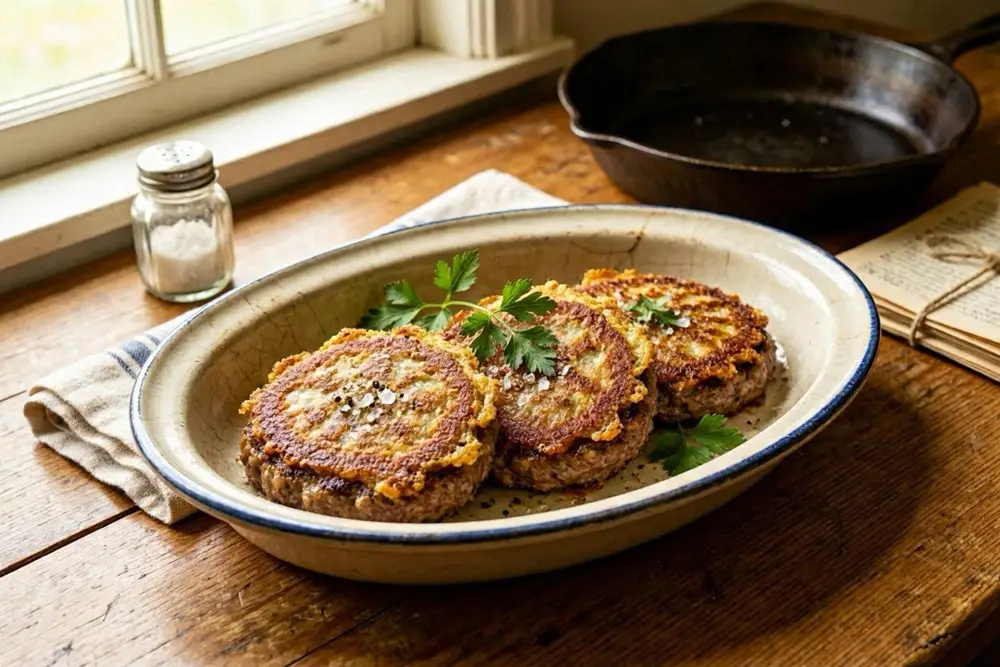
Freshly ground beef mixed with whipped butter, shaped into steaks, coated in flour and egg, and pan-fried in butter until golden — a Central European meat dish.
Mushrooms in Sour Cream
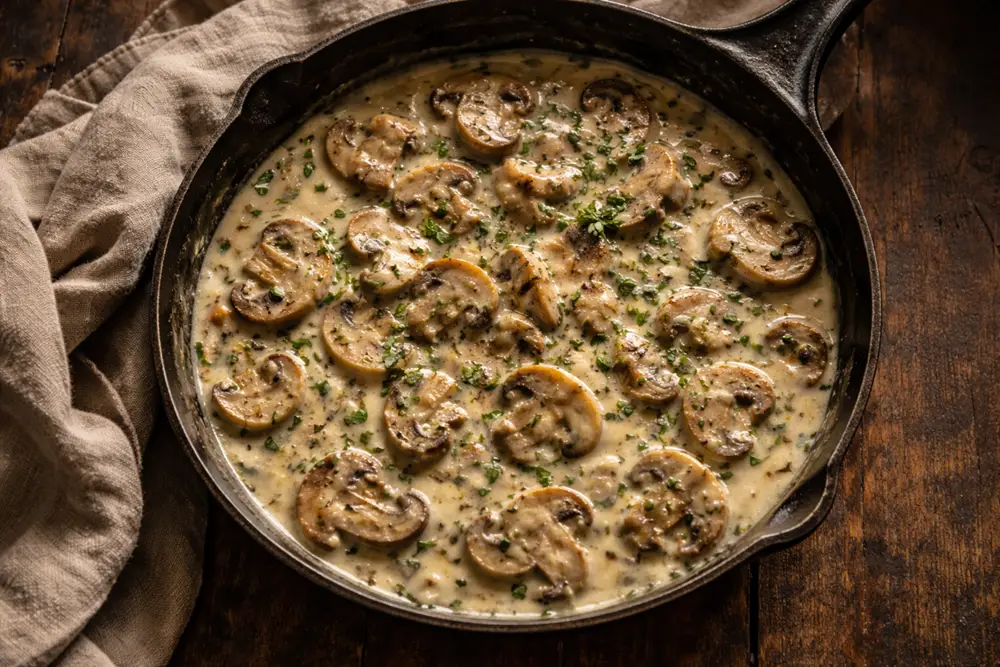
Pan-fried sliced mushrooms with onion in a rich sour cream and beef broth sauce – a simple, deeply savory Central European side dish.

Fish Croquettes
Cod is poached, ground, and bound with egg, parsley, and lemon zest, then breaded and pan-fried in butter until golden. A Central European classic.