Spicy Peppers for Winter
Whole round peppers preserved in a vinegar brine with mustard seeds and horseradish. A crisp, mildly tangy winter pickle from the early 20th century.
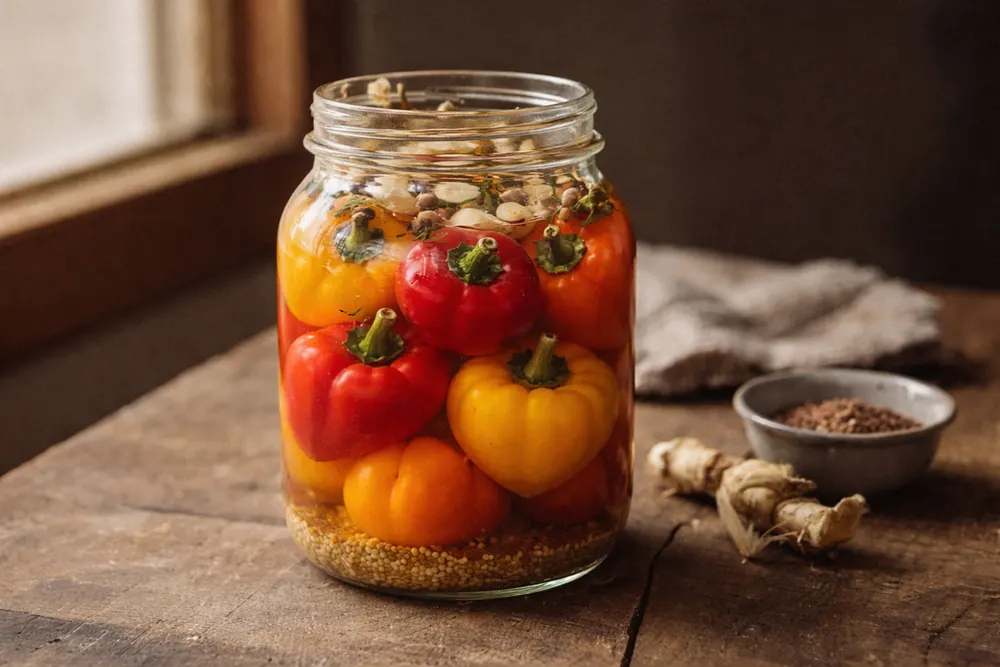
Quick Summary
Whole round peppers preserved in a vinegar brine with mustard seeds and horseradish. A crisp, mildly tangy winter pickle from the early 20th century.
Historical recipe
Modernised adaptation of an early 20th‑century source. Not independently kitchen-tested by Attic Recipes. Quantities, temperatures, and food safety guidance have been updated for a contemporary kitchen — results may vary and errors may exist. Nutritional values, where provided, are estimates only and have not been laboratory tested. Always follow current food safety guidelines for your region. If you have a health condition, allergy, or dietary requirement, consult a qualified professional before preparing this recipe.
Use of this recipe is entirely at your own risk and subject to our Terms of Service and Privacy Policy. Attic Recipes accepts no liability for any adverse outcome.
- Mustard
Additional notes
-
Warning
Vinegar acidity standards for safe home pickling vary by country. In the United States, Canada, Australia, and New Zealand, food safety authorities (USDA, NCHFP, Health Canada, FSANZ) recommend a minimum of 5% acetic acid in the final brine for shelf-stable pickled vegetables. In many European countries, the commonly accepted minimum is 2% in the final brine for refrigerator pickles, with higher acidity required for room-temperature storage. This recipe is formulated for cool storage or refrigeration. If you intend to store pickles at room temperature or process them in a water bath canner, verify the required acidity for your country and adjust the vinegar quantity accordingly. When in doubt, use more vinegar, not less.
For a shelf-stable result by US/Canadian/Australian standards: use 1.5 litres of 5% white vinegar and 1.5 litres of water in place of the 3 litres of water + 750ml vinegar. This gives approximately 2.1% final acidity — close to the boundary. For fully USDA-compliant shelf-stable pickles, process sealed jars in a boiling water bath for 10 minutes and follow tested pickle recipes from the National Center for Home Food Preservation (nchfp.uga.edu).
-
Warning
All peppers must be fully submerged in brine at all times. Any pepper exposed to air can develop mold. Discard the entire jar if you notice any mold, unusual smell, softening of the brine, or off flavours.
-
Warning
Jar sterilization is essential. Unsterilized jars used for sealed preserves carry a risk of bacterial contamination including Clostridium botulinum (botulism), which produces no visible signs and is potentially fatal. Always sterilize jars and lids before use.
-
Caution
If using vinegar essence (concentrated acetic acid 70–80%) in place of standard vinegar, handle with care. It is corrosive and can cause burns on contact with skin and eyes. Always dilute before use and keep out of reach of children. Salicylic acid, used as a seal preservative in the original recipe, is not recommended for modern home food preservation and is not an approved food additive in most countries.
-
Note
This recipe contains mustard seeds (a major EU allergen and FALCPA allergen in the US). Unsuitable for those with mustard allergy or sensitivity.
- 1
Sterilize the jar: wash thoroughly with hot soapy water, rinse well, then place upright in an oven at 120°C (250°F) for 15 minutes. Allow to cool completely before filling. Sterilize the lid separately by boiling in water for 10 minutes.
Tip Do not fill a hot jar with cold liquid or vice versa — thermal shock can crack glass. - 2
Wash the peppers and leave the stems intact. Pack them tightly upright into the sterilized jar, stems facing upward, fitting them as snugly as possible without bruising the flesh.
- 3
Sprinkle the 2 tablespoons of mustard seeds over the packed peppers. Lay the 2 peeled horseradish roots crosswise over the top of the peppers to hold them in place.
- 4
In a large saucepan, combine the 3 litres of water, 250g sugar, and 15g salt. Bring to a boil over medium heat, stirring until the sugar and salt are fully dissolved. Remove from the heat and allow to cool completely to room temperature.
Tip Do not add vinegar to hot liquid — heat drives off acetic acid and reduces the preserving power of the brine. - 5
Once the brine is completely cold, stir in 750ml white wine vinegar. Taste the brine — it should be noticeably tangy and pleasantly sour-sweet. Adjust with additional vinegar if a sharper result is preferred, keeping the guidance in the safety note in mind.
- 6
Pour the cooled brine over the peppers until they are completely submerged. All peppers must be fully below the surface of the liquid at all times. Close the jar tightly with the sterilized lid.
- 7
Store the jar in a cool, dark place (cellar or refrigerator). Allow the peppers to cure for at least 2 weeks before opening. Once opened, keep refrigerated and consume within 4 weeks.
Tip Check the jar after the first 24 hours — peppers can float up as they absorb brine. Press them back down and top up with additional brine if needed.
Nutrition Information per 1 pepper (approx. 100g drained)
Nutritional values are approximate estimates and may vary based on specific ingredients used, preparation methods, and portion sizes.
Serving Suggestions
Serve alongside roasted meats, pork dishes, or cold cuts. These peppers are a traditional accompaniment to winter meals throughout Central Europe — their sweet-sour crunch cuts through rich, fatty dishes. They are also good served on a cheese board or as part of a pickled vegetable platter.
About This Recipe
This is the kind of recipe that made a Central European root cellar worth having. Whole round peppers — firm, unblemished, packed upright in a large glass jar with mustard seeds and a couple of horseradish roots — are covered in a sweet-sour brine and left to cure for two weeks until they turn glossy, mildly tangy, and deeply flavourful. The result is crunchy and bright, not soft and aggressively sour like many commercial pickles.
The original method called for a large jar sealed with parchment paper and a brine built around what was sold as “essence” — a concentrated form of acetic acid that home cooks added to cooled water until the brine tasted right. It was a practical, flexible approach in an era before standardised vinegar was universally available, and the instruction to adjust the vinegar “to taste, but not too mild” reflects exactly how most preserving was done: by experience, not by measurement.
The sweet-sour balance is what sets these apart from plain pickled peppers. There is enough sugar in the brine to soften the sharpness of the vinegar without tipping into sweetness, and the mustard seeds and horseradish add warmth and quiet depth that develops over the curing period.
Why It Works
The preservation here is purely acidic — the vinegar lowers the pH of the brine to a point where most spoilage organisms cannot survive. Unlike fermented pickles, which rely on lactic acid bacteria and take weeks to develop, these peppers go into a pre-made acid brine, which means the process is fast and predictable. The horseradish contributes tannins that help keep the peppers firm, which is why many traditional pickle recipes include it even when horseradish flavour is not the point.
Leaving the stems on is not merely aesthetic. The stem end is the most vulnerable point of entry for the brine — if it is cut cleanly, the liquid penetrates the interior and softens the pepper rapidly. A short intact stem slows this process and keeps the flesh crunchy for longer.
Salt-Free Version
The original recipe includes a second, simpler preparation for those who could not eat salt. Pack whole peppers into a sterilized jar with pieces of peeled horseradish and a handful of mustard seeds, then pour over plain white wine vinegar diluted with a small amount of water. Seal and store in a cool, dark place. The result is sharper and more austere than the main recipe, but very good alongside fatty meats and cold cuts. Apply the same vinegar acidity guidance as for the main recipe.
Modern Kitchen Tips
The size of the jar is flexible — if a single 5–6 litre jar is impractical, use two or three smaller jars (1.5–2 litres each) and divide the brine and aromatics accordingly. Smaller jars are also easier to refrigerate once opened.
White wine vinegar at 9% acidity works well here and gives a clean, neutral flavour. If you prefer more complexity, a mild apple cider vinegar at the same acidity is a reasonable substitute, though it will add a slight fruity note. Avoid balsamic or heavily flavoured vinegars.
The peppers are ready after 2 weeks but improve noticeably at 3–4 weeks as the mustard and horseradish flavours develop. Once opened, keep refrigerated and consume within 4 weeks.
A classic of early 20th century Central European home preservation, adapted for the modern kitchen.
The Story Behind This Recipe
Historical Context
Home cooks of the period preserved peppers in large earthenware crocks or multi-litre glass jars sealed with parchment paper soaked in water mixed with salicylic acid — a traditional household preservative widely used in Central European kitchens before modern food safety standards changed preservation practice. The brine was built around what was then sold as 'essence': a concentrated acetic acid solution of 70–80%, added to the cooled brine by eye until the liquid tasted sharp but not harsh. The flexibility of this instruction reflects how most preserving was done at the time — by experience and taste, not by fixed measurement. The original recipe also noted that the peppers could be prepared entirely without salt for those who could not eat salty foods, in which case whole peppers were simply packed with horseradish and mustard seeds and covered with plain diluted wine vinegar.
Modern Kitchen Adaptation
Salicylic acid is not used in this version. It has no approved E-number for use in food under EU Regulation EC 1333/2008, is linked to salicylate sensitivity reactions particularly in children and people with aspirin sensitivity, and is not available as a food-grade ingredient in most countries. The parchment seal used in the original is also insufficient for safe long-term storage. This version uses a properly sterilized jar with a tight-fitting lid. The 'essence' (concentrated acetic acid 70–80%) has been replaced with standard white wine vinegar at 9% acidity. If vinegar essence is available and preferred, dilute carefully: 1 part 80% essence in approximately 10 parts water produces roughly 7% acetic acid — use this diluted solution in place of the wine vinegar, and handle the undiluted essence with care as it is corrosive. The salt quantity in the original was stated as 'half a large spoonful', which is ambiguous; 15g is used here as a reasonable estimate. The vinegar quantity has been calculated to achieve a safe minimum acidity in the final brine — see safety notes.
This recipe is an independent modern adaptation developed from historical sources in the public domain. It is provided for informational and educational purposes only and does not constitute professional dietary, nutritional, or medical advice. Food preparation involves inherent risks. The reader assumes full responsibility for safe food handling, ingredient sourcing, and adherence to current local food safety guidelines. The site operator accepts no liability for outcomes resulting from the preparation or consumption of this recipe.
One recipe.
Every week.
You Might Also Like
More recipes you'll enjoy
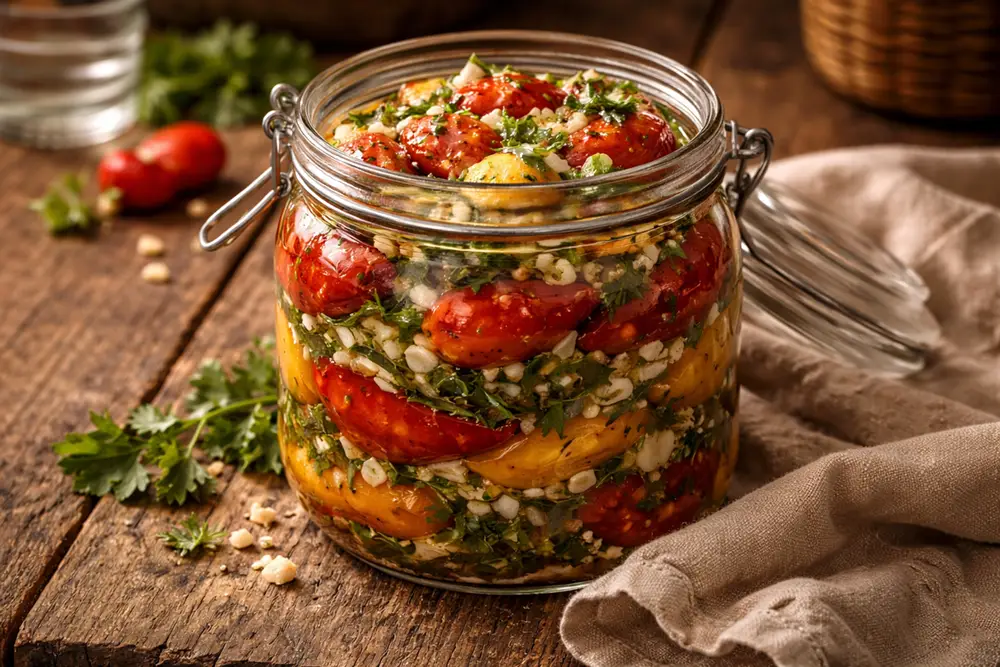
Fried Peppers in Oil and Vinegar
Pan-fried peppers layered with garlic, parsley, celery, and horseradish, then preserved in wine vinegar — a tangy, aromatic winter relish.
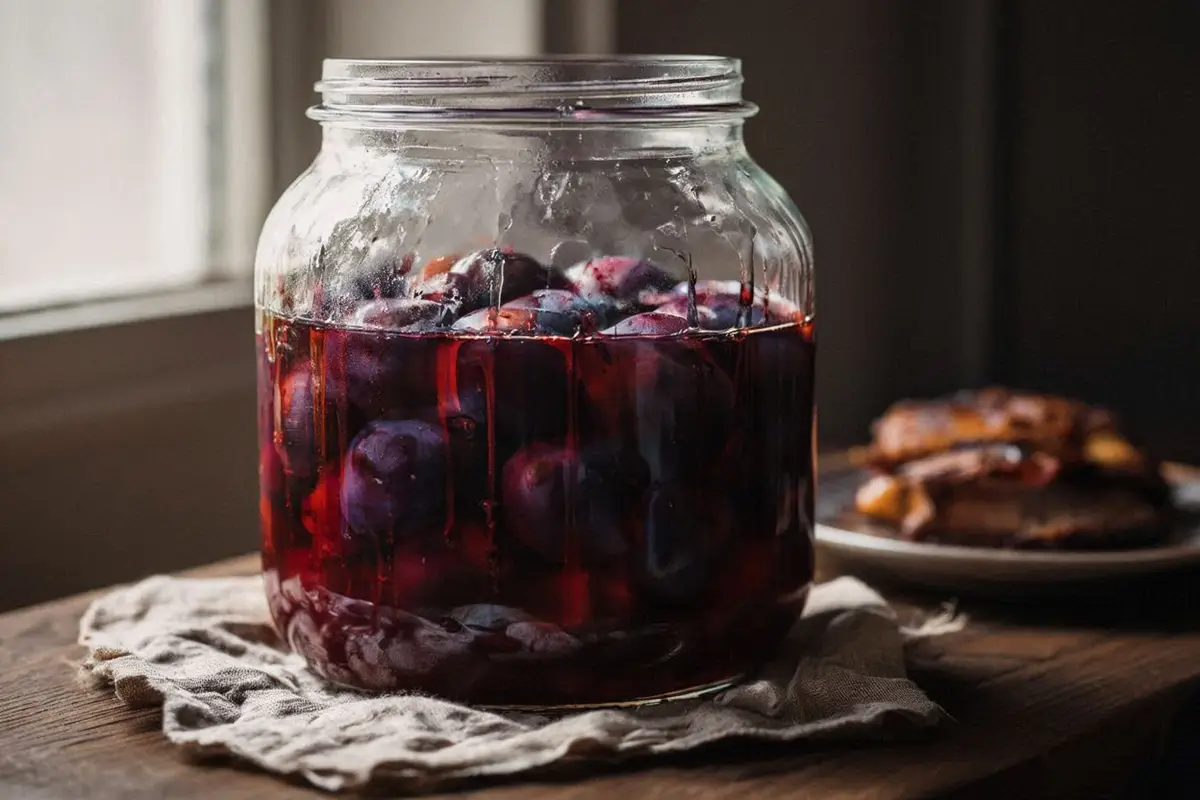
Plums in Wine Vinegar
Hungarian plums briefly cooked in a sweet wine vinegar syrup, bottled hot — a classic sweet-sour condiment alongside roasted meats.
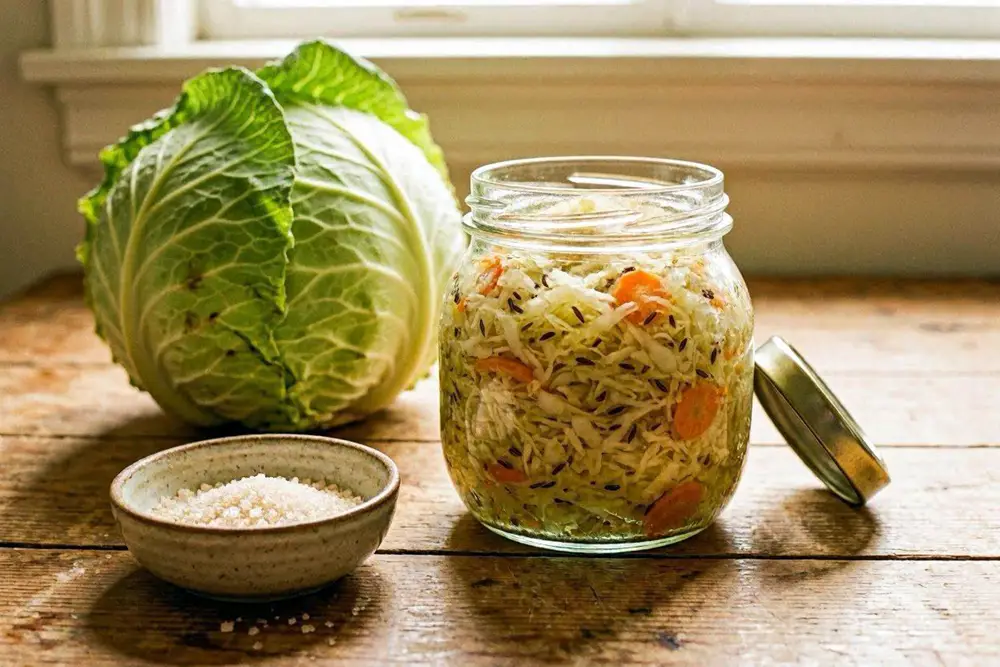
Fermented Shredded Cabbage (Kiseli Kupus Ribanac)
Traditional lacto-fermented shredded cabbage with carrot, apple, and caraway seed — packed into a jar and left to ferment in its own brine for two weeks.