Sour Cabbage Brine Soup with Leek
A tangy, probiotic-rich cold soup made from fermented sauerkraut brine, served with leek, crushed red pepper, and olive oil.

Quick Summary
A tangy, probiotic-rich cold soup made from fermented sauerkraut brine, served with leek, crushed red pepper, and olive oil.
Historical recipe
Modernised adaptation of an early 20th‑century source. Not independently kitchen-tested by Attic Recipes. Quantities, temperatures, and food safety guidance have been updated for a contemporary kitchen — results may vary and errors may exist. Nutritional values, where provided, are estimates only and have not been laboratory tested. Always follow current food safety guidelines for your region. If you have a health condition, allergy, or dietary requirement, consult a qualified professional before preparing this recipe.
Use of this recipe is entirely at your own risk and subject to our Terms of Service and Privacy Policy. Attic Recipes accepts no liability for any adverse outcome.
Additional notes
-
Caution
Sauerkraut brine can sometimes develop a thin, even, white surface film — a harmless surface yeast that tends to form when the cabbage isn't kept fully submerged or the ferment sits somewhere too warm. This can simply be skimmed off if the brine underneath still looks clear, smells clean, and the cabbage stays covered by liquid. Do not use the brine if the film is thick, fuzzy, or colored (green, black, or pink), if the liquid has turned slimy or persistently cloudy, or if it has a strong, unpleasant odor — these are signs of true spoilage, and the batch should be discarded rather than risked. Pregnant women, young children, the elderly, and immunocompromised individuals should take particular care with any fermented food and confirm it shows no signs of spoilage before eating.
-
Note
This soup is naturally very high in sodium from the fermentation brine and sauerkraut. It is not suitable for those on a sodium-restricted diet, including some pregnant women, older adults, and anyone managing hypertension or kidney conditions.
- 1
Make sure the sauerkraut brine is clear and bright, never cloudy — cloudiness or a white film on the surface are signs of spoilage and mean the batch should be discarded. Divide the {0001} evenly among 4 deep earthenware bowls or saucers.
- 2
Add a portion of the {0002} and {0003} to each bowl.
- 3
Sprinkle each bowl with a share of the {0004} and drizzle with a share of the {0005}.
- 4
Let the bowls stand in a warm room until the soup reaches room temperature — this is a resting step, not a cooking step; the brine should never be heated on the stove, as this destroys the beneficial bacteria and flattens the flavor.
- 5
Serve.
Nutrition Information per 1 serving (approx. 250g)
Nutritional values are approximate estimates and may vary based on specific ingredients used, preparation methods, and portion sizes.
Serving Suggestions
Serve as a light, palate-opening appetizer before a heartier winter meal. This drink is also part of regional folk tradition as a home remedy — reached for after a heavy night out — thanks to its salt and mineral content, though this is a traditional belief rather than a medical claim.
About This Recipe
Long before probiotic drinks arrived on supermarket shelves, home cooks had already worked out that the tangy liquid left over from a well-kept batch of sauerkraut was worth drinking on its own. This soup is less a “recipe” in the modern sense than a way of serving that liquid — sauerkraut brine, poured into shallow bowls and dressed with raw leek, a little of the cabbage itself, crushed red pepper, and a thread of olive oil.
It’s a dish built entirely around restraint. There’s no cooking involved, no thickening, nothing to mask the sharp, salty, faintly effervescent character of the brine. The success of the dish depends almost entirely on the quality of the fermentation behind it — clean equipment, regular draining, and a brine that stays clear rather than clouding over.
Why It Works
Good sauerkraut brine is a byproduct of healthy lactic acid fermentation, and its clarity is a genuine quality signal, not just an aesthetic one — a clear brine means the fermentation stayed clean and dominated by the right bacteria, while a cloudy or filmy brine points to spoilage organisms taking over. Leek and raw cabbage add crunch and a milder onion note that balances the acidity, while the olive oil rounds out the sharpness on the palate. Letting the soup rest to room temperature, rather than heating it, keeps the live cultures intact and lets the aromatics fully open up.
Modern Kitchen Tips
If you don’t make your own sauerkraut, a good store-bought sauerkraut brine is a perfectly reasonable substitute — just look for one that’s raw/unpasteurized if you want to preserve the probiotic content, and check that it’s clear rather than cloudy. Taste the brine before serving; if it’s harsh, a slightly higher ratio of olive oil to brine will soften it without diluting the character of the dish.
A classic of early 20th century home cooking, preserved and adapted for the modern kitchen.
The Story Behind This Recipe
Historical Context
Home cooks of the period relied on a clean, well-maintained batch of sauerkraut, regularly drained and topped up, to produce a clear, tear-bright brine. This clarity was itself a marker of quality: a filmy surface — described in some households as the brine having 'bloomed' — was watched closely, since a thin film could often be skimmed away, while a heavier, discolored, or foul-smelling one meant the batch had to be discarded. In the era before refrigeration, the fermenting cabbage and its brine were traditionally kept in a cellar, cooler than the rest of the house, and stored through the cold months into early spring. Quantities for the leek, cabbage garnish, and seasoning were left to the cook's judgment, and vegetables of the period tended to run smaller than modern produce.
Modern Kitchen Adaptation
Quantities have been standardized for a modern kitchen and 4 servings, as the original left them to taste; these are marked as estimated. Homemade sauerkraut brine works well here, but ready-made sauerkraut brine is now widely available and a practical substitute — either works as long as it is clear and free of any white film. The instruction to let the soup 'warm up in a warm room' refers to bringing it to room temperature, not heating it — active cooking would kill the live cultures that give the brine its characteristic tang and health benefits.
This recipe is an independent modern adaptation developed from historical sources in the public domain. It is provided for informational and educational purposes only and does not constitute professional dietary, nutritional, or medical advice. Food preparation involves inherent risks. The reader assumes full responsibility for safe food handling, ingredient sourcing, and adherence to current local food safety guidelines. The site operator accepts no liability for outcomes resulting from the preparation or consumption of this recipe.
One recipe.
Every week.
You Might Also Like
More recipes you'll enjoy
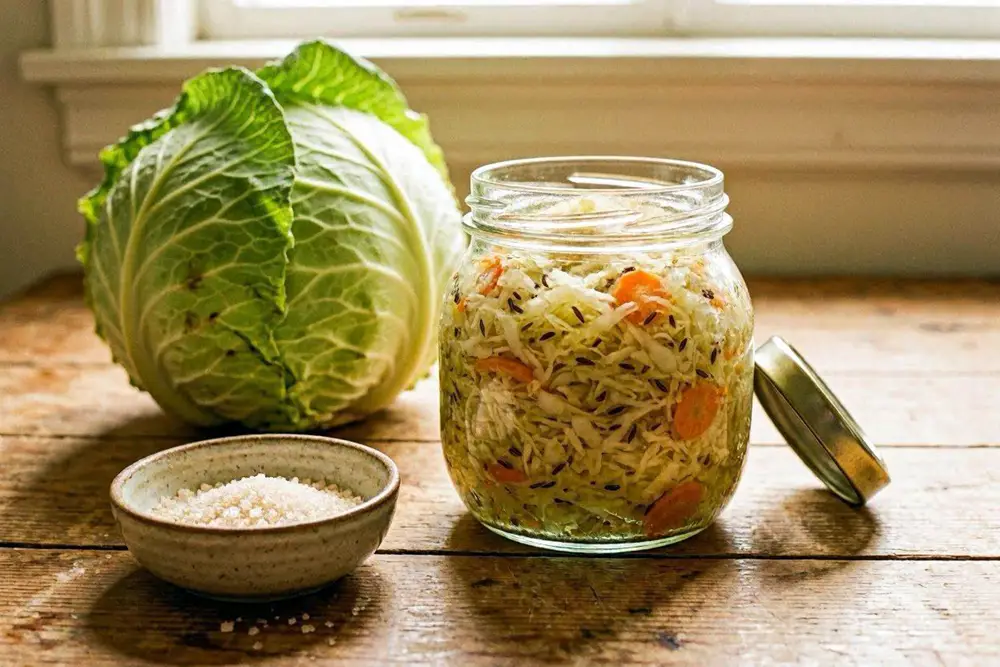
Fermented Shredded Cabbage (Kiseli Kupus Ribanac)
Traditional lacto-fermented shredded cabbage with carrot, apple, and caraway seed — packed into a jar and left to ferment in its own brine for two weeks.

Bulgarian Spring Snail Soup
A traditional Bulgarian spring delicacy — garden snails slow-cooked with onion and olive oil into a delicate, clear broth.

Partridge in Cabbage
Whole partridge stuffed with black rice and liver, wrapped in bacon, then slow-roasted inside a hollowed cabbage head for deep, earthy flavor.