Sauerkraut with Pastrma
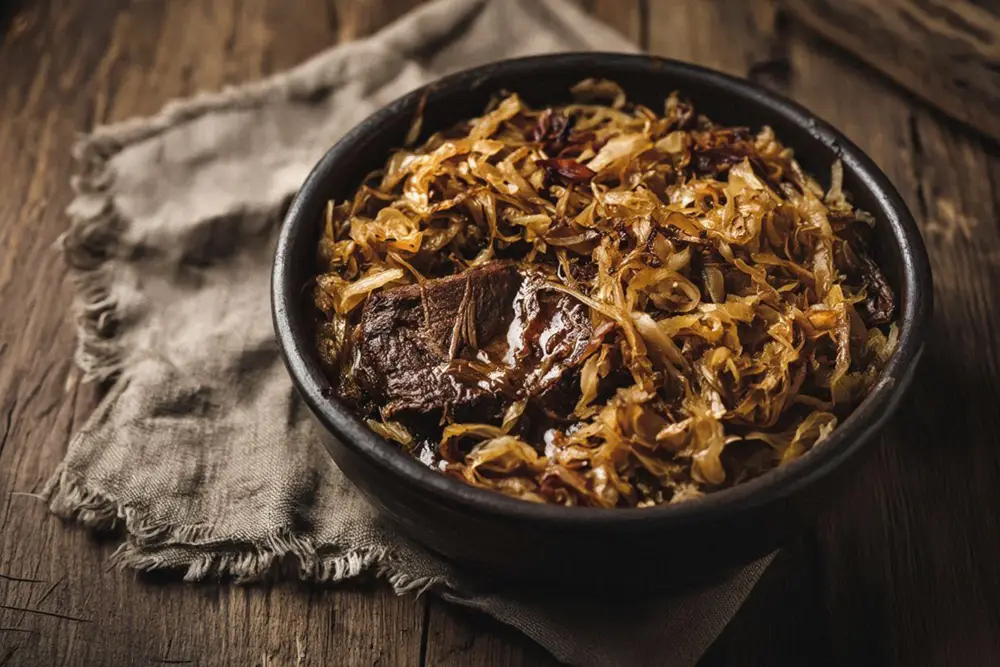
A two-day slow-braised sauerkraut layered with pastrma, beef, and bacon — a Central European winter dish built on patience and a clay pot.
Quick Summary
A two-day slow-braised sauerkraut layered with pastrma, beef, and bacon — a Central European winter dish built on patience and a clay pot.
Historical recipe
Modernised adaptation of an early 20th‑century source. Not independently kitchen-tested by Attic Recipes. Quantities, temperatures, and food safety guidance have been updated for a contemporary kitchen — results may vary and errors may exist. Nutritional values, where provided, are estimates only and have not been laboratory tested. Always follow current food safety guidelines for your region. If you have a health condition, allergy, or dietary requirement, consult a qualified professional before preparing this recipe.
Use of this recipe is entirely at your own risk and subject to our Terms of Service and Privacy Policy. Attic Recipes accepts no liability for any adverse outcome.
- Gluten
- Sulphites
Additional notes
-
Warning
Pastrma and commercially produced sauerkraut can both contain very high levels of sodium. Individuals managing hypertension or on a sodium-restricted diet should taste carefully before adding any additional salt and may wish to rinse both the pastrma and the sauerkraut before use.
-
Warning
Pork must be cooked through to a minimum internal temperature of 71°C (160°F). Use an instant-read thermometer to verify doneness before serving, particularly for thicker pieces. Pregnant women, children under 18, elderly individuals, and immunocompromised persons should not consume pork that has not reached this temperature.
-
Note
This recipe contains lard (saturated animal fat). Per-serving saturated fat is approximately 9g. Individuals monitoring saturated fat intake may substitute neutral vegetable oil — see modernAdaptation.
- 1
Day 1 — Pre-cook the pastrma: rinse 500 g of pastrma under cold water, then place in a small saucepan and cover with cold unsalted water. Bring to a boil and simmer for 15 minutes. Drain and set aside. This removes excess salt.
Tip Taste the pastrma after pre-cooking. If still very salty, simmer for a further 10 minutes in fresh water. - 2
Place the beef bone at the bottom of a 3–4 litre earthenware pot or Dutch oven. This prevents the cabbage from sitting directly on the base and burning during the long simmer.
- 3
Layer the ingredients in this order: a layer of sliced sauerkraut, then the 500 g of beef chunks, another layer of sauerkraut, then the 250 g of bacon slices, another layer of sauerkraut, then the pre-cooked pastrma. Finish with a final layer of sauerkraut on top.
- 4
Pour approximately 500 ml of water over the layers — enough to barely reach the top layer of cabbage. Add 30 g of lard. Place the pot on the lowest possible heat, cover, and simmer slowly for 90–120 minutes.
Tip This dish should barely bubble. If using a gas hob, use a heat diffuser if available. - 5
After simmering, remove the pot from the heat. Do not stir. Place the pot in a cool place (larder, cellar, or refrigerator) and leave overnight — minimum 8 hours. Do not add the pork at this stage.
- 6
Day 2 — Preheat the oven to 160°C (320°F) / 140°C fan. Remove the pot from the cool place. Tuck 400 g of pork pieces into the cabbage, pressing them into the layers rather than placing them on top.
- 7
Prepare the roux: in a frying pan, melt 30 g of lard over medium heat. Add 150 g of finely chopped onion and cook until soft and golden, approximately 8–10 minutes. Add 10 g of plain flour and stir for 1–2 minutes until lightly coloured. Add 5 g of sweet paprika, stir immediately, and remove from heat. Pour this mixture over the cabbage in the pot.
Tip Paprika burns quickly — add it off the heat or at the very last moment. Burnt paprika will make the dish bitter. - 8
If using, tuck the whole hot pepper into the cabbage. Taste the liquid — add salt only if needed, as pastrma, sauerkraut, and bacon all contribute significant salt. Place the pot in the preheated oven, uncovered, and bake for 60–75 minutes until the pork is cooked through and the top layer of cabbage is lightly coloured but not dry.
Tip Check every 20 minutes. If the surface is drying out, add a small splash of water and cover loosely with foil. - 9
Remove from the oven. The finished dish should be tender, well-cooked, and moist — not soupy and not dry. Remove the beef bone and the whole hot pepper before serving. Serve directly from the pot.
Nutrition Information per 1 serving (approx. 380g)
Nutritional values are approximate estimates and may vary based on specific ingredients used, preparation methods, and portion sizes.
Serving Suggestions
Serve directly from the pot with dense rye bread or crusty white bread to absorb the braising liquid. A cold glass of buttermilk or plain yoghurt alongside cuts through the richness of the meats. Leftovers reheat well the following day — many cooks consider the dish best on its third day.
About This Recipe
Some dishes are not built for a Tuesday evening. Sauerkraut with pastrma is a two-day project — not because the technique is complicated, but because the overnight rest between the first and second day of cooking is the point. The sauerkraut absorbs the meat juices, the acidity mellows, and the flavours settle into each other in a way that no amount of extra simmering on a single afternoon can replicate.
The combination of meats here follows a logic that was practical rather than indulgent: pastrma provided salt and depth, beef provided body, bacon provided fat, and pork — added only on the second day, because it cooks faster and would otherwise fall apart — provided the tender, yielding texture that makes the dish satisfying. Each meat does a different job, and each layer of sauerkraut acts as both a separator and a sponge, carrying the flavour downward through the pot as it cooks.
The earthenware pot matters. Its thick walls distribute heat slowly and evenly, keeping the contents at the long, low simmer that prevents the cabbage from turning to mush and the meats from toughening. A modern Dutch oven works for the same reason. What does not work is a thin-bottomed saucepan at anything above the lowest heat — the cabbage burns very easily, and period cooks knew it well enough to say so explicitly.
Why It Works
Sauerkraut is lacto-fermented cabbage — already acidic, already broken down at the cell level. Long braising does not cook it so much as transform it: the remaining structure softens, the sharp fermentation acidity mellows in the presence of fat and protein, and the liquid the cabbage releases combines with the meat juices to form a braising stock that builds in the pot over two days.
The bone placed at the base of the pot is a piece of practical engineering. It lifts the bottom layer of cabbage fractionally off the surface, creating a small gap through which the braising liquid circulates and preventing the direct contact with the heated base that causes scorching. It also contributes collagen to the liquid, which gives the finished dish a slightly unctuous quality that water alone would not produce.
The roux added on the second day — onion, fat, flour, paprika — is the only moment of high-heat cooking in the recipe. It is added not to thicken the liquid dramatically but to round it: the flour absorbs some of the surface fat, the onion adds sweetness, and the paprika gives colour and a faint warmth that runs through the finished dish.
Modern Kitchen Tips
Taste everything before you season. Pastrma, commercially produced sauerkraut, and smoked bacon all carry significant salt. In most cases, no additional salt will be needed on Day 2 — and if it is, a small pinch is usually sufficient.
If you cannot find pastrma or pastirma, rehydrated smoked beef jerky works better than most people expect. Choose a plain, unseasoned variety and soak in warm water for 30 minutes before using, then pre-cook as per the instructions.
The flour in the roux is optional — period recipes vary on this point, and some cooks omit it entirely. Without it, the braising liquid remains thinner and more broth-like; with it, it is slightly more cohesive. Both are correct.
Leftovers are the reward for the effort. Reheated gently the next day, this dish is richer and more fully integrated than it was when first served.
A two-day dish from an era when the best things in the kitchen required patience — and a cool larder.
The Story Behind This Recipe
Historical Context
Early 20th century Central European recipes for braised sauerkraut with mixed meats commonly used a two-day method — not as a matter of convenience, but as a deliberate technique. The overnight rest allowed the sauerkraut to absorb the meat juices and mellow its acidity, a step that shortened cooking time would not replicate. Home cooks of the period used a clay or earthenware pot set over a very low wood-burning stove, a heat source that naturally prevented boiling and encouraged the long, slow simmer the dish requires. Pastrma — intensely salted and air-dried meat — was a standard preserved protein in the Central European larder of the era, available year-round when fresh meat was not. A bone placed at the base of the pot to prevent the cabbage from scorching was standard practice in middle-class Central European households of the period. The flour in the roux was noted as optional even in the original instructions, reflecting regional variation in thickening practice.
Modern Kitchen Adaptation
Pastrma is a traditional air-dried and smoked preserved meat, typically made from mutton or beef, intensely salty and deeply flavoured. It requires pre-soaking or brief pre-cooking before use to reduce its salt content. If pastrma is unavailable, the closest substitutes are pastirma (the Turkish and Middle Eastern equivalent, available from specialist grocers and online), bresaola combined with a small quantity of smoked beef, or heavily smoked beef jerky rehydrated in warm water for 30 minutes before use. Do not substitute with fresh or smoked fish — the texture and salt profile are entirely different. Lard has been retained as the historically correct fat; an equal weight of neutral vegetable oil or a mixture of butter and vegetable oil may be used as a modern alternative without significantly affecting the result. The oven temperature of 160°C (320°F) / 140°C fan is estimated — the original recipe specified only placement in the oven or on a tile over heat, with no temperature given. A Dutch oven with a heavy lid is a suitable modern equivalent to the earthenware pot.
This recipe is an independent modern adaptation developed from historical sources in the public domain. It is provided for informational and educational purposes only and does not constitute professional dietary, nutritional, or medical advice. Food preparation involves inherent risks. The reader assumes full responsibility for safe food handling, ingredient sourcing, and adherence to current local food safety guidelines. The site operator accepts no liability for outcomes resulting from the preparation or consumption of this recipe.
One recipe.
Every week.
You Might Also Like
More recipes from the same category
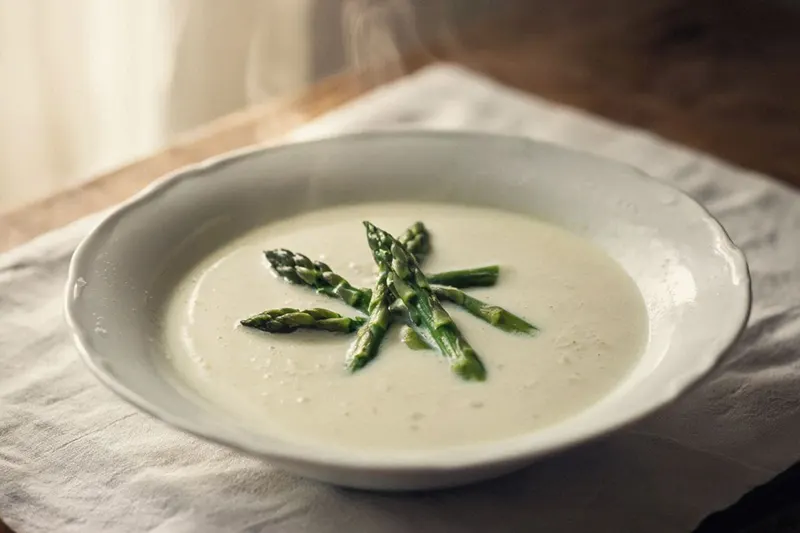
Asparagus Tip Soup
A silky, cream-enriched asparagus soup built on a white roux and finished with tempered egg yolks — an elegant first course from early 20th century cooking.
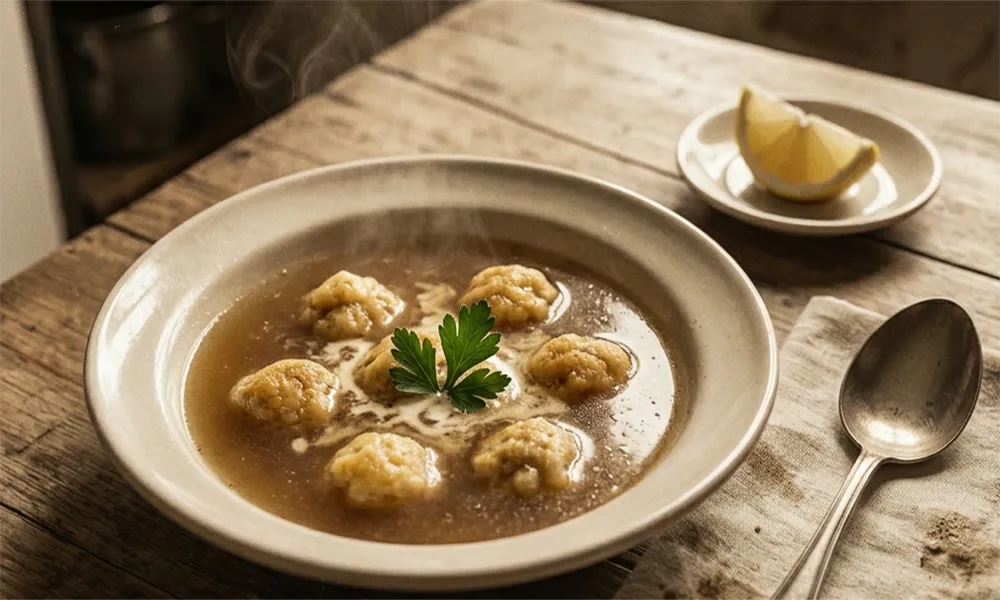
Beef Broth with Stuffed Dough Dumplings
Rich beef bone broth simmered with golden pan-fried dumplings stuffed with seasoned ground beef, finished with a light roux and fresh lemon juice.
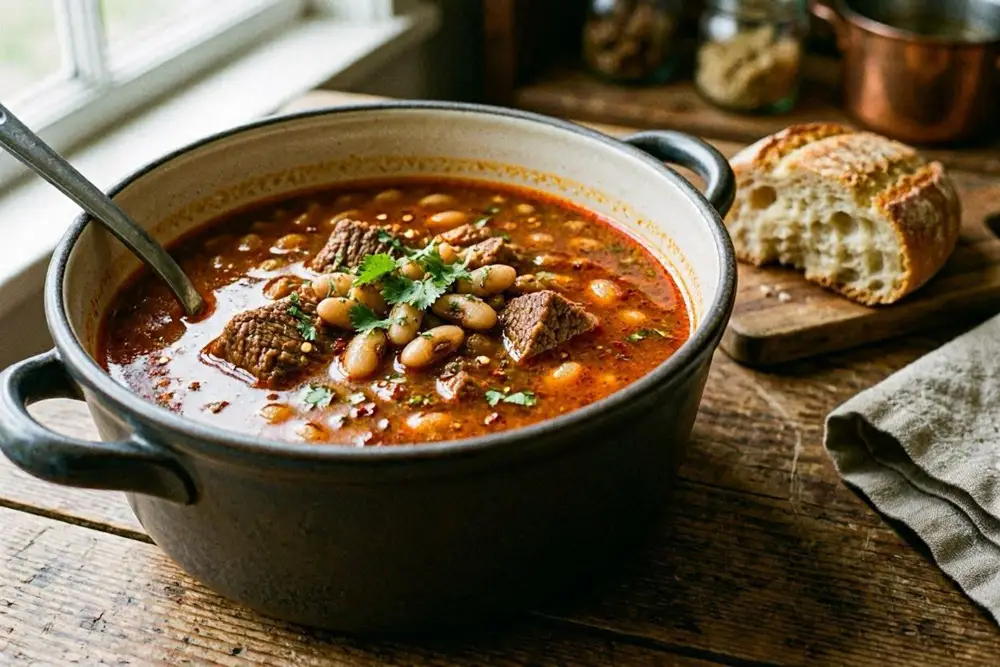
Bean Soup Cooked with Beef
White beans and beef shoulder slow-simmered with a bouquet garni, finished in the oven with a paprika-spiced pan roux. A deeply satisfying one-pot meal.