Rice with Bacon and Cheese
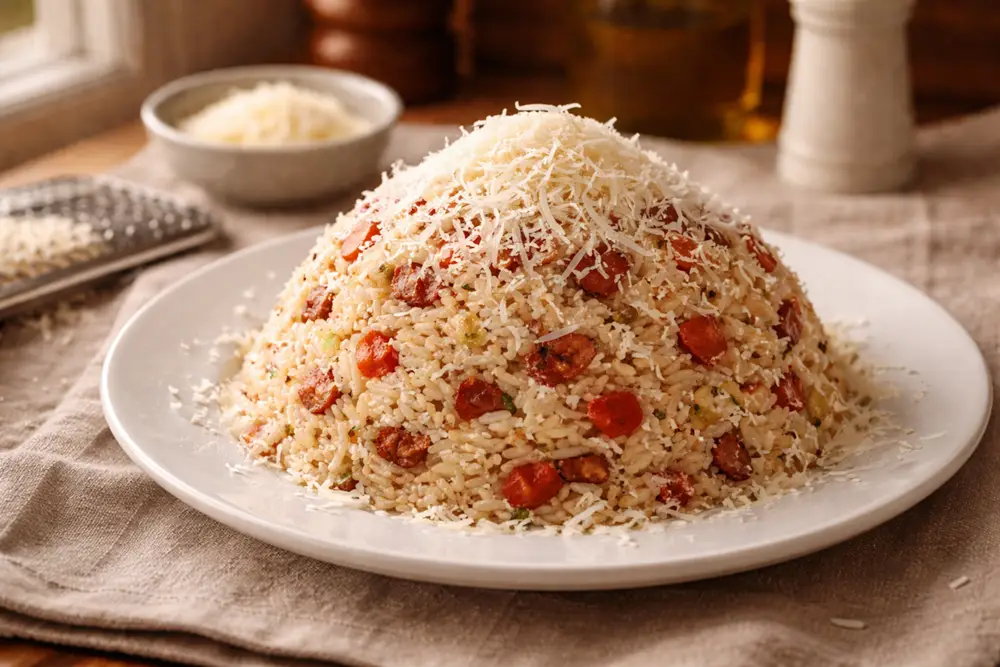
Savory rice cooked with dried bacon, poultry broth, and tomato passata, packed into a mold and inverted onto a plate, finished with generous grated cheese.
Historical recipe
Modernised adaptation of an early 20th‑century source. Not independently kitchen-tested by Attic Recipes. Quantities, temperatures, and food safety guidance have been updated for a contemporary kitchen — results may vary and errors may exist. Nutritional values, where provided, are estimates only and have not been laboratory tested. Always follow current food safety guidelines for your region. If you have a health condition, allergy, or dietary requirement, consult a qualified professional before preparing this recipe.
Use of this recipe is entirely at your own risk and subject to our Terms of Service and Privacy Policy. Attic Recipes accepts no liability for any adverse outcome.
- Dairy
Additional notes
-
Note
This recipe contains lard (pork fat). For a non-pork version, substitute with olive oil or butter in equal quantity.
- 1
Heat the lard in a heavy-bottomed saucepan over low heat. Add the finely chopped onion and fry gently for 3 minutes, stirring occasionally, until softened but not coloured.
- 2
Add the finely chopped dried bacon to the onion and cook over low heat, stirring constantly, for 2–3 minutes. Do not allow the onion to brown.
- 3
Add the washed and drained rice to the pan and stir to coat it in the fat and bacon. Cook for 1 minute.
- 4
Pour in 700 ml of warm poultry broth — it should fully cover the rice. Season with salt. Stir once, then leave to cook over low-medium heat.
Tip Warm broth keeps the cooking temperature stable and helps the rice absorb liquid evenly. - 5
As the rice absorbs the broth and begins to dry out, gradually add the tomato passata in small pours, stirring gently each time. Continue until all 200 ml of passata has been added and the rice is completely cooked through but still holds its shape. Do not overcook to mush.
- 6
Remove from heat. Stir in half the grated cheese and mix well.
- 7
Pack the rice tightly into a lightly greased mold, bowl, or deep-sided cup. Press firmly so it holds its shape. Invert immediately onto a round serving plate so the rice falls out in a cone or dome shape.
Tip Work quickly while the rice is still warm — it holds the mold shape much better hot than cold. - 8
Sprinkle the remaining grated cheese generously over the top and sides. Serve immediately.
Nutrition Information per 1 serving (approx. 250g)
Nutritional values are approximate estimates and may vary based on specific ingredients used, preparation methods, and portion sizes.
Serving Suggestions
Serve as a main dish with a simple green salad or roasted vegetables alongside. Also works well as a substantial side to braised or roasted meat. Leftovers can be sliced cold and pan-fried in a little butter until a crust forms — a different but equally good result.
About This Recipe
This is a dish that rewards patience with a quietly impressive result. Rice is cooked slowly with dried bacon and onion in broth, then finished with tomato and stirred through with cheese — then packed into a mold and turned out onto a plate in a neat cone or dome. It is not complicated, but the technique of molding rice was a signature move of early 20th century home entertaining: simple food presented with a little ceremony.
The combination of bacon, tomato, broth, and cheese is deeply satisfying without being heavy. The bacon provides the base flavour — slightly smoky, savoury — while the tomato passata adds acidity and colour that keeps the dish from feeling stodgy. The cheese, stirred in at the end and again over the top, binds and finishes everything.
What makes this recipe worth revisiting is the mold. It turns a weeknight rice dish into something that looks considered. The cone holds its shape for just long enough to be admired at the table before it is broken into and served.
Why It Works
Short-grain rice releases starch as it cooks, and that starch is what allows the mold to hold its shape. Adding the broth first and the tomato passata gradually mimics the logic of a risotto: the rice absorbs liquid in stages, building up a cohesive, slightly sticky texture without becoming waterlogged. The cheese stirred in at the end further binds the grains together.
The onion is cooked over low heat deliberately — browning it would add bitterness that competes with the bacon and tomato. Keeping it pale and soft means it disappears into the rice, contributing sweetness without presence.
Modern Kitchen Tips
Use warm broth, not cold — adding cold liquid to hot rice arrests the cooking and can make the texture uneven. If you run out of broth before the rice is done, top up with hot water rather than cold.
The mold works best with a bowl or deep cup with straight or slightly inward-sloping sides. Grease it lightly with butter or oil before packing. Have your serving plate ready before you invert — the rice should go straight from mold to plate while still hot.
If the cone collapses slightly when turned out, it does not matter much — a quick press with the back of a spoon restores the shape, and the cheese on top covers a multitude of imperfections.
A classic of early 20th century home cooking, preserved and adapted for the modern kitchen.
The Story Behind This Recipe
Historical Context
This dish belongs to a tradition of rice cooking from the Adriatic coastal regions of Central Europe, where Italian culinary influence shaped local home cooking throughout the 19th and early 20th centuries. The technique of cooking rice by gradual liquid absorption — adding broth first, then tomato juice — reflects an awareness of the risotto method, though the result here is firmer and intended for molding rather than serving loose. The presentation in a cone-shaped mold was a common formal touch in period home cooking, where visual effect on the table was considered as important as flavour. Hard local cheeses were typical; the type was rarely specified, as cooks used whatever aged cheese was available in the household.
Modern Kitchen Adaptation
The original recipe does not specify the type of fat — lard is the historically accurate choice and is listed in the ingredients. For a lighter result, 2 tablespoons of olive oil or butter can be substituted. The original calls for 'tomato juice,' which in a period context most likely referred to strained tomato passata or fresh tomato pulp rather than commercial bottled juice; passata is used here for consistent results. The rice variety is not specified in the original; a short-grain or round-grain rice such as Arborio is recommended, as it produces the starchy, cohesive texture needed for the mold to hold its shape cleanly. Long-grain rice such as basmati will not hold the mold and is not suitable here.
This recipe is an independent modern adaptation developed from historical sources in the public domain. It is provided for informational and educational purposes only and does not constitute professional dietary, nutritional, or medical advice. Food preparation involves inherent risks. The reader assumes full responsibility for safe food handling, ingredient sourcing, and adherence to current local food safety guidelines. The site operator accepts no liability for outcomes resulting from the preparation or consumption of this recipe.
One recipe.
Every week.
You Might Also Like
More recipes from the same category
Baked Fish with Tomatoes
Whole fish baked over ripe tomatoes with generous olive oil and lemon — a simple, fragrant Central European oven dish.
Beef Kidney with Wine
Beef kidney marinated in red wine, braised with herbs, finished with sour cream. Tender, rich, and deeply flavored.
Beef Tongue in Mushroom Sauce
Tender sliced beef tongue layered in a rich dark mushroom sauce, finished with sour cream, Parmesan, and a golden oven crust.