Rice Flour Potage
Beef broth thickened with a rice flour slurry, simmered until silky, and finished with a tempered egg yolk, sour cream, lemon juice, and butter.
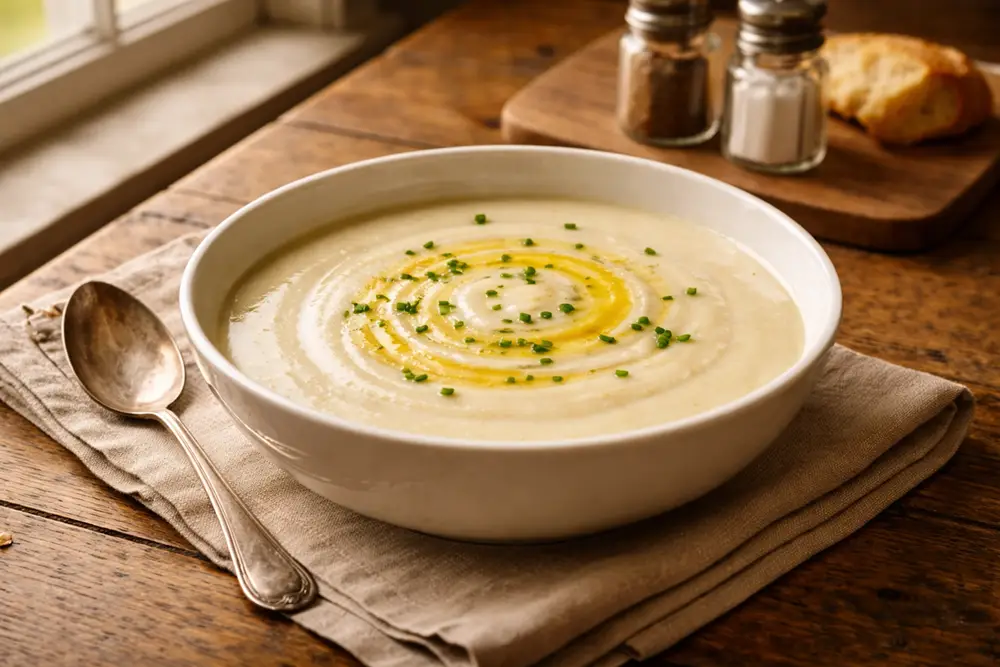
Historical recipe
Modernised adaptation of an early 20th‑century source. Not independently kitchen-tested by Attic Recipes. Quantities, temperatures, and food safety guidance have been updated for a contemporary kitchen — results may vary and errors may exist. Nutritional values, where provided, are estimates only and have not been laboratory tested. Always follow current food safety guidelines for your region. If you have a health condition, allergy, or dietary requirement, consult a qualified professional before preparing this recipe.
Use of this recipe is entirely at your own risk and subject to our Terms of Service and Privacy Policy. Attic Recipes accepts no liability for any adverse outcome.
- Eggs
- Dairy
Additional notes
-
Warning
This recipe contains a raw egg yolk that is tempered but not cooked to a sustained safe temperature. The soup must be very hot — at minimum 80°C, freshly removed from the heat — before straining it into the yolk mixture; do not allow it to cool first. Add the hot soup slowly and continuously while whisking, and use the full quantity without interruption so the liaison reaches a safe temperature throughout. Pregnant women, elderly individuals, children under 18, and immunocompromised individuals should use pasteurised egg yolks.
Use a pasteurised liquid egg yolk (available in most supermarkets) in the same quantity. The texture and richness of the finished potage are indistinguishable from fresh yolk.
-
Note
Sodium content will vary significantly depending on the saltiness of the broth used. If using a commercial stock, check the label and adjust added salt accordingly — or use an unsalted broth and season entirely to taste at the end.
- 1
Bring 2000ml of beef broth to a boil in a large pot over medium-high heat.
- 2
In a heatproof bowl, whisk 100g of rice flour with 150ml of cold beef broth or cold whole milk until completely smooth and free of lumps.
Tip Start with a small amount of liquid, work the flour into a thick paste first, then loosen with the rest — this prevents dry pockets of flour forming in the slurry. - 3
Once the broth is boiling, reduce the heat to medium. Slowly pour the rice flour slurry into the pot in a thin stream, whisking constantly. Continue whisking until fully incorporated.
- 4
Move the pot to a lower heat. Cover and simmer gently for 15 minutes, stirring occasionally. The potage should thicken noticeably and lose any raw flour taste.
Tip Rice flour needs the full 15 minutes to reach its maximum thickening. Do not increase the heat to rush this stage. - 5
Season with salt to taste. Remove from the heat.
- 6
In a large heatproof bowl, whisk together 1 egg yolk, 200ml of sour cream, and 15ml of lemon juice until smooth.
- 7
Strain the hot potage through a fine-mesh sieve directly into the egg yolk mixture, adding it slowly in a thin stream while whisking constantly. This tempering step raises the temperature of the liaison gradually and prevents the yolk from scrambling. The finished potage should be completely smooth and glossy.
Tip Never pour the full pot of hot soup into the yolk at once — the sudden heat will curdle both the egg and the sour cream. Slow and steady is the technique. - 8
Add 20g of cold butter in small pieces. Swirl the pot gently until each piece melts before adding the next. Do not return to high heat after adding the butter.
- 9
Serve immediately in warmed bowls.
Nutrition Information per 1 portion (approx. 500ml)
Nutritional values are approximate estimates and may vary based on specific ingredients used, preparation methods, and portion sizes.
Serving Suggestions
Serve as a first course before a roast or braised meat main. Garnish with finely chopped chives, flat-leaf parsley, or a few small croutons. A thin slice of toasted white bread alongside is traditional. The potage also works as a light lunch with good bread.
About This Recipe
There is a category of soup that does not announce itself. It arrives at the table pale and smooth, with no visible garnish to explain what it is, and it earns its place entirely on texture and depth of flavour. Rice flour potage is that soup. Thickened not with a butter roux but with a fine starch slurry, finished not with cream alone but with a liaison of egg yolk, sour cream, and lemon juice, it sits between a consommé and a velouté — lighter than either, more interesting than both.
The technique is simple but sequential: the slurry must be made cold to prevent lumps, added slowly to a boiling broth, simmered long enough for the starch to reach its full thickening potential, and then finished with a tempered liaison that adds richness without weight. Each step depends on the one before it. Skip or rush any of them and the result is either lumpy, thin, or curdled.
The mild acidity of the sour cream and lemon juice is not decoration. It cuts through the richness of the egg yolk and lifts the flavour of the broth, giving the finished potage a brightness that plain cream cannot achieve.
Why It Works
Rice flour produces a finer, more transparent gel than wheat flour or potato starch when cooked in liquid. A wheat-flour roux thickens through the swelling of starch granules in a fat matrix; rice flour, added as a cold slurry directly to boiling broth, gelatinises more cleanly and leaves no floury taste if simmered long enough. The 15-minute simmer is not arbitrary — it is the time required for the starch granules to fully hydrate and the raw flour flavour to cook out completely.
The liaison — egg yolk and sour cream whisked together — is the classical Central European alternative to a French cream finish. The yolk provides emulsifying lecithin, which helps bind the fat from the sour cream into the starchy broth and gives the surface that characteristic gloss. The sour cream provides fat and acidity simultaneously. Tempering, the slow addition of hot liquid to the cold liaison, raises the temperature of the egg proteins gradually so they set smoothly rather than scramble.
Butter added off the heat at the end is a mounting technique: cold fat swirled into a hot liquid creates a temporary emulsion that adds body and sheen. It is the same principle as finishing a pan sauce with butter, applied here to soup.
Modern Kitchen Tips
If the potage thickens more than expected as it sits — rice starch continues to absorb liquid after cooking — thin it with a small amount of warm broth added gradually, whisking to reincorporate.
A fine-mesh sieve is not optional for this recipe. Straining removes any surface skin, undissolved starch particles, and any threads of cooked egg white that may have formed at the edges of the pot during simmering. The difference between a strained and unstrained result is immediately visible.
The potage can be made ahead up to the end of Step 5, refrigerated, and reheated gently before completing Steps 6–9. Do not add the liaison or butter until just before serving.
A light first course that asks nothing of the cook except attention — and repays it completely.
The Story Behind This Recipe
Historical Context
Potages thickened with starch — rice flour, potato flour, or fine breadcrumbs — were a standard feature of early 20th century Central European household cooking, occupying a category between a thin consommé and a cream soup. Rice flour was valued for producing a particularly fine, smooth texture without the slight graininess of potato starch or the heaviness of a butter-and-flour roux. The liaison of egg yolk and sour cream as a finishing technique — rather than cream alone — is characteristic of Central European practice of the period, giving the potage a mild acidity and a lighter body than the French velouté it resembles. Home cooks of the period relied on this technique for light first courses that were economical without appearing so.
Modern Kitchen Adaptation
The original recipe specified 'a cup of sour cream' without a unit — standardised to 200ml, the volume of a standard commercial sour cream portion. Lemon juice was given as 'to taste' only; 15ml is a workable starting quantity that can be adjusted. Butter was described as 'a few pieces' without weight; 20g gives the finish without making the potage greasy. The cold liquid for the slurry was unspecified in quantity; 150ml produces a pourable slurry that incorporates cleanly into boiling broth. The tempering technique — whisking hot soup gradually into the egg yolk mixture rather than adding the yolk to the pot — is implied in the original instruction to 'strain the soup into the seasoning' but is made explicit here as it is the critical step for a smooth result. All four estimated quantities confirmed.
This recipe is an independent modern adaptation developed from historical sources in the public domain. It is provided for informational and educational purposes only and does not constitute professional dietary, nutritional, or medical advice. Food preparation involves inherent risks. The reader assumes full responsibility for safe food handling, ingredient sourcing, and adherence to current local food safety guidelines. The site operator accepts no liability for outcomes resulting from the preparation or consumption of this recipe.
One recipe.
Every week.
You Might Also Like
More recipes from the same category
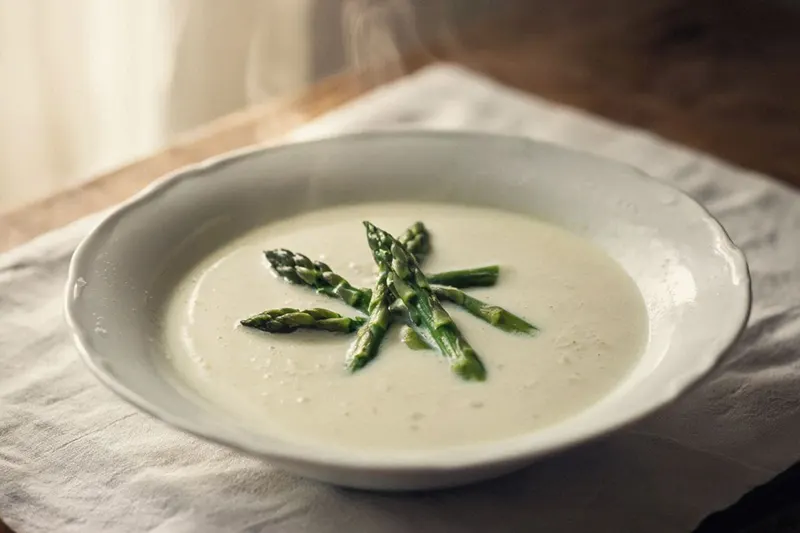
Asparagus Tip Soup
A silky, cream-enriched asparagus soup built on a white roux and finished with tempered egg yolks — an elegant first course from early 20th century cooking.

Bean Soup Cooked with Beef
White beans and beef shoulder slow-simmered with a bouquet garni, finished in the oven with a paprika-spiced pan roux. A deeply satisfying one-pot meal.
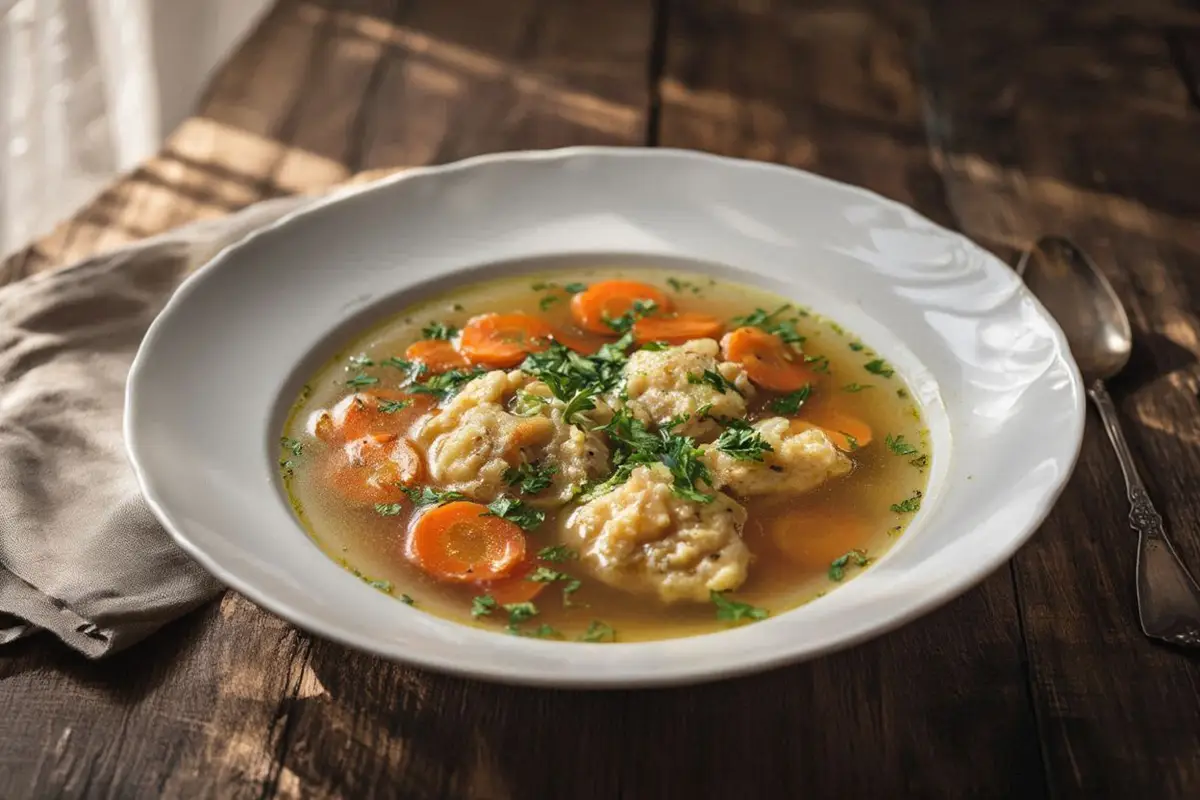
Beef Soup with Carrot-Colored Broth
A rich, golden Central European beef soup with carrot-colored broth, served with semolina or liver dumplings. Hearty, clear, and deeply flavorful.