Potato Strudel
Soufflé-light potato, egg yolk, and lemon-whipped whites folded into paper-thin hand-stretched strudel dough, an early 20th-century Central European
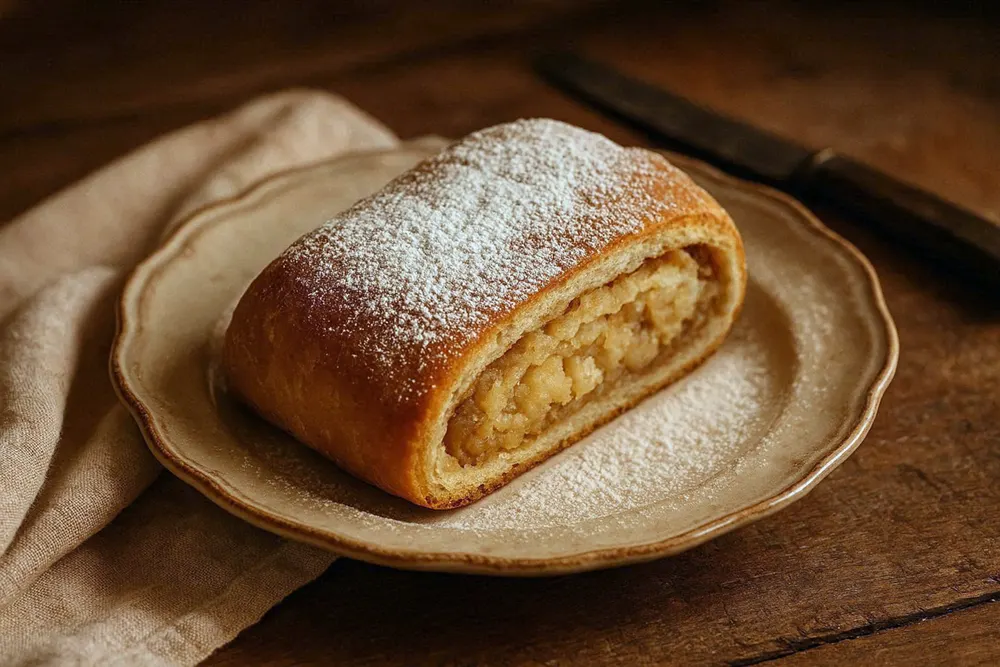
Historical recipe
Modernised adaptation of an early 20th‑century source. Not independently kitchen-tested by Attic Recipes. Quantities, temperatures, and food safety guidance have been updated for a contemporary kitchen — results may vary and errors may exist. Nutritional values, where provided, are estimates only and have not been laboratory tested. Always follow current food safety guidelines for your region. If you have a health condition, allergy, or dietary requirement, consult a qualified professional before preparing this recipe.
Use of this recipe is entirely at your own risk and subject to our Terms of Service and Privacy Policy. Attic Recipes accepts no liability for any adverse outcome.
- Eggs
- Gluten
- Dairy
Additional notes
-
Warning
This recipe contains eggs that may not reach full pasteurisation throughout the filling — the centre sets to a soufflé-like texture rather than a fully cooked solid. Not recommended for pregnant women, children under 18, the elderly, or immunocompromised individuals.
Use pasteurised egg whites (available in cartons) for the whipped component. Pasteurised whites whip to stiff peaks but may require slightly longer beating time.
-
Note
This recipe contains approximately 11g of saturated fat per serving due to the quantity of butter and egg yolks. Individuals managing cardiovascular conditions or cholesterol levels should be aware.
- 1
Make the strudel dough: combine 250g flour, a pinch of salt, 2 tablespoons of oil, 1 teaspoon of white wine vinegar, and 125ml of warm water in a bowl. Mix until a shaggy dough forms, then turn out and knead firmly for 8–10 minutes until perfectly smooth, elastic, and no longer sticky. The dough should feel like soft leather. Shape into a ball, brush the surface lightly with oil, cover with an inverted bowl, and rest for 20 minutes.
Tip The vinegar is not optional — it breaks down gluten bonds and makes the dough stretchable without tearing. Do not skip it. - 2
While the dough rests, cook the potatoes: scrub 1kg of starchy potatoes and boil them whole, skin on, in well-salted water until completely tender when pierced with a skewer — approximately 25–30 minutes depending on size. Drain, peel while still hot (use a clean cloth to hold them), and pass through a potato ricer or fine-mesh sieve into a large bowl. Spread out and allow to cool to room temperature. Do not mash with a masher — a ricer produces a lighter, drier result.
Tip Cooking potatoes in their skins keeps them from absorbing water and ensures a drier mash, which is critical for a light filling. - 3
Make the filling base: beat 8 egg yolks with 8 tablespoons (approximately 100g) of caster sugar using a hand or stand mixer for 4–5 minutes until the mixture is pale, thick, and falls from the beater in a thick ribbon. Add the riced, cooled potato to the beaten yolks and fold together with a large spatula until just combined and smooth. Do not overmix.
- 4
Whip the egg whites: in a clean, grease-free bowl, beat the 8 egg whites to stiff peaks — they should hold a firm point when the beater is lifted and not slide when the bowl is tilted. Add the zest and juice of 1 lemon to the beaten whites and fold in gently with a spatula. Fold the lemon whites into the potato-yolk base in three additions, using large, confident strokes from the bottom of the bowl upward. Stop as soon as no white streaks remain. Set the filling aside.
Tip The filling will look alarmingly light and airy — that is correct. It will set to a soufflé-like texture in the oven. - 5
Preheat your oven to 200°C (400°F) / 180°C fan. Spread a large, clean tablecloth or thin cotton sheet over your table and dust it lightly with flour. Divide the rested dough into 2 equal pieces. Working with one piece at a time, roll the dough out on the cloth with a rolling pin as thin as you can, then place your hands underneath the dough (palms down, knuckles up) and gently stretch it outward from the centre, working around the dough until it is paper-thin and nearly translucent. Aim for roughly 50×60cm per piece. Trim any thick edges with scissors.
Tip Remove rings and watches before stretching. Tears can be patched — don't worry about small holes. - 6
Brush the entire surface of the stretched dough generously with 60g of the melted butter. Fold in 4–5cm on all four sides to create a border — this prevents the filling from leaking out the ends. Brush the folded edges with butter again. Spread half of the potato filling over one half of the buttered dough, leaving the border clear and the unfilled half of the sheet bare.
- 7
Using the tablecloth to help, lift the filled edge and roll the strudel up loosely — the filling needs room to expand. Do not press or compact it. Lift the finished roll carefully onto a buttered baking tray, seam side down. Brush the top and sides with melted butter. Repeat with the second piece of dough and remaining filling to make a second strudel. Both rolls should fit on one large tray.
- 8
Bake in the preheated oven at 200°C (400°F) / 180°C fan for 35–40 minutes, until the crust is deep golden brown and crisp. If the tops colour too quickly in the first 15 minutes, loosely tent with foil and continue baking.
Tip Do not open the oven door for the first 20 minutes — the egg white filling behaves like a soufflé and needs stable heat to set. The filling is done when it reaches an internal temperature of 71°C (160°F); a skewer inserted into the centre should come out clean with no wet batter. - 9
Remove from the oven and allow to cool for 10 minutes on the tray. Cut into portions with a sharp serrated knife using a gentle sawing motion — do not press down or the layers will compress. Dust generously with 2 tablespoons of vanilla sugar and serve warm.
Nutrition Information per 1 porcija (approx 250g)
Nutritional values are approximate estimates and may vary based on specific ingredients used, preparation methods, and portion sizes.
Serving Suggestions
Serve warm, dusted with vanilla sugar. A spoonful of lightly sweetened sour cream or crème fraîche alongside cuts the richness and echoes the Central European tradition of pairing baked pastries with cultured dairy (note: contains milk). The strudel is at its best within an hour of baking, while the crust is still crisp and the filling soufflé-light; it softens considerably as it sits.
About This Recipe
There is something quietly subversive about a dessert that hides potatoes behind a paper-thin, golden crust. The potato strudel — known across the Central European kitchen as krumpli rétes, or simply Kartoffelstrudel — belongs to a tradition of resourceful baking that made something remarkable from the most ordinary of ingredients. In the early 20th century, the potato was not merely a side dish. It was a staple, a filler, and, in the hands of a skilled home baker, a filling so light and airy that it could pass for a soufflé wrapped in silk.
This recipe asks you to believe something counterintuitive: that eight egg whites, beaten to stiff peaks and folded into a mound of mashed potato, will produce a cloud rather than a lump. They will. The starch in the potato stabilises the whipped whites in the oven much as it does in a choux pastry, producing a filling that sets firm on the outside while remaining tender at its core. The lemon zest and juice, folded into the whites before they are incorporated, cut through the richness of eight yolks and give the finished strudel an unexpected freshness.
The dough is the other discipline here. Strudel dough is not difficult, but it is humbling — it demands patience and confidence in equal measure. The reward is a crust that shatters at the fork and dissolves on the tongue in a way that no commercial phyllo quite manages. If you have an afternoon and a large table and a grandmother’s tablecloth, this is worth the effort.
Why It Works
The filling functions on the same principle as a classic Salzburger Nockerl or a baked soufflé: egg whites trapped in a starchy matrix expand in the oven and then set, held in place by the gelatinised potato starch and the coagulated yolk proteins. The ratio of eight whites to eight yolks to 1kg of potato is precisely calibrated for this effect — the starch content of the potatoes is high enough to stabilise the structure, while the sugar beaten into the yolks lowers their setting temperature slightly, keeping the filling tender rather than rubbery.
The stretched dough works because of the long gluten chains developed during kneading and extended by the resting period. The vinegar in the dough slightly acidifies the gluten network, making it more extensible without tearing. The hot fat brushed over the dough before rolling — butter in the modern version, lard in the original — creates discrete, steam-separated layers in the oven, producing the characteristic shattering crispness of a well-made strudel.
Modern Kitchen Tips
On the potatoes: use a ricer, not a masher. A ricer pushes the cooked potato through small holes, producing a dry, fluffy result with no gluey patches. A masher works the starch and can produce a paste. A dry filling rises. A wet filling sinks.
On the egg whites: any trace of yolk or grease in the bowl will prevent the whites from reaching stiff peaks. Wipe your bowl and beaters with a little white wine vinegar on a paper towel before you start. The whites are ready when you can hold the bowl upside down without them moving.
On stretching the dough: if the dough springs back when you try to stretch it, stop and rest it for another five minutes under a warm bowl. It is telling you the gluten is still tense. Forcing it will cause tears.
On the phyllo alternative: if hand-stretched dough is not practical, use 6–8 sheets of commercial phyllo per strudel roll, layering them with melted butter between each sheet. The result will be crispier and more uniform in texture, but will sacrifice some of the delicacy of the hand-stretched version.
A forgotten gem of early 20th century Central European baking — humble ingredients, extraordinary result.
The Story Behind This Recipe
Historical Context
Early 20th century recipes for potato strudel typically listed ingredients by count rather than weight — eight potatoes, eight eggs — reflecting a domestic cooking tradition where cooks knew their ingredients by sight and feel rather than by scale. The instruction to 'spray with hot fat' refers to lard, the standard baking fat of the period, applied with a brush or a paper-wrapped cube of fat directly to the stretched dough. The filling method — beating yolks with sugar, folding in stiff whites — follows the same logic as a Viennese soufflé or a Baumkuchen batter: the egg whites were the leavening, long before chemical raising agents became common in home kitchens. The phrase 'mix everything lightly with the whipped cream' in the period translation almost certainly refers to the stiff egg whites themselves, not dairy cream — the two terms were occasionally conflated in older recipe translations between Central European languages, and combining both would have produced an unworkably wet filling.
Modern Kitchen Adaptation
Potatoes are given as a count in the original; 1kg of medium starchy potatoes is used here as a practical equivalent. Lard has been replaced with unsalted butter for brushing the dough — lard produces a marginally crisper, more traditional result and can be substituted by those who prefer it. The oven temperature of 200°C (400°F) / 180°C fan is estimated, as the original specifies only 'hot oven'; this is consistent with standard strudel baking practice. Ricing the potatoes rather than mashing them is a modern technique improvement — it produces a drier, lighter result critical to the filling's soufflé texture. The 'whipped cream' of the original has been interpreted as stiff egg whites only, consistent with the technique described and the number of eggs given.
This recipe is an independent modern adaptation developed from historical sources in the public domain. It is provided for informational and educational purposes only and does not constitute professional dietary, nutritional, or medical advice. Food preparation involves inherent risks. The reader assumes full responsibility for safe food handling, ingredient sourcing, and adherence to current local food safety guidelines. The site operator accepts no liability for outcomes resulting from the preparation or consumption of this recipe.
One recipe.
Every week.
You Might Also Like
More recipes from the same category

Baked Apricot and Rice Trumpet Pancakes
Delicate pancakes filled with creamy rice porridge and layered with rich apricot marmalade, baked in a sweet milk custard.
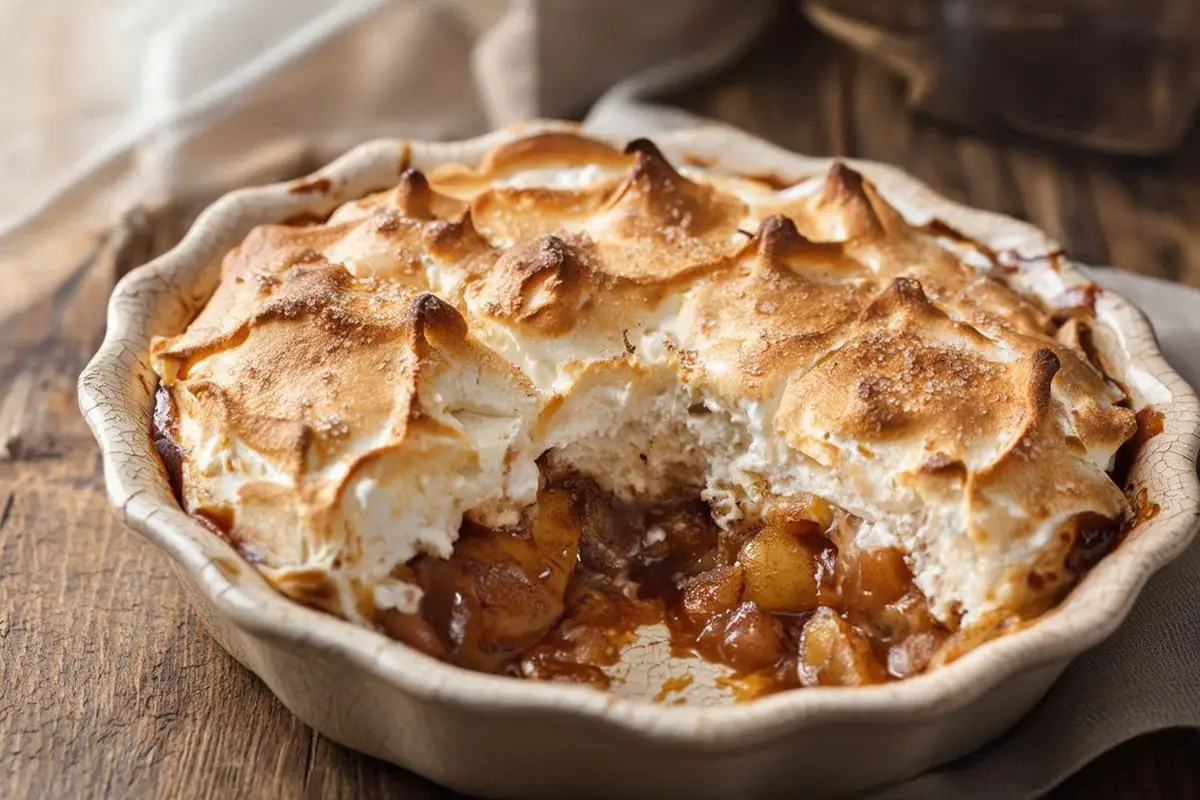
Velvet Apple & Meringue Gratin
A decadent vintage dessert featuring apples slow-cooked in a butter-sugar syrup, topped with a cloud of lemon-scented meringue.
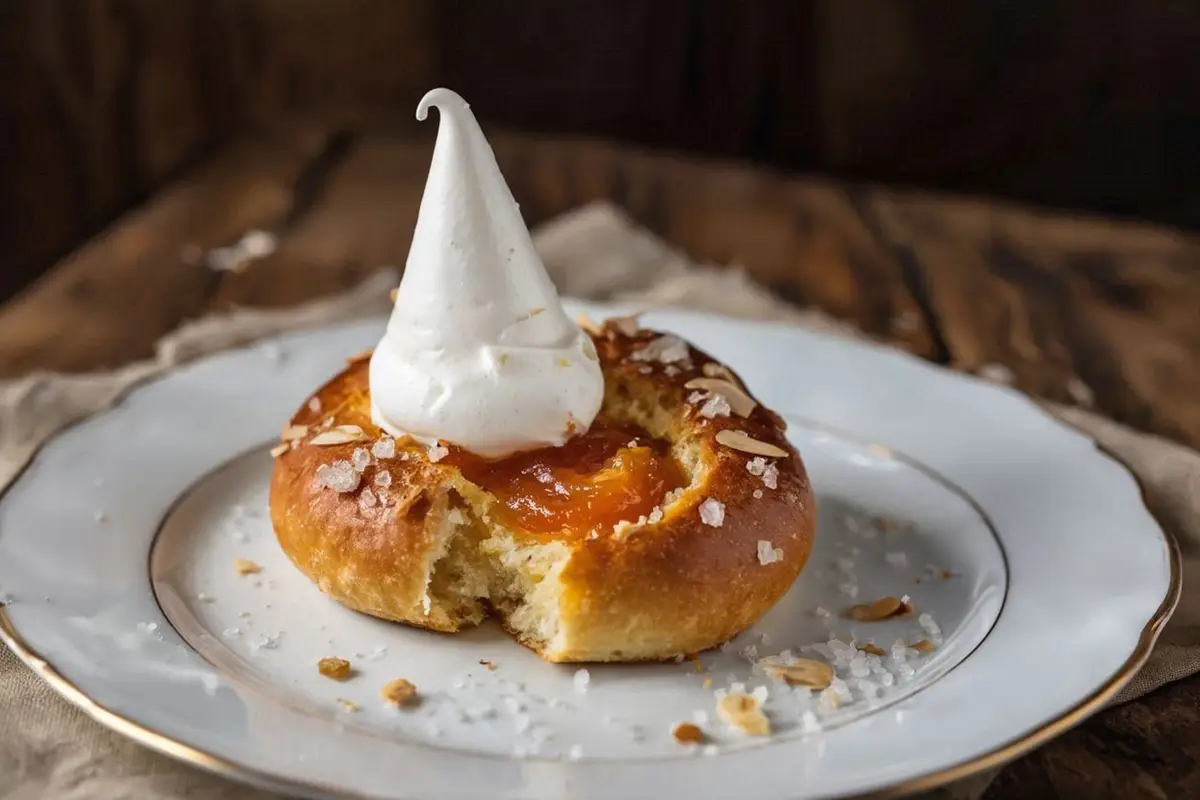
Carlsbad Imperial Cakes
A luxurious Bohemian yeast pastry featuring a rich butter dough, apricot jam centers, and a towering 'snow' meringue crown.