Oxtail Soup
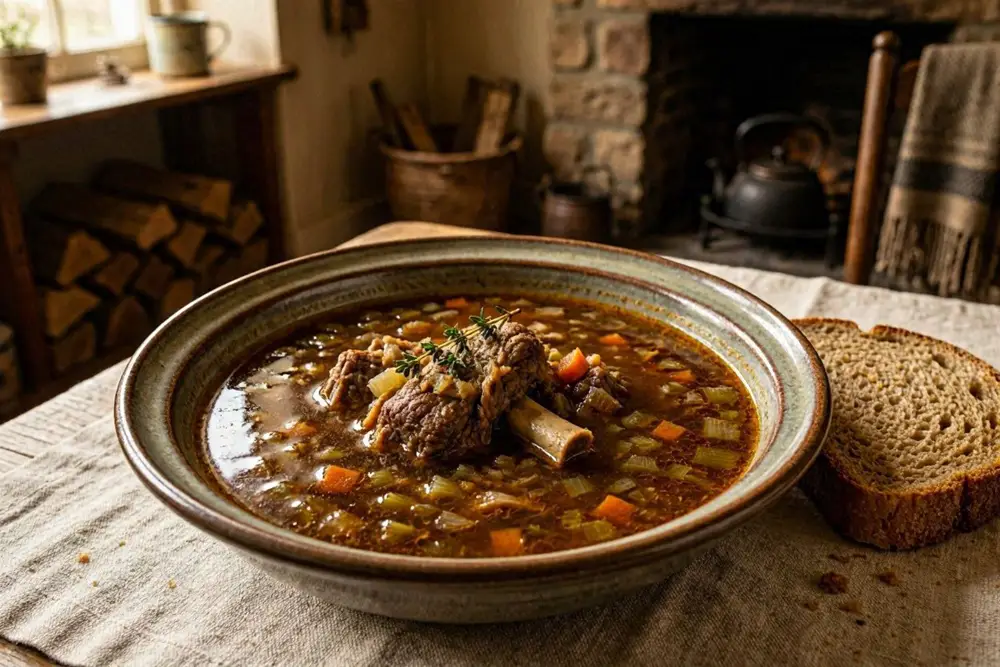
A slow-cooked oxtail soup with seared flour-dredged tail, root vegetables, whole spices, and aged red wine stirred in at the finish.
Quick Summary
A slow-cooked oxtail soup with seared flour-dredged tail, root vegetables, whole spices, and aged red wine stirred in at the finish.
Historical recipe
Modernised adaptation of an early 20th‑century source. Not independently kitchen-tested by Attic Recipes. Quantities, temperatures, and food safety guidance have been updated for a contemporary kitchen — results may vary and errors may exist. Nutritional values, where provided, are estimates only and have not been laboratory tested. Always follow current food safety guidelines for your region. If you have a health condition, allergy, or dietary requirement, consult a qualified professional before preparing this recipe.
Use of this recipe is entirely at your own risk and subject to our Terms of Service and Privacy Policy. Attic Recipes accepts no liability for any adverse outcome.
- Dairy
- Gluten
- Sulphites
Additional notes
-
Note
This recipe contains butter (dairy) and wheat flour (gluten) used for dredging the meat. Both are present in the finished soup. Not suitable for individuals with dairy or gluten intolerance.
For a gluten-free version, substitute rice flour or cornstarch for dredging. The result will be slightly less rich but otherwise equivalent.
-
Note
This recipe contains alcohol (red wine). The wine is added at the very end and is not cooked off. Pregnant women, children under 18, and individuals avoiding alcohol should omit the wine or substitute with a splash of red wine vinegar diluted in water.
-
Note
Oxtail is high in saturated fat (approx. 11g per serving). Individuals managing cardiovascular conditions or cholesterol levels should be aware of the fat content. Skimming the surface fat from the broth during and after cooking will reduce the total fat content.
- 1
Place the oxtail pieces in a large pot and cover with cold water. Bring to a boil over high heat. As soon as it boils, drain immediately and rinse each piece under cold running water. Wipe each piece dry with a clean kitchen cloth — the surface must be completely dry before the next step.
Tip This blanching step removes impurities and blood that would otherwise cloud the broth and produce foam throughout cooking. Do not skip it. - 2
Spread the 50 g flour on a plate. Roll each dried oxtail piece in the flour to coat lightly and evenly, shaking off any excess.
- 3
Melt the 75 g butter in a wide heavy-bottomed saucepan over medium-high heat until it begins to foam and the foam subsides. Add the floured oxtail pieces in a single layer — work in batches if necessary — and brown deeply on all sides, about 3–4 minutes per side. The meat should be a rich mahogany colour, not grey.
- 4
Transfer the seared oxtail to a large pot. Slowly pour in the 2000 ml warm beef bone broth. Bring to a boil over medium heat, skimming off any foam that rises to the surface during the first 10–15 minutes.
- 5
Add the finely chopped celery, onion, and carrot to the pot along with the 20 peppercorns, 6 cloves, 3 bay leaves, 4 thyme sprigs, and half the parsley. Season with 1 tsp salt. Reduce heat to the lowest steady simmer — the surface should tremble but not bubble vigorously. Cook for 4 hours.
Tip A gentle simmer at 90–95°C produces a clearer, more flavourful broth than a rolling boil. High heat makes the broth cloudy and toughens the meat. - 6
Watch the vegetables closely from the 45-minute mark onward. As soon as the celery, carrot, and onion are completely tender — but before they begin to break down — remove them with a slotted spoon and transfer to a separate bowl. Set aside.
- 7
Continue simmering the oxtail for the remainder of the 4 hours until the meat is completely soft and beginning to pull away from the bone. Strain the broth through a fine-mesh sieve into a clean pot, discarding the whole spices and herbs.
- 8
Return the strained broth to the heat. Finely chop the reserved cooked vegetables with a serrated knife — the serrated blade cuts through soft, cooked vegetables cleanly without crushing them. Return the chopped vegetables to the broth along with the oxtail pieces. Bring everything to a boil.
- 9
Remove from heat. Stir in the 60 ml aged red wine. Taste and adjust salt as needed. Scatter the reserved fresh parsley over the top and serve immediately in warm bowls.
Tip The wine is added off the heat — or at the very last moment — to preserve its aroma. Boiling wine after adding it drives off the volatile compounds that make aged red wine worth using in the first place.
Nutrition Information per 1 serving (approx. 450ml)
Nutritional values are approximate estimates and may vary based on specific ingredients used, preparation methods, and portion sizes.
Serving Suggestions
Serve as a main course with crusty bread or buttered rye bread alongside. The broth is substantial enough to carry the meal without a starter. A few drops of good red wine vinegar added to the bowl at the table — a period habit — brightens the richness of the long-cooked broth.
About This Recipe
Oxtail soup is patience made edible. The cut is almost entirely collagen and bone at the start — gelatinous, awkward, seemingly unpromising — and four hours later it produces a broth of a depth and body that no other piece of beef can match. The collagen converts to gelatin during the long simmer, giving the soup a natural richness and a lip-coating quality that defines the dish. This is not something that can be rushed without losing what makes it worth making.
The method here is characteristic of serious Central European home cooking from the early 20th century: blanch first to clarify, sear hard in butter to build colour, simmer gently for hours, and treat the vegetables as a separate concern from the meat. The vegetables go in early for flavour but come out before they collapse, then return to the finished soup chopped fine with a serrated knife — a small detail that produces a noticeably neater result. The aged red wine is added at the very end, off the heat, so that its aroma survives into the bowl.
The result is a soup that tastes like it was made by someone who knew what they were doing — because the original recipe was written by exactly that kind of cook.
Why It Works
The blanching step is often misunderstood as optional. It is not. Raw oxtail releases a significant quantity of blood and impurities during the first minutes of heating; removing these before the main cooking begins produces a clearer broth and eliminates the grey foam that would otherwise need constant skimming for the first hour. Wiping the pieces dry before dredging matters equally: wet flour becomes paste, not coating, and paste will not brown.
The flour dredge serves two purposes. It creates the Maillard crust during searing that contributes colour and complexity to the broth. It also leaves a small amount of starch in the cooking liquid that contributes body — not enough to thicken the soup, but enough to give it weight. This is distinct from a roux-thickened soup; the effect is subtler and integrates more cleanly.
The decision to simmer at 90–95°C rather than a rolling boil is the difference between a clear, flavourful broth and a cloudy, slightly bitter one. High heat emulsifies fat into the liquid and agitates proteins in ways that cannot be reversed. A gentle simmer keeps fat rising to the surface where it can be skimmed, and keeps proteins intact rather than fragmenting them into the broth.
Modern Kitchen Tips
A Dutch oven or heavy-bottomed enamelled pot holds heat more evenly than a standard saucepan and makes the four-hour simmer easier to maintain at the correct temperature without constant adjustment. If your lowest burner still runs hot, use a heat diffuser.
The soup keeps well — refrigerated overnight, the fat solidifies on the surface and can be lifted off in a single layer before reheating, producing a noticeably leaner result than when served fresh. The flavour also deepens overnight, making this an ideal dish to prepare a day ahead.
For a pressure cooker: sear the oxtail in the open pot, add broth and aromatics, seal and cook at high pressure for 90 minutes. Release pressure naturally. Strain, return vegetables and meat, bring to a boil, add wine off the heat. The broth will be slightly less clear than the stovetop version but the flavour will be equivalent.
A classic of early 20th century home cooking, preserved and adapted for the modern kitchen.
The Story Behind This Recipe
Historical Context
Oxtail soup was among the most prestigious of the slow-cooked meat soups in early 20th century Central European home cooking — prestigious because oxtail was not cheap, and because the four-hour simmer required both fuel and attention that not every household could afford. Home cooks of the period understood the blanching step intuitively as a matter of cleanliness and clarity; the technique of wiping each piece dry with a cloth before dredging in flour reflects the methodical, unhurried rhythm of serious domestic cooking of the era. The instruction to remove the vegetables as soon as they soften — rather than leaving them for the full cooking time — is characteristic of a period sensibility that treated the broth and the garnish as two separate concerns, each requiring its own timing. Aged Dalmatian red wine appears as the finishing element, a reminder that the Adriatic coast supplied wine to the broader Central European culinary repertoire long before modern distribution made wine universally available.
Modern Kitchen Adaptation
Beef bone broth is specified as 'weak' in the period recipe, meaning a light, unclarified stock rather than a concentrated commercial product. Diluting commercial beef stock 1:1 with water produces an equivalent result. The serrated knife for cutting cooked vegetables is preserved from the original method — it is genuinely the better tool for the task and produces a neater result than a straight blade on soft, cooked vegetables. No oven temperature is relevant here; the recipe is entirely stovetop. The four-hour simmer time is unchanged from the original — a pressure cooker can reduce this to approximately 90 minutes at high pressure, though the broth will be less clear.
This recipe is an independent modern adaptation developed from historical sources in the public domain. It is provided for informational and educational purposes only and does not constitute professional dietary, nutritional, or medical advice. Food preparation involves inherent risks. The reader assumes full responsibility for safe food handling, ingredient sourcing, and adherence to current local food safety guidelines. The site operator accepts no liability for outcomes resulting from the preparation or consumption of this recipe.
One recipe.
Every week.
You Might Also Like
More recipes you'll enjoy
Dried Pork Legs Paprikash
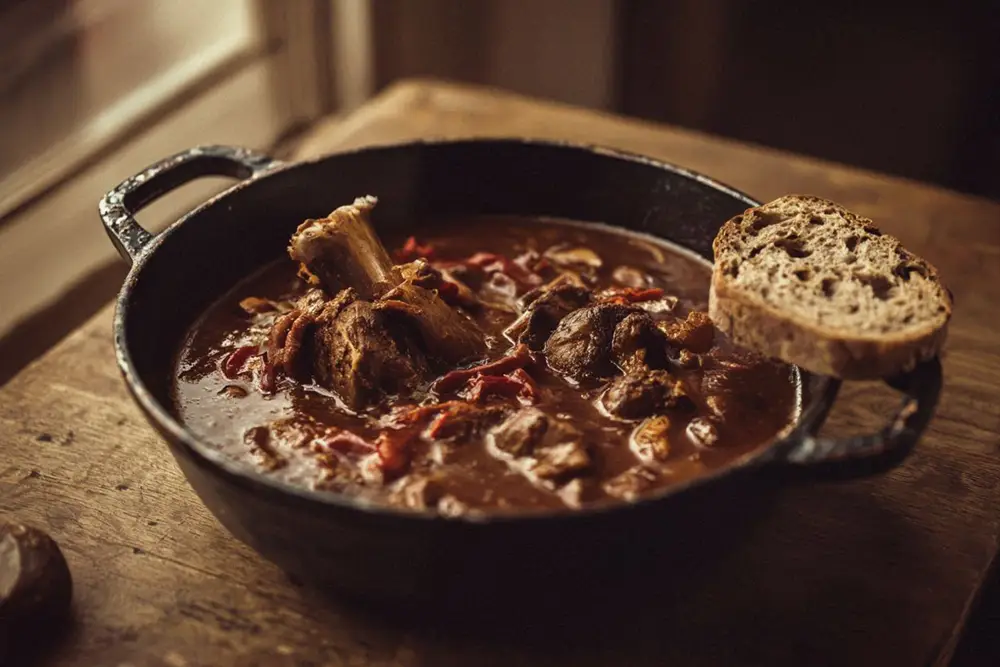
Authentic Central European paprikash recipe: slow-cooked smoked pork legs & veal with onions, tomatoes, peppers. Deep, dark, jammy sauce.
Bean Soup Cooked with Beef
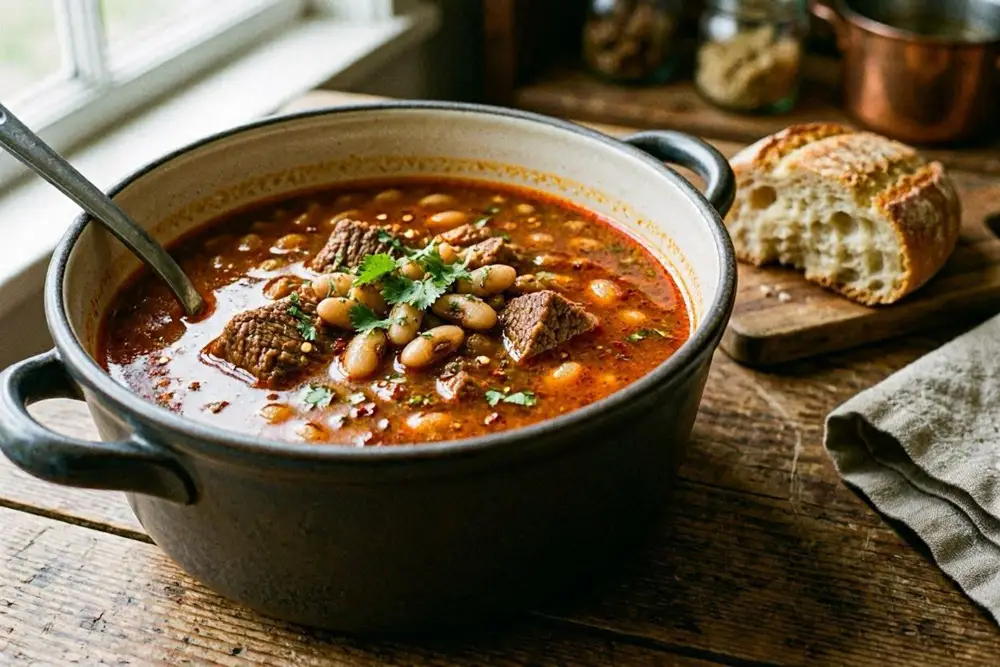
White beans and beef shoulder slow-simmered with a bouquet garni, finished in the oven with a paprika-spiced pan roux. A deeply satisfying one-pot meal.
Lamb Intestines Soup
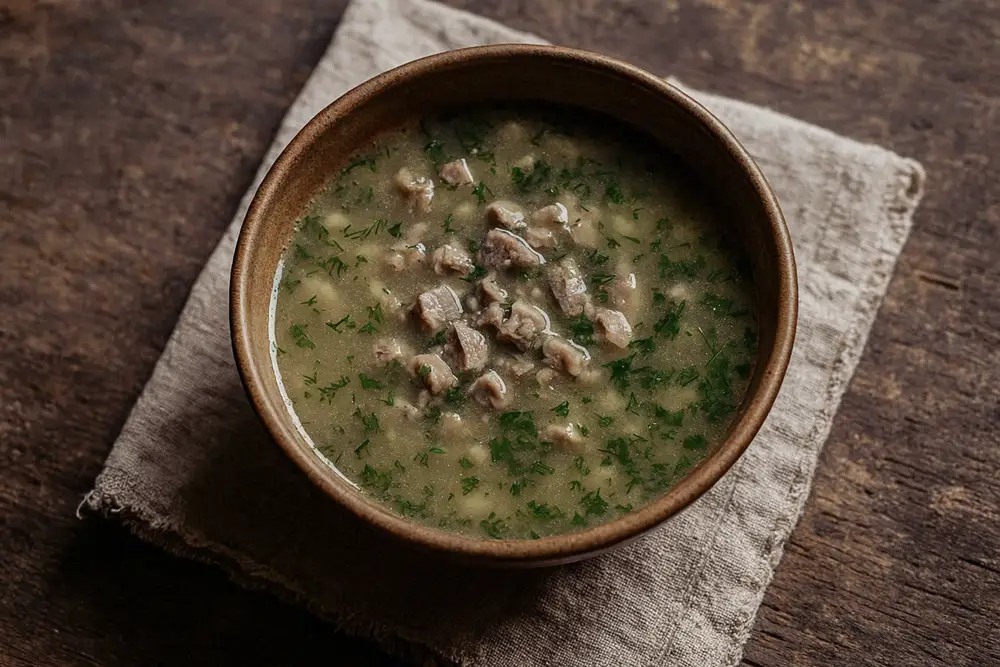
A traditional spring offal soup — blanched lamb intestines simmered with fresh butter, green onions, garlic, and wild herbs. Clean, light, and deeply savory.